
Eknath Easwaran (1910–1999)
Author of The Upanishads
About the Author
Eknath Easwaran (1910-1999) is widely respected as a teacher of meditation and an authentic guide to spiritual living. More than 200,000 copies of Take Your Time have been sold world wide.
Image credit: Monastic Dialogue
Series
Works by Eknath Easwaran
Meditation: A Simple Eight-Point Program for Translating Spiritual Ideals into Daily Life (1978) 359 copies, 6 reviews
Nonviolent Soldier of Islam: Badshah Khan: A Man to Match His Mountains (1984) 154 copies, 4 reviews
The End of Sorrow: The Bhagavad Gita for Daily Living, Volume I [India's timeless and practical scripture presented as a manual for everyday use] (1975) 125 copies
Your Life Is Your Message: Finding Harmony With Yourself, Others & the Earth (1993) 123 copies, 1 review
Passage Meditation: Bringing the Deep Wisdom of the Heart into Daily Life (Essential Easwaran Library) (2008) 104 copies, 5 reviews
Love Never Faileth: The Inspiration of Saint Francis, Saint Augustine, Saint Paul, Mother Teresa (1984) 82 copies
Like a Thousand Suns: The Bhagavad Gita for Daily Living, Volume II (The Bhagavad Gita for Daily Living, Vol. 2) (1993) 78 copies
Essence of the Bhagavad Gita: A Contemporary Guide to Yoga, Meditation, and Indian Philosophy (Wisdom of India) (2011) 62 copies, 15 reviews
The Compassionate Universe: The Power of the Individual to Heal the Environment (1993) 46 copies, 1 review
Essence of the Dhammapada: The Buddha's Call to Nirvana (Wisdom of India) (2013) 46 copies, 15 reviews
Seeing with the Eyes of Love: Eknath Easwaran on the Imitation of Christ (Classics of Christian Inspiration Series) (1991) 44 copies
Timeless Wisdom: Passages for Meditation from the World's Saints and Sages (Essential Easwaran Library) (2008) 31 copies
The Bhagavad Gita for Daily Living, Volume 1: A Verse-by-Verse Commentary: Chapters 1-6 The End of Sorrow (The Bhagavad Gita for Daily Living, 1) (2020) 13 copies
The Two Gandhis 6 copies
The Katha Upanishad 5 copies
The Little lamp 2 copies
Quando hai fretta cammina lentamente 2 copies
Die Bhagavad Gita: Die Quelle der indischen Spiritualität. Eingeleitet und übersetzt von Eknath Easwaran (2012) 2 copies
Classics of Christian Inspiration: Includes Love Never Faileth, Original Goodness, and Seeing With the Eyes of Love (1996) 1 copy
The Little Lamp Autumn 1977 1 copy
BLUE MOUNTAIN JOURNAL 1 copy
Associated Works
Tagged
Common Knowledge
- Other names
- EASWARAN, Eknath
- Birthdate
- 1910-12-17
- Date of death
- 1999-10-26
- Gender
- male
- Education
- University of Nagpur
- Occupations
- Spiritual teacher
author
translator - Organizations
- Blue Mountain Center of Meditation
Nilgiri Press - Awards and honors
- Fulbright Fellowship (University of California ∙ Berkeley ∙ 1959)
- Nationality
- India
USA - Birthplace
- Kerala, India
- Places of residence
- India
California, USA - Place of death
- California, USA
- Associated Place (for map)
- California, USA
Members
Reviews
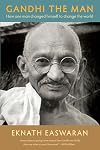
There comes along, however rarely it may seem, someone so in tune with their humanity that it makes us realize the potential inherent in our very selves, “central to our very being”, if only we would strive to realize it. Gandhi was one of these very people. So attuned with what it means to be human, what it means to live, his was a life so full of love and meaning that it, even today, so many years after its end, leaves us inspired and awed, and this book is a beautiful reflection of show more that life and the meaning behind it.
As beautifully written as it is illustrated, this book, while a quick and easy read, is one that leaves a deep and lasting impression. Told by someone who actually lived in what he calls “Gandhi’s India”, the author shows us Gandhi, the man, and makes us realize that the meaning Gandhi found in his own life, the meaning that drove him to become the great man whose name has been taught and honored around the world, is a meaning we can all apply to our own lives and work towards. It is something that is possible for us all.
In the forward of this book, Asha Devi is quoted, when asked what the dominant impression Gandhi made on her, as revealing the “secret” of this great man as “his great love”, and through this book we are shown that great love, the dedication Gandhi had to it, and how possible it could be for us to strive to live lives of great love as well.
By revealing to us how Gandhi the man became Gandhi the great man, by showing us where Gandhi started and allowing us to see the more “human” side of someone who seems to so many to be above our level of humanity, it shows us that we all start somewhere, and the potential within us is all the same. Gandhi is quoted, more than once, saying “I have not the shadow of a doubt that any man or woman can achieve what I have, if he or she would make the same effort and cultivate the same hope and faith”.
Indeed, the point of this book seems less about being a point by point historical account of Gandhi’s life (though it does certainly reveal his life to us and leads us to an even deeper love and appreciation of him and the life he led), and more about revealing to us the meaning he applied to it, and helping us understand that we, too, can apply this meaning to our lives, if only we were to try. It is a deeply inspirational and moving book that is as essential as the art of life it has to reveal within its pages. A must read, and a wonderful addition to any collection. I’m certainly glad to have been able to add it to mine! :) show less
As beautifully written as it is illustrated, this book, while a quick and easy read, is one that leaves a deep and lasting impression. Told by someone who actually lived in what he calls “Gandhi’s India”, the author shows us Gandhi, the man, and makes us realize that the meaning Gandhi found in his own life, the meaning that drove him to become the great man whose name has been taught and honored around the world, is a meaning we can all apply to our own lives and work towards. It is something that is possible for us all.
In the forward of this book, Asha Devi is quoted, when asked what the dominant impression Gandhi made on her, as revealing the “secret” of this great man as “his great love”, and through this book we are shown that great love, the dedication Gandhi had to it, and how possible it could be for us to strive to live lives of great love as well.
By revealing to us how Gandhi the man became Gandhi the great man, by showing us where Gandhi started and allowing us to see the more “human” side of someone who seems to so many to be above our level of humanity, it shows us that we all start somewhere, and the potential within us is all the same. Gandhi is quoted, more than once, saying “I have not the shadow of a doubt that any man or woman can achieve what I have, if he or she would make the same effort and cultivate the same hope and faith”.
Indeed, the point of this book seems less about being a point by point historical account of Gandhi’s life (though it does certainly reveal his life to us and leads us to an even deeper love and appreciation of him and the life he led), and more about revealing to us the meaning he applied to it, and helping us understand that we, too, can apply this meaning to our lives, if only we were to try. It is a deeply inspirational and moving book that is as essential as the art of life it has to reveal within its pages. A must read, and a wonderful addition to any collection. I’m certainly glad to have been able to add it to mine! :) show less

I wrote this review while listening to baseball and (later) opera. Obviously, I have not taken to heart one of the primary messages of this book: "Do Only One Thing At A Time!" Why should we limit ourselves to one thing at a time? Because "Every moment is a doorway to meaning, purpose, and joy. The key is an unhurried mind." I do recommend this book, especially if you have tried meditation and not been able to "make it stick". I have read many books on meditation, stilling the mind, slowing show more down. Most seem to make sense while you are reading them, but are too abstract to be much help in everyday life. Take Your Time by Eknath Easwaran is much more practical in its approach. Easwaran uses real life examples to explain each step in his approach to slowing down via the Eight-Point Program of Passage Meditation.
My favorite example describes the well-trained mind as like a loyal, well-trained dog. Even when it goes running off after squirrels, if you call it back, it will come. Meditation instructions often focus on "letting go" of unwanted thoughts. I've found that when I "let them go" my mind follows them. Changing the focus to calling the attention back worked much better for me . . . whenever the mind wanders, just say "Come back" and don't worry about where the stray thoughts might go.
I also appreciated the concept of "painting the bullock cart wheels" (p. 89). Many of us know that when faced with a big task, we easily get sidetracked with trivial details instead of what we are supposed to be doing. It helps to tell ourselves not to "paint the bullock cart wheels" when we need to be harvesting the grain! :)
The eight chapters cover various aspects of slowing down including doing one thing at a time, finding balance, and finding time for relationships. Each chapter also includes a list of Ideas and Suggestions on how to put the ideas into practice throughout the day. The eight-point program starts in the morning with meditation on a passage from spiritual literature and then uses other steps (repetition of a mantram, slowing down, one-pointed attention, training the senses, putting others first, spiritual fellowship, and spiritual reading) throughout the day to reinforce the meditation experience.
Another thing that helps this book is that, in addition to his work teaching meditation, the author was a professor of English Literature. In between the practical examples mentioned above were quotations from William Blake and Shakespeare, as well as Schopenhauer, Buddha, and the Upanishads.
My only criticism is more about book design than the book itself. Scattered throughout the chapters were indented quotations in large blue print. Sometimes these passages seemed to be subsection headings, but other times they were more like extracts used to grab the eye in a magazine article and thus seemed inappropriate in a book. Mostly I found them distracting. I would include only those indicating a new subsection in the chapter and I would not indent them.
Favorite passages:
Make wise choices about what you read. Read only what is necessary or worthwhile. And then take the time to read carefully.
Trying to get through life without control over your attention is a little like trying to reach a destination with no control over your car.
The Buddha said, "When you are walking, walk. When you are sitting, sit. Don't wobble."
To live in balance we need a mind that listens to us, not one that drags us about as it pleases.
[Buddha says] "If an experience calms your mind, slows you down, makes you more likely to be compassionate and kind, that experience is beneficial; you can enjoy it. If it agitates your mind, speeds you up, excites your senses, or makes you angry or resentful, it is not beneficial; you should avoid it."
Between one thought and the next is a tiny gap when the mind is at peace. Extending that gap is the secret of an unhurried mind.
When I travel on the freeways I see stickers that say "I love my dog," "I love my cat," "I love New York." If I were ever to put a sticker on my car, it would simply say "I love." show less
My favorite example describes the well-trained mind as like a loyal, well-trained dog. Even when it goes running off after squirrels, if you call it back, it will come. Meditation instructions often focus on "letting go" of unwanted thoughts. I've found that when I "let them go" my mind follows them. Changing the focus to calling the attention back worked much better for me . . . whenever the mind wanders, just say "Come back" and don't worry about where the stray thoughts might go.
I also appreciated the concept of "painting the bullock cart wheels" (p. 89). Many of us know that when faced with a big task, we easily get sidetracked with trivial details instead of what we are supposed to be doing. It helps to tell ourselves not to "paint the bullock cart wheels" when we need to be harvesting the grain! :)
The eight chapters cover various aspects of slowing down including doing one thing at a time, finding balance, and finding time for relationships. Each chapter also includes a list of Ideas and Suggestions on how to put the ideas into practice throughout the day. The eight-point program starts in the morning with meditation on a passage from spiritual literature and then uses other steps (repetition of a mantram, slowing down, one-pointed attention, training the senses, putting others first, spiritual fellowship, and spiritual reading) throughout the day to reinforce the meditation experience.
Another thing that helps this book is that, in addition to his work teaching meditation, the author was a professor of English Literature. In between the practical examples mentioned above were quotations from William Blake and Shakespeare, as well as Schopenhauer, Buddha, and the Upanishads.
My only criticism is more about book design than the book itself. Scattered throughout the chapters were indented quotations in large blue print. Sometimes these passages seemed to be subsection headings, but other times they were more like extracts used to grab the eye in a magazine article and thus seemed inappropriate in a book. Mostly I found them distracting. I would include only those indicating a new subsection in the chapter and I would not indent them.
Favorite passages:
Make wise choices about what you read. Read only what is necessary or worthwhile. And then take the time to read carefully.
Trying to get through life without control over your attention is a little like trying to reach a destination with no control over your car.
The Buddha said, "When you are walking, walk. When you are sitting, sit. Don't wobble."
To live in balance we need a mind that listens to us, not one that drags us about as it pleases.
[Buddha says] "If an experience calms your mind, slows you down, makes you more likely to be compassionate and kind, that experience is beneficial; you can enjoy it. If it agitates your mind, speeds you up, excites your senses, or makes you angry or resentful, it is not beneficial; you should avoid it."
Between one thought and the next is a tiny gap when the mind is at peace. Extending that gap is the secret of an unhurried mind.
When I travel on the freeways I see stickers that say "I love my dog," "I love my cat," "I love New York." If I were ever to put a sticker on my car, it would simply say "I love." show less
 This review was written for LibraryThing Early Reviewers.
First, a note: this is not Easwaran's acclaimed translation of the Dhammapada. This is a selection of verses from that translation with extensive meditations, by Easwaran, upon them.
There! that's out of the way.
This is a lovely book. It is also a posthumous book: Easwaran had planned it before his death, but it is only just now being published. I do not know who did the selection -- my guess is the people at Nilgiri Press -- but for a book that is a selection from a larger body of writings, show more it has a remarkable unity.
The whole thing is arranged around the metaphor of crossing the river of life in order to get to Nirvana on the opposite shore. The book is, in a sense, a guide for those who are interested in making that journey, and the guidelines include practical advice, pep talks, and abundant wisdom from the author's own experience.
I'd like to take a moment to touch on Easwaran's voice. I found him to be at once an inspiring, soothing and challenging instructor. At no point does he claim that the journey to Nirvana is an easy one; at no point does he say that it is beyond the reader's ability. The tone is intimate, never preachy or self-help-y (thank goodness! I wouldn't have finished it if it had been that).
That said, the book is an explication of a particular strain of Buddhism. At the risk of sounding utterly feckless (I'm ... mostly feckless) I guess I would say that this is a more Indian Buddhism than what I am used to -- rather than the often puzzling, intellectual feel of something like Zen, this Buddhism is unequivocally supernatural, though not completely so. Put another way, this is a book that speaks with no hesitation about the phenomenon of reincarnation. Easwaran tells us stories about Siddhartha that definitely partake of the supernatural, as well.
And for this reason -- though it's probably not fair to do this -- I have to hedge from giving this an unreserved recommendation, because it's the supernatural aspect of certain strains of Buddhism that make them significantly less appealing to me. The Buddhism I have come to love often feels more like a practical mind-science than a mystical religion ... but here, there is often much of the latter.
But ... it's still Buddhism! And I got an awful lot from the book, not least of which is an introduction to a very fine translation of the Dhammapada. If you are curious about the message of Buddhism, this fine book is well worth your time. show less
There! that's out of the way.
This is a lovely book. It is also a posthumous book: Easwaran had planned it before his death, but it is only just now being published. I do not know who did the selection -- my guess is the people at Nilgiri Press -- but for a book that is a selection from a larger body of writings, show more it has a remarkable unity.
The whole thing is arranged around the metaphor of crossing the river of life in order to get to Nirvana on the opposite shore. The book is, in a sense, a guide for those who are interested in making that journey, and the guidelines include practical advice, pep talks, and abundant wisdom from the author's own experience.
I'd like to take a moment to touch on Easwaran's voice. I found him to be at once an inspiring, soothing and challenging instructor. At no point does he claim that the journey to Nirvana is an easy one; at no point does he say that it is beyond the reader's ability. The tone is intimate, never preachy or self-help-y (thank goodness! I wouldn't have finished it if it had been that).
That said, the book is an explication of a particular strain of Buddhism. At the risk of sounding utterly feckless (I'm ... mostly feckless) I guess I would say that this is a more Indian Buddhism than what I am used to -- rather than the often puzzling, intellectual feel of something like Zen, this Buddhism is unequivocally supernatural, though not completely so. Put another way, this is a book that speaks with no hesitation about the phenomenon of reincarnation. Easwaran tells us stories about Siddhartha that definitely partake of the supernatural, as well.
And for this reason -- though it's probably not fair to do this -- I have to hedge from giving this an unreserved recommendation, because it's the supernatural aspect of certain strains of Buddhism that make them significantly less appealing to me. The Buddhism I have come to love often feels more like a practical mind-science than a mystical religion ... but here, there is often much of the latter.
But ... it's still Buddhism! And I got an awful lot from the book, not least of which is an introduction to a very fine translation of the Dhammapada. If you are curious about the message of Buddhism, this fine book is well worth your time. show less
This review was written for LibraryThing Early Reviewers.
Eknath's commentary comprises the bulk of the text here. The excerpts account for perhaps 1/12th of the book, and are helpfully compiled in an appendix (fewer than 20 pages); in fact, the 119 verses quoted here amount to perhaps 1/3 of the verses commeon to the Pali Dhammapada, Gundhari Dharmapada, and the Udānavarga (so: Wikipedia).
Eknath selects those passages from the Dhammapada he considers central to the Buddha's overall message, and provides commentary on their application to everyday show more life: addressing personal temptations, interactions with loved ones and enemies, learning from mistakes without losing motivation or hope, the tricks our minds play on us. In the process, Eknath provides an introduction to Buddhist practice, including a sketch of Buddhism as: the nature of karma and of dharma; the Eightfold Path and Four Noble Truths; a sketch of the Self understood as skhandas and samskaras (and like them, in constant flux); and the goal of Nirvana: the "farther shore" or "other side of the River". [K1-K2]
Effectively, my resistance to Buddhism stems from its seeming position that embodied existence is an obstacle or Fall. I acknowledge the distraction and difficulty of my embodied life, but believe there is grace in this existence, and it is not merely to be overcome or resisted. Buddhism generally, and meditation specifically, seems aimed at superseding this world; the "increased happiness" and continued engagement with the world seem secondary, at least in readings I'm acquainted with, whereas I very much look to heighten my engagement with the world, increase my happiness not secondarily but as a primary consideration. It's not that I reject the premise, necessarily. so much as I remain unpersuaded by it: perhaps not yet spiritually to the point I want to detach quite that much. Of course a key point here is that my outlook is from This Shore, and the descriptions of engagement / happiness and so forth are (allegedly) from the Farther Shore. It requires faith to bridge the gap, I haven't sufficient faith of that variety to compel a change in my outlook.
Eknath provocatively suggests a fruitful distinction between Self and Self-Will, something to examine in more depth, in tandem with meditation. [112 and K4 generally] Intriguing to contemplate that cause and effect can be seen as identical, and the crucial operation of Will to avoid suffering flowing from a failure to appreciate this. [K5] How to reconcile with an embodied existence, with something more than biding my time here, however well?
In the end, though I did not find it as arresting or energising as Take Your Time, Eknath here did prompt another attempt at meditation. Perhaps my view of this book will change after that practice is established. show less
Eknath selects those passages from the Dhammapada he considers central to the Buddha's overall message, and provides commentary on their application to everyday show more life: addressing personal temptations, interactions with loved ones and enemies, learning from mistakes without losing motivation or hope, the tricks our minds play on us. In the process, Eknath provides an introduction to Buddhist practice, including a sketch of Buddhism as: the nature of karma and of dharma; the Eightfold Path and Four Noble Truths; a sketch of the Self understood as skhandas and samskaras (and like them, in constant flux); and the goal of Nirvana: the "farther shore" or "other side of the River". [K1-K2]
Effectively, my resistance to Buddhism stems from its seeming position that embodied existence is an obstacle or Fall. I acknowledge the distraction and difficulty of my embodied life, but believe there is grace in this existence, and it is not merely to be overcome or resisted. Buddhism generally, and meditation specifically, seems aimed at superseding this world; the "increased happiness" and continued engagement with the world seem secondary, at least in readings I'm acquainted with, whereas I very much look to heighten my engagement with the world, increase my happiness not secondarily but as a primary consideration. It's not that I reject the premise, necessarily. so much as I remain unpersuaded by it: perhaps not yet spiritually to the point I want to detach quite that much. Of course a key point here is that my outlook is from This Shore, and the descriptions of engagement / happiness and so forth are (allegedly) from the Farther Shore. It requires faith to bridge the gap, I haven't sufficient faith of that variety to compel a change in my outlook.
Eknath provocatively suggests a fruitful distinction between Self and Self-Will, something to examine in more depth, in tandem with meditation. [112 and K4 generally] Intriguing to contemplate that cause and effect can be seen as identical, and the crucial operation of Will to avoid suffering flowing from a failure to appreciate this. [K5] How to reconcile with an embodied existence, with something more than biding my time here, however well?
In the end, though I did not find it as arresting or energising as Take Your Time, Eknath here did prompt another attempt at meditation. Perhaps my view of this book will change after that practice is established. show less
This review was written for LibraryThing Early Reviewers.Lists
el (1)
Awards


You May Also Like


Associated Authors
Statistics
- Works
- 86
- Also by
- 1
- Members
- 5,105
- Popularity
- #4,895
- Rating
- 4.2
- Reviews
- 118
- ISBNs
- 279
- Languages
- 8
- Favorited
- 8
