
Norman Rush
Author of Mating
About the Author
Works by Norman Rush
The Victim 1 copy
Associated Works
Object Lessons: The Paris Review Presents the Art of the Short Story (2012) — Introduction; Contributor — 253 copies, 9 reviews
The Literary Lover: Great Stories of Passion and Romance (1993) — Contributor — 55 copies, 2 reviews
Tagged
Common Knowledge
- Birthdate
- 1933-10-24
- Gender
- male
- Education
- Swarthmore College (1956)
- Nationality
- USA
- Places of residence
- Rockland County, New York, USA
- Associated Place (for map)
- New York, USA
Members
Reviews
“I wore myself out collecting enough wood for a ring fire, got us all set up inside it, went into my tent, and closed my eyes, and immediately there were lions in the neighborhood. There may have been only one. I heard a roar like no other sound on earth. I felt it in my atoms. This is my reward for taking precautions, was my first thought. I made myself emerge. I peered around. My [donkeys] were standing pressed together and shaking pathetically. I looked for glints from lion eyes out in show more the dark but saw nothing. In the morning I found it hard to eat. There was terror in me. I could die in this place, it was clear.”
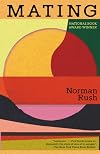
The unnamed protagonist of Mating is an American thirty-something nutritional anthropologist living in Botswana in the 1980s. She has just determined that her doctoral thesis is going nowhere. She meets Nelson Denoon, the founder of Tsau, a secretive utopian community run by African women in a remote area of Botswana. Denoon intrigues her, and she wants to get to know him intimately, so she treks solo across the Kalahari Desert to reach Tsau, where she hopes to be welcomed.
“[H]e went into a sort of aria asking how Tsau could fail to be terrific, since it was the pyramidon at the top of all his prior failures, so called. He gave the entire sequence of truths learned, project to project, such as controlling the scale, working in the vernacular, cutting expatriate staff to near zero, locating yourself remotely enough to avoid premature disruption, balancing collective and individual incentives, basing your political economy on women instead of men…”
This novel is one of the most unusual I have read. It is a novel of ideas and philosophy. It explores intimacy, love, history, politics, economics, feminism, and justice. It is a little drawn out in the beginning, recounting several of the protagonist’s relationships in Gabarone, but once she starts her trek across the Kalahari, it is entirely engrossing. She is searching for the “ideal” romantic relationship. The narrative is filled with intellectual sparring and literary references. Topics include commune life, capitalism, socialism, Marxism, apartheid, and the geopolitics of southern Africa. As an added bonus, it is guaranteed to expand the reader’s vocabulary, even if it is already vast.
There is an intriguing psychological component, where questions arise as to the reason Nelson wants to remain in Tsau. This part gets into philosophy, such as that of the Tao Te Ching, and transformations caused by near-death experiences. Is the change real or fabricated?
This book takes time to read, not only due to its length, but also due to the need to absorb, or possibly look up, some of the regional references that will likely not be in many readers’ immediate scope of knowledge. A helpful glossary is included for the Afrikaans and Setswana terms, as well as descriptions of (real) local organizations. Rush has a dense writing style that respects a reader’s intelligence. I found it masterfully written and intellectually stimulating. show less
The unnamed protagonist of Mating is an American thirty-something nutritional anthropologist living in Botswana in the 1980s. She has just determined that her doctoral thesis is going nowhere. She meets Nelson Denoon, the founder of Tsau, a secretive utopian community run by African women in a remote area of Botswana. Denoon intrigues her, and she wants to get to know him intimately, so she treks solo across the Kalahari Desert to reach Tsau, where she hopes to be welcomed.
“[H]e went into a sort of aria asking how Tsau could fail to be terrific, since it was the pyramidon at the top of all his prior failures, so called. He gave the entire sequence of truths learned, project to project, such as controlling the scale, working in the vernacular, cutting expatriate staff to near zero, locating yourself remotely enough to avoid premature disruption, balancing collective and individual incentives, basing your political economy on women instead of men…”
This novel is one of the most unusual I have read. It is a novel of ideas and philosophy. It explores intimacy, love, history, politics, economics, feminism, and justice. It is a little drawn out in the beginning, recounting several of the protagonist’s relationships in Gabarone, but once she starts her trek across the Kalahari, it is entirely engrossing. She is searching for the “ideal” romantic relationship. The narrative is filled with intellectual sparring and literary references. Topics include commune life, capitalism, socialism, Marxism, apartheid, and the geopolitics of southern Africa. As an added bonus, it is guaranteed to expand the reader’s vocabulary, even if it is already vast.
There is an intriguing psychological component, where questions arise as to the reason Nelson wants to remain in Tsau. This part gets into philosophy, such as that of the Tao Te Ching, and transformations caused by near-death experiences. Is the change real or fabricated?
This book takes time to read, not only due to its length, but also due to the need to absorb, or possibly look up, some of the regional references that will likely not be in many readers’ immediate scope of knowledge. A helpful glossary is included for the Afrikaans and Setswana terms, as well as descriptions of (real) local organizations. Rush has a dense writing style that respects a reader’s intelligence. I found it masterfully written and intellectually stimulating. show less

“I wore myself out collecting enough wood for a ring fire, got us all set up inside it, went into my tent, and closed my eyes, and immediately there were lions in the neighborhood. There may have been only one. I heard a roar like no other sound on earth. I felt it in my atoms. This is my reward for taking precautions, was my first thought. I made myself emerge. I peered around. My [donkeys] were standing pressed together and shaking pathetically. I looked for glints from lion eyes out in show more the dark but saw nothing. In the morning I found it hard to eat. There was terror in me. I could die in this place, it was clear.”
The unnamed protagonist of Mating is an American thirty-something nutritional anthropologist living in Botswana in the 1980s. She has just determined that her doctoral thesis is going nowhere. She meets Nelson Denoon, the founder of Tsau, a secretive utopian community run by African women in a remote area of Botswana. Denoon intrigues her, and she wants to get to know him intimately, so she treks solo across the Kalahari Desert to reach Tsau, where she hopes to be welcomed.
“[H]e went into a sort of aria asking how Tsau could fail to be terrific, since it was the pyramidon at the top of all his prior failures, so called. He gave the entire sequence of truths learned, project to project, such as controlling the scale, working in the vernacular, cutting expatriate staff to near zero, locating yourself remotely enough to avoid premature disruption, balancing collective and individual incentives, basing your political economy on women instead of men…”
This novel is one of the most unusual I have read. It is a novel of ideas and philosophy. It explores intimacy, love, history, politics, economics, feminism, and justice. It is a little drawn out in the beginning, recounting several of the protagonist’s relationships in Gabarone, but once she starts her trek across the Kalahari, it is entirely engrossing. She is searching for the “ideal” romantic relationship. The narrative is filled with intellectual sparring and literary references. Topics include commune life, capitalism, socialism, Marxism, apartheid, and the geopolitics of southern Africa. As an added bonus, it is guaranteed to expand the reader’s vocabulary, even if it is already vast.
There is an intriguing psychological component, where questions arise as to the reason Nelson wants to remain in Tsau. This part gets into philosophy, such as that of the Tao Te Ching, and transformations caused by near-death experiences. Is the change real or fabricated?
This book takes time to read, not only due to its length, but also due to the need to absorb, or possibly look up, some of the regional references that will likely not be in many readers’ immediate scope of knowledge. A helpful glossary is included for the Afrikaans and Setswana terms, as well as descriptions of (real) local organizations. Rush has a dense writing style that respects a reader’s intelligence. I found it masterfully written and intellectually stimulating.
4.5 show less
The unnamed protagonist of Mating is an American thirty-something nutritional anthropologist living in Botswana in the 1980s. She has just determined that her doctoral thesis is going nowhere. She meets Nelson Denoon, the founder of Tsau, a secretive utopian community run by African women in a remote area of Botswana. Denoon intrigues her, and she wants to get to know him intimately, so she treks solo across the Kalahari Desert to reach Tsau, where she hopes to be welcomed.
“[H]e went into a sort of aria asking how Tsau could fail to be terrific, since it was the pyramidon at the top of all his prior failures, so called. He gave the entire sequence of truths learned, project to project, such as controlling the scale, working in the vernacular, cutting expatriate staff to near zero, locating yourself remotely enough to avoid premature disruption, balancing collective and individual incentives, basing your political economy on women instead of men…”
This novel is one of the most unusual I have read. It is a novel of ideas and philosophy. It explores intimacy, love, history, politics, economics, feminism, and justice. It is a little drawn out in the beginning, recounting several of the protagonist’s relationships in Gabarone, but once she starts her trek across the Kalahari, it is entirely engrossing. She is searching for the “ideal” romantic relationship. The narrative is filled with intellectual sparring and literary references. Topics include commune life, capitalism, socialism, Marxism, apartheid, and the geopolitics of southern Africa. As an added bonus, it is guaranteed to expand the reader’s vocabulary, even if it is already vast.
There is an intriguing psychological component, where questions arise as to the reason Nelson wants to remain in Tsau. This part gets into philosophy, such as that of the Tao Te Ching, and transformations caused by near-death experiences. Is the change real or fabricated?
This book takes time to read, not only due to its length, but also due to the need to absorb, or possibly look up, some of the regional references that will likely not be in many readers’ immediate scope of knowledge. A helpful glossary is included for the Afrikaans and Setswana terms, as well as descriptions of (real) local organizations. Rush has a dense writing style that respects a reader’s intelligence. I found it masterfully written and intellectually stimulating.
4.5 show less
Everything that I think this book sets out to do, it does, I think, incredibly well. With all the issues it topicalizes, explores and maintains incessantly it could be very dull indeed; I'd have expected the level of excitement a body of footnotes to the extended history of 20th century's social thought and gender issues would elicit. Here, however, each sentence carries a carefully crafted, cutting-edge syntactic strategy, gripping and leading your thought and emotion. The text is never show more boring, it is never even unadventurous, always insightful and yet can never be fully grasped.
Much has been made of the fact that the female narrator's voice actually belongs to a middle-aged novelist, and this is highly subversive in itself, because if it bothers you, you are thinking in wrong categories. Incidentally and absolutely unsurprisingly, to my knowledge no one has been able to put a finger on anything that betrays the author's true gender (notwithstanding the discussion on "working the tits down to nubs").
In her honesty the narrator reaches the darkest depths of psyche, disarming and menacing in their naked charm. Stylistically very distinctive and certainly far from both, by force of her inquiry and insight -- in my own literary "idioverse" as she'd put it -- she balances between Conrad and Frisch. In a consistent body of prose it is shown with piercing persuasiveness that intellectual scrutiny and even intervention into the ways of the soul cannot destroy, does not have to diminish in any way the metaphysical, the mystical component of human life. Nor does it take anything away from the sublime quality of the text.
And that returns me to my initial growing surprise, part of which was the impression that Rush could actually create a genious, a giant of thought, who would then only be incorporated in his novel as a character. This might seem like a waste (and is, of course, sleight of hand), but a taste of Rush's oeuvre convinces me that the stakes are high enough.
And yes, it is a novel about love, as visceral and as transcendent as can be. No inquiry, no insight explains that away. show less
Much has been made of the fact that the female narrator's voice actually belongs to a middle-aged novelist, and this is highly subversive in itself, because if it bothers you, you are thinking in wrong categories. Incidentally and absolutely unsurprisingly, to my knowledge no one has been able to put a finger on anything that betrays the author's true gender (notwithstanding the discussion on "working the tits down to nubs").
In her honesty the narrator reaches the darkest depths of psyche, disarming and menacing in their naked charm. Stylistically very distinctive and certainly far from both, by force of her inquiry and insight -- in my own literary "idioverse" as she'd put it -- she balances between Conrad and Frisch. In a consistent body of prose it is shown with piercing persuasiveness that intellectual scrutiny and even intervention into the ways of the soul cannot destroy, does not have to diminish in any way the metaphysical, the mystical component of human life. Nor does it take anything away from the sublime quality of the text.
And that returns me to my initial growing surprise, part of which was the impression that Rush could actually create a genious, a giant of thought, who would then only be incorporated in his novel as a character. This might seem like a waste (and is, of course, sleight of hand), but a taste of Rush's oeuvre convinces me that the stakes are high enough.
And yes, it is a novel about love, as visceral and as transcendent as can be. No inquiry, no insight explains that away. show less
This is an intelligent, empathetic book narrated in an authentic, unique female voice. The narrator talks about the relationship she has with an American anthropologist on a commune (run by women) in Botswana. I've re-read this book several times--that's how attractive the characters are and how rich the writing is.
Lists
A Novel Cure (1)
Leseliste (1)
Awards


You May Also Like


Associated Authors
Statistics
- Works
- 6
- Also by
- 7
- Members
- 2,462
- Popularity
- #10,408
- Rating
- 3.7
- Reviews
- 38
- ISBNs
- 47
- Languages
- 6
- Favorited
- 4