
Edmond Hamilton (1904–1977)
Author of The City At World's End
About the Author
Image credit: molosovsky
Series
Works by Edmond Hamilton
Batman & Superman in World's Finest: The Silver Age Omnibus Vol. 1 (World's Finest: the Golden Age Omnibus) (2016) 23 copies
The Star-Stealers: The Complete Tales of The Interstellar Patrol, The Collected Edmond Hamilton, Volume Two (2009) 21 copies
The horror on the asteroid: And other tales of planetary horror (The Gregg Press science fiction series) (1975) 7 copies
The Accursed Galaxy [short fiction] 5 copies
Alien Earth 5 copies
The Star Stealers 5 copies
Requiem 5 copies
Urania Millemondinverno 1976 5 copies
Captain Future: Erde In Gefahr 2 4 copies
Agonia Della Terra 4 copies
Exile [short story] 4 copies
The Star Hunters 4 copies
King Of Stars 3 copies
Devolution [short fiction] 3 copies
The Man Who Returned 3 copies
The Island of Unreason 3 copies
A Conquest Of Two Worlds 3 copies
Day Of Judgment 3 copies
Fessenden's Worlds 3 copies
The Godmen/The Stars, My Brothers 3 copies
Infinite Stars (Infinite Stars, #1) 3 copies
Lost City Of Burma 3 copies
Il mago di Marte 2 copies
Il Ciclo Dei Lupi Dei Cieli 2 copies
Le dieu monstrueux de Mamurth 2 copies
Regresso aos céus 2 copies
Crashing Suns [short story] 2 copies
I Soli Che Si Scontrano 2 copies
The Seeds From Outside 2 copies
Action Comics # 309 2 copies
City at the World's End 2 copies
The Daughter Of Thor 2 copies
Under The White Star 2 copies
Castaway 2 copies
The Pro 2 copies
The Cosmic Cloud 2 copies
Thundering Worlds 2 copies
Child Of The Winds 2 copies
Easy Money 2 copies
After A Judgment Day 2 copies
Lost Treasure Of Mars 2 copies
The Quest In Time 2 copies
Batman Vol. 1 #185 — Author — 2 copies
Batman Vol. 1 #110 2 copies
Day of the Micro-Men 1 copy
Marshal Ezra Gurney 1 copy
Batman Vol. 1 #218 — Author — 1 copy
Batman (1940) #109 1 copy
Zvaigžņu karaļi 1 copy
Captain Future Series & More 1 copy
Batman (1940) #94 1 copy
Batman (1940) #91 1 copy
Batman (1940) #86 1 copy
Detective Comics (1937) #251 1 copy
Detective Comics (1937) #245 1 copy
Detective Comics (1937) #243 1 copy
Detective Comics (1937) #215 1 copy
Detective Comics (1937) #201 1 copy
Detective Comics (1937) #198 1 copy
The Living Brain 1 copy
Les Harpistes de Titan 1 copy
O vale da criação 1 copy
The Birth Of Grag 1 copy
Captain Future's Boyhood 1 copy
The Moon Laboratory 1 copy
Superman 166 1 copy
The Comet 1 copy
Forgotten World 1 copy
Patrulha interestelar 1 copy
The Shores Of Infinity 1 copy
Treasure On Thunder Moon 1 copy
The Prisoner Of Mars 1 copy
Lost Elysium 1 copy
When Space Burst 1 copy
The Free-Lance Of Space 1 copy
Der Todesbote 1 copy
Murder In the Void 1 copy
The Isle Of The Sleeper 1 copy
Horror From The Magellanic 1 copy
The Broken Stars 1 copy
The Man Who Lived Twice 1 copy
Kingdoms of the Stars 1 copy
The Planet Revolt 1 copy
Luta Inter-Galática 1 copy
luta inter-galáctica 1 copy
The Knowledge Machine 1 copy
De dode planeet 1 copy
La stella della vita 1 copy
The Man Who Saw Everything 1 copy
Liline the Moon Girl 1 copy
Horror on the Asteroid 1 copy
The Abysmal Invaders 1 copy
Superman Supacomic No.73 1 copy
Sunfire 1 copy
The Synthetic Man 1 copy
The Metal Robot 1 copy
The Sun People 1 copy
Barsoom vol. 31 1 copy
Giant Batman Album No. 14 1 copy
Superman [1939] #159 1 copy
The Horse That Talked 1 copy
The Earth-Brain 1 copy
Alien World 1 copy
What Was It Like 1 copy
Adventure Comics # 336 1 copy
Snake Men of Kaldar 1 copy
The War Of The Sexes 1 copy
Corridor Of The Suns 1 copy
Superman [1939] #167 1 copy
Superman [1939] #166 1 copy
Superman [1939] #164 1 copy
Space-rocket Murders 1 copy
Action Comics # 313 1 copy
Action Comics # 329 1 copy
Action Comics # 338 1 copy
Mensagens do Futuro 1 copy
Il figlio dei due mondi 1 copy
City from the Sea 1 copy
Sea Born 1 copy
Revolt on the Tenth World 1 copy
World Without Sex 1 copy
The Cosmic Looters 1 copy
The Dark Backward 1 copy
Vulcan The Hollow World 1 copy
Batman Vol. 1 #77 1 copy
Sun 1 copy
Batman Vol. 1 #111 1 copy
Batman Vol. 1 #109 1 copy
Batman Vol. 1 #104 — Author — 1 copy
Batman Vol. 1 #99 1 copy
Batman Vol. 1 #95 1 copy
Batman Vol. 1 #94 1 copy
Batman Vol. 1 #93 1 copy
Batman Vol. 1 #91 1 copy
Batman Vol. 1 #86 1 copy
Batman Vol. 1 #83 — Author — 1 copy
Batman Vol. 1 #76 1 copy
Priestess Of The Labyrinth 1 copy
The Comet Doom 1 copy
Batman Vol. 1 #38 1 copy
Child Of Atlantis 1 copy
Les graines d'ailleurs 1 copy
Gift From The Stars 1 copy
Great Brain of Kaldar 1 copy
Adventure Comics # 327 1 copy
Adventure Comics # 344 1 copy
Lake Of Life 2 1 copy
The Inn Outside The World 1 copy
The Shining Land 1 copy
Jupiter 1 copy
Saturn The Prairie Planet 1 copy
Regresso aos Céus 1 copy
Super Adventure Comic No. 92 1 copy
Grag's Pet The Moon-pup 1 copy
Adventure Comics # 311 1 copy
Otho Finds A Mascot 1 copy
The Amazing Creation Of Otho 1 copy
Mars The Crimson Sphere 1 copy
Roo The World Of Arkar 1 copy
Mysteriet på Palmön 1 copy
The Mystery Of The Sun 1 copy
The Fear Neutralizer 1 copy
Deneb The Mystery Star 1 copy
The Pirate's Planet 1 copy
The Moons Of Mars 1 copy
Horror Out of Carthage 1 copy
Mercury World Of Contrasts 1 copy
Panic On The Earth! 1 copy
Eros 1 copy
The Moon 1 copy
Adventure Comics # 308 1 copy
Venus The Key To The Past 1 copy
Uranus The Mountain World 1 copy
Associated Works
The Big Book of Science Fiction: The Ultimate Collection (2016) — Contributor — 522 copies, 8 reviews
Before the Golden Age: A Science Fiction Anthology of the 1930s (Book 3) (1974) — Contributor, some editions — 287 copies, 5 reviews
The Prentice Hall Anthology of Science Fiction and Fantasy (2000) — Contributor — 100 copies, 2 reviews
Weird Vampire Tales: 30 Blood-Chilling Stories from the Weird Fiction Pulps (1992) — Contributor — 98 copies, 3 reviews
Isaac Asimov's Magical Worlds of Fantasy, Volume 9: Atlantis (1988) — Contributor — 93 copies, 1 review
Weird Tales : a selection in facsimile, of the best from the world's most famous fantasy magazine (1976) — Contributor — 82 copies
Moonrise: The Golden Age of Lunar Adventures (British Library Science Fiction Classics) (2018) — Contributor — 70 copies, 3 reviews
Isaac Asimov Presents : The Golden Years of Science Fiction, 3rd Series (1984) — Contributor — 62 copies
Before the Golden Age Volume 4 : A Science Fiction Anthology of the 1930's (1976) — Contributor — 55 copies, 1 review
To Sleep, Perchance to Dream...Nightmare: 30 Terrifying Tales (1993) — Contributor — 54 copies, 1 review
The Lure of Atlantis: Strange Tales from the Sunken Continent: 40 (British Library Tales of the Weird) (2023) — Contributor — 39 copies
Weird Tales: A Facsimile of the World's Most Famous Fantasy Magazine: v. 1 (1978) — Contributor — 29 copies
Weird Tales: The Best of the 1920s — Contributor — 14 copies
The Magazine of Fantasy and Science Fiction October 1964, Vol. 27, No. 4 (1964) — Contributor — 13 copies
Imaginative Tales July 1957 — Contributor — 5 copies
Weird Tales Volume 22 Number 1, July 1933 — Contributor — 4 copies
Weird Tales Volume 30 Number 4, October 1937 — Contributor — 4 copies
Weird Tales Volume 28 Number 2, August-September 1936 — Contributor — 4 copies
Weird Tales Volume 12 Number 2, August 1928 — Contributor — 3 copies
Weird Tales Volume 32 Number 1, July 1938 — Contributor — 2 copies
Weird Tales Volume 20 Number 5, November 1932 — Contributor — 2 copies
Weird Tales Volume 14 Number 2, August 1929 — Contributor — 2 copies
Weird Tales Volume 33 Number 4, April 1939 — Contributor — 2 copies
Weird Tales Volume 26 Number 3, September 1935 — Contributor — 2 copies
Weird Tales Volume 32 Number 2, August 1938 — Contributor — 2 copies
Weird Tales Volume 32 Number 3, September 1938 — Contributor — 2 copies
Weird Tales Volume 19 Number 2, February 1932 — Contributor — 2 copies
Weird Tales Volume 20 Number 4, October 1932 — Contributor — 2 copies
Weird Tales Volume 21 Number 1, January 1933 — Contributor — 2 copies
Two Complete Science-Adventure Books Spring 1951 — Contributor — 1 copy
Tchnienie Grozy — Contributor — 1 copy
Weird Tales Volume 30 Number 3, September 1937 — Contributor — 1 copy
Weird Tales Volume 22 Number 5, November 1933 — Contributor; Contributor — 1 copy
Thrilling Science Fiction, Fall 1969 — Contributor — 1 copy
Friendly Aliens: Thirteen Stories of the Fantastic Set in Canada by Foreign Authors (1981) — Contributor — 1 copy
Tagged
Common Knowledge
- Legal name
- Hamilton, Edmond Moore
- Other names
- Blade, Alexander
Sterling, Brett
Tenneshaw, S. M.
Garth, Will
Castle, Robert
Wentworth, Robert O. (show all 8)
Davidson, Hugh
Hamilton, Edmund - Birthdate
- 1904-10-21
- Date of death
- 1977-02-01
- Gender
- male
- Education
- Westminister College
- Occupations
- writer
- Awards and honors
- Jules Verne Prize (Best Short Story | 1933)
- Relationships
- Brackett, Leigh (wife)
- Short biography
- Edmond Hamilton est né dans l'Ohio le 21 octobre 1904. Il travailla aux chemins de fer de Pennsylvanie avant de commencer à écrire en 1926. Marié à l'écrivain Leigh Brackett depuis le 31 décembre 1946, Edmond Hamilton poursuit son œuvre littéraire qui comporte déjà plus de cent titres.
- Nationality
- USA
- Birthplace
- Youngstown, Ohio, USA
- Places of residence
- Youngstown, Ohio, USA (birth)
New Castle, Pennsylvania, USA
Lancaster, California, USA (death) - Place of death
- Lancaster, California, USA
- Burial location
- New Kinsman Cemetery, Kinsman, Trumbull County, Ohio, USA
- Associated Place (for map)
- USA
Members
Reviews

This book started well and had so much promise. Perhaps if it had been written more recently its potential could have been realised.
In short The City at World's End is just plain depressing. The mc is a depressing pessimist, the setting is depressing, the writing is depressing. Nonetheless I pushed on until chapter six when the author threw down this line regarding the mc's irritation at his fiancé because of the "inability of the female mind to grapple with the essentials of a situation". show more
Now I get that the book was written in a different era, when a woman's place was in the home. But really! Did the author have to present all the women in his book as hysterical simpletons?
The really frustrating thing is I'm going to keep encountering this. I'm dependent on audiobooks for a lot of my reading, and I can't afford to buy them. So it's off to the public domain I go. And apparently there are two roles for women in public domain sci fi (on the rare occasion the author notices that there is more than one sex) - the helpless female, and the sex symbol.
Sigh. This has been a depressing review of a depressing book. show less
In short The City at World's End is just plain depressing. The mc is a depressing pessimist, the setting is depressing, the writing is depressing. Nonetheless I pushed on until chapter six when the author threw down this line regarding the mc's irritation at his fiancé because of the "inability of the female mind to grapple with the essentials of a situation". show more
Now I get that the book was written in a different era, when a woman's place was in the home. But really! Did the author have to present all the women in his book as hysterical simpletons?
The really frustrating thing is I'm going to keep encountering this. I'm dependent on audiobooks for a lot of my reading, and I can't afford to buy them. So it's off to the public domain I go. And apparently there are two roles for women in public domain sci fi (on the rare occasion the author notices that there is more than one sex) - the helpless female, and the sex symbol.
Sigh. This has been a depressing review of a depressing book. show less

Access a version of the below that includes illustrations on my blog.
Whenever I dip back into the pre-Great Darkness Saga adventures of the Legion of Super-Heroes, I'm like, this is what people look back on so fondly? Even by the standards of 1960s superhero comics, I would argue, most of these stories are dismal and dull and daft.
The dominant writers of the period, Edmond Hamilton and Jerry Siegel, are obsessed with plots where it seems like the Legionnaires have turned against one another: show more the stories collected in this volume include leader Sun Boy* going nuts from space fatigue and the Legion having to take him down, the Legion imprisoning Lightning Lad for revealing their secrets to their enemies, the female Legionnaires seducing and eliminating the men under the influence of evil women from the planet (I shit you not) Femnaz, five Legionnaires traveling back in time solely to screw over Superboy by revealing his secret identity, and short-lived member Command Kid turning the Legionnaires against each other. Each plot is more contrived than the previous, and the Femnaz one is ridiculously awful: the women of Femnaz destroy their planet's men because the men try to clamp down on violent arena games and won't let them shoot rockets at the moon. They see the error of their ways when they crack their moon in half with some of their rockets, and the male Legionnaires put it back together for them. Uh huh.
Almost without exception, these stories can only be liked for the potential they possess, rather than the actual ideas in them. A good case in point is the Time Trapper, a rare example of a genuine story arc in this series. He's mentioned in a couple stories as a contrived way to get the overly poweful Superboy and Mon-El out of the action, but he intrigues nevertheless: because of the "Iron Curtain of Time" he's created, the Legion can't pass beyond their own time period, no matter how hard the more powerful Legionnaires try. But the way this plot plays out is a bit silly. After a few mentions of this Iron Curtain of Time, the Legion considers using a never-before-mentioned superweapon, the Concentrator, against the Time Trapper. They decide not to do it, but having mentioned this device to the Science Police Chief, he decides they must be put through rigorous psychological evaluations to see if they'll break and reveal its existence and function to outsiders under pressure. The S.P. Chief turns out to be the Time Trapper in disguise, and they foil his plan using the Concentrator, but he escapes back into the future beyond the Iron Curtain of Time. The next story is all about the Legion making preparations to track the Time Trapper down... but they never actually do this, and he's not mentioned again in this volume. The Time Trapper's name intrigues, as does the idea of the futuristic Legion having an enemy from even further in the future, but the stories using him are dumb.
This is especially so of the story where the Legion is preparing to track him down. They're so desperate they call in the Legion of Super-Pets from the twentieth century: Krypto the Super-Dog, Comet the Super-Horse, Streaky the Super-Cat, and Beppo the Super-Monkey. Chameleon Boy's pet, Proty II, gets jealous and demands a position on the team, but because Proty doesn't have any superpowers, they make him do a try-out to demonstrate he can make the cut anyway. There are a lot of problems with this. The first is that Proty is seemingly as sentient as any Legionnaire; he seems to have been designated a "pet" solely because his natural form is of a small blob instead of a humanoid. The second is that any of the "pets" count as pets, since they all seem to be capable of reason and communication. The last is that being a shapeshifting telepath somehow isn't enough a superpower to qualify Proty for membership in the Legion of Super-Pets, even though his "master" Chameleon Boy gets to be in the Legion of Super-Heroes on virtue of just being a shapeshifter and not a telepath! In a later story, Proty sets up a puzzle to determine the Legion leader, one that only one member of the Legion can even solve, yet he's somehow still just a pet. Space racism at work, I guess.
You can see how many of the stories here had potential that was picked up by later writers: the Heroes of Lallor, four super-teens from a planet ruled by a dictatorship, would recur now and again, and their tale is one of the better here. (A villain manipulates the Heroes of Lallor and the Legion into seeing each other as enemies, but understanding and compassion win the day.) I was fascinated to see the debut of Lone Wolf, the hero later known as Timber Wolf; he eventually becomes something of a savage loner, but here he's as whitebread as all the other Legionnaires. And though his actual plan was dumb, I loved the idea of Lex Luthor travelling into the future and pretending to be a pre-evil Lex by wearing a wig to earn the trust of the Legion in order to kill them just because they're friends with Superboy/man. So there's some potential here, but most of it isn't delivered on.
Also: what's up with the Bouncing Boy subplot? He gets his powers removed by mistake in an aside in one issue, and they're temporarily restored for mere minutes in another. Like, I can't even work out what motivates these little snippets because he hadn't even done anything in the book before he showed up to have his powers eliminated.
* Continuity is never a strong point of the Legion: in Adventure Comics #318 (Mar. 1964) and #319 (Apr. 1964), Sun Boy is leader; in Adventure #323 (Aug. 1964), Saturn Girl is up for re-election as leader. Saturn Girl had previously been elected leader in Adventure #304 (Jan. 1963), so it seems like Jerry Siegel forgot about #318-19 when writing #323. We could assume, however, that there was an unseen election between #319 and #323-- after how disastrously Sun Boy's leadership went in #318 (and #319 wasn't exactly a shining hour, either), it would make sense for there to be an election and for an established safe hand like Saturn Girl to be reelected. What weirds me out is not the fault of this book though: none of the on-line lists I can find of Legion leaders include Sun Boy, which seems an odd thing for the detail-oriented Legion fans to miss. show less
Whenever I dip back into the pre-Great Darkness Saga adventures of the Legion of Super-Heroes, I'm like, this is what people look back on so fondly? Even by the standards of 1960s superhero comics, I would argue, most of these stories are dismal and dull and daft.
The dominant writers of the period, Edmond Hamilton and Jerry Siegel, are obsessed with plots where it seems like the Legionnaires have turned against one another: show more the stories collected in this volume include leader Sun Boy* going nuts from space fatigue and the Legion having to take him down, the Legion imprisoning Lightning Lad for revealing their secrets to their enemies, the female Legionnaires seducing and eliminating the men under the influence of evil women from the planet (I shit you not) Femnaz, five Legionnaires traveling back in time solely to screw over Superboy by revealing his secret identity, and short-lived member Command Kid turning the Legionnaires against each other. Each plot is more contrived than the previous, and the Femnaz one is ridiculously awful: the women of Femnaz destroy their planet's men because the men try to clamp down on violent arena games and won't let them shoot rockets at the moon. They see the error of their ways when they crack their moon in half with some of their rockets, and the male Legionnaires put it back together for them. Uh huh.
Almost without exception, these stories can only be liked for the potential they possess, rather than the actual ideas in them. A good case in point is the Time Trapper, a rare example of a genuine story arc in this series. He's mentioned in a couple stories as a contrived way to get the overly poweful Superboy and Mon-El out of the action, but he intrigues nevertheless: because of the "Iron Curtain of Time" he's created, the Legion can't pass beyond their own time period, no matter how hard the more powerful Legionnaires try. But the way this plot plays out is a bit silly. After a few mentions of this Iron Curtain of Time, the Legion considers using a never-before-mentioned superweapon, the Concentrator, against the Time Trapper. They decide not to do it, but having mentioned this device to the Science Police Chief, he decides they must be put through rigorous psychological evaluations to see if they'll break and reveal its existence and function to outsiders under pressure. The S.P. Chief turns out to be the Time Trapper in disguise, and they foil his plan using the Concentrator, but he escapes back into the future beyond the Iron Curtain of Time. The next story is all about the Legion making preparations to track the Time Trapper down... but they never actually do this, and he's not mentioned again in this volume. The Time Trapper's name intrigues, as does the idea of the futuristic Legion having an enemy from even further in the future, but the stories using him are dumb.
This is especially so of the story where the Legion is preparing to track him down. They're so desperate they call in the Legion of Super-Pets from the twentieth century: Krypto the Super-Dog, Comet the Super-Horse, Streaky the Super-Cat, and Beppo the Super-Monkey. Chameleon Boy's pet, Proty II, gets jealous and demands a position on the team, but because Proty doesn't have any superpowers, they make him do a try-out to demonstrate he can make the cut anyway. There are a lot of problems with this. The first is that Proty is seemingly as sentient as any Legionnaire; he seems to have been designated a "pet" solely because his natural form is of a small blob instead of a humanoid. The second is that any of the "pets" count as pets, since they all seem to be capable of reason and communication. The last is that being a shapeshifting telepath somehow isn't enough a superpower to qualify Proty for membership in the Legion of Super-Pets, even though his "master" Chameleon Boy gets to be in the Legion of Super-Heroes on virtue of just being a shapeshifter and not a telepath! In a later story, Proty sets up a puzzle to determine the Legion leader, one that only one member of the Legion can even solve, yet he's somehow still just a pet. Space racism at work, I guess.
You can see how many of the stories here had potential that was picked up by later writers: the Heroes of Lallor, four super-teens from a planet ruled by a dictatorship, would recur now and again, and their tale is one of the better here. (A villain manipulates the Heroes of Lallor and the Legion into seeing each other as enemies, but understanding and compassion win the day.) I was fascinated to see the debut of Lone Wolf, the hero later known as Timber Wolf; he eventually becomes something of a savage loner, but here he's as whitebread as all the other Legionnaires. And though his actual plan was dumb, I loved the idea of Lex Luthor travelling into the future and pretending to be a pre-evil Lex by wearing a wig to earn the trust of the Legion in order to kill them just because they're friends with Superboy/man. So there's some potential here, but most of it isn't delivered on.
Also: what's up with the Bouncing Boy subplot? He gets his powers removed by mistake in an aside in one issue, and they're temporarily restored for mere minutes in another. Like, I can't even work out what motivates these little snippets because he hadn't even done anything in the book before he showed up to have his powers eliminated.
* Continuity is never a strong point of the Legion: in Adventure Comics #318 (Mar. 1964) and #319 (Apr. 1964), Sun Boy is leader; in Adventure #323 (Aug. 1964), Saturn Girl is up for re-election as leader. Saturn Girl had previously been elected leader in Adventure #304 (Jan. 1963), so it seems like Jerry Siegel forgot about #318-19 when writing #323. We could assume, however, that there was an unseen election between #319 and #323-- after how disastrously Sun Boy's leadership went in #318 (and #319 wasn't exactly a shining hour, either), it would make sense for there to be an election and for an established safe hand like Saturn Girl to be reelected. What weirds me out is not the fault of this book though: none of the on-line lists I can find of Legion leaders include Sun Boy, which seems an odd thing for the detail-oriented Legion fans to miss. show less
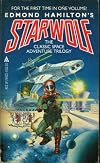
Another rollicking, adventurous good time from the semi-pulp scifi era I hadn't previously read (or anything else by Hamilton for that matter). This omnibus was in the last of the books from my aunt, who loved this sort of thing.
It was a light, fast, fun action-y collection. Though nestled in there is some surprisingly astute self-reflection and great characterization, some nice thoughts on how you can't ever really 'go home again' for a whole host of reasons and causes.
Worth the read!
It was a light, fast, fun action-y collection. Though nestled in there is some surprisingly astute self-reflection and great characterization, some nice thoughts on how you can't ever really 'go home again' for a whole host of reasons and causes.
Worth the read!

Access a version of the below that includes illustrations on my blog.
This volume continues on from volume 1, establishing the Legion of Super-Heroes as a regular ongoing feature; it contains the Legion stories from issues #306 to 317 of Adventure Comics, plus one story from Superman's Pal, Jimmy Olsen guest-starring the Legion. All of the regular Legion stories are written by Edmond Hamilton (husband of Leigh Brackett, fact fans), usually with art by John Forte. We can see that the Legion show more has bedded in as the regular concept we now recognize. Though the early stories here claim they come from the twenty-first century, it soon switches to the thirtieth and stats there. Beyond that, we get key concepts like the idea of Legion tryouts, the Legion of Substitute Heroes, the debut of Proty (and then Proty II), the resurrection of Lightning Lad, the first mention of the Time Trapper, Phantom Girl's thing for Ultra Boy, Star Boy's thing for Dream Girl, and so on. Overall I found this a solid set of Legion stories that really show how it can work as an ongoing concept; I reread my review of volume 3 (into which this ones leads) before writing this one, and I was I quite grumpy about it, writing, "Even by the standards of 1960s superhero comics, I would argue, most of these stories are dismal and dull and daft." Well, maybe Hamilton's early days were better than his later ones, or maybe I was just in a bad mood back in 2016, because I didn't think this was great literature, but I did enjoy it for what it was. Maybe it was interesting because you can see the Legion concept developing, as was the case in volume 1, whereas that wasn't really a factor later on.
In any case, here are some notes and highlights. Like I said above, this volume contains the debut of the Legion of Substitute Heroes, and in fact two other stories focused on them. Obviously I know about them from later stories, but this was my first time reading their debut. I can see why people glommed onto them, they are actually quite charming. Polar Boy, Night Girl, Stone Boy, Fire Lad, and Chlorophyll Kid are all rejected at Legion tryouts, but remain so dedicated to the Legion that they decide to form a back-up group for the Legion. (Legion rejects get flying belts, which seems kind of over-the-top, but maybe flying belts are a dime a dozen in the thirtieth century.) What really makes the story shine is Polar Boy's determination to make the Subs work as a group; they keep trying to help the Legion but are unneeded, but Polar Boy knows if they don't prove useful sometime, his new friends will fall apart.
The other highlight for the Subs is the one where the Legion creates a contest to admit one Sub. It's neat to see them use their crappy powers cleverly, and it's charming both that Stone Boy wins because of his motivation, not his powers, and that he turns down the offer so he can stay with his friends. You can see why these characters would make an impression on the readers, and why later writers would keep going back to them.You might think that someone handed a cast of characters with (I believe) eighteen members might think to themselves that that's enough, but not Edmond Hamilton, who introduces three more Legionnaires here: Element Lad, Lightning Lass, and Dream Girl. Element Lad's is okay, more an excuse for a scientific mystery than a new character (and I don't think he really does much in the rest of the volume).
Lightning Lass's is interesting; I had never read her debut story before, though I was familiar with the broad strokes from later stories: joins while her brother is dead, gets her powers changed. What I hadn't known was exactly how this all happens, and I was actually surprised. I've read the story where Lightning Lad is resurrected before, but it was an awful long time ago, so when Lightning Lad was seemingly resurrected I thought it really was him. It turns out to be his sister disguising herself as her dead brother. Sun Boy figures it out but plays along; the Bierbaums would later make him into kind of an entitled player, but here he's a good guy, helping her out covertly (or at least he thinks he is, because he doesn't know she has lightning powers too). I'm a bit surprised they didn't pick up on the cross-dressing angle later on, as Lightning Lass makes a very successful boy.
Later, after Lightning Lad comes back to life, she continues in the Legion. I knew she got her powers switched later on, to control of gravity (thus making her "Light Lass") but I had figured it was by accident or something. It's actually done deliberately by Dream Girl in her debut story (who knew it was so easy to change someone's superpowers? who knew someone who take their powers being changed so easily?), because the Legion doesn't permit member to have identical powers. Lightning Lad came back to life in Adventure #312, and the power swap happens in #317. I'm assuming they got letters from earnest fans who noted the contradiction because no one in the intervening stories notes the issue.
Speaking of Dream Girl, she doesn't join up permanently in her debut, but she immediately makes an impression, both in terms of her physical attributes (the subplot about all the boys swooning for her is hilarious) but also in terms of her cleverness, using her powers to try to save the Legion's life without threatening the timeline. Dream Girl is one of my faves, so I was delighted to see this story. If I'm not mistaken, it would be a long time before she returned, not until a story collected in volume 5.
And speaking of long gaps between appearances, Star Boy was one of the very first Legionnaires we learned about, in Adventure #282, but then promptly disappeared, appearing in no other Legion stories for over two years, until #310 (collected here). He finally does something of note in the Dream Girl story, though it's mostly falling for her. During his run, Paul Levitz would explain this long absence, as well as Thom's changing powers, in one of my favorite Legion stories. Another story that later writers would do a lot with is Adventure #316, where Ultra Boy goes on the run... though of course he turns out to have good reasons for it that he can't tell anyone about.
Chamelon Boy's "pet," the seemingly sentient, telepathic, shapeshifting blob named Proty, makes his debut in #308, the story where Lightning Lass debuts... and dies in #312, just four issues later, sacrificing his life so that Lightning Lad can come back to life. But Proty II debuts immediately thereafter, without fanfare, in Jimmy Olsen #72. Jimmy identifies someone disguised as him as Proty (how he does this, I don't know, because there's no story where Jimmy meets Proty), but he's corrected by Chameleon Boy: "Actually, it's 'Proty II', a friend of my first protean pet, who died when he sacrificed his life for Saturn Girl!" And that's it! I wonder if Jimmy Olsen #72 was mostly done when someone informed its writer/editor that Proty had been killed off, so they had to add this comment at the last minute... and thus a whole new character was born! When Proty II pops up in Adventure for the first time, it's with no more explanation.
Obviously a lot of these stories are ridiculous (e.g, the one where Supergirl fights her own duplicate, who turns all the female Legionnaires pink), but the place of honor has to be set aside for the one where a criminal sneaks into their clubhouse and steals a time bubble... so that he can team up with Emperor Nero, John Dillinger, and Adolf Hitler ("the three wickedest men in history"), transferring their brains into the bodies of Superboy, Mon-El, and Ultra Boy to create super-criminals. I am not so sure you would see Hitler treated so casually these days; funny that he gets taken more seriously the further away we get from him. show less
This volume continues on from volume 1, establishing the Legion of Super-Heroes as a regular ongoing feature; it contains the Legion stories from issues #306 to 317 of Adventure Comics, plus one story from Superman's Pal, Jimmy Olsen guest-starring the Legion. All of the regular Legion stories are written by Edmond Hamilton (husband of Leigh Brackett, fact fans), usually with art by John Forte. We can see that the Legion show more has bedded in as the regular concept we now recognize. Though the early stories here claim they come from the twenty-first century, it soon switches to the thirtieth and stats there. Beyond that, we get key concepts like the idea of Legion tryouts, the Legion of Substitute Heroes, the debut of Proty (and then Proty II), the resurrection of Lightning Lad, the first mention of the Time Trapper, Phantom Girl's thing for Ultra Boy, Star Boy's thing for Dream Girl, and so on. Overall I found this a solid set of Legion stories that really show how it can work as an ongoing concept; I reread my review of volume 3 (into which this ones leads) before writing this one, and I was I quite grumpy about it, writing, "Even by the standards of 1960s superhero comics, I would argue, most of these stories are dismal and dull and daft." Well, maybe Hamilton's early days were better than his later ones, or maybe I was just in a bad mood back in 2016, because I didn't think this was great literature, but I did enjoy it for what it was. Maybe it was interesting because you can see the Legion concept developing, as was the case in volume 1, whereas that wasn't really a factor later on.
In any case, here are some notes and highlights. Like I said above, this volume contains the debut of the Legion of Substitute Heroes, and in fact two other stories focused on them. Obviously I know about them from later stories, but this was my first time reading their debut. I can see why people glommed onto them, they are actually quite charming. Polar Boy, Night Girl, Stone Boy, Fire Lad, and Chlorophyll Kid are all rejected at Legion tryouts, but remain so dedicated to the Legion that they decide to form a back-up group for the Legion. (Legion rejects get flying belts, which seems kind of over-the-top, but maybe flying belts are a dime a dozen in the thirtieth century.) What really makes the story shine is Polar Boy's determination to make the Subs work as a group; they keep trying to help the Legion but are unneeded, but Polar Boy knows if they don't prove useful sometime, his new friends will fall apart.
The other highlight for the Subs is the one where the Legion creates a contest to admit one Sub. It's neat to see them use their crappy powers cleverly, and it's charming both that Stone Boy wins because of his motivation, not his powers, and that he turns down the offer so he can stay with his friends. You can see why these characters would make an impression on the readers, and why later writers would keep going back to them.You might think that someone handed a cast of characters with (I believe) eighteen members might think to themselves that that's enough, but not Edmond Hamilton, who introduces three more Legionnaires here: Element Lad, Lightning Lass, and Dream Girl. Element Lad's is okay, more an excuse for a scientific mystery than a new character (and I don't think he really does much in the rest of the volume).
Lightning Lass's is interesting; I had never read her debut story before, though I was familiar with the broad strokes from later stories: joins while her brother is dead, gets her powers changed. What I hadn't known was exactly how this all happens, and I was actually surprised. I've read the story where Lightning Lad is resurrected before, but it was an awful long time ago, so when Lightning Lad was seemingly resurrected I thought it really was him. It turns out to be his sister disguising herself as her dead brother. Sun Boy figures it out but plays along; the Bierbaums would later make him into kind of an entitled player, but here he's a good guy, helping her out covertly (or at least he thinks he is, because he doesn't know she has lightning powers too). I'm a bit surprised they didn't pick up on the cross-dressing angle later on, as Lightning Lass makes a very successful boy.
Later, after Lightning Lad comes back to life, she continues in the Legion. I knew she got her powers switched later on, to control of gravity (thus making her "Light Lass") but I had figured it was by accident or something. It's actually done deliberately by Dream Girl in her debut story (who knew it was so easy to change someone's superpowers? who knew someone who take their powers being changed so easily?), because the Legion doesn't permit member to have identical powers. Lightning Lad came back to life in Adventure #312, and the power swap happens in #317. I'm assuming they got letters from earnest fans who noted the contradiction because no one in the intervening stories notes the issue.
Speaking of Dream Girl, she doesn't join up permanently in her debut, but she immediately makes an impression, both in terms of her physical attributes (the subplot about all the boys swooning for her is hilarious) but also in terms of her cleverness, using her powers to try to save the Legion's life without threatening the timeline. Dream Girl is one of my faves, so I was delighted to see this story. If I'm not mistaken, it would be a long time before she returned, not until a story collected in volume 5.
And speaking of long gaps between appearances, Star Boy was one of the very first Legionnaires we learned about, in Adventure #282, but then promptly disappeared, appearing in no other Legion stories for over two years, until #310 (collected here). He finally does something of note in the Dream Girl story, though it's mostly falling for her. During his run, Paul Levitz would explain this long absence, as well as Thom's changing powers, in one of my favorite Legion stories. Another story that later writers would do a lot with is Adventure #316, where Ultra Boy goes on the run... though of course he turns out to have good reasons for it that he can't tell anyone about.
Chamelon Boy's "pet," the seemingly sentient, telepathic, shapeshifting blob named Proty, makes his debut in #308, the story where Lightning Lass debuts... and dies in #312, just four issues later, sacrificing his life so that Lightning Lad can come back to life. But Proty II debuts immediately thereafter, without fanfare, in Jimmy Olsen #72. Jimmy identifies someone disguised as him as Proty (how he does this, I don't know, because there's no story where Jimmy meets Proty), but he's corrected by Chameleon Boy: "Actually, it's 'Proty II', a friend of my first protean pet, who died when he sacrificed his life for Saturn Girl!" And that's it! I wonder if Jimmy Olsen #72 was mostly done when someone informed its writer/editor that Proty had been killed off, so they had to add this comment at the last minute... and thus a whole new character was born! When Proty II pops up in Adventure for the first time, it's with no more explanation.
Obviously a lot of these stories are ridiculous (e.g, the one where Supergirl fights her own duplicate, who turns all the female Legionnaires pink), but the place of honor has to be set aside for the one where a criminal sneaks into their clubhouse and steals a time bubble... so that he can team up with Emperor Nero, John Dillinger, and Adolf Hitler ("the three wickedest men in history"), transferring their brains into the bodies of Superboy, Mon-El, and Ultra Boy to create super-criminals. I am not so sure you would see Hitler treated so casually these days; funny that he gets taken more seriously the further away we get from him. show less
Lists
Awards

You May Also Like


Associated Authors
Statistics
- Works
- 445
- Also by
- 142
- Members
- 5,144
- Popularity
- #4,842
- Rating
- 3.6
- Reviews
- 82
- ISBNs
- 375
- Languages
- 9
- Favorited
- 11