
Laurence Perrine (1915–1995)
Author of Sound and Sense: An Introduction to Poetry
About the Author
Image credit: via Alchetron.com
Works by Laurence Perrine
Tagged
Common Knowledge
- Birthdate
- 1915-10-13
- Date of death
- 1995-04-27
- Gender
- male
- Education
- Oberlin College
Yale University - Organizations
- Southern Methodist University
- Nationality
- USA
- Associated Place (for map)
- USA
Members
Reviews

I have a whole shelf of paperback poetry anthologies with “new,” “contemporary,” or “modern” in the title. Most of them date back to the 1960s, when I was a new teacher and a poor graduate student. I couldn’t afford to buy individual books by each of the living poets I was discovering, and I probably couldn’t have found a bookstore that stocked them. So I had to depend on these anthologies, and I’ve been carting them around with me ever since. Every time we move, I give show more stacks and stacks of books to Friends of the Library, literally hundreds of them, but I have never been able to part with these well-worn anthologies from the ’60s.
Read the shelves with me: New Poets of England and America ( 1957), The New American Poetry (1960), The Modern Poets (1963), Today’s Poets (1964), A Controversy of Poets (1965), The New Poets (1967), Poems of Our Moment (1968), The Poem in Its Skin (1968), The Young American Poets (1968), The Contemporary American Poets (1969). Of course, the shelf continues, for example, through The New Naked Poetry (1976), The Vintage Book of Contemporary American Poetry (1990), and New American Poets of the 90s (1991), on up through Postmodern American Poetry (1994), but it’s the ones from the 1960s that have meant so much to me for so long.
When I stand there, choosing one to represent this significant phase of my reading life, my hand automatically reaches for the volume that probably influenced me most. It’s actually an examination copy of a textbook, distributed by Harcourt, Brace & World (c1966): 100 American Poems of the Twentieth Century, edited by Laurence Perrine and James M. Reid. “No claim is made,” the editors say, “that these are the hundred best American poems of the twentieth century. Such a claim is beyond proof,” but each poem “has merit and distinction.” There were familiar poems by well-known poets: “Richard Cory” by Edwin Arlington Robinson, “Stopping by Woods on a Snowy Evening” by Robert Frost, “Patterns” by Amy Lowell, “Chicago” by Carl Sandburg, “The Love Song of J. Alfred Prufrock,” by T. S. Eliot, “anyone lived in a pretty how town” by e e cummings, “Incident” by Countee Cullen, and “Auto Wreck” by Karl Shapiro. By that time, I would have already used all of those in my classes. But there were less familiar poems by these same authors—at least to me, at that time—that caught and held my attention, and they still do; for example “Design” by Frost and “Journey of the Magi” by Eliot, both of which would make my twentieth-century anthology if I were to do one.
But even more important by far, were the new poems by new poets, many of which introduced me to poets whose work I’ve celebrated for forty years now. I did not know Elizabeth Bishop, and “The Fish” filled me up:
I stared and stared
and victory filled up
the little rented boat,
from the pool of bilge
where oil had spread a rainbow
around the rusted engine
to the bailer rusted orange,
the sun-cracked thwarts,
the oarlocks on their strings,
the gunnels—until everything
was rainbow, rainbow, rainbow!
And I let the fish go.
I knew Robert Penn Warren’s fiction well and, of course, his critical handbooks, but “Dragon Country: To Jacob Boehme” introduced me to a new dimension of the writer and his motifs:
But if the beast were withdrawn now, life might dwindle again
To the ennui, the pleasure, and night sweat, known in the time before . . . .
Howard Nemerov (q.v.) gave me “Santa Claus” to provoke thoughtfulness in my classes just before the holiday season. W. D. Snodgrass, whose Heart’s Needle had shown me scenes from my University of Iowa campus from a poet’s-eye view, sent me reeling in a new direction with his “Powwow.” James Dickey’s “The Lifeguard” sent me looking for more of his quizzical visions. Will Stanton’s “Dandelions” became one of my favorite poems to read aloud to groups on my speakers’ circuit.
But other anthologies led me to new poems and new poets. What made this one stand out? It may have been the selection (balancing familiar and unfamiliar), the variety (from Ogden Nash and Phyllis McGinley to Randall Jarrell and Anne Sexton) or the format (the manageable size, the readable print, the easeful white space). But there’s another feature I haven’t mentioned yet. The editors explain it in their foreword: “The reader is asked to read a poem through as many times as need be for its words and its phrasing to become familiar to him. Once this is done, a dialogue will have been set up between the poet and the reader.” OK, Good advice but nothing new here.
“To this dialogue is then added the commentary that follows each poem, and by this means the intimations and meanings of the poems are explored.” Yes, that’s it. The dialogue between the poet and the reader is joined by a third party. A real conversation is simulated. The comments are brief and straight-forward, exploratory. No deep analysis; not expostulation or critical exegesis. Simply a comment. For example, on Robert Frost’s “Design” one paragraph examines color imagery: the white heal-all, which would ordinarily be blue, the white spider, which would ordinarily be black or brown, and the white moth. “What has brought together these three white things, two of them so rarely white?” I like the way the editors keep the conversation going. That, I discovered, is one sure-fire way to invite readers into the experience of a poem. No headnotes or introductions: just the poem, then a silent dialogue, and finally a brief, informative, conversational comment. I think it makes this selection of 100 richer than most compendiums of 500.
“An unassuming poem about an unassuming plant,” Perrine says of “Dandelions”; but then he goes on to raise some questions, drop some hints, voice an opinion. Like a friend over coffee, he keeps a conversation going—and going deeper. I have many anthologies that I wish engaged me in just such conversations. show less
Read the shelves with me: New Poets of England and America ( 1957), The New American Poetry (1960), The Modern Poets (1963), Today’s Poets (1964), A Controversy of Poets (1965), The New Poets (1967), Poems of Our Moment (1968), The Poem in Its Skin (1968), The Young American Poets (1968), The Contemporary American Poets (1969). Of course, the shelf continues, for example, through The New Naked Poetry (1976), The Vintage Book of Contemporary American Poetry (1990), and New American Poets of the 90s (1991), on up through Postmodern American Poetry (1994), but it’s the ones from the 1960s that have meant so much to me for so long.
When I stand there, choosing one to represent this significant phase of my reading life, my hand automatically reaches for the volume that probably influenced me most. It’s actually an examination copy of a textbook, distributed by Harcourt, Brace & World (c1966): 100 American Poems of the Twentieth Century, edited by Laurence Perrine and James M. Reid. “No claim is made,” the editors say, “that these are the hundred best American poems of the twentieth century. Such a claim is beyond proof,” but each poem “has merit and distinction.” There were familiar poems by well-known poets: “Richard Cory” by Edwin Arlington Robinson, “Stopping by Woods on a Snowy Evening” by Robert Frost, “Patterns” by Amy Lowell, “Chicago” by Carl Sandburg, “The Love Song of J. Alfred Prufrock,” by T. S. Eliot, “anyone lived in a pretty how town” by e e cummings, “Incident” by Countee Cullen, and “Auto Wreck” by Karl Shapiro. By that time, I would have already used all of those in my classes. But there were less familiar poems by these same authors—at least to me, at that time—that caught and held my attention, and they still do; for example “Design” by Frost and “Journey of the Magi” by Eliot, both of which would make my twentieth-century anthology if I were to do one.
But even more important by far, were the new poems by new poets, many of which introduced me to poets whose work I’ve celebrated for forty years now. I did not know Elizabeth Bishop, and “The Fish” filled me up:
I stared and stared
and victory filled up
the little rented boat,
from the pool of bilge
where oil had spread a rainbow
around the rusted engine
to the bailer rusted orange,
the sun-cracked thwarts,
the oarlocks on their strings,
the gunnels—until everything
was rainbow, rainbow, rainbow!
And I let the fish go.
I knew Robert Penn Warren’s fiction well and, of course, his critical handbooks, but “Dragon Country: To Jacob Boehme” introduced me to a new dimension of the writer and his motifs:
But if the beast were withdrawn now, life might dwindle again
To the ennui, the pleasure, and night sweat, known in the time before . . . .
Howard Nemerov (q.v.) gave me “Santa Claus” to provoke thoughtfulness in my classes just before the holiday season. W. D. Snodgrass, whose Heart’s Needle had shown me scenes from my University of Iowa campus from a poet’s-eye view, sent me reeling in a new direction with his “Powwow.” James Dickey’s “The Lifeguard” sent me looking for more of his quizzical visions. Will Stanton’s “Dandelions” became one of my favorite poems to read aloud to groups on my speakers’ circuit.
But other anthologies led me to new poems and new poets. What made this one stand out? It may have been the selection (balancing familiar and unfamiliar), the variety (from Ogden Nash and Phyllis McGinley to Randall Jarrell and Anne Sexton) or the format (the manageable size, the readable print, the easeful white space). But there’s another feature I haven’t mentioned yet. The editors explain it in their foreword: “The reader is asked to read a poem through as many times as need be for its words and its phrasing to become familiar to him. Once this is done, a dialogue will have been set up between the poet and the reader.” OK, Good advice but nothing new here.
“To this dialogue is then added the commentary that follows each poem, and by this means the intimations and meanings of the poems are explored.” Yes, that’s it. The dialogue between the poet and the reader is joined by a third party. A real conversation is simulated. The comments are brief and straight-forward, exploratory. No deep analysis; not expostulation or critical exegesis. Simply a comment. For example, on Robert Frost’s “Design” one paragraph examines color imagery: the white heal-all, which would ordinarily be blue, the white spider, which would ordinarily be black or brown, and the white moth. “What has brought together these three white things, two of them so rarely white?” I like the way the editors keep the conversation going. That, I discovered, is one sure-fire way to invite readers into the experience of a poem. No headnotes or introductions: just the poem, then a silent dialogue, and finally a brief, informative, conversational comment. I think it makes this selection of 100 richer than most compendiums of 500.
“An unassuming poem about an unassuming plant,” Perrine says of “Dandelions”; but then he goes on to raise some questions, drop some hints, voice an opinion. Like a friend over coffee, he keeps a conversation going—and going deeper. I have many anthologies that I wish engaged me in just such conversations. show less

A marvelous anthology, both in its selection and organization of stories and in its interpretive questions. As a teacher of a basic literature course, I've often used the introductory section as a way of demonstration the difference between what Perrine calls "escape literature" and "interpretive literature."

I originally snagged this from my father who was ready to cart it off to the used bookstore - he'd used it when teaching high school decades ago. I had this idea that I'd make some book art out of it, because I was certain there'd be nothing in it that would appeal to me. But of course I decided to read it before getting out the scissors, and that's when I discovered the short story Two Bottles of Relish by Lord Dunsany. I'm not a huge fan of Dunsany, but nothing else I've read of his reads show more quite like this one. And it's apparently a bit hard to track down (not the play, that seems to be all over the place). So now I must hang on to the book.
Somehow I'm not terribly upset. show less
Somehow I'm not terribly upset. show less
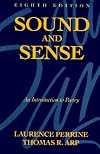
The poems themselves in this book are great. I love poetry. But the author of the book is so freaking annoying and so freaking pretentious. I can't stand it.
Lists
Sonlight Books (1)
Craft Books (1)
You May Also Like


Associated Authors
Statistics
- Works
- 12
- Members
- 2,589
- Popularity
- #9,924
- Rating
- 3.9
- Reviews
- 11
- ISBNs
- 77