
X. J. Kennedy (1929–2026)
Author of Literature: An Introduction to Fiction, Poetry, and Drama
About the Author
Widely anthologized, Kennedy's poetry may not be as influential among contemporary poets as others' because of his preference for, in his words, "old-fangled structures most poets have junked these days." As Kennedy's comments on his verse suggest, his poetry is witty, concise, and unpretentious. show more His subject matter is drawn from the everyday including his Catholic background and middle-class suburban life. Yet his concerns can be profound including death, violence, suicide, and Genesis. (Bowker Author Biography) show less
Series
Works by X. J. Kennedy
The Bedford Guide for College Writers with Reader, Research Manual, and Handbook (2002) — Editor — 197 copies
Backpack Literature: An Introduction to Fiction, Poetry, Drama, and Writing (4th Edition) (2005) — Editor — 96 copies
Instructor's Manual to accompany Literature (An Introduction to Fiction, Poetry, Drama, and Writing) Fifth Compact Edition (2007) 16 copies
The Longman Dictionary of Literary Terms -The Essential Literary Terms: The Jargon for the Informed Reader (for Sourcebooks, Inc.) (2005) 16 copies
Literature: An Introduction to Fiction, Poetry, Drama, and Writing, MLA Update Edition (13th Edition) (2016) 14 copies
Writing and Revising with 2009 MLA and 2010 APA Updates: A Portable Guide (Portable (Bedford/St. Martins)) (2010) 9 copies
Literature: An Introduction to Fiction, Poetry, Drama, and Writing, Compact Edition (6th Edition) (2009) — Editor — 7 copies
Literature: An Introduction to Fiction, Poetry, Drama, and Writing, Compact Edition (8th Edition) (2015) 6 copies
The Bedford Guide for College Writers with Reader, Research Manual, and Handbook, 2020 APA Update (2020) 1 copy
Literature for Life with NEW MyLiteratureLab with Literature Collection eText -- Access Card Package (2012) 1 copy
Hangover Mass 1 copy
Associated Works
Poetry Speaks to Children, Read & Hear [book & CD] (2005) — Guest, some editions — 673 copies, 16 reviews
Never Take a Pig to Lunch: And Other Poems About the Fun of Eating (1994) — Contributor — 345 copies, 12 reviews
A Controversy of Poets: An Anthology of Contemporary American Poetry, (1965) — Contributor — 83 copies
Sunlight on the River: Poems About Paintings, Paintings About Poems (2015) — Contributor — 11 copies, 2 reviews
Cricket Magazine, Vol. 8, No. 1, September 1980 — Contributor — 1 copy
Tagged
Common Knowledge
- Legal name
- Kennedy, Joseph Charles
- Other names
- Kennedy, X. J.
Kennedy, Joe - Birthdate
- 1929-08-29
- Date of death
- 2026-01-30
- Gender
- male
- Education
- Seton Hall (BSc ∙ 1950)
Columbia University (MA ∙ 1951)
Sorbonne
University of Michigan - Occupations
- editor
translator
poet
teacher
publisher - Organizations
- Spectator Amateur Press Association / SAPS (cofounder)
United States Navy
Paris Review (poetry editor)
Counter/Measures (co-editor) - Awards and honors
- Shelley Memorial Award (1969/1970)
Michael Braude Award for Light Verse (1989)
Frost Medal (2009)
Aiken Taylor Award (1998)
NCTE Award for Excellence in Poetry for Children (2000) - Relationships
- Kennedy, Dorothy M. (wife)
- Cause of death
- natural causes
- Nationality
- USA
- Birthplace
- Dover, New Jersey, USA
- Places of residence
- Dover, New Jersey, USA (birth)
Bedford, Massachusetts, USA - Place of death
- Peabody, Massachusetts, USA
- Associated Place (for map)
- Massachusetts, USA
Members
Reviews
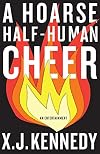
A Hoarse, Half-Human Cheer was a real hoot. You may find yourself speaking like this after emerging from the book, blinking in the modern light, expecting, perhaps, a sepia tinge to the air.
I got A Hoarse, Half-Human Cheer for free through NetGalley.
X.J. Kennedy's got this great sense of the voice of the fifties, or at least the voice of the fifties as passed down to us through the generations, just soaked throughout the entire novel. And accompanying the voice is a fun little caper story show more involving the mob, basketball, wise-cracking secretaries, karate-kicking priests (reminded me of the Dead Alive scene with the priest shouting, "I kick ass for the Lord!"), army surplus, and a dame with a lot of moxie. There are clear villains and good guys, there is some good, old fashioned violence. There is a really, really funny scene where a renegade priest has gone off his rocker and blessed a warehouse full of Ritz crackers which, as their Catholic duty, the priests and nuns of the Catholic college at the heart of the story, the college staff have to eat in one evening, lest the body of Christ be profaned. "Surely you wouldn’t smear jelly on the Body of Our Lord?"
Well worth your time. show less
I got A Hoarse, Half-Human Cheer for free through NetGalley.
X.J. Kennedy's got this great sense of the voice of the fifties, or at least the voice of the fifties as passed down to us through the generations, just soaked throughout the entire novel. And accompanying the voice is a fun little caper story show more involving the mob, basketball, wise-cracking secretaries, karate-kicking priests (reminded me of the Dead Alive scene with the priest shouting, "I kick ass for the Lord!"), army surplus, and a dame with a lot of moxie. There are clear villains and good guys, there is some good, old fashioned violence. There is a really, really funny scene where a renegade priest has gone off his rocker and blessed a warehouse full of Ritz crackers which, as their Catholic duty, the priests and nuns of the Catholic college at the heart of the story, the college staff have to eat in one evening, lest the body of Christ be profaned. "Surely you wouldn’t smear jelly on the Body of Our Lord?"
Well worth your time. show less
What a strange book.
And yet, despite its strangeness, and cryptic title, I found myself liking it quite a bit, though it's hard to say exactly why.
A Hoarse, Half-Human Cheer (which will henceforth be referred to only as A Cheer, because let's face it, that title is way too long and bizarre) takes place in 1947 at a Catholic college in New Jersey, Saint Cassian's of Imola. Though the story is told through several viewpoints, always in the third person, its main characters are Doug Knox and show more Moon Gogarty. Father Knox, basketball coach and religion class teacher, first comes off as an obnoxious hard-ass. And though the obnoxiousness fades quickly, the hard-assness does not. Knox is quick, blunt, capable, knowledgeable on martial arts, and very, very lucky. (Seriously, the number of times he almost dies in this book are crazy. I counted five.)
Moon Gogarty is an awkward, naïve apprentice mortician-turned-student at Saint Cash's. I suppose he's pretty stock character-y in the fact that he plays the "Lovable Dork" almost to a tee. But he isn't, overall, a bad character.
It takes a while for things to really get going- in the beginning, it's mostly about life at the college, and the few incidents that do happen don't seem important or related. But once stuff starts to pick up, the book becomes a wild, fun, madcap roller coaster. There's a nymphomanic biology professor, an ex-GI with a mechanical claw, a vengeful basketball prodigy, a tonsured lunatic, and, surrounding it all and closing ever inward, the Italian mafia.
Saint Cash's, you see, has made some shady deals with Ricco Peruccese, a.k.a. Ricky Peru, and his gang, leading them unwittingly into the nasty business of the mob- war surplus racket, blackmail, hits, prostitution, and a whole lot of other stuff. Basically, they open up a can of worms that they can't shut.
And that's not even the half of it- into all that sticky bidness come a priest who's off his rocker, plus an equally insane "prophet", not to mention a whole lot of guns and Ritz crackers.
My biggest problem with A Cheer is that the whole storyline involving Cross and the Church of the One Right Path seemed pretty rushed, especially as Cross' motivation is only revealed in the last five pages or so. In that respect, I felt like the author tried to squeeze just a bit too much into a book that was already chock-full of plots and characters.
I should warn you, though: there's some misogyny and domestic abuse. Quite a few women get hit by complete assholes who are usually cheating on them with several other women. I didn't think, however that those characters' misogyny was disproportionate to the book as a whole, or that their statements reflected any sort of hatred towards women on behalf of the author. I mean, it was the late forties, after all- disgusting as it may be, that sort of thing was very prevalent back then. (Not that that excuses it in the slightest.) Also, there are a few semi-graphic sex scenes. Don't let your local nun catch you reading this.
P.S. I received an advance copy of this book from the publisher in exchange for an honest review. I must say, however, that this didn't affect my opinion at all- it just meant that my copy had a few more spelling and grammar errors than the official one ;) show less
And yet, despite its strangeness, and cryptic title, I found myself liking it quite a bit, though it's hard to say exactly why.
A Hoarse, Half-Human Cheer (which will henceforth be referred to only as A Cheer, because let's face it, that title is way too long and bizarre) takes place in 1947 at a Catholic college in New Jersey, Saint Cassian's of Imola. Though the story is told through several viewpoints, always in the third person, its main characters are Doug Knox and show more Moon Gogarty. Father Knox, basketball coach and religion class teacher, first comes off as an obnoxious hard-ass. And though the obnoxiousness fades quickly, the hard-assness does not. Knox is quick, blunt, capable, knowledgeable on martial arts, and very, very lucky. (Seriously, the number of times he almost dies in this book are crazy. I counted five.)
Moon Gogarty is an awkward, naïve apprentice mortician-turned-student at Saint Cash's. I suppose he's pretty stock character-y in the fact that he plays the "Lovable Dork" almost to a tee. But he isn't, overall, a bad character.
It takes a while for things to really get going- in the beginning, it's mostly about life at the college, and the few incidents that do happen don't seem important or related. But once stuff starts to pick up, the book becomes a wild, fun, madcap roller coaster. There's a nymphomanic biology professor, an ex-GI with a mechanical claw, a vengeful basketball prodigy, a tonsured lunatic, and, surrounding it all and closing ever inward, the Italian mafia.
Saint Cash's, you see, has made some shady deals with Ricco Peruccese, a.k.a. Ricky Peru, and his gang, leading them unwittingly into the nasty business of the mob- war surplus racket, blackmail, hits, prostitution, and a whole lot of other stuff. Basically, they open up a can of worms that they can't shut.
And that's not even the half of it- into all that sticky bidness come a priest who's off his rocker, plus an equally insane "prophet", not to mention a whole lot of guns and Ritz crackers.
My biggest problem with A Cheer is that the whole storyline involving Cross and the Church of the One Right Path seemed pretty rushed, especially as Cross' motivation is only revealed in the last five pages or so. In that respect, I felt like the author tried to squeeze just a bit too much into a book that was already chock-full of plots and characters.
I should warn you, though: there's some misogyny and domestic abuse. Quite a few women get hit by complete assholes who are usually cheating on them with several other women. I didn't think, however that those characters' misogyny was disproportionate to the book as a whole, or that their statements reflected any sort of hatred towards women on behalf of the author. I mean, it was the late forties, after all- disgusting as it may be, that sort of thing was very prevalent back then. (Not that that excuses it in the slightest.) Also, there are a few semi-graphic sex scenes. Don't let your local nun catch you reading this.
P.S. I received an advance copy of this book from the publisher in exchange for an honest review. I must say, however, that this didn't affect my opinion at all- it just meant that my copy had a few more spelling and grammar errors than the official one ;) show less
This is my go-to book for attempting to teach students about poetry. It's broken into sections that feel flexible, not didactic. The first part is called "What do poems DO?" and there are examples of lots of poems that make us smile, or tell a story, or send a message. Some poems are accompanied by some explanation, some stand alone. There are black and white illustrations sprinkled throughout, but the poems themselves are the stars.
The second section deals with the "terms" side of things, show more and asks, "What's inside a poem?" And here we have poems that are rich in imagery, or musical language, or rhythms, for example. The third section examines types of poems, with examples, such as limericks, songs, takeoffs, haiku, and "finders keepers" (a personal fave of mine). Finally, the fourth section gives use writing activities to help nudge us off into writing our own poems.
What I love about this volume is that it's accessible and friendly in tone. It's packed with engaging poems that will have broad appeal. And it's darn USEFUL as a way to structure poetry units and lessons. show less
The second section deals with the "terms" side of things, show more and asks, "What's inside a poem?" And here we have poems that are rich in imagery, or musical language, or rhythms, for example. The third section examines types of poems, with examples, such as limericks, songs, takeoffs, haiku, and "finders keepers" (a personal fave of mine). Finally, the fourth section gives use writing activities to help nudge us off into writing our own poems.
What I love about this volume is that it's accessible and friendly in tone. It's packed with engaging poems that will have broad appeal. And it's darn USEFUL as a way to structure poetry units and lessons. show less
Grades 3-7
The title is perfect: a star gives off a different sort of light and poetry also causes us to see things in a different light. Kenndey compiles these poems with children in mind. His intent is to make children smile, send messages, or share feelings. Through these delightful poems with black-and-white sketches, Kennedy is sending a strong message that poems as lighthearted, humorous, and fun. The poems contain "beats that repeat" or "word play". In addition, the poems come in the show more form omany forms such as haiku, limericks, and songs. Kenneday has selected famous poets such as Emily Dickinson, Langston Hughes, and Walt Whitman for this selection of children's poems. In the addition, Kennedy has also selected poems from lesser-known poets. The poems have great appeal to children; they may be read silently or aloud. The subjects of the poems range from daddy making breakfast because mom still sleeps to riding the skateboard. In other words, the subjects connect with children and their lives. show less
The title is perfect: a star gives off a different sort of light and poetry also causes us to see things in a different light. Kenndey compiles these poems with children in mind. His intent is to make children smile, send messages, or share feelings. Through these delightful poems with black-and-white sketches, Kennedy is sending a strong message that poems as lighthearted, humorous, and fun. The poems contain "beats that repeat" or "word play". In addition, the poems come in the show more form omany forms such as haiku, limericks, and songs. Kenneday has selected famous poets such as Emily Dickinson, Langston Hughes, and Walt Whitman for this selection of children's poems. In the addition, Kennedy has also selected poems from lesser-known poets. The poems have great appeal to children; they may be read silently or aloud. The subjects of the poems range from daddy making breakfast because mom still sleeps to riding the skateboard. In other words, the subjects connect with children and their lives. show less
Lists
Awards


You May Also Like


Associated Authors
Statistics
- Works
- 89
- Also by
- 24
- Members
- 4,599
- Popularity
- #5,475
- Rating
- 3.9
- Reviews
- 50
- ISBNs
- 318