

Tony Blair
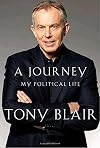
Author of A Journey: My Political Life
About the Author
Tony Blair was born on May 6, 1953. He graduated from Oxford University in 1976 with a Second Class Honours BA in Jurisprudence. He became a member of parliament for Sedgefield in 1983 and was elected prime minister of the United Kingdom from 1997 to 2007. In 2008, he founded the Tony Blair Faith show more Foundation, which promotes respect and understanding between the major religions and makes the case for faith as a force for good in the modern world. He also leads the Breaking the Climate Deadlock initiative and lectures at Yale University. (Bowker Author Biography) show less
Image credit: Paul Morse (2002), cropped.
Works by Tony Blair
The Courage of Our Convictions: Why Reform of the Public Services Is the Route to Social Justice (Fabian Ideas S.) (2002) 5 copies
Il nuovo Labour 3 copies
Hitchens vs. Blair: Be It Resolved Religion Is a Force for Good in the World (The Munk Debates) (2011) 3 copies
Tony Blair - Një rrugëtim 1 copy
Minha visão da Inglaterra 1 copy
Associated Works
Problem Solved: A Powerful System for Making Complex Decisions with Confidence and Conviction (2017) — Foreword, some editions — 30 copies
Investing in Financial Research: A Decision-Making System for Better Results (2019) — Foreword, some editions — 5 copies
Tagged
Common Knowledge
- Canonical name
- Blair, Tony
- Legal name
- Blair, Anthony Charles Lynton
- Birthdate
- 1953-05-06
- Gender
- male
- Education
- University of Oxford (St. John's College)
The Chorister School, Durham
Fettes College, Edinburgh, Scotland, UK
Lincoln's Inn, London, England, UK - Occupations
- politician
Prime Minister of the United Kingdom (1997-2007|Labour)
Leader of the Labour Party of the United Kingdom (1994-2007) - Organizations
- Labour Party of the United Kingdom
- Awards and honors
- Congressional Gold Medal (2003)
Presidential Medal of Freedom (2009)
Charlemagne Prize (1999) - Relationships
- Blair, Cherie (wife)
Blair, L. C. L. (father) - Short biography
- Anthony Charles Lynton Blair (born 6 May 1953) is a former British Labour Party politician who served as the Prime Minister of the United Kingdom from 2 May 1997 to 27 June 2007.
- Nationality
- UK
- Birthplace
- Edinburgh, Scotland, UK
- Places of residence
- Edinburgh, Scotland, UK
Adelaide, South Australia, Australia
Durham, England, UK - Associated Place (for map)
- UK
Members
Discussions
Tony Blair, war crimes and the Chilcot inquiry. in Pro and Con (July 2016)
Reviews
8/10: As political memoir, Blair's book is better than most. There's the inevitable self-justification of course, but no more than is reasonable, and whether you agree with his policies or not, it's hard not to accept that he surely did his best. The book was as it's most interesting as he reflected on what had been. The final chapters, which look forward as much as back, are much weaker, perhaps because the self-confidence is stronger (strangely, Blair seems to find it easier to be sure show more about the future than the past). Nonetheless, it remains a 'must-read' if only to try and understand the huge influence that Blair's premiership has been on all of us. show less

Phew! I feel really sorry for those people, employed by the press, and asked to review this book in twenty-four hours. I presume that they did the only thing that I could have done in those circumstances and read portions concerning major events within Blair's Prime Ministerial reign.
This explains why I have yet to read a review that touches the point of the book. It is not, as I - along with the reviewers - thought, an attempt to justify the decisions of his leadership. It is much more the show more opening to the people, particularly of Britain, of a debate about the direction which politics should take.
Due to family matters, it has taken me two weeks to read this tome - I think that I may have managed it in one; but certainly no less. The views are in line with the direction in which TB took the Labour Party but certainly took some hard mental work to, even begin, to get my head around.
The book is written in a very readable style and the Man' (thanks Chris Mullin) is one of the rare bread of authors who can, intentionally, make me laugh out loud whilst reading. The fact that the very next sentence may challenge the heart of my political beliefs is the reason that this book is so special.
Many times I found myself nodding my head and, instinctively agreeing with his reading of the situation, sometimes I needed to read a section two, or three times and sometimes I couldn't agree even after that.
Blair uses a very clever technique when it comes to the major events of his government, he wisely accepts that the public will have their own views and he is unlikely to get an anti-war protester to say, "Oh yes! I get it now TB was correct." He, therefore, does not aim for that level of acceptance. He simply asks that one reads his reading of the need for war and allow that there is the possibility that he was right. For me, admittedly a Blairite, this works. Being lead gently, I can see that some of my doubts are based in that wonderful place of being an armchair politician: just as my football team would win every game were they to play my team and tactics, it would have been possible to deal with al-Qaeda in a peaceful manner. Fortunately, my views were not tested; his were.
It is going to take, at least, a second read for the full effect of this book to seep into my dense brain but, I really believe this book to be a significant addition to political theory - thank you TB! show less
This explains why I have yet to read a review that touches the point of the book. It is not, as I - along with the reviewers - thought, an attempt to justify the decisions of his leadership. It is much more the show more opening to the people, particularly of Britain, of a debate about the direction which politics should take.
Due to family matters, it has taken me two weeks to read this tome - I think that I may have managed it in one; but certainly no less. The views are in line with the direction in which TB took the Labour Party but certainly took some hard mental work to, even begin, to get my head around.
The book is written in a very readable style and the Man' (thanks Chris Mullin) is one of the rare bread of authors who can, intentionally, make me laugh out loud whilst reading. The fact that the very next sentence may challenge the heart of my political beliefs is the reason that this book is so special.
Many times I found myself nodding my head and, instinctively agreeing with his reading of the situation, sometimes I needed to read a section two, or three times and sometimes I couldn't agree even after that.
Blair uses a very clever technique when it comes to the major events of his government, he wisely accepts that the public will have their own views and he is unlikely to get an anti-war protester to say, "Oh yes! I get it now TB was correct." He, therefore, does not aim for that level of acceptance. He simply asks that one reads his reading of the need for war and allow that there is the possibility that he was right. For me, admittedly a Blairite, this works. Being lead gently, I can see that some of my doubts are based in that wonderful place of being an armchair politician: just as my football team would win every game were they to play my team and tactics, it would have been possible to deal with al-Qaeda in a peaceful manner. Fortunately, my views were not tested; his were.
It is going to take, at least, a second read for the full effect of this book to seep into my dense brain but, I really believe this book to be a significant addition to political theory - thank you TB! show less
Tony Blair is highly divisive. Many will have formed their views long before reading A Journey and will be unmoved by anything that could have been within. For anyone who is open to hearing the tale of a decade at the heart of a reforming government that took Britain through some exceptionallly good times and into the current harder times, A Journey is well worth the effort.
It is amusing now that Blair is so divisive. The accusation levelled him when he took power was exactly the opposite - show more that his Third Way was an attempt to appeal to everyone at the same time. Did he change or did British society? Blair's autobiography begins with that momentous moment in 1997 when change happened. After 18 years of opposition, the Labour Party had finally won a General Election. Blair's role in Labour's victory is crucial and he tells that part of the story well. The transition from the threat of wipeout in the 1980s through Neil Kinnock and John Smith to Tony Blair is a fascinating part of Britain's changing political landscape. The decline of the power of organised labour is set by Blair in direct contrast to the rise of New Labour. The New Labour project is where much of the early narrative sits and it is a genuine piece of political thought that should not be overlooked.
The New Labour programme was radical and it was avowedly centrist. Blair spells out in A Journey the deliberate strategy of articulating the middle of the argument and positioning his party at that spot. His dealing with the media moguls in the early years are also a part of that strategy and the wooing of Rupert Murdoch was a clear strategic move. Blair's contribution to Political Thought - that it is possible to be both radical and centrist is worth reading. Radicals typically find themselves positioned at one end of an argument but for Blair it was possible to be both. Interestingly, by the end of A Journey he has clearly moved away from his early stance and moved from reflecting public opinion to leading it regardless of whether his decisions were popular.
Blair makes another point early on that is astute - there are many who blur the distinction between disagreement and antagonism. Blair could never be described as a coward and in A Journey he calls out those on the fringe who believe those who act in ways they disagree with are not just wrong but are evil. This is one of those self-evident truths that only becomes clear when someone says it and Blair puts that thought into print. Inevitably those who read this autobiography and are part of that world view will still consider Blair to be evil but at least it is reassuring to know that he feels just as strongly in their being wrong.
The rise to power is a terrific insight into quite how reforming Blair was within the Labour Party. While his reforms may not have stuck beyond his premiership, that he was able to change Clause IV for instance is an interesting read. Blair clearly sees this as a symbolic shift created by his New Labour and for the politico it is worth being reminded quite what a different ideology Labour used to stand for.
There are some pieces of negative self-reflection - the mistake that is the Freedom of Information Act being the most stark example. Of course Blair doesn't really unearth the true problem of FoI which is that it leads directly to the ending of record keeping. The recreation of DfID is an amusing moment with Blair revealing he considers the organisation to be pretty much an NGO and then seemingly just shrugging his shoulders and moving on.
Being a central figure in world events for 10 years gives Blair's views a credence that are worth reading. He might not always be right but he was there when Diana died, he was for a couple of days the leader of the free world post 9/11, he fought wars in Europe, Africa, and Asia, and he was a part of the Northern Ireland peace process. To some now that does not matter but for anyone who can look back on recent history, Blair's analysis of each of these makes for compelling reading.
Inevitably, much more is made of Iraq than the other conflicts. While this reviewer can't recall many of the Iraq War protesters standing with him to oppose action in Kosovo, it was a turning point. Unfortunately, Blair misses a lot of the point about Kosovo in his narrative. The point being that Blair still only sees the direct and not the unintended consequences of action. In the case of Kosovo, it is relations with Russia. Blair notes that Putin turned against the UK and the US but he fails to analyse why - probably because it is his fault. Anyone with any knowledge of Eastern Europe could have forseen the slight Russia felt at its closest European ally being attacked but Blair fails to even acknowledge it.
This lack of acknowledgement of real failures is the biggest problem with A Journey. The really serious failures are not frequent but other people's mistakes are typically analysed in a way that Blair never really does with himself. For Iraq - the problem should never have surprised anyone. What Blair does do though is show what steps the UK and US took to prevent other risks that might not have been thought of. Unfortunately neither he nor the Bush administration realised the biggest problems of all would come from al-Qaeda and Iran. It is really an unforgivable oversight because it is just so obvious that both would intervene given the opportunity and they were given that chance - in the case of Iran it would have been much easier to have prevented their involvement by giving more attention to the borders.
The Iraq question takes up more than its fair share of the book. This is clearly because Blair understands that his legacy revolves around what happened there. It matters not at all that Iraq is in a state of stability now, it matters to most that there was instability for so long. As there have been many legal manoueverings against Blair, he lays out his case in a legalistic manner. Blair also assails the various cases brought against him and is both boastful and correct in saying that he has never been shown to have been in the wrong.
Northern Ireland gets a substantial chunk of the text and in retrospect that is right. The Good Friday Peace Accord is a terrific insight into the world of negotiation in a situation where two sides both perceive the discussions as zero-sum. The book gives due credit to all of those involved.
The final third of the book is about people. It is mostly about Gordon Brown. Their relationship is at the heart of everything Labour did from 1997-2010 and it is well known that it was a failed relationship. Blair analyses some of the options he had at various stages and is not entirely convincing in his case that Brown was both a significant asset and an inhibitor to Blair's vision. The rockiness of the relationship is left between the lines. There are no anecdotes about the many times they screamed at each other. The battle is described typically as being conducted through proxies - Charlie Whelan, Joanne Moore, Ed Balls, the Milliband brothers etc. Some of these are loathsome characters but Blair does not really put the boot in as badly as he could have done. It is clear that it would be hard for even Charlie Whelan's own mother to love him and that Damian "McPoison" McBride is better off not being in any position of influence but Blair never really savages anyone.
Indeed, Blair acknowledges quite a few opponents as having a fair amount of talent. Ken Livingstone for instance comes in for praise, albeit somewhat faint. He describes Mo Mowlam in charming terms, lauds his closest associates, and has a lot of positive things to say about most world leaders in particular George W. Bush. Where Blair does miss the mark is in ascribing motivations to others. At times he falls into the trap he accuses others of early on - people that disagree with the New Labour programme clearly don't "get" it. It can't be that they disagree - it must be that they don't understand. This is probably a character weakness of Blair. Blairs double standard also reaches his protege David Milliband who he almost accuses of dithering when Brown took power yet Milliband was in exactly the same position that Blair was when John Smith became Labour leader.
He also has another weakness - Blair does not realise still quite what he had power over and what he didn't. For him to describe the economic policy as being his is laughable. While he may have been PM, Blair clearly does not realise that most policy decisions go absolutely nowhere near No 10. The Prime Minister will never know quite how many hundreds of decisions are made every week that add up to a policy direction he might influence but really did not have the control over he still thinks he has. Gordon Brown in particular took far more decisions than Blair gives him credit for in A Journey.
A further weakness of Blair that rings through the narrative is that he thinks like a lawyer. There are too many lawyers in the UK government but Blair is part of the cause not the solution on that front. Blair does not think about the wider picture too often and most of his major decisions are rooted in the rightness of the act he faces right now, and not the wider impact. Towards the end of his autobiography, Blair lays down his Pathways to the Future which were to be his legacy. If he really wanted his legacy to have been followed by his successor then he should have adopted an entirely different strategy because the one he chose failed abjectly.
For followers of British politics over the past couple of decades, the personality stuff is still fascinating despite the various weaknesses of the central figure. The relationship for instance with Peter Mandelson and Alastair Campbell are nice tidbits. John Prescott is portrayed really quite sympathetically as is David Blunkett - the cause of Blunkett's resignation is moving no matter how much dislike he might have generated.
The international people are fawned over a little, particularly the French. Blair drops in too many French phrases and he has an affinity with them that is not a typical British trait. What some might see as sleaze, Blair sees as oozing confidence for instance. He discusses European interactions quite a bit but there is an evident underlying tension between the British way of doing things and the Brussels way of talking about things. The relationship with George W. Bush is colourfully described including an explanation of the 'Yo Blair' moment.
Blair has a couple of interesting thoughts for the future, in particular the tackling of international terrorism but this is not so much a book about what to do in the future but an explanation of what went on and why in the past.
The style and flow of A Journey is excellent. It is a big book and not one that can be aborbed in a single sitting but it is very readable. It might not meet the intellectual excellence that some of those Blair directs regular barbs at for their lack of touch with reality hold dear but the prose is engaging. The narrative only really bogs down in Iraq - perhaps appropriately. The decision to not go strictly chronologically is wise as it allows a greater focus on the issues. The end result works well, those interested in British politics should read it. show less
It is amusing now that Blair is so divisive. The accusation levelled him when he took power was exactly the opposite - show more that his Third Way was an attempt to appeal to everyone at the same time. Did he change or did British society? Blair's autobiography begins with that momentous moment in 1997 when change happened. After 18 years of opposition, the Labour Party had finally won a General Election. Blair's role in Labour's victory is crucial and he tells that part of the story well. The transition from the threat of wipeout in the 1980s through Neil Kinnock and John Smith to Tony Blair is a fascinating part of Britain's changing political landscape. The decline of the power of organised labour is set by Blair in direct contrast to the rise of New Labour. The New Labour project is where much of the early narrative sits and it is a genuine piece of political thought that should not be overlooked.
The New Labour programme was radical and it was avowedly centrist. Blair spells out in A Journey the deliberate strategy of articulating the middle of the argument and positioning his party at that spot. His dealing with the media moguls in the early years are also a part of that strategy and the wooing of Rupert Murdoch was a clear strategic move. Blair's contribution to Political Thought - that it is possible to be both radical and centrist is worth reading. Radicals typically find themselves positioned at one end of an argument but for Blair it was possible to be both. Interestingly, by the end of A Journey he has clearly moved away from his early stance and moved from reflecting public opinion to leading it regardless of whether his decisions were popular.
Blair makes another point early on that is astute - there are many who blur the distinction between disagreement and antagonism. Blair could never be described as a coward and in A Journey he calls out those on the fringe who believe those who act in ways they disagree with are not just wrong but are evil. This is one of those self-evident truths that only becomes clear when someone says it and Blair puts that thought into print. Inevitably those who read this autobiography and are part of that world view will still consider Blair to be evil but at least it is reassuring to know that he feels just as strongly in their being wrong.
The rise to power is a terrific insight into quite how reforming Blair was within the Labour Party. While his reforms may not have stuck beyond his premiership, that he was able to change Clause IV for instance is an interesting read. Blair clearly sees this as a symbolic shift created by his New Labour and for the politico it is worth being reminded quite what a different ideology Labour used to stand for.
There are some pieces of negative self-reflection - the mistake that is the Freedom of Information Act being the most stark example. Of course Blair doesn't really unearth the true problem of FoI which is that it leads directly to the ending of record keeping. The recreation of DfID is an amusing moment with Blair revealing he considers the organisation to be pretty much an NGO and then seemingly just shrugging his shoulders and moving on.
Being a central figure in world events for 10 years gives Blair's views a credence that are worth reading. He might not always be right but he was there when Diana died, he was for a couple of days the leader of the free world post 9/11, he fought wars in Europe, Africa, and Asia, and he was a part of the Northern Ireland peace process. To some now that does not matter but for anyone who can look back on recent history, Blair's analysis of each of these makes for compelling reading.
Inevitably, much more is made of Iraq than the other conflicts. While this reviewer can't recall many of the Iraq War protesters standing with him to oppose action in Kosovo, it was a turning point. Unfortunately, Blair misses a lot of the point about Kosovo in his narrative. The point being that Blair still only sees the direct and not the unintended consequences of action. In the case of Kosovo, it is relations with Russia. Blair notes that Putin turned against the UK and the US but he fails to analyse why - probably because it is his fault. Anyone with any knowledge of Eastern Europe could have forseen the slight Russia felt at its closest European ally being attacked but Blair fails to even acknowledge it.
This lack of acknowledgement of real failures is the biggest problem with A Journey. The really serious failures are not frequent but other people's mistakes are typically analysed in a way that Blair never really does with himself. For Iraq - the problem should never have surprised anyone. What Blair does do though is show what steps the UK and US took to prevent other risks that might not have been thought of. Unfortunately neither he nor the Bush administration realised the biggest problems of all would come from al-Qaeda and Iran. It is really an unforgivable oversight because it is just so obvious that both would intervene given the opportunity and they were given that chance - in the case of Iran it would have been much easier to have prevented their involvement by giving more attention to the borders.
The Iraq question takes up more than its fair share of the book. This is clearly because Blair understands that his legacy revolves around what happened there. It matters not at all that Iraq is in a state of stability now, it matters to most that there was instability for so long. As there have been many legal manoueverings against Blair, he lays out his case in a legalistic manner. Blair also assails the various cases brought against him and is both boastful and correct in saying that he has never been shown to have been in the wrong.
Northern Ireland gets a substantial chunk of the text and in retrospect that is right. The Good Friday Peace Accord is a terrific insight into the world of negotiation in a situation where two sides both perceive the discussions as zero-sum. The book gives due credit to all of those involved.
The final third of the book is about people. It is mostly about Gordon Brown. Their relationship is at the heart of everything Labour did from 1997-2010 and it is well known that it was a failed relationship. Blair analyses some of the options he had at various stages and is not entirely convincing in his case that Brown was both a significant asset and an inhibitor to Blair's vision. The rockiness of the relationship is left between the lines. There are no anecdotes about the many times they screamed at each other. The battle is described typically as being conducted through proxies - Charlie Whelan, Joanne Moore, Ed Balls, the Milliband brothers etc. Some of these are loathsome characters but Blair does not really put the boot in as badly as he could have done. It is clear that it would be hard for even Charlie Whelan's own mother to love him and that Damian "McPoison" McBride is better off not being in any position of influence but Blair never really savages anyone.
Indeed, Blair acknowledges quite a few opponents as having a fair amount of talent. Ken Livingstone for instance comes in for praise, albeit somewhat faint. He describes Mo Mowlam in charming terms, lauds his closest associates, and has a lot of positive things to say about most world leaders in particular George W. Bush. Where Blair does miss the mark is in ascribing motivations to others. At times he falls into the trap he accuses others of early on - people that disagree with the New Labour programme clearly don't "get" it. It can't be that they disagree - it must be that they don't understand. This is probably a character weakness of Blair. Blairs double standard also reaches his protege David Milliband who he almost accuses of dithering when Brown took power yet Milliband was in exactly the same position that Blair was when John Smith became Labour leader.
He also has another weakness - Blair does not realise still quite what he had power over and what he didn't. For him to describe the economic policy as being his is laughable. While he may have been PM, Blair clearly does not realise that most policy decisions go absolutely nowhere near No 10. The Prime Minister will never know quite how many hundreds of decisions are made every week that add up to a policy direction he might influence but really did not have the control over he still thinks he has. Gordon Brown in particular took far more decisions than Blair gives him credit for in A Journey.
A further weakness of Blair that rings through the narrative is that he thinks like a lawyer. There are too many lawyers in the UK government but Blair is part of the cause not the solution on that front. Blair does not think about the wider picture too often and most of his major decisions are rooted in the rightness of the act he faces right now, and not the wider impact. Towards the end of his autobiography, Blair lays down his Pathways to the Future which were to be his legacy. If he really wanted his legacy to have been followed by his successor then he should have adopted an entirely different strategy because the one he chose failed abjectly.
For followers of British politics over the past couple of decades, the personality stuff is still fascinating despite the various weaknesses of the central figure. The relationship for instance with Peter Mandelson and Alastair Campbell are nice tidbits. John Prescott is portrayed really quite sympathetically as is David Blunkett - the cause of Blunkett's resignation is moving no matter how much dislike he might have generated.
The international people are fawned over a little, particularly the French. Blair drops in too many French phrases and he has an affinity with them that is not a typical British trait. What some might see as sleaze, Blair sees as oozing confidence for instance. He discusses European interactions quite a bit but there is an evident underlying tension between the British way of doing things and the Brussels way of talking about things. The relationship with George W. Bush is colourfully described including an explanation of the 'Yo Blair' moment.
Blair has a couple of interesting thoughts for the future, in particular the tackling of international terrorism but this is not so much a book about what to do in the future but an explanation of what went on and why in the past.
The style and flow of A Journey is excellent. It is a big book and not one that can be aborbed in a single sitting but it is very readable. It might not meet the intellectual excellence that some of those Blair directs regular barbs at for their lack of touch with reality hold dear but the prose is engaging. The narrative only really bogs down in Iraq - perhaps appropriately. The decision to not go strictly chronologically is wise as it allows a greater focus on the issues. The end result works well, those interested in British politics should read it. show less

Blair, or B.Liar? Whatever you like him or not (or like to dislike him!) Tony Blair, for whose even vaguely interested in politics, doesn't leave indifferent.
Having led the Labour Party from 1994 to 2007 (and reaching its top surely mustn't have been easy when your full name is Anthony Charles Lynton Blair, the product of private schooling and an education at Oxford!) the man surely led them to hold power for more than a decade (one of the longest term for a Labour) but it was at a price. show more He had, indeed, above all completely redefined their ideological foundations to drastically reshape it. Beyond the never-ending polemics about the relevance or not of the so-called 'New Labour', let us acknowledge then, at least, that he brought to British socialism a wave of fresh air which was more than needed... If you ever considered him a socialist, that is!
Reflecting upon his 'journey', he reveals himself a bit, in a book where he surely appears very likeable but is, sadly, way too diluted on political matters to don't be labelled disappointing. Indeed, there is no depth; and from a politician of such a stature I for one expected more punch. Was he too conscious of his self image?
From his tumultuous relationship with Gordon Brown to being an insatiable reformer (him who had drowned Great Britain under legislations among the most debatable) and, of course, the wars he had dragged his country into, we manage to understand slightly better what motivated him during his mandates. It's just a pity that, some of the most controversial issues are completely brushed under the carpet (e.g. the Cash-for-Honours scandal, his relationship with Rupert Murdoch...). In the end, we close this book with the same questions we had upon opening it: was Tony Blair simply naïve, or an hypocrite? Was he a genuine politician fighting whatever what may for his own convictions, especially against the grain? Or was he, on the contrary, a vulgar populist? Was he a demagogue, the typical product of a 'spin doctors culture'? Or a genial politician, the kind of firebrand visionary we desperately need these days? I personally can't tell, because I didn't feel any 'persona' in between the lines.
These 'Memoirs', then, were too shallow for me. Should I take it that the man himself is shallow? His leadership was proof to the contrary (whatever you like him or not, and, I confess, I don't) so, clearly, this is not a read to fully understand him. It's not even a good read to get a full grip of his premiership, as, again, there's not much insights. What was the point of such 'Memoirs'? As far as I am concerned, it completely eluded me. show less
Having led the Labour Party from 1994 to 2007 (and reaching its top surely mustn't have been easy when your full name is Anthony Charles Lynton Blair, the product of private schooling and an education at Oxford!) the man surely led them to hold power for more than a decade (one of the longest term for a Labour) but it was at a price. show more He had, indeed, above all completely redefined their ideological foundations to drastically reshape it. Beyond the never-ending polemics about the relevance or not of the so-called 'New Labour', let us acknowledge then, at least, that he brought to British socialism a wave of fresh air which was more than needed... If you ever considered him a socialist, that is!
Reflecting upon his 'journey', he reveals himself a bit, in a book where he surely appears very likeable but is, sadly, way too diluted on political matters to don't be labelled disappointing. Indeed, there is no depth; and from a politician of such a stature I for one expected more punch. Was he too conscious of his self image?
From his tumultuous relationship with Gordon Brown to being an insatiable reformer (him who had drowned Great Britain under legislations among the most debatable) and, of course, the wars he had dragged his country into, we manage to understand slightly better what motivated him during his mandates. It's just a pity that, some of the most controversial issues are completely brushed under the carpet (e.g. the Cash-for-Honours scandal, his relationship with Rupert Murdoch...). In the end, we close this book with the same questions we had upon opening it: was Tony Blair simply naïve, or an hypocrite? Was he a genuine politician fighting whatever what may for his own convictions, especially against the grain? Or was he, on the contrary, a vulgar populist? Was he a demagogue, the typical product of a 'spin doctors culture'? Or a genial politician, the kind of firebrand visionary we desperately need these days? I personally can't tell, because I didn't feel any 'persona' in between the lines.
These 'Memoirs', then, were too shallow for me. Should I take it that the man himself is shallow? His leadership was proof to the contrary (whatever you like him or not, and, I confess, I don't) so, clearly, this is not a read to fully understand him. It's not even a good read to get a full grip of his premiership, as, again, there's not much insights. What was the point of such 'Memoirs'? As far as I am concerned, it completely eluded me. show less
Lists
Awards


You May Also Like


Associated Authors
Statistics
- Works
- 39
- Also by
- 4
- Members
- 1,137
- Popularity
- #22,579
- Rating
- 3.5
- Reviews
- 26
- ISBNs
- 69
- Languages
- 14