
Václav Havel (1936–2011)
Author of Disturbing the Peace: A Conversation with Karel Huizdala
About the Author
Václav Harvel (October 5, 1936 - December 18, 2011) was a Czech playwright, essayist, poet, philosopher and politician. He was the ninth and last president of Czechoslovakia (1989-1992) and the first president of the Czech Republic (1993-2003). He wrote more than 20 plays and numerous non-fiction show more works, translated internationally. At the time of his death he was Chairman of the New York-based Human Rights Foundation. Havel received many recognitions, including the United States Presidential Medal of Freedom, the Gandhi Peace Prize, the Philadelphia Liberty Medal, the Order of Canada, the freedom medal of the Four Freedoms Award, the Ambassador of Conscience Award and the Hanno R. Ellenbogen Citizenship Award. Havel died in his home in 2011. He was the author of many poetry collections and plays including, The Garden Party, The Beggar's Opera, Mountain Hotel and The Pig. (Bowker Author Biography) show less
Image credit: Image © ÖNB/Wien
Series
Works by Václav Havel
Living in Truth: 22 Essays Published on the Occasion of the Award of the Erasmus Prize to Vaclav Havel (1987) 256 copies
O lidskou identitu : úvahy, fejetony, protesty, polemiky, prohlášení a rozhovory z let 1969-1979 (1989) 10 copies
Projevy, leden-cerven 1990 (Dokumenty demokraticke revoluce) (Czech Edition) (1990) 8 copies, 1 review
Die Gauneroper. Das Berghotel. Erschwerte Möglichkeit der Konzentration. Der Fehler. Theaterstücke. (1990) 7 copies
Protest 6 copies
Friedenspreis des Deutschen Buchhandels: Ansprachen aus Anlaß der Verleihung des Friedenspreises des Deutschen Buchhand (1989) 6 copies
Teade 5 copies
The view from Prague the expectations of world leaders at the dawn of the 21st century (2007) 4 copies
LARGO DESOLATO BURUK EZGİ 2 copies
Largo desolato ; Pokoušení ; Asanace 2 copies
Şeytan Çelmesi 2 copies
Paraules sobre la paraula 2 copies
Unveiling 2 copies
Europe as a Task 1 copy
Ut med språket 1 copy
EN DEFENSA DE LA LIBERTAD 1 copy
mumo opening 1 copy
Hostina 1 copy
Wu quan shi zhe de li liang 1 copy
LUFTA Kundër LUFTES 1 copy
Görüþme Kutlama Çaðrý 1 copy
Versuchung 1 copy
Moć nemoćnih 1 copy
Despre identitatea umana 1 copy
Területrendezés, Kisértés 1 copy
Catastrophe 1 copy
Mistake 1 copy
The Hotel 1 copy
Associated Works
Teaching with Fire: Poetry That Sustains the Courage to Teach (2003) — Contributor — 224 copies, 1 review
We Are Children Just the Same: Vedem, the Secret Magazine by the Boys of Terezin (1995) — Foreword, some editions — 74 copies, 1 review
Tagged
Common Knowledge
- Canonical name
- Havel, Václav
- Legal name
- Havel, Václav
- Birthdate
- 1936-10-05
- Date of death
- 2011-12-18
- Gender
- male
- Education
- Czech Technical University in Prague
- Occupations
- playwright
essayist
politician
President of Czechoslovakia (1989-1992)
President of Czech Republic (1992-2003) - Organizations
- Government of Czechoslovakia
Government of Czech Republic - Awards and honors
- Gandhi Peace Prize (2003)
Austrian State Prize for European Literature (1968)
Royal Society of Literature (Honorary Fellow)
Presidential Medal of Freedom (2003)
Franz Kafka Prize (2010)
Order of Canada ( [2003]) (show all 8)
American Academy of Arts and Letters ( [1991])
Olof Palme Prize (1989) - Nationality
- Czech Republic
- Birthplace
- Prague, Czechoslovakia
- Places of residence
- Prague, Czech Republic
- Place of death
- Hrádeček, Czech Republic
- Map Location
- Czech Republic
Members
Reviews
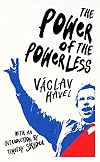
Vaclav Havel's essay, titled 'The Power of the Powerless,' is a powerful piece of writing on the unequal relationship between a dictatorial regime and its citizens, who are stripped of their strength.
I read the essay in one sitting, so I confess every lesson did not sink in. However, while reading the book on my Kindle, I visited Amazon's website and bought the print edition. This book offers invaluable lessons, so I got a paperback copy as a reference for my future writing.
Vaclav Havel's show more writing style is direct, assertive, spare, and accessible to everyone, unlike academic writing, which uses one hundred convoluted words where one will suffice.
He started the book by comparing traditional dictatorship, which relies on force, to modern totalitarianism, relying on force, persuasion, and 'thought control.' Even though he did not reference George Orwell's book, '1984,' you will discern shades of the dystopian novel's lessons in this excellent essay.
Timothy Snyder's excellent introduction is a helpful bonus and sets the stage for Vaclav Havel to take over and speak in his voice. I recommend reading the introduction (many people avoid reading the introduction) because Timothy highlights a few critical spots in the book. For instance, when Vaclav Havel writes about consumerism, the reader can relate his concerns to the rampant growth of destructive consumerism and its havoc in society. When he wrote about the insidious influence of media (the internet was not then the force it is now), you ought to relate it to how politicians, businesspeople, and anarchists use the net to spread their messages.
I am unfamiliar with Czech history, so I confess to being bemused when he used examples of Czech politics or when he wrote about Russian interference in his country. However, don't let this bog you down: relate the lessons in the essay to what is happening in your country.
If you are merely curious, buy the Kindle version, and if you wish to reference the book, buy the print edition. show less
I read the essay in one sitting, so I confess every lesson did not sink in. However, while reading the book on my Kindle, I visited Amazon's website and bought the print edition. This book offers invaluable lessons, so I got a paperback copy as a reference for my future writing.
Vaclav Havel's show more writing style is direct, assertive, spare, and accessible to everyone, unlike academic writing, which uses one hundred convoluted words where one will suffice.
He started the book by comparing traditional dictatorship, which relies on force, to modern totalitarianism, relying on force, persuasion, and 'thought control.' Even though he did not reference George Orwell's book, '1984,' you will discern shades of the dystopian novel's lessons in this excellent essay.
Timothy Snyder's excellent introduction is a helpful bonus and sets the stage for Vaclav Havel to take over and speak in his voice. I recommend reading the introduction (many people avoid reading the introduction) because Timothy highlights a few critical spots in the book. For instance, when Vaclav Havel writes about consumerism, the reader can relate his concerns to the rampant growth of destructive consumerism and its havoc in society. When he wrote about the insidious influence of media (the internet was not then the force it is now), you ought to relate it to how politicians, businesspeople, and anarchists use the net to spread their messages.
I am unfamiliar with Czech history, so I confess to being bemused when he used examples of Czech politics or when he wrote about Russian interference in his country. However, don't let this bog you down: relate the lessons in the essay to what is happening in your country.
If you are merely curious, buy the Kindle version, and if you wish to reference the book, buy the print edition. show less
As a person continuously humiliated by mental torment, when with my mind deprived of privacy (as in -voices), deprived of freedom (as in - obsessive compulsive thinking), I found the same values that Havel found in dissidents whose inner truth did not allow to compromise with living a lie. Of course one should not compare a mentally ill person to a dissident, but often dissidents in Soviet Russia were branded as 'mentally ill' and stuffed psychiatric drugs (Haloperidol et al) to destroy show more their intellectual capacities. Years later, when my situation got stable, I found that after a human being is stripped of everything - pride, dignity, valor, merit, he discovers what remains - pure ideas, whether it be freedom, love, nobility, responsibility, compassion, commitment. These and other ideas are the exit from the Platonic cave. They become a measuring rod of everything around, they make us reach for the humane and the Divine. This is the pre-political, the state of genuine humaneness which is difficult to define, but a person consious enough knows when it is lacking. Havel's work is a super-structure in which the main theme - the pre-political in the humane is equally valid and timelessly important in the modern post-democratic times. It is very important to bear in mind what is it that defines this humaneness, and where exactly we turn into political cyborgs, in a delayed notion of collapse of the human spirit into a wretched digital manipulation of the cognitive cybernetics of mass media and power structures and 'system of rule' of the modern age, that by the means of inverted totalitarianism introduces exactly the notions of post-totalitarian rule, yet in reverse - leading back to totalitarianism by slow, hidden steps, in bright-daylight and a reshuffled sense of concepts of a different economic order. show less
As a person continuously humiliated by mental torment, when with my mind deprived of privacy (as in -voices), deprived of freedom (as in - obsessive compulsive thinking), I found the same values that Havel found in dissidents whose inner truth did not allow to compromise with living a lie. Of course one should not compare a mentally ill person to a dissident, but often dissidents in Soviet Russia were branded as 'mentally ill' and stuffed psychiatric drugs (Haloperidol et al) to destroy show more their intellectual capacities. Years later, when my situation got stable, I found that after a human being is stripped of everything - pride, dignity, valor, merit, he discovers what remains - pure ideas, whether it be freedom, love, nobility, responsibility, compassion, commitment. These and other ideas are the exit from the Platonic cave. They become a measuring rod of everything around, they make us reach for the humane and the Divine. This is the pre-political, the state of genuine humaneness which is difficult to define, but a person consious enough knows when it is lacking. Havel's work is a super-structure in which the main theme - the pre-political in the humane is equally valid and timelessly important in the modern post-democratic times. It is very important to bear in mind what is it that defines this humaneness, and where exactly we turn into political cyborgs, in a delayed notion of collapse of the human spirit into a wretched digital manipulation of the cognitive cybernetics of mass media and power structures and 'system of rule' of the modern age, that by the means of inverted totalitarianism introduces exactly the notions of post-totalitarian rule, yet in reverse - leading back to totalitarianism by slow, hidden steps, in bright-daylight and a reshuffled sense of concepts of a different economic order. show less
As a person continuously humiliated by mental torment, when with my mind deprived of privacy (as in -voices), deprived of freedom (as in - obsessive compulsive thinking), I found the same values that Havel found in dissidents whose inner truth did not allow to compromise with living a lie. Of course one should not compare a mentally ill person to a dissident, but often dissidents in Soviet Russia were branded as 'mentally ill' and stuffed psychiatric drugs (Haloperidol et al) to destroy show more their intellectual capacities. Years later, when my situation got stable, I found that after a human being is stripped of everything - pride, dignity, valor, merit, he discovers what remains - pure ideas, whether it be freedom, love, nobility, responsibility, compassion, commitment. These and other ideas are the exit from the Platonic cave. They become a measuring rod of everything around, they make us reach for the humane and the Divine. This is the pre-political, the state of genuine humaneness which is difficult to define, but a person consious enough knows when it is lacking. Havel's work is a super-structure in which the main theme - the pre-political in the humane is equally valid and timelessly important in the modern post-democratic times. It is very important to bear in mind what is it that defines this humaneness, and where exactly we turn into political cyborgs, in a delayed notion of collapse of the human spirit into a wretched digital manipulation of the cognitive cybernetics of mass media and power structures and 'system of rule' of the modern age, that by the means of inverted totalitarianism introduces exactly the notions of post-totalitarian rule, yet in reverse - leading back to totalitarianism by slow, hidden steps, in bright-daylight and a reshuffled sense of concepts of a different economic order. show less
Lists
Awards


You May Also Like


Associated Authors
Statistics
- Works
- 129
- Also by
- 13
- Members
- 3,466
- Popularity
- #7,335
- Rating
- 4.0
- Reviews
- 36
- ISBNs
- 270
- Languages
- 22
- Favorited
- 14

