

Gerald Heard (1889–1971)
Author of A Taste for Honey
About the Author
Gerald Heard (1889-1971) was a well-known British polymath and science commentator for the BBC
Series
Works by Gerald Heard
Pain, Sex and Time: A New Outlook on Evolution and the Future of Man (Provenance Editions) (2004) 27 copies
Man, the Master 6 copies
Science in the Making 5 copies
Wishing Well: An Outline of the evolution of the mammals, told as a series of stories about how the animals got their wi (1953) 3 copies
The Emergence of Man 2 copies
Training for a Life of Growth 2 copies
The Great Fog [short story] 1 copy
The Swap 1 copy
Exploring the Stratosphere 1 copy
These Hurrying Years 1 copy
B+M----Planet 4 1 copy
Associated Works
The Game Is Afoot: Parodies, Pastiches, and Ponderings of Sherlock Holmes (1994) — Contributor — 216 copies, 2 reviews
Spores of Doom: Dank Tales of the Fungal Weird: 59 (British Library Tales of the Weird) (2025) — Contributor — 37 copies, 2 reviews
To the Queen's Taste: The First Supplement to 101 Years Entertainment Consisting of the Best Stories Published in the First Four Years of Ellery Queen's Mystery Magazine (1946) — Contributor — 28 copies
Bewitched Beings: Phantoms, Familiars, and the Possessed in Stories from Two Centuries (1974) — Contributor — 15 copies, 1 review
The Haunted and the Haunters: Tales of Ghosts and Other Apparitions (1975) — Contributor — 12 copies
Tagged
Common Knowledge
- Legal name
- Heard, Henry Fitzgerald
- Other names
- Heard, Gerald
- Birthdate
- 1889-10-06
- Date of death
- 1971-08-14
- Gender
- male
- Education
- University of Cambridge
- Occupations
- historian
philosopher
science writer
teacher - Relationships
- Smith, Huston (student)
- Nationality
- UK
- Birthplace
- London, England, UK
- Places of residence
- London, England, UK
Santa Monica, California, USA - Place of death
- Santa Monica, California, USA
- Associated Place (for map)
- London, England, UK
Members
Reviews

Sydney Silchester has a taste for honey and a taste for solitude. He’s able to avoid mixing with the nearby village and deal directly with a local beekeeping couple to keep himself in honey. But one day, the wife of the couple is dead—stung to death by her own bees—and the hives are ordered destroyed. Fortunately for Sydney, he discovers a new supplier, a recluse like himself who goes by “Mr. Mycroft”. Mr. Mycroft thinks the beekeeper’s death suspicious and ropes Sydney into a show more Watson-like role as he solves the case.
This is quite obviously a Sherlock Holmes continuation, and I thought it pretty good overall. It was quite scary, actually, imagining killer bees! I like bees, but wasps and hornets are jerks, and killer bees resemble the latter more than the former. There was no real mystery in terms of identifying a murder; it was more like a thriller as the reader wonders whether Mr. Mycroft and Sydney will be able to defeat the criminal. Mr. Mycroft proves as brilliant as you might expect from someone who is essentially Sherlock Holmes. Sydney is more like Stupid Watson than Book Watson; he’s a lot whinier and prissier than Watson with regard to Mr. Mycroft’s plans and traps. So while I enjoyed reading about the mystery, I wanted to slap the narrator.
I would not object to reading another if I happened to come across it, but I am not going to go out of my way looking for it. show less
This is quite obviously a Sherlock Holmes continuation, and I thought it pretty good overall. It was quite scary, actually, imagining killer bees! I like bees, but wasps and hornets are jerks, and killer bees resemble the latter more than the former. There was no real mystery in terms of identifying a murder; it was more like a thriller as the reader wonders whether Mr. Mycroft and Sydney will be able to defeat the criminal. Mr. Mycroft proves as brilliant as you might expect from someone who is essentially Sherlock Holmes. Sydney is more like Stupid Watson than Book Watson; he’s a lot whinier and prissier than Watson with regard to Mr. Mycroft’s plans and traps. So while I enjoyed reading about the mystery, I wanted to slap the narrator.
I would not object to reading another if I happened to come across it, but I am not going to go out of my way looking for it. show less
A recluse who really enjoys his honey gets drawn into a murder plot involving killer bees, and also involving his neighbor, an elderly gentleman called "Mr. Mycroft," who keeps bees and who sure talks a lot about crime and deduction.
I'm not entirely sure how well this works as a (coy but obvious) Sherlock Holmes story. "Mr. Mycroft"'s powers of deduction may be very much Mr. Holmes', but a lot of his dialog failed to ring entirely true to me, somehow. And, honestly, the killer bee plot is show more just kind of silly. But I almost didn't care about that, just because the misanthropic narrator entertained me so much. I'm not even entirely sure why. He's not a good person, but he amused me immensely. Maybe it's just that you don't see many protagonists in fiction whose main motivation is that they just want to not have to talk to people, and as an anti-social introvert myself, I can't help but relate.
Rating: I'm giving this one a 3.5/5. The ridiculousness of the plot and its failure to 100% work for me as a Holmes story make it hard to justify rating it higher, but I am still seriously tempted. show less
I'm not entirely sure how well this works as a (coy but obvious) Sherlock Holmes story. "Mr. Mycroft"'s powers of deduction may be very much Mr. Holmes', but a lot of his dialog failed to ring entirely true to me, somehow. And, honestly, the killer bee plot is show more just kind of silly. But I almost didn't care about that, just because the misanthropic narrator entertained me so much. I'm not even entirely sure why. He's not a good person, but he amused me immensely. Maybe it's just that you don't see many protagonists in fiction whose main motivation is that they just want to not have to talk to people, and as an anti-social introvert myself, I can't help but relate.
Rating: I'm giving this one a 3.5/5. The ridiculousness of the plot and its failure to 100% work for me as a Holmes story make it hard to justify rating it higher, but I am still seriously tempted. show less
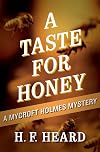
Mr. Silchester really loves honey--but not the kind you can get at a market. Only honey straight from the beekeeper will do. And finding it is even enough to persuade Mr. Silchester to have contact with other human beings, something he rarely sees the need for, feeling himself to be perfectly self-sufficient. (Of course, he has a housekeeper who comes in and cooks for him!) He collects his jars of honey and combs from a strange couple, and at one point he hears the husband berating the wife. show more Soon afterwards, the wife is stung to death by bees! While sympathetic, Mr. Silchester's main concern is where to find more honey, since the deadly bees are to be destroyed and he thinks it unlikely the beekeeper will continue with new bees.
A somewhat farfetched occurrence puts the reclusive Mr. Silchester in touch with Mr. Mycroft, who also keeps bees, although on their first meeting he appears more interested in talking Mr. Silchester's ear off than concluding the sale of his honey. Mr. Mycroft believes that the wife being stung to death was no accident, but actually a clever "murder by bees" by her evil husband, who no doubt has new victims in his sights. And when it turns out the beekeeper is still keeping bees, Mr. Silchester begins to take Mr. Mycroft more seriously. Not seriously enough, however. He avoids fulfilling Mr. Mycroft's request to introduce him to the beekeeper. But then....
That's enough for plot. It proceeds from there, and it is a highly unusual piece of crime fiction with a possibly unique murder weapon--not to mention the "solution" to dealing with the criminal. And who is the mysterious Mr. Mycroft? For some unfathomable reason, Mysterious Press splashes "A Mycroft Holmes Mystery" across the cover. If they had bothered to read their own lengthy introduction and (less lengthy) afterword, they might not have. (Even with these additions, the ebook is still only 186 pages long.)
Regardless of the identify of Mr. Mycroft or the unusual murder method, the book suffers on several counts. The plot lacks complications or much suspense. Instead we are treated to Mr. Mycroft's endless, but only sometimes engrossing, speechifying, including side tracks and psychological analyses of the murderer. Just like the reader, Mr. Silchester's own attention wanders, only to be drawn back when Mr. Mycroft says something REALLY interesting. Mr. Silchester's role is also to ask those necessary questions (a la Dr. Watson) that allow Mycroft to explain his methods of detection, which often escaped notice, so that Silchester (and us readers) can appreciate their brilliance. Mycroft's methods are clever and definitely reminiscent of Sherlock Holmes, but even in a short book, they are not interesting enough to raise the narrative above that of the average mystery novel. Other Mr. Mycroft books follow--but I am not inclined to do so myself. show less
A somewhat farfetched occurrence puts the reclusive Mr. Silchester in touch with Mr. Mycroft, who also keeps bees, although on their first meeting he appears more interested in talking Mr. Silchester's ear off than concluding the sale of his honey. Mr. Mycroft believes that the wife being stung to death was no accident, but actually a clever "murder by bees" by her evil husband, who no doubt has new victims in his sights. And when it turns out the beekeeper is still keeping bees, Mr. Silchester begins to take Mr. Mycroft more seriously. Not seriously enough, however. He avoids fulfilling Mr. Mycroft's request to introduce him to the beekeeper. But then....
That's enough for plot. It proceeds from there, and it is a highly unusual piece of crime fiction with a possibly unique murder weapon--not to mention the "solution" to dealing with the criminal. And who is the mysterious Mr. Mycroft? For some unfathomable reason, Mysterious Press splashes "A Mycroft Holmes Mystery" across the cover. If they had bothered to read their own lengthy introduction and (less lengthy) afterword, they might not have. (Even with these additions, the ebook is still only 186 pages long.)
Regardless of the identify of Mr. Mycroft or the unusual murder method, the book suffers on several counts. The plot lacks complications or much suspense. Instead we are treated to Mr. Mycroft's endless, but only sometimes engrossing, speechifying, including side tracks and psychological analyses of the murderer. Just like the reader, Mr. Silchester's own attention wanders, only to be drawn back when Mr. Mycroft says something REALLY interesting. Mr. Silchester's role is also to ask those necessary questions (a la Dr. Watson) that allow Mycroft to explain his methods of detection, which often escaped notice, so that Silchester (and us readers) can appreciate their brilliance. Mycroft's methods are clever and definitely reminiscent of Sherlock Holmes, but even in a short book, they are not interesting enough to raise the narrative above that of the average mystery novel. Other Mr. Mycroft books follow--but I am not inclined to do so myself. show less
Heard was an English born American Historian, science writer and broadcaster, public lecturer, educator and philosopher. Published in 1951 Heard documents some of the sightings of flying saucers over parts of America between 1947 to 1950. He then speculates on the science of their manufacture and movement, where they come from, what they are doing and what we can expect in the future. He says that he keeps an open mind as to their existence, but emphasise the validity of some of the witness show more reports and the suspicions that the American government are hiding facts from the public.
It is a book that wants to create fiction out of the facts of the sightings of these discs in the sky. I think that he aims to create a sense of wonder, but the writing is stolid and humourless. Casting around for ideas as to where the flying discs come from, he speculates that they could be bees that live on Mars. Using his scientific knowledge he spends some pages informing us about the intelligence of bees on earth and how they can locate food sources with an apparent language of their own. His reasoning leads him to think that the high speed of the flying discs could only be piloted by small creatures that would have a natural resistance to velocity. Perhaps Gerald Heard did have a sense of humour after all.
A book that perhaps tried to jump on the bandwagon of those flying saucer sightings of yesteryear, with its mixture of science and speculation, but it failed to interest me today - 2 stars. show less
It is a book that wants to create fiction out of the facts of the sightings of these discs in the sky. I think that he aims to create a sense of wonder, but the writing is stolid and humourless. Casting around for ideas as to where the flying discs come from, he speculates that they could be bees that live on Mars. Using his scientific knowledge he spends some pages informing us about the intelligence of bees on earth and how they can locate food sources with an apparent language of their own. His reasoning leads him to think that the high speed of the flying discs could only be piloted by small creatures that would have a natural resistance to velocity. Perhaps Gerald Heard did have a sense of humour after all.
A book that perhaps tried to jump on the bandwagon of those flying saucer sightings of yesteryear, with its mixture of science and speculation, but it failed to interest me today - 2 stars. show less
Lists
Awards

You May Also Like


Associated Authors
Statistics
- Works
- 48
- Also by
- 20
- Members
- 802
- Popularity
- #31,797
- Rating
- 3.7
- Reviews
- 17
- ISBNs
- 52
- Languages
- 1