
Kristina Cook
Author of Haven
About the Author
Image credit: author page - Simon& Schuster
Series
Works by Kristina Cook
Associated Works
Tagged
Common Knowledge
Members
Reviews
“Unlaced” was another in a string of failures to find something I once took for granted: a fun, satisfying, well-crafted book. I truly thought at several points that it would be a DNF, but I had made predictions about what would happen, and I was determined to see if I was right. There was skimming involved.
It is the tale of Lucy, 21, who wants only to continue to explore her natural gifts with animals. She has an affinity for all creatures great and small, and a knack for healing them, show more and in 1817 she does not have the option of going to train to be a legitimate veterinarian. However, she is sent to London, to have her debut, and she realizes that while she is there she can prevail upon another family friend to get her some kind of in with the veterinary college. She certainly doesn’t want to get married – she insists on that, frequently; she will go through with her Season to please her father, and then go right back to what she wants to do.
Enter Henry, Lord Mandeville, a marquess with Issues. His mother was cruel to him, and unfaithful to his father, and he has vowed that he will not follow his father’s example of blind adoring faith in an unworthy woman. He has no interest in marrying for love; he will marry a woman who will bring something useful to the match. (Character in the book: "He’s mysterious and moody, especially after that scandal three years past." My comment: Well, then, he's obviously The One.) (And, of course, that mysterious scandal is all very enticing.)
So far, so … good, I suppose, despite the fact that anachronistic feminism is hard to pull off. Would a girl of the period really develop the mindset Lucy has, however unconventional her upbringing or however great her gifts with animals? I didn’t quite believe in an early 19th century girl who planned to be a veterinarian, wore breeches, rode astride, and so on: desiring only "the freedom to learn, and maybe, just maybe, the opportunity to build her own informal veterinary practice." And I found it harder to believe in a local populace who would trust their animals, from lapdogs to carthorses, to a minimally educated “informal” dilettante. A farmer could never afford to let an untrained vet tend the animals that were his livelihood; God knows I wouldn’t let an untrained vet touch any pet of mine. There are a great many professions at which one can do quite well for oneself without formal training; any form of medicine, be it human or animal, is not something that can be tried out with enthusiasm and a smattering of learning. One does not know instinctively how to, oh, for example, deliver a foal in a breech position.
And this made me question a lot of other things which might otherwise have skated by. Lucy coming out at the late age of 21, and her attitude toward same. The main characters, Lucy and Henry, begin calling each other Lucy and Henry within about an hour of meeting – in 1817. Lucy scampers about the countryside completely unchaperoned, which for a lady I thought was completely unacceptable, and for a young lady in the midst of her Season beyond completely unacceptable. There’s plenty more, but this will be quite long enough.
Another failure, in my opinion, was in the author’s knowledge of horses. There was not a tremendous amount of horse-related stuff, but everything there was seemed a little off. Henry and Lucy, both stated to be excellent riders, were constantly digging their heels into their horses’ sides. Who knows, maybe riding was utterly different a hundred years ago, and it’s been a while since I’ve been on a horse, but when I was taking lessons, if I’d kicked a horse like that I think my lessons would have come to an end. At one point Lucy is asked about the foal she helped bring into the world. “The filly? Oh yes, the foal.” Yes. The foal. Which is female. And therefore a filly. This is not something I can imagine anyone who knows horses saying. Ever. The author also flips between “it” and “he” when referring to a horse, at least once in consecutive sentences. Lucy’s other main equestrian patient came when she was summoned urgently to a horse with colic, because no one else knew what to do for it. Not the grooms; not the horsemen; not the horse owners; not another single soul had a clue in the world what to do for colic. Colic is not a rare and exotic ailment. This is absurd. "Digging a heel into Thunder’s side, she led her horse..." A) Again with the digging. And B) she has 2 horses? Because riding and leading are different things." Finally (for the purposes of this review), Lucy's brother let her mare get fat while she was away. Why? "You can’t expect me to go around on a mount called Princess now, can you?” Why not? Does she commonly wear a fluffy nametag with "Princess" picked out in hearts and flowers? Are people going to point and laugh and say "Hee hee, there goes whatsit on a girly horse"? So you let a horse go without decent exercise for months? Who was there to even see besides servants?? These people irk me.
I saw something recently, and I wish I had made a note of exactly what it was and where, about how, really, the advice to writers of “show, don’t tell” is bogus because when you write you’re always telling. I wish I had noted the name of the person writing that, so that I can avoid their work. Or so I could shoot them a message recommending this book as an example of “tell, don’t show”. Because:
Lucy is held up as an example of a sensible, logical girl. However, when someone wakes her up and calls her out to deliver that foal (filly), she puts on a dress of butter yellow. Anyone who’s read the James Herriot books knows that large animal delivery is a messy business - pale yellow is an idiotic thing to wear. Also, she keeps putting herself into situations where untoward things happen, and then wonders how and why. The whole idea of cause and effect seems beyond her. (At hearing the news that a horse is sick and she is needed, she hurries off to prepare, “beaming delightedly”. It’s a bit off-putting that because a horse is ill and she can have a chance to show off, she is delighted.) Again, there are plenty of other examples.
And because:
Henry is held up as an example of a terrifically good man. However, the second time he meets Lucy, within an hour or two he is groping her and kissing her “senseless”. And then blaming her: “And do those odd activities of yours generally include allowing men you barely know to kiss you senseless?” And he proceeds to behave much the same way any time he is even close to being alone with her. (His hands "moved down her sides, brushing softly against the curve of her breasts"… my simultaneous reactions were that she needed to slap him, a lot, and that her anatomy must be rather odd if he moved his hands down her sides to her breasts.) It is utterly hilarious when he is described as "normally a man of acute restraint". He seems to feel she is less than a lady (small “L”) because she is the daughter of a physician and there are no titles in her immediate family – and because she pursues these “odd activities” – therefore he can treat her however he wants. This is wrong on so many levels that if I go into all of them this review will approach NaNoWriMo proportions. Why do romance writers do this? At less than a 1/4 of the way in, the Hero had pawed Lucy, insulted her, apologized to her, defended her, insulted her again, and by that point could be found drunkenly pawing her again - in a locked room. A room he locked them into. I was ready to call 911, and she? Melted into him. Which goes back to how sensible she is. But, we are told, Henry made some liberal speeches, and saved a wounded puppy. Oh, well, if there’s a puppy – well, then.
"I mustn’t forget your reputation”, he says, after having forgotten her reputation at least half a dozen times.
Of course, he’s a remarkable artist. Proof being that he draws Lucy. Half-naked. Then wanders about London with the drawing. She sees it. She doesn’t mind. In fact, she says: "These should be displayed somewhere.” “‘...That one I’ve begun in oil on canvas.’ He’d sketched her from the back, her chin tipped over one shoulder. She wore nothing but a corset, partially unlaced.” I find it remarkable that he is unconcerned about who might see it in progress or when completed (i.e., anyone who knows or might meet Lucy, ever). And what does he plan to do with the completed piece? Does he have a sleazy man-cave?
As anyone who has read my reviews of historical fiction before might know, my number one pet peeve is the improper, anachronistic use of the work “okay”. I have closed books permanently upon coming across a medieval or Victorian “okay”. I have flung books. This book was on my Kindle, so I couldn’t fling it when I came to “Everything okay, miss?” It’s a stupid, careless, easily avoided mistake, and I have no patience for it. But I kept reading. Even when there was a second “okay” about a third of the way through. It began to almost literally hurt after a while. Because there were so many other language errors. I never understand why anyone with a tin ear for language chooses to set a book in a time for which she has no feeling. To refer to “blocks” as a unit of measurement in 1817 in reference to country estates? To talk about something being therapeutic? (It took me less than two minutes to find that that word wasn’t used before 1846.) "It’s grown infected"… I have to give her this one; I was sure that “infected” was anachronistic, but the word was in use in the 14th century. However, that possibly correct usage was more than outweighed by “You, my lord, are pressing your luck.” Here’s another quote: “to push (one's) luck is from 1911”
Besides the anachronisms, there were the other oddities of language, the (say it with me) “I don’t think it means what you think it means” syndrome. Lucy’s legs “shaking madly”? Lemonade referred to as a “pungent liquid”? ("Affecting the organs of taste or smell with a sharp acrid sensation.") The foal mentioned above “ceased it strident suckling”. There’s a missing “s” there; use of “it” is obnoxious after the emphasis on the foal’s gender a minute before; and … strident? … How? … “characterized by harsh, insistent, and discordant sound” – suckling?
Similarly: Colin, re Lucy: “‘You’ve taken a spirited mare and broken her beyond recognition.’ Right. I love horses. You compare me to a mare, in any way or shape or form, and there will be hell to pay.
"He felt a sharp pain shoot through his gut. Regret? No, it must be hunger. He hadn’t eaten all day." How unintentionally hilarious. It was a free book: this is good. It was a bad book: this isn’t good. show less
It is the tale of Lucy, 21, who wants only to continue to explore her natural gifts with animals. She has an affinity for all creatures great and small, and a knack for healing them, show more and in 1817 she does not have the option of going to train to be a legitimate veterinarian. However, she is sent to London, to have her debut, and she realizes that while she is there she can prevail upon another family friend to get her some kind of in with the veterinary college. She certainly doesn’t want to get married – she insists on that, frequently; she will go through with her Season to please her father, and then go right back to what she wants to do.
Enter Henry, Lord Mandeville, a marquess with Issues. His mother was cruel to him, and unfaithful to his father, and he has vowed that he will not follow his father’s example of blind adoring faith in an unworthy woman. He has no interest in marrying for love; he will marry a woman who will bring something useful to the match. (Character in the book: "He’s mysterious and moody, especially after that scandal three years past." My comment: Well, then, he's obviously The One.) (And, of course, that mysterious scandal is all very enticing.)
So far, so … good, I suppose, despite the fact that anachronistic feminism is hard to pull off. Would a girl of the period really develop the mindset Lucy has, however unconventional her upbringing or however great her gifts with animals? I didn’t quite believe in an early 19th century girl who planned to be a veterinarian, wore breeches, rode astride, and so on: desiring only "the freedom to learn, and maybe, just maybe, the opportunity to build her own informal veterinary practice." And I found it harder to believe in a local populace who would trust their animals, from lapdogs to carthorses, to a minimally educated “informal” dilettante. A farmer could never afford to let an untrained vet tend the animals that were his livelihood; God knows I wouldn’t let an untrained vet touch any pet of mine. There are a great many professions at which one can do quite well for oneself without formal training; any form of medicine, be it human or animal, is not something that can be tried out with enthusiasm and a smattering of learning. One does not know instinctively how to, oh, for example, deliver a foal in a breech position.
And this made me question a lot of other things which might otherwise have skated by. Lucy coming out at the late age of 21, and her attitude toward same. The main characters, Lucy and Henry, begin calling each other Lucy and Henry within about an hour of meeting – in 1817. Lucy scampers about the countryside completely unchaperoned, which for a lady I thought was completely unacceptable, and for a young lady in the midst of her Season beyond completely unacceptable. There’s plenty more, but this will be quite long enough.
Another failure, in my opinion, was in the author’s knowledge of horses. There was not a tremendous amount of horse-related stuff, but everything there was seemed a little off. Henry and Lucy, both stated to be excellent riders, were constantly digging their heels into their horses’ sides. Who knows, maybe riding was utterly different a hundred years ago, and it’s been a while since I’ve been on a horse, but when I was taking lessons, if I’d kicked a horse like that I think my lessons would have come to an end. At one point Lucy is asked about the foal she helped bring into the world. “The filly? Oh yes, the foal.” Yes. The foal. Which is female. And therefore a filly. This is not something I can imagine anyone who knows horses saying. Ever. The author also flips between “it” and “he” when referring to a horse, at least once in consecutive sentences. Lucy’s other main equestrian patient came when she was summoned urgently to a horse with colic, because no one else knew what to do for it. Not the grooms; not the horsemen; not the horse owners; not another single soul had a clue in the world what to do for colic. Colic is not a rare and exotic ailment. This is absurd. "Digging a heel into Thunder’s side, she led her horse..." A) Again with the digging. And B) she has 2 horses? Because riding and leading are different things." Finally (for the purposes of this review), Lucy's brother let her mare get fat while she was away. Why? "You can’t expect me to go around on a mount called Princess now, can you?” Why not? Does she commonly wear a fluffy nametag with "Princess" picked out in hearts and flowers? Are people going to point and laugh and say "Hee hee, there goes whatsit on a girly horse"? So you let a horse go without decent exercise for months? Who was there to even see besides servants?? These people irk me.
I saw something recently, and I wish I had made a note of exactly what it was and where, about how, really, the advice to writers of “show, don’t tell” is bogus because when you write you’re always telling. I wish I had noted the name of the person writing that, so that I can avoid their work. Or so I could shoot them a message recommending this book as an example of “tell, don’t show”. Because:
Lucy is held up as an example of a sensible, logical girl. However, when someone wakes her up and calls her out to deliver that foal (filly), she puts on a dress of butter yellow. Anyone who’s read the James Herriot books knows that large animal delivery is a messy business - pale yellow is an idiotic thing to wear. Also, she keeps putting herself into situations where untoward things happen, and then wonders how and why. The whole idea of cause and effect seems beyond her. (At hearing the news that a horse is sick and she is needed, she hurries off to prepare, “beaming delightedly”. It’s a bit off-putting that because a horse is ill and she can have a chance to show off, she is delighted.) Again, there are plenty of other examples.
And because:
Henry is held up as an example of a terrifically good man. However, the second time he meets Lucy, within an hour or two he is groping her and kissing her “senseless”. And then blaming her: “And do those odd activities of yours generally include allowing men you barely know to kiss you senseless?” And he proceeds to behave much the same way any time he is even close to being alone with her. (His hands "moved down her sides, brushing softly against the curve of her breasts"… my simultaneous reactions were that she needed to slap him, a lot, and that her anatomy must be rather odd if he moved his hands down her sides to her breasts.) It is utterly hilarious when he is described as "normally a man of acute restraint". He seems to feel she is less than a lady (small “L”) because she is the daughter of a physician and there are no titles in her immediate family – and because she pursues these “odd activities” – therefore he can treat her however he wants. This is wrong on so many levels that if I go into all of them this review will approach NaNoWriMo proportions. Why do romance writers do this? At less than a 1/4 of the way in, the Hero had pawed Lucy, insulted her, apologized to her, defended her, insulted her again, and by that point could be found drunkenly pawing her again - in a locked room. A room he locked them into. I was ready to call 911, and she? Melted into him. Which goes back to how sensible she is. But, we are told, Henry made some liberal speeches, and saved a wounded puppy. Oh, well, if there’s a puppy – well, then.
"I mustn’t forget your reputation”, he says, after having forgotten her reputation at least half a dozen times.
Of course, he’s a remarkable artist. Proof being that he draws Lucy. Half-naked. Then wanders about London with the drawing. She sees it. She doesn’t mind. In fact, she says: "These should be displayed somewhere.” “‘...That one I’ve begun in oil on canvas.’ He’d sketched her from the back, her chin tipped over one shoulder. She wore nothing but a corset, partially unlaced.” I find it remarkable that he is unconcerned about who might see it in progress or when completed (i.e., anyone who knows or might meet Lucy, ever). And what does he plan to do with the completed piece? Does he have a sleazy man-cave?
As anyone who has read my reviews of historical fiction before might know, my number one pet peeve is the improper, anachronistic use of the work “okay”. I have closed books permanently upon coming across a medieval or Victorian “okay”. I have flung books. This book was on my Kindle, so I couldn’t fling it when I came to “Everything okay, miss?” It’s a stupid, careless, easily avoided mistake, and I have no patience for it. But I kept reading. Even when there was a second “okay” about a third of the way through. It began to almost literally hurt after a while. Because there were so many other language errors. I never understand why anyone with a tin ear for language chooses to set a book in a time for which she has no feeling. To refer to “blocks” as a unit of measurement in 1817 in reference to country estates? To talk about something being therapeutic? (It took me less than two minutes to find that that word wasn’t used before 1846.) "It’s grown infected"… I have to give her this one; I was sure that “infected” was anachronistic, but the word was in use in the 14th century. However, that possibly correct usage was more than outweighed by “You, my lord, are pressing your luck.” Here’s another quote: “to push (one's) luck is from 1911”
Besides the anachronisms, there were the other oddities of language, the (say it with me) “I don’t think it means what you think it means” syndrome. Lucy’s legs “shaking madly”? Lemonade referred to as a “pungent liquid”? ("Affecting the organs of taste or smell with a sharp acrid sensation.") The foal mentioned above “ceased it strident suckling”. There’s a missing “s” there; use of “it” is obnoxious after the emphasis on the foal’s gender a minute before; and … strident? … How? … “characterized by harsh, insistent, and discordant sound” – suckling?
Similarly: Colin, re Lucy: “‘You’ve taken a spirited mare and broken her beyond recognition.’ Right. I love horses. You compare me to a mare, in any way or shape or form, and there will be hell to pay.
"He felt a sharp pain shoot through his gut. Regret? No, it must be hunger. He hadn’t eaten all day." How unintentionally hilarious. It was a free book: this is good. It was a bad book: this isn’t good. show less
You know why I loved Pride & Prejudice? Because Darcy & Elizabeth hated each other at first. (Well, Elizabeth hated him… Darcy is debatable).
My all-time favorite trope is seeing two characters that dislike each other so much, slowly fall in love.
This book is a reverse Romeo and Juliet. Two families that love each other and basically do everything together, and two children who would rather be with anyone else in the world than each other. Ryder & Jemma are two kids who live in the south show more whose families have conspired all their lives to bring them together. Now there’s a storm heading towards Magnolia, and being in confined, dark spaces may surface some feelings that they don’t really want out.
Okay let’s begin by what I loved:
Firstly, the setting. This book is set in Magnolia Branch, Mississippi. This means southern accents, and farms, and big dogs, and shotguns, and churches. I loved the southern feel of this story. It was so refreshing from typical, bland, ambiguous settings in most books out there.
Jemma & Ryder definitely held their own as protagonists. Jemma is this all around awesome girl. She’s not this delicate southern flower, but a really kickass girl who can shoot guns as well as photographs. She’s smart, a cheerleader, and a self-proclaimed good girl. However she wants to break free of the expectations of her family. So she has little rebellions here and there. Basically she just wants to be able to choose her own life.
It’s not that I don’t want to live out my days here. It’s just that I want the opportunity to...I don’t know...spread my wings and fly a bit before I come back home to roost, you know? If I end up back in Magnolia Branch, I want it to be because I’ve chosen to be here.
Ryder is a southern gentleman. He’s sweet, caring, and charming. I never thought he was being a “stupid boy”. He is definitely the guy you’d love to take home to your parents. Ryder is a dream. I have a huge crush on him.
This book isn’t only about the romance, but it features strong female friendships (and absolutely NO slut shaming! YAY), while also building a believable high school atmosphere (cheerleading, football games, and *gasp* even real classes), and it deals with grief and loss as well.
I think the biggest part of this book, other than the romance, was the storm. The storm was actually a very big part of this book and I loved seeing its effects. I loved that Ryder & Jemma had to ride it out alone because of some very… unfortunate circumstances. Imagine being locked up in a very small confined storm shelter with an incredibly attractive guy who you might love/hate.
They finally had all the time in the world to talk and man, that was some pretty good talking. ;)
“I hear his breath catch. Slowly, his hand moves over mine, his fingertips brushing my knuckles until his entire hand covers mine.”
I could keep gushing about how this book was all kinds of awesome. My only issue with this book is the fact that I wanted MORE. (and that Jemma was a bit naïve at first but I forgave her because she was awesome). But, if you’re still reading my review and not rushing to buy the book, then we have a problem. show less
My all-time favorite trope is seeing two characters that dislike each other so much, slowly fall in love.
This book is a reverse Romeo and Juliet. Two families that love each other and basically do everything together, and two children who would rather be with anyone else in the world than each other. Ryder & Jemma are two kids who live in the south show more whose families have conspired all their lives to bring them together. Now there’s a storm heading towards Magnolia, and being in confined, dark spaces may surface some feelings that they don’t really want out.
Okay let’s begin by what I loved:
Firstly, the setting. This book is set in Magnolia Branch, Mississippi. This means southern accents, and farms, and big dogs, and shotguns, and churches. I loved the southern feel of this story. It was so refreshing from typical, bland, ambiguous settings in most books out there.
Jemma & Ryder definitely held their own as protagonists. Jemma is this all around awesome girl. She’s not this delicate southern flower, but a really kickass girl who can shoot guns as well as photographs. She’s smart, a cheerleader, and a self-proclaimed good girl. However she wants to break free of the expectations of her family. So she has little rebellions here and there. Basically she just wants to be able to choose her own life.
It’s not that I don’t want to live out my days here. It’s just that I want the opportunity to...I don’t know...spread my wings and fly a bit before I come back home to roost, you know? If I end up back in Magnolia Branch, I want it to be because I’ve chosen to be here.
Ryder is a southern gentleman. He’s sweet, caring, and charming. I never thought he was being a “stupid boy”. He is definitely the guy you’d love to take home to your parents. Ryder is a dream. I have a huge crush on him.
This book isn’t only about the romance, but it features strong female friendships (and absolutely NO slut shaming! YAY), while also building a believable high school atmosphere (cheerleading, football games, and *gasp* even real classes), and it deals with grief and loss as well.
I think the biggest part of this book, other than the romance, was the storm. The storm was actually a very big part of this book and I loved seeing its effects. I loved that Ryder & Jemma had to ride it out alone because of some very… unfortunate circumstances. Imagine being locked up in a very small confined storm shelter with an incredibly attractive guy who you might love/hate.
They finally had all the time in the world to talk and man, that was some pretty good talking. ;)
“I hear his breath catch. Slowly, his hand moves over mine, his fingertips brushing my knuckles until his entire hand covers mine.”
I could keep gushing about how this book was all kinds of awesome. My only issue with this book is the fact that I wanted MORE. (and that Jemma was a bit naïve at first but I forgave her because she was awesome). But, if you’re still reading my review and not rushing to buy the book, then we have a problem. show less
Haven by Kristi Cook
Warning: Spoilers follow
Apparently my capacity for books with vampires in them is infinite! I was willing to bet that I wouldn't enjoy Haven, because I thought I'd had my fill of vampire-mortal Twilight knock offs, but I was wrong.
Here's why I liked it: I liked the "gifts" possessed by her friends, and liked the idea of an X-men like kind of school where those who are different can be accepted. It's a universal theme, and what's not to like. I liked that even within this haven, there was show more still a scorned group, the shifters, and that Violet did something about that when the opportunity arose.
I liked the reaction of her friends when Violet first starts seeing Aidan; their curiosity and their teasing because it seemed completely natural. Gifted or not, budding love inspires the same reactions. I also liked that later on in the book, there was an explanation for why they Violet was so instantly attracted to Aiden. Some reviewers have criticized the speed with which they fall for each other, but it is explained once you know more details of a Sabbat, and I liked that too.
I liked the source of the conflict; that someone, Julius, would be threatened by someone and act on it, without even checking out the details to find out if a cure really would be a threat to him. The science geek in me even liked the idea of vampirism being a parasitic disease.
So, even though there were multiple similarities to many other vampire romance in a school novels I've read, Evernight comes to mind first, I still enjoyed reading this one, and am willing to be that the YA readers at my school do as well. I'm betting that once it is borrowed, I won't see if back on the shelf until the end of the year.
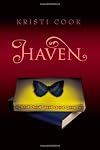
The thing I didn't like at all was the cover. Usually, I can look at the cover after I've read a book and discern why certain features have been chosen, but in this case, I'm completely baffled. There is NO significance or reference in Haven to a butterfly resting on a closed book. On the back of the cover, there is, what looks like, a huge moth, which again has NOTHING to do with the book. I'm seriously annoyed by the choices on the cover. I don't give "book jacket" assignments to my students, but if I did, and one of them handed in the Haven cover, it would be an epic failure. show less
Apparently my capacity for books with vampires in them is infinite! I was willing to bet that I wouldn't enjoy Haven, because I thought I'd had my fill of vampire-mortal Twilight knock offs, but I was wrong.
Here's why I liked it: I liked the "gifts" possessed by her friends, and liked the idea of an X-men like kind of school where those who are different can be accepted. It's a universal theme, and what's not to like. I liked that even within this haven, there was show more still a scorned group, the shifters, and that Violet did something about that when the opportunity arose.
I liked the reaction of her friends when Violet first starts seeing Aidan; their curiosity and their teasing because it seemed completely natural. Gifted or not, budding love inspires the same reactions. I also liked that later on in the book, there was an explanation for why they Violet was so instantly attracted to Aiden. Some reviewers have criticized the speed with which they fall for each other, but it is explained once you know more details of a Sabbat, and I liked that too.
I liked the source of the conflict; that someone, Julius, would be threatened by someone and act on it, without even checking out the details to find out if a cure really would be a threat to him. The science geek in me even liked the idea of vampirism being a parasitic disease.
So, even though there were multiple similarities to many other vampire romance in a school novels I've read, Evernight comes to mind first, I still enjoyed reading this one, and am willing to be that the YA readers at my school do as well. I'm betting that once it is borrowed, I won't see if back on the shelf until the end of the year.
The thing I didn't like at all was the cover. Usually, I can look at the cover after I've read a book and discern why certain features have been chosen, but in this case, I'm completely baffled. There is NO significance or reference in Haven to a butterfly resting on a closed book. On the back of the cover, there is, what looks like, a huge moth, which again has NOTHING to do with the book. I'm seriously annoyed by the choices on the cover. I don't give "book jacket" assignments to my students, but if I did, and one of them handed in the Haven cover, it would be an epic failure. show less
Haven by Kristi Cook
Cook is a new YA author for 2011 and I'd say that she's debuted on quite a good note. This story really had it all--a solid plot, a cast of likable characters, a swoon-worthy love-interest, and a little life-death action on the side. While I'll be the first to admit that Cook's story wasn't overly original, I thought she did a good job making it her own and adding enough twists to make it interesting. It was definitely a well-written storyline that pulled me in. It was a read that I simply show more couldn't put down once I started. (Ask my husband. I think he was a tad annoyed.)
The main character has the "cluelessness" trait that I have found to be quite prevalent in this genre right now. There are so many clues that lead you to the obvious (and even not so obvious) conclusions that she just didn't get. Cook pens her as another very intelligent young woman with little common sense. If you've read other YA paranormal romance, you know what I'm talking about. I think authors need to give their female teenage characters a tad more credit...but maybe that's just me.
At the opening of the novel, I was a tad worried that the book was going to be too much like other books that I've read in the genre lately. However, I will stand by this book and say that in the end it was a good book in its own right. The comparisons may be legit, but I felt that Haven was able to stand its ground as a well-written story with well-developed characters. show less
The main character has the "cluelessness" trait that I have found to be quite prevalent in this genre right now. There are so many clues that lead you to the obvious (and even not so obvious) conclusions that she just didn't get. Cook pens her as another very intelligent young woman with little common sense. If you've read other YA paranormal romance, you know what I'm talking about. I think authors need to give their female teenage characters a tad more credit...but maybe that's just me.
At the opening of the novel, I was a tad worried that the book was going to be too much like other books that I've read in the genre lately. However, I will stand by this book and say that in the end it was a good book in its own right. The comparisons may be legit, but I felt that Haven was able to stand its ground as a well-written story with well-developed characters. show less
Awards

You May Also Like


Associated Authors
Statistics
- Works
- 14
- Also by
- 2
- Members
- 1,086
- Popularity
- #23,653
- Rating
- 3.4
- Reviews
- 54
- ISBNs
- 38
- Languages
- 2
- Favorited
- 1