
Lady Sarashina
Author of As I Crossed a Bridge of Dreams: Recollections of a Woman in Eleventh-Century Japan
About the Author
Works by Lady Sarashina
As I Crossed a Bridge of Dreams: Recollections of a Woman in Eleventh-Century Japan (1058) 543 copies, 10 reviews
Associated Works
Tagged
Common Knowledge
- Canonical name
- Sarashina, Lady
- Legal name
- Sugawara Takasue no Musume
菅原孝標女 - Birthdate
- c. 1008
- Date of death
- after 1059
- Gender
- female
- Occupations
- lady in waiting
- Nationality
- Japan (birth)
- Map Location
- Japan
Members
Reviews
As I crossed a bridge of dreams : recollections of a woman in eleventh-century Japan by Lady Sarashina
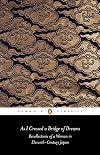
This book was written during the Heian period (794-1185 CE). It is a hard book to describe, so I am going to start with a few quotes from the translator. “One thousand years ago a woman in Japan with no name wrote a book without a title” (Morris 1). First of all, this is not entirely accurate: she had a name, but we don’t know what it was. She is usually called either “Takasue’s Daughter,” because she mentions her father’s name, or “Lady Sarashina” because someone decided show more to name her book Sarashina. This translator calls her the latter and explains that women of Lady Sarashina’s class “had a great deal of leisure, they were educated, and their social position was favorable” (Morris 1). Their writing “is intensely personal. In their notes and letters and recollections they reveal themselves to us in all their nakedness, describing each nuance of feeling, each intimate hope, each secret disappointment. Yet there are also great lacunae: for all the emotional and aesthetic detail we frequently cannot tell whether they were married, what children they had, where they lived, who supported them in their leisure, or when and how they had their meals” (Morris 1-2).
This statement is so true for this book. Lady Sarashina talks a lot about her dreams (in both senses), her travels, her observations, and her correspondence with others. In this period, educated people wrote a lot of poetry, as messages or to mark a moment in time. The translator explains that Lady Sarashina wrote tanka, which are five lines of 5-7-5-7-7 syllables. Here is an example that she sends as a teenager (?) to her step-mother: “You promised to return. / How long must I still wait till you fulfill that vow? / Spring did not forget the tree / Whose branches were white with frost” (45). The Penguin edition that I read reproduces the woodblock illustrations from an 18th century edition. They are beautiful and add to the overall ambiance of the book.
The episodic nature and absence of accounts of daily life take a while to get used to. For example, as the notes explain, there is a gap of 18 months between two sections. In that time, she got married and had a baby. She did not record those big life events at all in her narrative.
My favorite part is the beginning of the book when the Lady Sarashina recounts her life at the age of twelve. She desires written Tales, such as the famous The Tale of Genji. She prays to her personal Buddha statue: “Oh, please arrange things so that we may soon go to the Capital, where there are so many Tales, and please let me read them all” (31). When her relatives give her many Tales, she says “I could sit undisturbed behind my curtain, bent comfortably forward as I took out the books one by one and enjoyed them to my heart’s content…. Placing the lamp close to where I sat, I kept reading all day long and late as possible into the night” (47). Perhaps Lady Sarashina should become Library Thing’s mascot! show less
This statement is so true for this book. Lady Sarashina talks a lot about her dreams (in both senses), her travels, her observations, and her correspondence with others. In this period, educated people wrote a lot of poetry, as messages or to mark a moment in time. The translator explains that Lady Sarashina wrote tanka, which are five lines of 5-7-5-7-7 syllables. Here is an example that she sends as a teenager (?) to her step-mother: “You promised to return. / How long must I still wait till you fulfill that vow? / Spring did not forget the tree / Whose branches were white with frost” (45). The Penguin edition that I read reproduces the woodblock illustrations from an 18th century edition. They are beautiful and add to the overall ambiance of the book.
The episodic nature and absence of accounts of daily life take a while to get used to. For example, as the notes explain, there is a gap of 18 months between two sections. In that time, she got married and had a baby. She did not record those big life events at all in her narrative.
My favorite part is the beginning of the book when the Lady Sarashina recounts her life at the age of twelve. She desires written Tales, such as the famous The Tale of Genji. She prays to her personal Buddha statue: “Oh, please arrange things so that we may soon go to the Capital, where there are so many Tales, and please let me read them all” (31). When her relatives give her many Tales, she says “I could sit undisturbed behind my curtain, bent comfortably forward as I took out the books one by one and enjoyed them to my heart’s content…. Placing the lamp close to where I sat, I kept reading all day long and late as possible into the night” (47). Perhaps Lady Sarashina should become Library Thing’s mascot! show less
As I Crossed a Bridge of Dreams: Recollections of a Woman in Eleventh-century Japan (Classics) by Lady Sarashina
I don't really know why I decided to buy this. Japan is of course a fascinating country with a fascinating culture and history, but I know nothing about the Heian era or its writings – or anything much before the Meiji restoration – so I have no context to put it into. Nonetheless, it's incredibly fascinating and moving to read words (in translation) written nearly a millennium ago, before William the Conqueror landed in England, on the opposite side of the world, and to find in them a show more recognisable humanity. show less
This was a very interesting book, both by itself and as an addition to the other known Heian-era diaries written by women. The author’s outlook and experience provides a contrast to the other diaries that I’ve read. Of course there are also some similarities. Like Sei Shonagon, Murasaki Shikibu and Michitsuna no Haha (authors of The Pillow Book, The Tale of Genji and Diary of Lady Murasaki, and The Gossamer Years), the author of this diary was from the provincial governor class, and her show more real name is unknown – she is referred to as Sarashina or Lady Sarashina, after a place rather offhandedly mentioned. Sarashina also doesn’t seem to have much knowledge of the conflicts that were active at that time. And this is another diary where readers get a lot of intimate thoughts and experiences, but not much concrete information about the author – her husband is mentioned casually, for example. But unlike Sei Shonagon and Murasaki Shikibu, Sarashina’s attempt at court service was not successful. Sometimes those two authors are criticized by the too-positive tone of their memoirs (when there was actually a lot of political infighting at the time, not to mention the rebellion against the capital), but Sarashina isn’t enthralled by court service and doesn’t have any sections of the empress favoring her or complimenting her wit. Her focus on all the clothing of the era is also minimal. She describes a number of unhappy events – mostly the deaths of family members, later her husband – but until the end, the overall tone isn’t too unhappy. While I found The Gossamer Years absorbing, it was a pretty depressing book, with the author always unhappy that her highly ranked husband (who also had another wife) never had time for her. Sarashina seems genuinely interested in the pilgrimages she takes – the author of The Gossamer Years also took many trips, but it was only to fill the unhappy times when her husband was away.
Who can resist this wonderful opening section?
“Yet even shut away in the provinces I somehow came to hear that the world contained things known as Tales, and from that moment my greatest desire was to read them for myself. To idle away the time, my sister, my stepmother, and others in the household would tell me stories from the Tales, including episodes about Genji, the Shining Prince; but, since they had to depend on their memories, they could not possibly tell me all I wanted to know and their stories only made me more curious than ever…I would perform my ablutions and, stealing into the altar room, would prostrate myself and pray fervently, ‘Oh, please arrange things so that we may soon go to the Capital, where there are so many Tales, and please let me read them all.’”
From there, Sarashina describes the family’s move from the provinces to the capital. In general, I enjoyed reading about her descriptions of places and trips. The pilgrimages that she took weren’t mainly an excuse for social events, and she doesn’t really comment on everyone she sees and the clothes that they’re wearing.
There are some unhappy events – her sister dies and she is separated from her father when he leaves the capital. Sarashina is also devastated when she learns that a woman whose handwriting she admired has died. The intro – a bit dated – suggests that she’s overemotional or something like that, but her grief doesn’t really seem out of place to me. Exchanging letters, judging poetry, and assessing someone by their handwriting were all pretty commonplace in the capital. Sarashina was still fairly young at the time, and, as a woman, she was generally secluded and communicated through writing and behind screens. Her unhappiness over the death of someone she didn’t know doesn’t seem out of character.
Sarashina describes her indifferent success at Court and one fleeting hint at romance. Her mentions of her husband are rather muted, but she is unhappy after his death. A running motif in the memoir is her dreams – she describes them as prophetic.
Sadly, towards the end, the author decides that some of her bad fortune is due to her excessive focus on tales, in a sort of Northanger Abbey way. She tries to refocus her prayers and writes a lot about her loneliness. However, the end feels like an ending – not like the piece was cut off. Certainly recommended for anyone interested in the Heian era. show less
Who can resist this wonderful opening section?
“Yet even shut away in the provinces I somehow came to hear that the world contained things known as Tales, and from that moment my greatest desire was to read them for myself. To idle away the time, my sister, my stepmother, and others in the household would tell me stories from the Tales, including episodes about Genji, the Shining Prince; but, since they had to depend on their memories, they could not possibly tell me all I wanted to know and their stories only made me more curious than ever…I would perform my ablutions and, stealing into the altar room, would prostrate myself and pray fervently, ‘Oh, please arrange things so that we may soon go to the Capital, where there are so many Tales, and please let me read them all.’”
From there, Sarashina describes the family’s move from the provinces to the capital. In general, I enjoyed reading about her descriptions of places and trips. The pilgrimages that she took weren’t mainly an excuse for social events, and she doesn’t really comment on everyone she sees and the clothes that they’re wearing.
There are some unhappy events – her sister dies and she is separated from her father when he leaves the capital. Sarashina is also devastated when she learns that a woman whose handwriting she admired has died. The intro – a bit dated – suggests that she’s overemotional or something like that, but her grief doesn’t really seem out of place to me. Exchanging letters, judging poetry, and assessing someone by their handwriting were all pretty commonplace in the capital. Sarashina was still fairly young at the time, and, as a woman, she was generally secluded and communicated through writing and behind screens. Her unhappiness over the death of someone she didn’t know doesn’t seem out of character.
Sarashina describes her indifferent success at Court and one fleeting hint at romance. Her mentions of her husband are rather muted, but she is unhappy after his death. A running motif in the memoir is her dreams – she describes them as prophetic.
Sadly, towards the end, the author decides that some of her bad fortune is due to her excessive focus on tales, in a sort of Northanger Abbey way. She tries to refocus her prayers and writes a lot about her loneliness. However, the end feels like an ending – not like the piece was cut off. Certainly recommended for anyone interested in the Heian era. show less
As I Crossed a Bridge of Dreams: Recollections of a Woman in 11th-Century Japan (Classics S) by Lady Sarashina
A lovely example of 'autobiography', and a lovely example of the two great paradoxes of art and religion:
i) religion suggests that we should concern ourselves more with the ultimate results of our behavior (i.e., heaven, rebirth etc...) than the proximate results (i.e., enjoyment, sensual gratification etc...) It can only do this effectively by using the language (broadly speaking) of this world, because we don't know the language of the next. But this use of language leads us to value the show more language and objects of this world, which distracts us from heaven/rebirth.
ii) art makes life bearable; at the same time it draws us away from the 'real world,' including our problems dealing with the first paradox.
For 'Sarashina', the religion is syncretic Shinto/Buddhism, the art is the tales of her time and place, Heian Japan (e.g., Genji, The Pillow Book). As translated by Ivan Morris, her prose is lovely and her poetry readable, though forcing them into English misses a lot, I'm sure. I'm also skeptical because I feel entirely at home in Sarashina's world; there seems to be no important difference between her and me. Since she was an 11th century Japanese woman, it's just possible that Morris has made the translation a little too smooth. show less
i) religion suggests that we should concern ourselves more with the ultimate results of our behavior (i.e., heaven, rebirth etc...) than the proximate results (i.e., enjoyment, sensual gratification etc...) It can only do this effectively by using the language (broadly speaking) of this world, because we don't know the language of the next. But this use of language leads us to value the show more language and objects of this world, which distracts us from heaven/rebirth.
ii) art makes life bearable; at the same time it draws us away from the 'real world,' including our problems dealing with the first paradox.
For 'Sarashina', the religion is syncretic Shinto/Buddhism, the art is the tales of her time and place, Heian Japan (e.g., Genji, The Pillow Book). As translated by Ivan Morris, her prose is lovely and her poetry readable, though forcing them into English misses a lot, I'm sure. I'm also skeptical because I feel entirely at home in Sarashina's world; there seems to be no important difference between her and me. Since she was an 11th century Japanese woman, it's just possible that Morris has made the translation a little too smooth. show less
Lists
Awards

You May Also Like


Associated Authors
Statistics
- Works
- 4
- Also by
- 1
- Members
- 635
- Popularity
- #39,693
- Rating
- 4.0
- Reviews
- 10
- ISBNs
- 34
- Languages
- 7
- Favorited
- 2