
Kimberly Witherspoon
Author of Don't Try This At Home: Culinary Catastrophes from the World's Greatest Cooks and Chefs
About the Author
Image credit: Kimberly Witherspoon
Works by Kimberly Witherspoon
Don't Try This At Home: Culinary Catastrophes from the World's Greatest Cooks and Chefs (2005) — Editor — 436 copies, 10 reviews
How I Learned To Cook: Culinary Educations from the World's Greatest Chefs (2006) — Editor — 194 copies, 3 reviews
Tagged
Common Knowledge
- Canonical name
- Witherspoon, Kimberly
- Gender
- female
- Education
- Brown University (BA|International Relations)
- Occupations
- literary agent
Members
Reviews

How I Learned to Cook is a collection of 40 essays by well-known chefs and food writers, describing early pivotal incidents in their culinary careers. The title might be a bit misleading; the stories aren’t generally about learning how to cook, but rather “the biggest screw-up I ever had in the kitchen” and “how I learned to love food” and “how I realized — perhaps against my will — that cooking would become my profession.”
Of course, with so many contributors, the writing show more is uneven and there are some duds among the selections. But for the most part, the essays showcase the larger-than-life personalities of chefs and the weird culture of the world of professional cooking. Particular favorites included Rick Bayless’ story about spending his family’s weekly food budget on one rack of lamb as a teenager — and his father didn’t even like lamb; Anthony Bourdain decimating television cooking; and David Chang’s story of an apprenticeship to a perfectionist soba noodle maker in Japan. show less
Of course, with so many contributors, the writing show more is uneven and there are some duds among the selections. But for the most part, the essays showcase the larger-than-life personalities of chefs and the weird culture of the world of professional cooking. Particular favorites included Rick Bayless’ story about spending his family’s weekly food budget on one rack of lamb as a teenager — and his father didn’t even like lamb; Anthony Bourdain decimating television cooking; and David Chang’s story of an apprenticeship to a perfectionist soba noodle maker in Japan. show less
Don't Try This At Home : Culinary Catastrophes From The World's Greatest Chefs by Kimberly Witherspoon
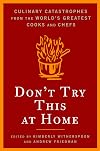
-This is a collection of short stories from renowned chefs concerning life-altering moments in their careers, events that changed their points of view, approaches to the business or more simply comic and tragic low points. The stories have a huge variety in topic and quality. Some of the chefs are global stars, others have been, and some are on their way so it is a nice cross section of the culinary world. It is a quick read, with the average chapter being 4-5 pages. Amusing at times, the show more stories can be moving, funny, inspirational, annoying, or downright selfish. The culinary world is a vastly varied place that makes for an interesting read. show less
Don't Try This At Home: Culinary Catastrophes from the World's Greatest Chefs by Kimberly Witherspoon
I'll admit that though I'm a very good cook, and with my partner own somewhere in the neighborhood of 130 cookbooks, I don't own cookbooks by any of the chefs represented in this collection. I have nothing against them, but I've never heard of most of them. This means that I read the anthology without a picture of anyone (except Anthony Bourdain) or any orienting knowledge of them. Not a Julia Child, Marcella Hazan, Marian Burros, Mark Bittman, or Nigella Lawson in sight.
The 41 authors vary show more significantly in their capacity to tell a story and evoke either empathy or laughter. Puzzlingly, the entries are in alphabetical order by author, which means that the stories aren't grouped thematically or interwoven by theme--there is no narrative arc. The only rationale I can ascribe this to is that this way, none of the authors would feel snubbed. This seems emblamatic of something that's mostly missing from this collection, acknowledgement that the chefs themselves may cause their staff members to experience disasters. You'd hardly know from these naratives how unpleasant and self-absorbed some chefs can be.
In addition, the 'disasters' range from true disasters (a back-seat slosh that rivals some of the restaurant scenes in Fight Club for the disgust it inspires) to non-disasters (a famous person is supposed to show up for dinner, and does) to did-you-understand-the-question? stories (it's funny to pull pranks on other cooks).
The collection was interesting enough to read, but not something I'd be likely to remember in the long-term. There are better stories to be had in books by individual cooks and chefs. show less
The 41 authors vary show more significantly in their capacity to tell a story and evoke either empathy or laughter. Puzzlingly, the entries are in alphabetical order by author, which means that the stories aren't grouped thematically or interwoven by theme--there is no narrative arc. The only rationale I can ascribe this to is that this way, none of the authors would feel snubbed. This seems emblamatic of something that's mostly missing from this collection, acknowledgement that the chefs themselves may cause their staff members to experience disasters. You'd hardly know from these naratives how unpleasant and self-absorbed some chefs can be.
In addition, the 'disasters' range from true disasters (a back-seat slosh that rivals some of the restaurant scenes in Fight Club for the disgust it inspires) to non-disasters (a famous person is supposed to show up for dinner, and does) to did-you-understand-the-question? stories (it's funny to pull pranks on other cooks).
The collection was interesting enough to read, but not something I'd be likely to remember in the long-term. There are better stories to be had in books by individual cooks and chefs. show less
Don't try this at home : culinary catastrophes from the world's greatest chefs by Kimberly Witherspoon
Don't try *what* at home? Acting like a pompous chef who knows it all and wants to tell you that you certainly don't? Reminds me of Chopped on the Food Network where some chefs get all snotty because they went to culinary school and other chefs, sorry 'cooks', didn't. There is only one true way of judging food - did you enjoy it or not? Who cares who prepared it or what training they had? If the food is awful then the fact it was prepared by a graduate of the Culinary Arts Institute isn't show more going to make up for it at all. Perhaps that's why so many of us go to restaurants and patisseries that state 'home-cooked', they've probably got a clientele because of their good cooking although, if someone else is paying, I'm very willing to go to a Michelin 3-star restaurant (no one so far has been willing).
The book is a series of anecdotes where the chefs do a lot of bragging. There was one story where the chef sets fire to the entree and brilliantly converts into a dish he gets praised for. That was about the best the book had to offer as the other anecdotes are tedious.
I only finished the book, months after starting it, because I was in a long bank queue and I'd read all the mortgage-loan-credit card literature and it was all I had. Yep, that boring. show less
The book is a series of anecdotes where the chefs do a lot of bragging. There was one story where the chef sets fire to the entree and brilliantly converts into a dish he gets praised for. That was about the best the book had to offer as the other anecdotes are tedious.
I only finished the book, months after starting it, because I was in a long bank queue and I'd read all the mortgage-loan-credit card literature and it was all I had. Yep, that boring. show less
Lists
Awards


You May Also Like


Associated Authors
Statistics
- Works
- 3
- Members
- 729
- Popularity
- #34,829
- Rating
- 3.4
- Reviews
- 13
- ISBNs
- 20
- Languages
- 3