

Grace Metalious (1924–1964)
Author of Peyton Place
About the Author
Series
Works by Grace Metalious
Associated Works
Tagged
Common Knowledge
- Canonical name
- Metalious, Grace
- Legal name
- DeRepentigny, Marie Grace
- Other names
- de Repentigny, Marie Grace (birth)
- Birthdate
- 1924-09-08
- Date of death
- 1964-02-25
- Gender
- female
- Education
- Manchester Central High School
- Occupations
- author
- Short biography
- Born Marie Grace de Repentigny
- Nationality
- USA
- Birthplace
- Manchester, New Hampshire, USA
- Places of residence
- Manchester, New Hampshire, USA
Gilmanton, New Hampshire, USA
Durham, New Hampshire, USA - Place of death
- Boston, Massachusetts, USA
- Burial location
- Smith Meeting House Cemetery, Gilmanton, New Hampshire, USA
- Associated Place (for map)
- New Hampshire, USA
Members
Reviews

Peyton Place, a landmark of a book. Most people are familiar with at least the name and core concept of gossipy small town folks and their scandals, even if they aren’t aware of the novel’s existence.
The book covers roughly ten years in the life of an isolated, sleepy New England town from 1935 to 1945. There is no single central character. Instead, the book follows the intricate web between a large number of Peyton Place’s residents and the back-biting, bad mouthing and general show more hypocrisy that runs rampant through the town.
The book is much better written than I was expecting. It is rich in incidental details, showing an intimate portrait of an isolated New England town in the late 1930’s. Some of my favorite parts were throwaway details about ringing the bells for school or the old men sitting on the wooden benches in front of the court house. Peyton Place itself is probably the most prominent character in the book. Often Metalious uses quotes from unnamed characters to act as the ‘voice’ of Peyton Place.
Regardless, the book is not literary fiction. Rather, it revels in titillating details. I noticed over the course of the book that the narrative tended to wallow in the more salacious bits. At first, shocking secrets are presented pretty matter-of-factly. I got the feeling that the author felt more and more comfortable with her narrative as she wrote, because while the soap opera-like twists were always pretty breathtaking, as the story wound on they were presented more and more sensationally. I have to admit, it really did make the book more fun to read. Who doesn’t like tut-tutting over other folk’s dirty laundry?
I do think that the book is a cut above Jackie Collins/Danielle Steele trash fiction though. While Metalious crammed Peyton Place with enough hot details to fill an issue of the National Enquirer, she was also very clear in pointing out the hypocrisy in the way that New England was presenting itself to the rest of the country back then. The book was clearly at least semi-autobiographical (as the character Allison MacKenzie seems to closely resemble the author) and you can see that as gleeful as the author was in dragging out scandal of the place, she clearly had some fondness for her roots.
Lots of bad stuff happens in Peyton Place, but it is not all bad. There are still picnics in the woods, drowsy Indian summer days and townspeople helping each other out.
Whatever reputation it earned when originally published, the book is some kind of classic now. Fifty-plus years later, the book still holds a reader's interest. It is unquestionably dated, but it is a novel portraying a particular time and place, so that is not a strike against it. The only reason I didn't rate this one at five stars is that some of the dialog is stilted (though some of it is fantastic) and I felt toward the end that the story was getting a little long in the tooth.
All these years after the original publication of Peyton Place I was still often shocked while reading. The novel really does go for the sensational. But like Jean Shepherd’s purposely ‘anti-nostalgic’ reminiscences or the movie Pleasantville, it also tries to make you see that maybe the 'good old days' weren't so good for those that lived them. show less
The book covers roughly ten years in the life of an isolated, sleepy New England town from 1935 to 1945. There is no single central character. Instead, the book follows the intricate web between a large number of Peyton Place’s residents and the back-biting, bad mouthing and general show more hypocrisy that runs rampant through the town.
The book is much better written than I was expecting. It is rich in incidental details, showing an intimate portrait of an isolated New England town in the late 1930’s. Some of my favorite parts were throwaway details about ringing the bells for school or the old men sitting on the wooden benches in front of the court house. Peyton Place itself is probably the most prominent character in the book. Often Metalious uses quotes from unnamed characters to act as the ‘voice’ of Peyton Place.
Regardless, the book is not literary fiction. Rather, it revels in titillating details. I noticed over the course of the book that the narrative tended to wallow in the more salacious bits. At first, shocking secrets are presented pretty matter-of-factly. I got the feeling that the author felt more and more comfortable with her narrative as she wrote, because while the soap opera-like twists were always pretty breathtaking, as the story wound on they were presented more and more sensationally. I have to admit, it really did make the book more fun to read. Who doesn’t like tut-tutting over other folk’s dirty laundry?
I do think that the book is a cut above Jackie Collins/Danielle Steele trash fiction though. While Metalious crammed Peyton Place with enough hot details to fill an issue of the National Enquirer, she was also very clear in pointing out the hypocrisy in the way that New England was presenting itself to the rest of the country back then. The book was clearly at least semi-autobiographical (as the character Allison MacKenzie seems to closely resemble the author) and you can see that as gleeful as the author was in dragging out scandal of the place, she clearly had some fondness for her roots.
Lots of bad stuff happens in Peyton Place, but it is not all bad. There are still picnics in the woods, drowsy Indian summer days and townspeople helping each other out.
Whatever reputation it earned when originally published, the book is some kind of classic now. Fifty-plus years later, the book still holds a reader's interest. It is unquestionably dated, but it is a novel portraying a particular time and place, so that is not a strike against it. The only reason I didn't rate this one at five stars is that some of the dialog is stilted (though some of it is fantastic) and I felt toward the end that the story was getting a little long in the tooth.
All these years after the original publication of Peyton Place I was still often shocked while reading. The novel really does go for the sensational. But like Jean Shepherd’s purposely ‘anti-nostalgic’ reminiscences or the movie Pleasantville, it also tries to make you see that maybe the 'good old days' weren't so good for those that lived them. show less
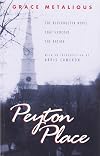
I first read this book in the fall of 1982, while attending junior college. Having grown up in a town much like Peyton Place (a Mississippi town of about 300) I could relate to some of the attitudes and narrow mindedness of the characters. I can certainly understand why this was so controversial in the 1950s, but what I can't understand is how Grace Metalious was considered such a bad writer. I think the book is well-written and highly entertaining. I've read many articles about the show more publishing impact this book had on the US and the only thing I can figure out is that a lot of people were just plain jealous. Sure, this isn't Gone With the Wind, but it wasn't meant to be. To me, Peyton Place accomplishes what Grace Metalious herself said she set out to do: expose the hypocrisy and bigotry of people in a small town. I know first-hand that this type of behavior still exists. As a gay man in a small southern town, I have experienced much bigotry toward gay people. I would recommend this book to anyone who likes to read. Think about it, without this book would books such as Valley of the Dolls or Hollywood Wives have been published? There are authors now who make a career out of writing books that are a pale imitation to this one. Considering this book sold millions of copies and is still in print today, I think a quote from Grace Metalious explains it best, "If I am a terrible writer, then an awful lot of people have terrible taste." show less
This book can easily be taken out of context of its original closeted 50s: domestic abuse considered normal as long as you pay your taxes, alcoholism with no consequences but unwanted pregnancies and homosexuality hidden at all costs. For this, Cameron's introduction is a must read because it sets the stage: this novel is a shocker to be sure, full of terrible secrets, but it's also a critique of the times - the hypocrisy, the lies, the un-lived lives due to shame.
Passages of the book are show more lengthy (book 3 with Allison's pseudo-emancipation, notably), the weather imagery is rather heavy, but there are also some terrible, cruel remarks which resonate today still, including Harrington's buy-off of Betty Anderson or Swain's torment over his act.
This novel is a mix: soap opera and social critism - either way, the reader will be rewarded. show less
Passages of the book are show more lengthy (book 3 with Allison's pseudo-emancipation, notably), the weather imagery is rather heavy, but there are also some terrible, cruel remarks which resonate today still, including Harrington's buy-off of Betty Anderson or Swain's torment over his act.
This novel is a mix: soap opera and social critism - either way, the reader will be rewarded. show less

If you read this, you'll see why it was so controversial in 1956. I suspect it gained such attention because it is also extremely well written and insightful. In the course of a few hundred pages, Metalious covers every major human vice. She also builds an engaging storyline about life in a small New England town. The characters debate the complexity of modern times through the simple ways these issues affect them. For example, the new school principal, a rare outsider, becomes a local and show more yet continues to challenge his friends' views about religion and relationships. What I like most about this book is the way the dialogue and character portrayals reflect the nuance of human psychology. Metalious efficiently shows us their inner conflict, and, as in reality, gives only some of them a life-changing moment where they are forced to resolve their own inner turmoil. show less
Lists
Awards


You May Also Like


Associated Authors
Statistics
- Works
- 6
- Also by
- 3
- Members
- 2,311
- Popularity
- #11,109
- Rating
- 3.6
- Reviews
- 47
- ISBNs
- 56
- Languages
- 6
- Favorited
- 1
