
Christopher Collier (1) (1930–)
Author of My Brother Sam is Dead
For other authors named Christopher Collier, see the disambiguation page.
About the Author
Christopher Collins is a writer of historical novels for children. Collier has taught at both the University of Bridgeport and the University of Connecticut. He has also served as Connecticut's State Historian. The violence and profanity in Collier's works is very controversial, rendering them show more banned from reading curriculums in certain schools. Despite the controversy, Collier's book My Brother Sam is Dead won a Newberry Honor in 1975. He has also written War Comes to Willie Freeman, and The Literature of Connecticut History and Roger Sherman's Connecticut for adults. (Bowker Author Biography) show less
Image credit: David Garrigus Productions
Series
Works by Christopher Collier
The United States Enters the World Stage: From Alaska Purchase Through World War I, 1867-1919 (Drama of American History) (1991) 13 copies
All Politics Is Local: Family, Friends, and Provincial Interests in the Creation of the Constitution (2003) 11 copies
Associated Works
Tagged
Common Knowledge
- Birthdate
- 1930-01-29
- Gender
- male
- Education
- Clark University (BA|1951)
Columbia University (MA|1955, PhD|1964) - Organizations
- United States Army (1952-1954)
American Historical Association
Organization of American Historians
Connecticut Historical Society
Association for the Study of Connecticut History - Relationships
- Collier, James Lincoln (brother)
- Nationality
- USA
- Birthplace
- New York, New York, USA
- Places of residence
- Orange, Connecticut, USA
- Associated Place (for map)
- USA
Members
Reviews
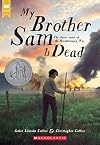
My Brother Sam is Dead offers a surprisingly unbiased look at the American Revolution. Some may hate this one for its brutal honesty regarding the Patriots, unvarnished by the usual idealistic gloss we get in school, but I think it's one of the best out there, especially for this age range, and will make sure my daughter reads it when she is old enough. Why not 5 stars? I would have liked to know Sam a little better, to have liked him and cared about him more.
First sentence: It was April, and outside in the dark the rain whipped against the windows of our tavern, making a sound like muffled drums.
Premise/plot: My Brother Sam is Dead is historical fiction for middle grade (and/or upper elementary grades). It is set during the American Revolution. The narrator, Timmy Meeker, spends the duration of the book confused by the complexities of war. He isn't really in favor or support of either side. He wants things to go back to normal. He hates that his show more brother Sam has been kicked out of the family for his "rebel" views and joining up with the Patriots. He knows his dad leans more towards being a Tory or Royalist. But also at the same time his dad has ALL THE OPINIONS that war is the worst thing on the planet.
My thoughts: This was my first time to read My Brother Sam is Dead. When I started it, I thought I would like it more than I did.
I picked up on the anti-war sentiment from the start. That didn't surprise me. I didn't expect war to be glamorized or idolized. I expected the view point to be war is UGLY, war is MESSY, war is TRAUMATIC, war is HORRIBLE. Many if not most books about war--any war--touch upon this ugliness, this trauma, this raw pain, this sorrow.
My Brother Sam Is Dead was written and published towards the end of the Vietnam War. Anti-war sentiment was high. America was also a few years away from celebrating the bicentennial. I don't know if either of these facts had any impact at all on the story these brothers were telling, were sharing. But it doesn't escape my attention that they might have wanted to remind readers that just because the war happened two hundred years ago, doesn't make it any less ugly, horrifying, terrifying, gross, disgusting, revolting, traumatizing. The "cause" they were fighting for did not negate the reality of war being what it fundamentally is.
I guess what surprised me, and probably shouldn't have, is the way Tim loses his father and his brother. Not the fact that both died--or either died. BUT the how. It isn't so much that Sam Meeker dies in the novel. It is the how and why. The father's death was sad and unnecessary, but it was the brother's death that turns the novel about.
I do think that adult readers may read the book differently perhaps. I'm not sure. I do know that this is a book that I never would have picked up as a kid or teen.
As an adult, I was seeing things not so much through Tim's eyes but through the eyes of his parents. show less
Premise/plot: My Brother Sam is Dead is historical fiction for middle grade (and/or upper elementary grades). It is set during the American Revolution. The narrator, Timmy Meeker, spends the duration of the book confused by the complexities of war. He isn't really in favor or support of either side. He wants things to go back to normal. He hates that his show more brother Sam has been kicked out of the family for his "rebel" views and joining up with the Patriots. He knows his dad leans more towards being a Tory or Royalist. But also at the same time his dad has ALL THE OPINIONS that war is the worst thing on the planet.
My thoughts: This was my first time to read My Brother Sam is Dead. When I started it, I thought I would like it more than I did.
I picked up on the anti-war sentiment from the start. That didn't surprise me. I didn't expect war to be glamorized or idolized. I expected the view point to be war is UGLY, war is MESSY, war is TRAUMATIC, war is HORRIBLE. Many if not most books about war--any war--touch upon this ugliness, this trauma, this raw pain, this sorrow.
My Brother Sam Is Dead was written and published towards the end of the Vietnam War. Anti-war sentiment was high. America was also a few years away from celebrating the bicentennial. I don't know if either of these facts had any impact at all on the story these brothers were telling, were sharing. But it doesn't escape my attention that they might have wanted to remind readers that just because the war happened two hundred years ago, doesn't make it any less ugly, horrifying, terrifying, gross, disgusting, revolting, traumatizing. The "cause" they were fighting for did not negate the reality of war being what it fundamentally is.
I guess what surprised me, and probably shouldn't have, is the way Tim loses his father and his brother. Not the fact that both died--or either died. BUT the how. It isn't so much that Sam Meeker dies in the novel. It is the how and why. The father's death was sad and unnecessary, but it was the brother's death that turns the novel about.
I do think that adult readers may read the book differently perhaps. I'm not sure. I do know that this is a book that I never would have picked up as a kid or teen.
As an adult, I was seeing things not so much through Tim's eyes but through the eyes of his parents. show less
My Brother Sam Is Dead (A Newbery Honor Book) (A Newberry Honor Book) by James Lincoln Collier (1974-05-03) by James Lincoln Collier
My Brother Sam is Dead by James Lincoln Collier and Christopher Collier is the story of Tim Meeker, a 14-year-old boy living in the American colonies during the tumultuous time of the Revolutionary War. At first the war seems distant to Tim, just a topic of conversation in the tavern his family keeps. However, when his older brother Sam enlists in the Continental Army over the fierce objections of their Loyalist father, the war truly comes home for the Meeker family. Written by an acclaimed show more children’s author and his historian brother, the novel draws on historical facts to paint a picture of everyday life for a Colonial family swept up in the conflict and violence of the Revolution. My Brother Sam is Dead shows that, despite our national mythology surrounding the Revolution and the Founding Fathers, not all of the colonists were in favor of the rebellion, and many friends and families were bitterly divided over the subject. In the story, the soldiers Tim encounters do not always behave according to what we may assume; the British soldiers wistfully yearn for home, and the desperate Continental forces steal from the very colonists for whom’s freedom they are fighting. As Tim’s mother remarks, “War turns men into beasts” (140). The epilogue leads readers to consider if there may have been a path to American independence that did not require the loss of so many lives. The book is an unflinching portrayal of the horrors of war, and some readers may be turned off by its descriptions of violence. However, for most readers, I think this is an excellent, fast-moving story that forces us to reflect on our assumptions about American history and the true cost of war. show less
A terrible, brilliant historical novel about the reality of war on the homefront, how it disrupts and destroys families and how it forces young people to grow up quickly. Tim, the narrator, is 13, the son of a tavern owner in Connecticut, when the American Revolution begins.
"So there were a lot of changes in our lives, but the biggest was the one that was happening inside myself. Ever since I had got the wagon home by myself I hadn't felt like a boy anymore. You don't think that things show more really happen overnight, but this one did. Of course I was dead tired when I went to bed that night, and Mother let me sleep late in the morning. And when I woke up I was different. I noticed it first at breakfast. Usually I sat there over my porridge moaning to myself about the chores I had to do or having to go to school or something, and trying to think of some way to get out of whatever it was. Or when Mother turned her head I'd scoop up a fingerful of molasses from the jar and stir it into my milk. Or I'd eat breakfast slowly so I could stall off going to work.
"But that morning after the terrible trip home, right from the first moment we got finished saying grace, I began planning the things I had to do - which things had to be done first and what was the best way to get them done. It was funny: it didn't even cross my mind to stall or try to get out of the work. I didn't wait for Mother to tell me what to do: I brought the subject up myself. ....
"We discussed it all, and about half way through breakfast I began to realize that I had changed. I wasn't acting my usual self, I was acting more like a grownup. You couldn't say that I was really an adult, but I wasn't a child anymore, that was certain. I thought about showing off in front of [my older brother] Sam when he came home. I'd say things like, 'Well, Sam, we've decided not to put in oats this year, we're going to use the space for corn.' Or, 'We're not keeping the kitchen fire going all the time - I haven't got enough time for woodcutting as it is.' I would be the one who knew about things, not him." pp. 132-133 show less
"So there were a lot of changes in our lives, but the biggest was the one that was happening inside myself. Ever since I had got the wagon home by myself I hadn't felt like a boy anymore. You don't think that things show more really happen overnight, but this one did. Of course I was dead tired when I went to bed that night, and Mother let me sleep late in the morning. And when I woke up I was different. I noticed it first at breakfast. Usually I sat there over my porridge moaning to myself about the chores I had to do or having to go to school or something, and trying to think of some way to get out of whatever it was. Or when Mother turned her head I'd scoop up a fingerful of molasses from the jar and stir it into my milk. Or I'd eat breakfast slowly so I could stall off going to work.
"But that morning after the terrible trip home, right from the first moment we got finished saying grace, I began planning the things I had to do - which things had to be done first and what was the best way to get them done. It was funny: it didn't even cross my mind to stall or try to get out of the work. I didn't wait for Mother to tell me what to do: I brought the subject up myself. ....
"We discussed it all, and about half way through breakfast I began to realize that I had changed. I wasn't acting my usual self, I was acting more like a grownup. You couldn't say that I was really an adult, but I wasn't a child anymore, that was certain. I thought about showing off in front of [my older brother] Sam when he came home. I'd say things like, 'Well, Sam, we've decided not to put in oats this year, we're going to use the space for corn.' Or, 'We're not keeping the kitchen fire going all the time - I haven't got enough time for woodcutting as it is.' I would be the one who knew about things, not him." pp. 132-133 show less
Lists
Awards


You May Also Like


Associated Authors
Statistics
- Works
- 34
- Also by
- 2
- Members
- 6,111
- Popularity
- #4,029
- Rating
- 3.6
- Reviews
- 103
- ISBNs
- 213
- Languages
- 1