
Andrea Smith (1) (1966–)
Author of Conquest: Sexual Violence and American Indian Genocide
For other authors named Andrea Smith, see the disambiguation page.
About the Author
Andrea Smith is Associate Professor of Ethnic Studies and Media and Cultural Studies at the University of California, Riverside. She is the author of Native Americans and the Christian Right: The Gendered Politics of Unlikely Alliances and coeditor of Theorizing Native Studies, both also published show more by Duke University Press. show less
Image credit: Andrea Smith
Works by Andrea Smith
Associated Works
The Revolution Starts at Home: Confronting Intimate Violence Within Activist Communities (2011) — Preface — 301 copies, 3 reviews
Tagged
Common Knowledge
Members
Reviews
Awesome. This book absolutely lives up to its press.
First of all, I'm just desperately grateful to Smith for her language -- words, ideas, connections, concepts, frameworks. To be able to say why new-age religious appropriative crap is so harmful, or to put into words what feels so desperately cure-nearly-as-bad-as-the-ill about the domestic violence shelter model, or her neat expression of my frustration with the professionalization of everything I feel grassroots passion about... There is show more such exhilaration in finally having conceptual language for these things.
Plus the clear-voicedness that Smith puts into this book! I sometimes feel so frickin' immersed in the mainstream POV about the genocide of American Indians (Very Long Time Ago and Pretty Much Inevitable and anyway Everyone Meant Well And Did Their Very Best), that it's always such a relief to see someone writing about it without all the stupid minimizing lies.
(And would I be too much of an academic geek to be thrilled that there are copious endnotes? Every couple sentences, another superscript? Because I am full of joy about that. This book is a reference, an ongoing tool against the skeptics, not "merely" a set of thrilling conceptual frameworks.)
The penultimate chapter, "Anticolonial Responses to Gender Violence," is absolutely essential reading for everyone in the women's anti-violence movement (and is likely pretty darn useful in the anti-prison movement, and other anti-violence movements -- I only called out women's anti-violence by name because that's where my activist roots are, and thus I can see how neatly this chapter deals with the broken places). Smith meticulously documents the failures of both mainstream and alternative anti-violence models, and instead of viewing those failures as those unfortunate edge cases that you'll always have, she moves them to the center of her analysis: if your anti-violence model doesn't work for women of color, for poor women, for LGBTQI women, for disabled women, for mothers of disabled children, for undocumented immigrants, she asserts, then your model breaks in important -- not marginal! -- ways. Additionally, models that work well for the women who Smith centralizes, tend to simply work well. That is, even women who can afford to walk away from their communities benefit from not having to. It's a sweet bit of work, that chapter. Seriously, go read it. Even if you don't want to deal with the itemization of ongoing genocide in the earlier chapters -- and I can see why you might not want to -- do read chapter 7. show less
First of all, I'm just desperately grateful to Smith for her language -- words, ideas, connections, concepts, frameworks. To be able to say why new-age religious appropriative crap is so harmful, or to put into words what feels so desperately cure-nearly-as-bad-as-the-ill about the domestic violence shelter model, or her neat expression of my frustration with the professionalization of everything I feel grassroots passion about... There is show more such exhilaration in finally having conceptual language for these things.
Plus the clear-voicedness that Smith puts into this book! I sometimes feel so frickin' immersed in the mainstream POV about the genocide of American Indians (Very Long Time Ago and Pretty Much Inevitable and anyway Everyone Meant Well And Did Their Very Best), that it's always such a relief to see someone writing about it without all the stupid minimizing lies.
(And would I be too much of an academic geek to be thrilled that there are copious endnotes? Every couple sentences, another superscript? Because I am full of joy about that. This book is a reference, an ongoing tool against the skeptics, not "merely" a set of thrilling conceptual frameworks.)
The penultimate chapter, "Anticolonial Responses to Gender Violence," is absolutely essential reading for everyone in the women's anti-violence movement (and is likely pretty darn useful in the anti-prison movement, and other anti-violence movements -- I only called out women's anti-violence by name because that's where my activist roots are, and thus I can see how neatly this chapter deals with the broken places). Smith meticulously documents the failures of both mainstream and alternative anti-violence models, and instead of viewing those failures as those unfortunate edge cases that you'll always have, she moves them to the center of her analysis: if your anti-violence model doesn't work for women of color, for poor women, for LGBTQI women, for disabled women, for mothers of disabled children, for undocumented immigrants, she asserts, then your model breaks in important -- not marginal! -- ways. Additionally, models that work well for the women who Smith centralizes, tend to simply work well. That is, even women who can afford to walk away from their communities benefit from not having to. It's a sweet bit of work, that chapter. Seriously, go read it. Even if you don't want to deal with the itemization of ongoing genocide in the earlier chapters -- and I can see why you might not want to -- do read chapter 7. show less
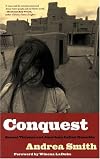
In Conquest, Smith places Native American women at the center of her analysis of sexual violence, challenging both conventional definitions of the term and conventional responses to the problem.
Beginning with the impact of the abuses inflicted on Native American children at state-sanctioned boarding schools from the 1880s to the 1980s, Smith adroitly expands our conception of violence to include environmental racism, population control and the widespread appropriation of Indian cultural show more practices by whites and other non-natives. Smith deftly connects these and other examples of historical and contemporary colonialism to the high rates of violence against Native American women-the most likely women in the United States to die of poverty-related illnesses, be victims of rape and suffer partner abuse. show less
Beginning with the impact of the abuses inflicted on Native American children at state-sanctioned boarding schools from the 1880s to the 1980s, Smith adroitly expands our conception of violence to include environmental racism, population control and the widespread appropriation of Indian cultural show more practices by whites and other non-natives. Smith deftly connects these and other examples of historical and contemporary colonialism to the high rates of violence against Native American women-the most likely women in the United States to die of poverty-related illnesses, be victims of rape and suffer partner abuse. show less

Argues that violence directed at Indians has been specifically sexual—Indians, especially women, seen as inherently dirty and therefore proper subjects of rape and extermination—and that putting the most disadvantaged groups at the center of any analysis and policy reforms is the key to avoiding using one axis of oppression to increase another, as she argues occurs when reformers try to use the criminal justice system to punish batterers and rapists in Indian communities. She also show more connects New Agey white interest in Indian ceremonies (not usually religions, but the trappings thereof) with sexual violence: it’s all about knowledge, and knowing the unwilling, and knowledge is of course a word for sex as well as information.
She admits that many proposals for dealing with offenders in the community are hampered by the fact that many in the community don’t see sexual violence as a big problem, and I was left uncertain what concrete steps she wanted to see, but that’s a standard problem with a big critique and the connections she makes are important ones. Reproductive “choice,” for example, looks very different if you’re from a group historically at risk of forced sterilization, losing your children to the state, and tremendous material difficulty if you do have children. Reproductive justice is a very different thing than choice, and she argues that Indian women should make strategic alliances on both sides of the abortion/contraception debate, and also demand to get something out of those alliances rather than accepting that their interests are somehow subsumed in those of the larger (white) group. show less
She admits that many proposals for dealing with offenders in the community are hampered by the fact that many in the community don’t see sexual violence as a big problem, and I was left uncertain what concrete steps she wanted to see, but that’s a standard problem with a big critique and the connections she makes are important ones. Reproductive “choice,” for example, looks very different if you’re from a group historically at risk of forced sterilization, losing your children to the state, and tremendous material difficulty if you do have children. Reproductive justice is a very different thing than choice, and she argues that Indian women should make strategic alliances on both sides of the abortion/contraception debate, and also demand to get something out of those alliances rather than accepting that their interests are somehow subsumed in those of the larger (white) group. show less

Really a 2.5, but for how heavily this is cited, I was pretty disappointed. It's got some interesting stuff and some stuff that really hasn't aged well (the whole vaccine thing looks a little awkward in our present day.) I will say Smith does a decent job of balancing her citational practice, and leading you to other places. Granted, I was hoping to use it for a specific reason, and it's not the book's fault it didn't lead me there, but I do hope folks move on to other books beyond this to show more cite and also to get information from. show less
Lists
South End Press (1)
Awards

You May Also Like


Associated Authors
Statistics
- Works
- 5
- Also by
- 3
- Members
- 515
- Popularity
- #48,204
- Rating
- 4.2
- Reviews
- 5
- ISBNs
- 132
- Languages
- 1