
Gloria Anzaldúa (1942–2004)
Author of Borderlands / La Frontera: The New Mestiza
About the Author
A native of the Southwest, Anzaldua is a Chicana lesbian feminist theorist, creative writer, editor, and activist. She has taught Chicano studies, feminist studies, and writing at a number of universities. In addition, she has conducted writing workshops around the world and has been a contributing show more editor for the feminist literary journal Sinister Wisdom since 1984. She has also been active in the migrant farm workers movement. Anzaldua first came to critical attention with an anthology she coedited with Cherrie Moraga, another Chicana lesbian feminist theorist and writer. Titled This Bridge Called My Back: Writings by Radical Women of Color (1981), the anthology includes poetry, fiction, autobiographical writing, criticism, and theory by Chicana, African American, Asian American, and Native American women who advocate change in academia and the culture at large. Anzaldua is well known for her second book, Borderlands/La Frontera (1987). It combines prose and poetry, history, autobiography, and criticism in Spanish, English, as well as Tex-Mex and Nahautl. Its purpose is to interrogate and deconstruct sexual, psychological, and spiritual borderlands as well as the United States-Mexican border. In 1990 Many Faces/Making Souls was published. Anzaldua currently resides in Santa Cruz, California. (Bowker Author Biography) show less
Image credit: Gloria Anzaldúa at Smith College, 1990 [credit: K. Kendall]
Works by Gloria Anzaldúa
This Bridge Called My Back: Writings by Radical Women of Color (1981) — Editor — 1,146 copies, 4 reviews
This Bridge Called My Back, Fourth Edition: Writings by Radical Women of Color (2015) — Editor — 380 copies, 1 review
Making Face, Making Soul = Haciendo caras: Creative and Critical Perspectives by Feminists of Color (1990) — Editor — 363 copies
This Bridge Called My Back, Fortieth Anniversary Edition: Writings by Radical Women of Color (2021) — Editor — 72 copies
How To Tame a Wild Tongue 1 copy
Associated Works
Weaving the Visions: New Patterns in Feminist Spirituality (1989) — Contributor — 387 copies, 2 reviews
Gay and Lesbian Poetry in Our Time (Stonewall Inn Editions) (1988) — Contributor — 190 copies, 1 review
Cassell's Encyclopedia of Queer Myth, Symbol and Spirit: Gay, Lesbian, Bisexual and Transgender Lore (1997) — Foreword, some editions — 118 copies
The Heath Anthology of American Literature, Concise Edition (2003) — Contributor — 73 copies, 1 review
Daughters of the Fifth Sun: A Collection of Latina Fiction and Poetry (1995) — Contributor — 60 copies, 1 review
Currents from the Dancing River: Contemporary Latino Fiction, Nonfiction, and Poetry (1994) — Contributor — 55 copies
Hecho en Tejas: An Anthology of Texas-Mexican Literature (Southwestern Writers Collection) (2006) — Contributor — 32 copies
The Serpent and the Fire: Poetries of the Americas from Origins to Present (2024) — Contributor — 18 copies
Sinister Wisdom 36: Surviving Psychiatric Assault & Creating Emotional Well-Being in Our Communities (1988) — Editor — 14 copies
Sinister Wisdom 38: With an Emphasis on Lesbian Relationships (1989) — Editor; Contributor — 7 copies
Tagged
Common Knowledge
- Canonical name
- Anzaldúa, Gloria
- Legal name
- Anzaldúa, Gloria Evangelina
- Birthdate
- 1942-09-26
- Date of death
- 2004-05-15
- Gender
- female
- Education
- University of California, Santa Cruz (Ph.D|2005 - awarded posthumously)
University of Texas, Austin (MA|1972 - Comparative Literature)
Pan American University (BA|1968) - Occupations
- feminist writer
- Awards and honors
- American Studies Association Lifetime Achievement Award
Before Columbus Foundation American Book Award (1986)
Lesbian Rights Award (1991)
Lambda Lesbian Small Book Press Award (1991)
Sappho Award of Distinction (1992)
National Endowment for the Arts Fiction Award (1991) (show all 7)
Bode-Pearson Prize (2001) - Cause of death
- complications of diabetes
- Nationality
- USA
- Birthplace
- Harlingen, Texas, USA
- Places of residence
- Santa Cruz, California, USA
- Place of death
- Santa Cruz, California, USA
- Burial location
- Valle de la Paz Cemetery, Texas, USA
- Map Location
- Texas, USA
Members
Reviews
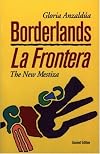
This book is difficult to review because it is so many things at once. Anzaldúa's refusal to limit herself to one language, genre, or way of approaching history and truth resulted in my feeling enlightened, challenged, corrected, seen, and inspired. I finished this book with a deeper understanding of not only the physical and metaphorical borderlands Anzaldúa inhabited but also the complexity, struggle, and beauty of borderlands in general. I look forward to finding time to read this book show more again someday as I believe there is too much within it to get from one reading. show less

I read the second edition of this book for a Latina/o Studies class in college, and found it such a powerful experience that I began pushing it on all my friends. One of them finally took me up on my offer to borrow it, and predictably, it is now lost somewhere in Mumbai!
A collection of essays and poems, written in both English and Spanish, Borderlands/La Frontera was a ground-breaking book that helped pave the way for the concept of "border studies." Brilliant, and at time bitter, it show more explores the border as a psychological construct, in which different strands of identity meet, and frequently clash. The physical border, in Anzaldua's case, is the U.S./Mexico border in Texas. But equally important, and equally real for the author, are the cultural, gender, and sexual boundaries that intersect her life. As a Tejana, Chicana, American, woman, feminist, and lesbian, Anzaldua has quite a few conflicting identities to try and reconcile, and her documentation of their not-so-peaceful co-existence makes for moving and, at times, uncomfortable reading.
As a straight, Anglo (a term that I don't necessarily accept, but will use here for simplicity) woman, I was amazed at how directly some of Anzaldua's narrative spoke to my own life experiences. I can recall moments of almost breathless wonder, as I read passages that finally gave voice to inchoate thoughts and feelings, vaguely-sensed but never expressed. This, I feel, is the author's true strength: her narrative voice, in the expression of her own experiences. As a theorist and educator, I am not so sure. I've heard some stories about her classroom that make me glad I was never her student... show less
A collection of essays and poems, written in both English and Spanish, Borderlands/La Frontera was a ground-breaking book that helped pave the way for the concept of "border studies." Brilliant, and at time bitter, it show more explores the border as a psychological construct, in which different strands of identity meet, and frequently clash. The physical border, in Anzaldua's case, is the U.S./Mexico border in Texas. But equally important, and equally real for the author, are the cultural, gender, and sexual boundaries that intersect her life. As a Tejana, Chicana, American, woman, feminist, and lesbian, Anzaldua has quite a few conflicting identities to try and reconcile, and her documentation of their not-so-peaceful co-existence makes for moving and, at times, uncomfortable reading.
As a straight, Anglo (a term that I don't necessarily accept, but will use here for simplicity) woman, I was amazed at how directly some of Anzaldua's narrative spoke to my own life experiences. I can recall moments of almost breathless wonder, as I read passages that finally gave voice to inchoate thoughts and feelings, vaguely-sensed but never expressed. This, I feel, is the author's true strength: her narrative voice, in the expression of her own experiences. As a theorist and educator, I am not so sure. I've heard some stories about her classroom that make me glad I was never her student... show less
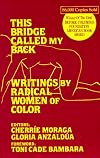
For some reason I went into this thinking it was some sort of feminist manifesto, but it's an anthology of experiences of women of color, told through essays, poetry, biography and only sometimes political manifesto. It focuses particularly on experiences in feminism and those interpreted through feminist ideas but the focus is by no means exclusive. It has some limitations within its remit such as those mentioned in the introduction - eg limited to the US, almost exclusively talks about show more lesbian sexuality - but does an excellent job of covering a broad spectrum of experiences and voices. A lot of the writing is only a few pages so a lot of people and a lot of different perspectives get covered - even though I disagree with some of the politics etc it's inevitable and interesting and important to see it talked about. Reading about experiences from nearly 35 years ago and their hopes for change is inspiring and sometimes sad. Ultimately I have trouble faulting it, as long as you go in realising it's an anthology of experiences, all of which are emotional and interesting. show less
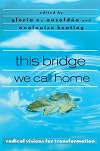
this was mostly such a slog for me. partly it's that it's largely (not enough, but still, quite a bit) outdated, which is great. so it serves almost more as an historical document than a series of essays i was interested in reading for content. but also the entire first third (the hardest part for me) was essay after essay talking about the book that came before this. i'm glad it had such an impact but i don't need a book talking about the impact of another book. it felt worthless, if i'm show more being honest. it became more interesting as it went further on, but still so many of the essays were tough for me to get through. i had an easier time with the poetry, most of which was really powerful. there were a few standout essays and stories; most notably for me were the joy harjo story and the chandra ford essay.
i did note such an interesting point, that we (white liberals, specifically, being called out in this essay) always say 'they're just like us' as a way of supposed community and commonality, but we'd never ever say 'we're just like them.' what a powerful inversion that shows so much. show less
i did note such an interesting point, that we (white liberals, specifically, being called out in this essay) always say 'they're just like us' as a way of supposed community and commonality, but we'd never ever say 'we're just like them.' what a powerful inversion that shows so much. show less
Lists
Awards


You May Also Like


Associated Authors
Statistics
- Works
- 26
- Also by
- 60
- Members
- 4,873
- Popularity
- #5,158
- Rating
- 4.1
- Reviews
- 33
- ISBNs
- 62
- Languages
- 3
- Favorited
- 7
