
Daisy Hernández
Author of Colonize This! Young Women of Color on Today's Feminism
About the Author
Image credit: Daisy Hernandez
Works by Daisy Hernández
The Kissing Bug: A True Story of a Family, an Insect, and a Nation's Neglect of a Deadly Disease (2021) 109 copies, 4 reviews
Associated Works
Manning up: transsexual men on finding brotherhood, family and themselves (2014) — Afterword — 35 copies
Tagged
Common Knowledge
- Canonical name
- Hernández, Daisy
- Birthdate
- 1975-05-23
- Gender
- female
- Education
- William Paterson College (BA|English)
New York University (MA|Journalism and Latin American Studies) - Nationality
- USA
- Birthplace
- Union City, New Jersey, USA
- Associated Place (for map)
- New Jersey, USA
Members
Reviews

Rating: 4* of five
The Publisher Says: A provocative, personal, blazingly intelligent examination of one of the most vexing questions facing the United States today—who is, and should be, a citizen?
“How did ‘Give me your tired, your poor, your huddled masses yearning to breathe free’ turn upside down to where we are today? Everyone needs to read this book, citizens and non-citizens alike. Brilliant!”—Sandra Cisneros
"The most comprehensive book on citizenship/immigration I've ever show more read. A must-read!"—Javier Zamora
In this one-of-a-kind book, Daisy Hernández fiercely interrogates one of the most complicated subjects of contemporary life and citizenship. Braiding memoir, history, and cultural criticism, she exposes the truths and lies of how we define ourselves as a country and a people. Turning to her own family's stories—her mother arrived from Colombia, her father a political refugee from Castro's Cuba—Hernández shows how the very idea of citizenship is a myth and part of the stories we tell ourselves about the American soul and psyche.
Reframing our understanding of what it means to be an American, Notes on Citizenship is an urgent and necessary account of the laws, customs, and language we use to include and exclude, especially those who come from Latin America. With her scholar's mind and memoirist's gift for narrative, Hernández weaves a story both personal and national, while reckoning with our country's ongoing debate about who belongs and providing fresh ways of thinking about citizenship. At once bracing, fearless, and tender, Notes on Citizenship is a powerful portrait of one family's experiences in the borderlands of citizenship and an honest illumination of the country in which we live.
I RECEIVED A DRC FROM THE PUBLISHER VIA NETGALLEY. THANK YOU.
My Review: The Supreme Court has heard oral arguments on the deeply contentious topic of ending the age-old concept of "birthright citizenship," very much in the current regime's sights for elimination. Based on the Justice's tenor of questioning the Justice Department's counsel, I don't feel the regime can count on the ruling being in their favor.
This collection of essays has as its core a desire to think through how citizenship has changed in practice. The US Constitution defines citizenship in the Fourteenth Amendment, and it's pretty unambiguous about it. (That same amendment gifted us with the legal horror of corporate personhood.) It's been a longstanding desire of racist, fascist scum to make the idea of citizenship into a conditional grant...which, if anyone though about it for a single minute, would mean there's no citizenship for anyone at all.
Author Daisy thinks through the various ramifications of this terrible idea. Once a right is "granted" it can be taken away. That is why every time a law is passed that limits a right, like birthright citizenship, you...you personally...are at risk of losing whatever right it is. If this kakistocracy has not taught you the lesson that believing "they wouldn't/can't do that" is a dangerous illusion, read Author Daisy's essays. They can, and they will, and even court orders will not force the scum to cease and desist from illegal, immoral behavior. Look how many losses in court have been dealt the regime; yet no sign of meaningful compliance, compliance with the *intent* of the orders and laws, exists. This is, in other words, a coup against the form of government we take for granted.
Read these essays, even though the collection feels thematically scattered, because each essay is very clearly argued, and makes excellent points. It is a slowly unfolding disaster but it is unfolding...it's time to pull your socks up and do the work of citizenship.
Follow Author Daisy's example. show less
The Publisher Says: A provocative, personal, blazingly intelligent examination of one of the most vexing questions facing the United States today—who is, and should be, a citizen?
“How did ‘Give me your tired, your poor, your huddled masses yearning to breathe free’ turn upside down to where we are today? Everyone needs to read this book, citizens and non-citizens alike. Brilliant!”—Sandra Cisneros
"The most comprehensive book on citizenship/immigration I've ever show more read. A must-read!"—Javier Zamora
In this one-of-a-kind book, Daisy Hernández fiercely interrogates one of the most complicated subjects of contemporary life and citizenship. Braiding memoir, history, and cultural criticism, she exposes the truths and lies of how we define ourselves as a country and a people. Turning to her own family's stories—her mother arrived from Colombia, her father a political refugee from Castro's Cuba—Hernández shows how the very idea of citizenship is a myth and part of the stories we tell ourselves about the American soul and psyche.
Reframing our understanding of what it means to be an American, Notes on Citizenship is an urgent and necessary account of the laws, customs, and language we use to include and exclude, especially those who come from Latin America. With her scholar's mind and memoirist's gift for narrative, Hernández weaves a story both personal and national, while reckoning with our country's ongoing debate about who belongs and providing fresh ways of thinking about citizenship. At once bracing, fearless, and tender, Notes on Citizenship is a powerful portrait of one family's experiences in the borderlands of citizenship and an honest illumination of the country in which we live.
I RECEIVED A DRC FROM THE PUBLISHER VIA NETGALLEY. THANK YOU.
My Review: The Supreme Court has heard oral arguments on the deeply contentious topic of ending the age-old concept of "birthright citizenship," very much in the current regime's sights for elimination. Based on the Justice's tenor of questioning the Justice Department's counsel, I don't feel the regime can count on the ruling being in their favor.
This collection of essays has as its core a desire to think through how citizenship has changed in practice. The US Constitution defines citizenship in the Fourteenth Amendment, and it's pretty unambiguous about it. (That same amendment gifted us with the legal horror of corporate personhood.) It's been a longstanding desire of racist, fascist scum to make the idea of citizenship into a conditional grant...which, if anyone though about it for a single minute, would mean there's no citizenship for anyone at all.
Author Daisy thinks through the various ramifications of this terrible idea. Once a right is "granted" it can be taken away. That is why every time a law is passed that limits a right, like birthright citizenship, you...you personally...are at risk of losing whatever right it is. If this kakistocracy has not taught you the lesson that believing "they wouldn't/can't do that" is a dangerous illusion, read Author Daisy's essays. They can, and they will, and even court orders will not force the scum to cease and desist from illegal, immoral behavior. Look how many losses in court have been dealt the regime; yet no sign of meaningful compliance, compliance with the *intent* of the orders and laws, exists. This is, in other words, a coup against the form of government we take for granted.
Read these essays, even though the collection feels thematically scattered, because each essay is very clearly argued, and makes excellent points. It is a slowly unfolding disaster but it is unfolding...it's time to pull your socks up and do the work of citizenship.
Follow Author Daisy's example. show less

This has been sitting around for awhile; I'm sure glad I picked it up out of the "to be read" pile.
Although labeled a "memoir", it's really a collection of essays, most of which have been published elsewhere. As a result, Hernández' story is not told in a chronological way, but rather in themes. It works.
Her parents were both immigrants to New York, her father from Cuba, her mother from Colombia. So Hernández grew up in multiple cultures, and these essays describe how she navigated divides show more of language, class, gender, sexuality, and came to appreciate and admire her family even as she moved into a life very different from theirs, a transition so common to first-generation Americans.
She has a real ear for language, particularly descriptive language. Her contrasting descriptions of two santeras, for instance: "La Viejita María is a woman who looks like dried corn. Her face is a light yellow, the skin dry and wrinkled; her white hair like a husk, with silk threads pulled back and running wild around her head" annd "Yvette is a woman who looks like a church bell. Her copper body curves with purpose, angles on a chair as if from a tower overlooking a village by the sea." Language for her is music: "The women in my family insist that I translated in those years, that I was the song between Tía Dora and the nurse . . . danced from English to Spanish and Spanglish and back again, following the music of questions . . ." show less
Although labeled a "memoir", it's really a collection of essays, most of which have been published elsewhere. As a result, Hernández' story is not told in a chronological way, but rather in themes. It works.
Her parents were both immigrants to New York, her father from Cuba, her mother from Colombia. So Hernández grew up in multiple cultures, and these essays describe how she navigated divides show more of language, class, gender, sexuality, and came to appreciate and admire her family even as she moved into a life very different from theirs, a transition so common to first-generation Americans.
She has a real ear for language, particularly descriptive language. Her contrasting descriptions of two santeras, for instance: "La Viejita María is a woman who looks like dried corn. Her face is a light yellow, the skin dry and wrinkled; her white hair like a husk, with silk threads pulled back and running wild around her head" annd "Yvette is a woman who looks like a church bell. Her copper body curves with purpose, angles on a chair as if from a tower overlooking a village by the sea." Language for her is music: "The women in my family insist that I translated in those years, that I was the song between Tía Dora and the nurse . . . danced from English to Spanish and Spanglish and back again, following the music of questions . . ." show less
 This review was written for LibraryThing Early Reviewers.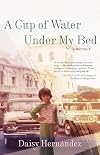
In reading A Cup of Water Under My Bed I pictured Daisy Hernandez's childhood as a kind of tightrope dance. She learned to walk a straight and narrow line between varying beliefs and experiences concerning religion (Catholic versus Santeria), language (English versus Spanish), society (wealthy versus poverty), culture (American versus Cuban-Columbian), and even relationships (abuse versus love) and sex (straight, bisexual and lesbian). Navigating her coming of age through these conflicting show more influences, Hernandez emerges as compassionate and intelligent. She has the ability to articulate the difficulties of childhood (her father's alcoholism and abuse) as well as the innocence of childhood (stealing candies and eavesdropping on adult conversations). When she has to hide her sexuality from her aunt in order to have a relationship with her it breaks my heart. As it was they stopped speaking for seven years when her tia heard Hernandez has kissed a girl. Of course there is more to the story than this. Just go read it. Again. show less
This review was written for LibraryThing Early Reviewers."Over and over again, this truth: Writing is how I leave my family and how I take them with me."
I have been sitting with this one for over a week because I just didn't have the words for the emotions I felt during and after reading this one. A Cup of Water Under the Bed by Daisy Hernandez had masterful prose, descriptive and emotional writing that speaks to your soul and makes you contemplate and reconcile your feelings about language, being tethered to a homeland and how to navigate your show more own identity. It is an ode to the power of language and how it shapes our interactions with people, places and things. It explored this idea that not every word has a literal translation, that some have context and experience that do not translate and how it is okay to allow such language to just exist and belong to its intended group.
The one word that comes to mind to describe this book's main theme is "reckoning":
☆ reckoning with being bilingual, one language feels like pebbles on the tongue while the other feels like home
☆ reckoning with the bittersweetness of American Dream and who reaps the benefits
☆ reckoning with the humanity and imperfections of parents
☆ reckoning with learning to love family despite the hurt and forgiveness
☆ reckoning with sexuality and identity within the rigidity of Latinx culture
☆ reckoning with feminism in a world dominated by machismo and patriarchy
☆ reckoning with the disparities in income, education, financial literacy and access to social capital as a Latinx person
☆ reckoning with faith and spiritual practices and colonialism
☆ reckoning with what healing looks like
☆ reckoning with assimilation vs. tradition
☆ reckoning with gender based violence and the social inequalities women face
☆ reckoning with the guilt of being a child of immigrants and not living up to expectations
Alot of the author's experiences resonated with me on a personal level. There were times when I felt like she was describing my own parents' experiences. This book helped me to see how our imperfections can also be beautiful and tell a story rich in history and resilience.
Bookdragon Rating: 🔥🔥🔥🔥🔥 show less
I have been sitting with this one for over a week because I just didn't have the words for the emotions I felt during and after reading this one. A Cup of Water Under the Bed by Daisy Hernandez had masterful prose, descriptive and emotional writing that speaks to your soul and makes you contemplate and reconcile your feelings about language, being tethered to a homeland and how to navigate your show more own identity. It is an ode to the power of language and how it shapes our interactions with people, places and things. It explored this idea that not every word has a literal translation, that some have context and experience that do not translate and how it is okay to allow such language to just exist and belong to its intended group.
The one word that comes to mind to describe this book's main theme is "reckoning":
☆ reckoning with being bilingual, one language feels like pebbles on the tongue while the other feels like home
☆ reckoning with the bittersweetness of American Dream and who reaps the benefits
☆ reckoning with the humanity and imperfections of parents
☆ reckoning with learning to love family despite the hurt and forgiveness
☆ reckoning with sexuality and identity within the rigidity of Latinx culture
☆ reckoning with feminism in a world dominated by machismo and patriarchy
☆ reckoning with the disparities in income, education, financial literacy and access to social capital as a Latinx person
☆ reckoning with faith and spiritual practices and colonialism
☆ reckoning with what healing looks like
☆ reckoning with assimilation vs. tradition
☆ reckoning with gender based violence and the social inequalities women face
☆ reckoning with the guilt of being a child of immigrants and not living up to expectations
Alot of the author's experiences resonated with me on a personal level. There were times when I felt like she was describing my own parents' experiences. This book helped me to see how our imperfections can also be beautiful and tell a story rich in history and resilience.
Bookdragon Rating: 🔥🔥🔥🔥🔥 show less
Lists
Awards


You May Also Like


Associated Authors
Statistics
- Works
- 4
- Also by
- 5
- Members
- 892
- Popularity
- #28,723
- Rating
- 4.1
- Reviews
- 24
- ISBNs
- 25
- Languages
- 1
- Favorited
- 1
