
Robert Chandler (1) (1953–)
Author of Russian Short Stories from Pushkin to Buida
For other authors named Robert Chandler, see the disambiguation page.
Works by Robert Chandler
Associated Works
Life and Fate (1984) — Translator, some editions; Introduction, some editions — 4,150 copies, 100 reviews
The Captain's Daughter (1831) — Introduction & Translation, some editions — 1,234 copies, 28 reviews
Soul: And Other Stories (2008) — Translator, some editions; Introduction, some editions — 362 copies, 5 reviews
An Armenian Sketchbook (1998) — Translator, some editions; Introduction, some editions — 299 copies, 8 reviews
Happy Moscow (1991) — Translator, some editions; Introduction, some editions — 169 copies, 3 reviews
Rasputin and other ironies (2016) — Editor, some editions; Translator, some editions — 147 copies, 5 reviews
Tagged
Common Knowledge
- Canonical name
- Chandler, Robert
- Birthdate
- 1953
- Gender
- male
- Education
- University of Leeds (AB)
- Occupations
- poet
translator - Short biography
- Robert Chandler (b. 1953) is a British poet and translator. He is the editor of Russian Short Stories from Pushkin to Buida (Penguin) and the author of Alexander Pushkin (Hesperus).
His translations include numerous works by Andrei Platonov, Vasily Grossman's Life and Fate, and Pushkin's The Captain's Daughter. Chandler's co-translation of Platonov's Soul was chosen in 2004 as “best translation of the year from a Slavonic language” by the American Association of Teachers of Slavic and East European Languages (AATSEEL). His translation of Hamid Ismailov’s The Railway won the AATSEEL prize for Best Translation into English in 2007,[1] and received a special commendation from the judges of the 2007 Rossica Translation Prize. Chandler’s translations of Sappho and Guillaume Apollinaire are published in the Everyman’s Poetry series. - Nationality
- UK
- Associated Place (for map)
- UK
Members
Reviews

This is a fantastic biography of Alexander Pushkin, widely considered Russia’s greatest poet and founder of modern Russian literature. Even if you’re familiar with his story, you’ll probably learn something, but Chandler doesn’t overwhelm us with superfluous detail or a tome. In fact, since Pushkin was known for his concision and restraint, it seems Chandler’s concise history is perfectly tuned to his subject. I appreciated his care in stating when there were areas of uncertainty show more or conjecture, making clear his sources and reasons why they might be doubted when that was appropriate. Most of all, I appreciate his insight into a truly gifted man, including his flaws.
It’s hard to state just how big an impact Pushkin’s writing had on Russian’s of his day, as it was so clever, full of grace, and advanced the national language, though Chandler relates anecdotes that help us understand. He explains meanings, or possible meanings in Pushkin’s prose and poetry. He gives a very interesting account of the tragic duel that took his life at 37, including the humiliations both men inflicted on each other, and in Pushkin’s case, even after D’Anthes had relented relative to Natalya and had married her sister instead. Pushkin’s reputation which would grow over the years, particularly after Dostoevsky’s speech to commemorate a statue of him in Moscow in 1880, and Chandler includes a great summary of the attempts various groups have made over to appropriate his legacy.
Some additional tidbits…
- “By the age of ten, according to his sister, Pushkin had read Plutarch, the Iliad and the Odyssey in French, and much of the eighteenth-century literature in his father’s library. In other respects, however, he was a poor student, and he seems to have failed, even as an adult, to master basic arithmetic.” Also: “By the end of his life he had acquired a library of 4,000 volumes, in fourteen languages.”
- His African great-grandfather Abram Gannibal’s story is fascinating as well – taken by Islamic slave-traders to Constantinople as a boy, then taken to Moscow by Peter the Great who would become his godfather, and befriending Diderot and Voltaire after being sent to France to study.
- Chandler describes an inkwell that Pushkin was given as a gift by Pavel Nashchokin and treasured, showing a black man leaning against an anchor in front of two bales of cotton; I recall seeing this in my favorite room of his house museum in St. Petersburg, the library.
- Pushkin was quite a womanizer, chasing all sorts of women and occasionally prostitutes, and suffering bouts of venereal disease as a result. In one amusing line, Chandler says “It is uncertain whether Pushkin ever slept with Praskovya [a neighbor in her 40’s], but we know that he had sex with a startling number of her daughters and nieces.” His affair with Karolina Sobanska, a Polish woman who was sophisticated, intelligent, and sexually experienced – everything his eventual wife Natalya Goncharova was not – makes for an interesting comparison.
- Pushkin’s writing on freedom and his association with the Decembrists (personally knowing at least 12 of them) would get him exiled to the south of Russia for four years by Alexander I, and monitored closely and censored by Nicholas I – and yet, he was so careless that revolutionary groups never let him into their inner circles. His relationship with Nicholas was apparently more nuanced than many reduce it to.
- He was irascible and showed a lot of bravado; in one of his many duels earlier in life, he arrived with a hatful of cherries and ate them while his opponent took the first shot.
- “While living in St. Petersburg, he would sometimes get up early, walk the sixteen miles to Tsarskoye Selo, have lunch, wander about the parks and then walk back home again.”
- Pushkin’s ‘Mozart and Salieri’ from his ‘Little Tragedies’ gave Peter Shaffer the idea for Amadeus, and while Pushkin has often been compared to Mozart because of his genius, Chandler makes the point that he was also diligent and hard-working, like Salieri. To research his work on Pugachov, he read over a thousand pages of documents over eleven days, summarizing some and copying others down in full, and then later travelled to Kazan, Orenburg, and the Urals to interview eyewitnesses who were around in the early 1770’s.
- Fascinating, and cringe-worthy: “To be a good husband, he had to banish thoughts of the Polish Karolina Sobanska; to get his ‘Comedy’ published, he had to excise from it any elements that could be seen as pro-Polish; to become Historian Laureate, he had to defend the Russian invasion of Poland. Lastly, his enemy Bulgarin, was of Polish origin. In a letter of December 1830, Pushkin wrote that he hoped that the coming war against Poland would be a ‘war of extermination’. It is possible that, at some deeper level of his mind, he might have meant ‘a war against all elements that might threaten his new position in the world’ – but these are dangerous words, no matter how one interprets them.” It’s hard to take the more forgiving view Chandler offers, when Pushkin would also later say that “it is as futile for the Poles to rebel against Moscow as for Yevgeny to threaten the Bronze Horseman,” referring of course to his famous poem. show less
It’s hard to state just how big an impact Pushkin’s writing had on Russian’s of his day, as it was so clever, full of grace, and advanced the national language, though Chandler relates anecdotes that help us understand. He explains meanings, or possible meanings in Pushkin’s prose and poetry. He gives a very interesting account of the tragic duel that took his life at 37, including the humiliations both men inflicted on each other, and in Pushkin’s case, even after D’Anthes had relented relative to Natalya and had married her sister instead. Pushkin’s reputation which would grow over the years, particularly after Dostoevsky’s speech to commemorate a statue of him in Moscow in 1880, and Chandler includes a great summary of the attempts various groups have made over to appropriate his legacy.
Some additional tidbits…
- “By the age of ten, according to his sister, Pushkin had read Plutarch, the Iliad and the Odyssey in French, and much of the eighteenth-century literature in his father’s library. In other respects, however, he was a poor student, and he seems to have failed, even as an adult, to master basic arithmetic.” Also: “By the end of his life he had acquired a library of 4,000 volumes, in fourteen languages.”
- His African great-grandfather Abram Gannibal’s story is fascinating as well – taken by Islamic slave-traders to Constantinople as a boy, then taken to Moscow by Peter the Great who would become his godfather, and befriending Diderot and Voltaire after being sent to France to study.
- Chandler describes an inkwell that Pushkin was given as a gift by Pavel Nashchokin and treasured, showing a black man leaning against an anchor in front of two bales of cotton; I recall seeing this in my favorite room of his house museum in St. Petersburg, the library.
- Pushkin was quite a womanizer, chasing all sorts of women and occasionally prostitutes, and suffering bouts of venereal disease as a result. In one amusing line, Chandler says “It is uncertain whether Pushkin ever slept with Praskovya [a neighbor in her 40’s], but we know that he had sex with a startling number of her daughters and nieces.” His affair with Karolina Sobanska, a Polish woman who was sophisticated, intelligent, and sexually experienced – everything his eventual wife Natalya Goncharova was not – makes for an interesting comparison.
- Pushkin’s writing on freedom and his association with the Decembrists (personally knowing at least 12 of them) would get him exiled to the south of Russia for four years by Alexander I, and monitored closely and censored by Nicholas I – and yet, he was so careless that revolutionary groups never let him into their inner circles. His relationship with Nicholas was apparently more nuanced than many reduce it to.
- He was irascible and showed a lot of bravado; in one of his many duels earlier in life, he arrived with a hatful of cherries and ate them while his opponent took the first shot.
- “While living in St. Petersburg, he would sometimes get up early, walk the sixteen miles to Tsarskoye Selo, have lunch, wander about the parks and then walk back home again.”
- Pushkin’s ‘Mozart and Salieri’ from his ‘Little Tragedies’ gave Peter Shaffer the idea for Amadeus, and while Pushkin has often been compared to Mozart because of his genius, Chandler makes the point that he was also diligent and hard-working, like Salieri. To research his work on Pugachov, he read over a thousand pages of documents over eleven days, summarizing some and copying others down in full, and then later travelled to Kazan, Orenburg, and the Urals to interview eyewitnesses who were around in the early 1770’s.
- Fascinating, and cringe-worthy: “To be a good husband, he had to banish thoughts of the Polish Karolina Sobanska; to get his ‘Comedy’ published, he had to excise from it any elements that could be seen as pro-Polish; to become Historian Laureate, he had to defend the Russian invasion of Poland. Lastly, his enemy Bulgarin, was of Polish origin. In a letter of December 1830, Pushkin wrote that he hoped that the coming war against Poland would be a ‘war of extermination’. It is possible that, at some deeper level of his mind, he might have meant ‘a war against all elements that might threaten his new position in the world’ – but these are dangerous words, no matter how one interprets them.” It’s hard to take the more forgiving view Chandler offers, when Pushkin would also later say that “it is as futile for the Poles to rebel against Moscow as for Yevgeny to threaten the Bronze Horseman,” referring of course to his famous poem. show less

After I read the wonderful collection of Russian Short Stories from Pushkin to Buida, also edited and selected by Robert Chandler, I snapped up this one. "Magic tales" include folk tales, and this book contains real folk tales collected by folklorists from around Russia, as well as versions of magic tales as created by noted writers, including Pushkin, Teffi, Bazhov, and Platonov. I am a Platonov fan, and I was most taken by his tales (or perhaps, because I read them last, I am most under show more their spell, as I read this book off and on over the course of six weeks or so).
Chandler notes in his introduction that magic tales, in their original folk versions, way back when, were often filled with sex and violence, and so were restricted to men. The versions that have come down to us in the west as fairy tales for children were stripped of much of this.
Animals play a huge role in these stories, often seeking help from people. The people who help them in turn gain their help in magical situations. Often, there is a good sister and a bad sister; often there are groups of three brothers or sisters in which the first two fail and the third succeeds because she listens to the animals or old ladies, who may or may not be Baba Yagas (the witch equivalents in Russian tales). Baba Yagas are so important in Russian folklore that there is an essay on them at the end of this book, which also contains copious notes. Often too, people must travel long distances, and often seem to do so magically. And there are forest spirits and mountain spirits. Class differences also play a role, in the sense of poor peasants and rich tsars (there seem to be tsars for every region, not one tsar over all of Russia).
I enjoyed this book, although not as much as the previous collection, as I don't have as big an interest in magic tales as I do in Russian fiction overall. I probably would also have gotten more out of it if I hadn't dipped in and out of it. As it is, I preferred the versions created by authors to the versions collected by folklorists, although I found some of them quite striking. They probably would be more of interest, in general, to people who are fascinated by fairy tales. show less
Chandler notes in his introduction that magic tales, in their original folk versions, way back when, were often filled with sex and violence, and so were restricted to men. The versions that have come down to us in the west as fairy tales for children were stripped of much of this.
Animals play a huge role in these stories, often seeking help from people. The people who help them in turn gain their help in magical situations. Often, there is a good sister and a bad sister; often there are groups of three brothers or sisters in which the first two fail and the third succeeds because she listens to the animals or old ladies, who may or may not be Baba Yagas (the witch equivalents in Russian tales). Baba Yagas are so important in Russian folklore that there is an essay on them at the end of this book, which also contains copious notes. Often too, people must travel long distances, and often seem to do so magically. And there are forest spirits and mountain spirits. Class differences also play a role, in the sense of poor peasants and rich tsars (there seem to be tsars for every region, not one tsar over all of Russia).
I enjoyed this book, although not as much as the previous collection, as I don't have as big an interest in magic tales as I do in Russian fiction overall. I probably would also have gotten more out of it if I hadn't dipped in and out of it. As it is, I preferred the versions created by authors to the versions collected by folklorists, although I found some of them quite striking. They probably would be more of interest, in general, to people who are fascinated by fairy tales. show less

"A short yet fascinating account of Russia's most celebrated writer. " And that's it in a nut-shell.
I was initially drawn to this work as I have been reading many "Pushkin Press" titles and was intrigued - was this publishing company named after or in honour of the man, Pushkin? And if so, why was he so deserving of such an honour?
Apart from being one of Russia's great historians and poets who left a lasting literary legacy, his own story was larger than life.
A man whose family was from the show more old Russian nobility, who were loyal to Peter III, fell under Catherine the Great; whose maternal great-grandfather was referred to as the "Blackamoor" of Peter the Great. Pushkin himself lived on the edge - from an early age, his life was dedicated to writing, poetry, women, gambling, did I mention women, drinking, politics, theatre, frivolity - a dissolute life by all standards which led to duelling, imprisonment, exile, then repeat again and again - ".... only the intervention of friends and the dowager empress forestalled a worse fate and not for the first time ..." A man who lived a charmed life, though towards the end, this lavish lifestyle led to his latter years spent in debt and ended in a fatal duel (1837).
I doubt very much any writer of fiction could have created such an extraordinary life for any character. I very much want to track down and read not only is poetry but more indepth biographies. show less
I was initially drawn to this work as I have been reading many "Pushkin Press" titles and was intrigued - was this publishing company named after or in honour of the man, Pushkin? And if so, why was he so deserving of such an honour?
Apart from being one of Russia's great historians and poets who left a lasting literary legacy, his own story was larger than life.
A man whose family was from the show more old Russian nobility, who were loyal to Peter III, fell under Catherine the Great; whose maternal great-grandfather was referred to as the "Blackamoor" of Peter the Great. Pushkin himself lived on the edge - from an early age, his life was dedicated to writing, poetry, women, gambling, did I mention women, drinking, politics, theatre, frivolity - a dissolute life by all standards which led to duelling, imprisonment, exile, then repeat again and again - ".... only the intervention of friends and the dowager empress forestalled a worse fate and not for the first time ..." A man who lived a charmed life, though towards the end, this lavish lifestyle led to his latter years spent in debt and ended in a fatal duel (1837).
I doubt very much any writer of fiction could have created such an extraordinary life for any character. I very much want to track down and read not only is poetry but more indepth biographies. show less
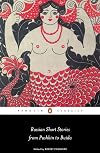
What a treat this anthology was! It brings together short stories from the 19th and 20th centuries, by writers both familiar and new to me, with fascinating introductions by the editor (who also translated many of the stories), Robert Chandler, that put both authors and stories in context. It includes many well-known short story writers, like Pushkin, Chekhov, Gogol, Bulgakov, and more, as well as writers who are better known for their longer works like Dostoyevsky, Tolstoy, and Platonov. It show more omits well-known writers, like Grossman, who almost exclusively wrote longer works.
It was a pleasure for me to be introduced to some writers I had long heard of (and some of whom reside on my TBR), but had never read, like Teffi, Leskov, and Shalamov. I also appreciated being able to read some writers who wrote (and who were even born) after Stalin had died. Then again, I had read some of the stories before, but was glad to reread them. And I was surprised to find I enjoyed Dostoyevsky's story, "Bobok," and indeed found it funny, something I have never associated with Dostoyevsky. All in all, I liked most of the stories Chandler picked, something extraordinarily difficult to achieve in any anthology, but I did feel the better known authors are better known for a reason; their stories are better.
The stories cover a wide range of topics, from personal to political, from life in the country to life in the city, from the realistic to the absurd, from tragic to comic, from touching to outraging. For anyone interested in Russian literature, or anyone who likes short stories, this book is a treasure. show less
It was a pleasure for me to be introduced to some writers I had long heard of (and some of whom reside on my TBR), but had never read, like Teffi, Leskov, and Shalamov. I also appreciated being able to read some writers who wrote (and who were even born) after Stalin had died. Then again, I had read some of the stories before, but was glad to reread them. And I was surprised to find I enjoyed Dostoyevsky's story, "Bobok," and indeed found it funny, something I have never associated with Dostoyevsky. All in all, I liked most of the stories Chandler picked, something extraordinarily difficult to achieve in any anthology, but I did feel the better known authors are better known for a reason; their stories are better.
The stories cover a wide range of topics, from personal to political, from life in the country to life in the city, from the realistic to the absurd, from tragic to comic, from touching to outraging. For anyone interested in Russian literature, or anyone who likes short stories, this book is a treasure. show less
You May Also Like


Associated Authors
Statistics
- Works
- 9
- Also by
- 17
- Members
- 611
- Popularity
- #41,143
- Rating
- 4.1
- Reviews
- 7
- ISBNs
- 23