
Richard Goldstein (1) (1944–)
Author of The Poetry of Rock
For other authors named Richard Goldstein, see the disambiguation page.
About the Author
Image credit: Richard Goldstein
Works by Richard Goldstein
Another Little Piece of My Heart: My Life of Rock and Revolution in the '60s (2015) 39 copies, 3 reviews
US: The Paperback Magazine #3 — Editor — 1 copy
Associated Works
The Columbia Reader on Lesbians & Gay Men in Media, Society, and Politics (1999) — Contributor — 86 copies
Wrestling with Zion: Progressive Jewish-American Responses to the Israeli-Palestinian Conflict (2003) — Contributor — 84 copies, 1 review
Tagged
Common Knowledge
- Birthdate
- 1944
- Gender
- male
- Occupations
- music critic
- Organizations
- Village Voice
- Nationality
- USA
- Places of residence
- Bronx, New York, USA
- Associated Place (for map)
- New York, USA
Members
Reviews

An interesting and mostly successful attempt to identify the poetry in rock lyrics of the Sixties. As in just about any selection, there are notable omissions (no Rolling Stones – what about 'Ruby Tuesday'? – or Jimi Hendrix – 'Castles Made of Sand'?), but a number of the chosen songs do look particularly fine when rendered on the page ('In My Life', 'Darling, Be Home Soon', 'Suzanne', 'White Rabbit' and 'The Sound of Silence' in particular).
It is a limited book: to my show more disappointment, author Richard Goldstein didn't try to show how pop lyricism is a continuation of the traditional poetic form – placing words and meaning into metre and rhythm. (Indeed, the earliest poets like Homer and Sappho composed in metre as the poems weren't written down; the song structure helped them to remember. Whilst this may not be immediately apparent in a modern culture that still sees poetry as something written by Wordsworth or Tennyson, it is worth remembering that conventional poetry and song lyrics share a common ancestor). Rather, Goldstein has a very Sixties view of pop culture (the book was written in 1969) and I can't help but feel he sees rock music as separate-but-equal from conventional poetry; its specialness defined by its newness and countercultural advocacy. This struck me as a rather limited approach; in fact, rock lyricism as poetry has outlasted and outgrown the Sixties counterculture, as shown by the lyric songs of the likes of Tom Waits and Nick Cave.
Nevertheless, Goldstein's advocacy of pop lyricism as poetry is well thought-out: he acknowledges that some songs don't translate well to verse, as there is a strong sense of "sound-as-content" in the form (pg. 4) – i.e. that rhythmic grunts or 'sha-la-las' might be integral to a song but look silly on the page. His argument is based around the strong notion that whilst "all rock lyrics are altered by versification... not all suffer castration as well." (pg. xi). He argues, rightly, that the "impressive awareness of language and a profound sense of rhythm" (pg. xii) evident in some pop lyrics validates them as an art form. Like any medium, rock music can produce both "art and drivel... The crucial factor is not the style [form], but those who choose to work in it." (pg. 6). The great Sixties artists were not conventional 'poets' but the likes of Dylan and Lennon/McCartney; in avoiding written poetry in favour of a electric guitar and a raucous backbeat, they were the latest inheritors of a lyric tradition that had evolved and endured for millennia. show less
It is a limited book: to my show more disappointment, author Richard Goldstein didn't try to show how pop lyricism is a continuation of the traditional poetic form – placing words and meaning into metre and rhythm. (Indeed, the earliest poets like Homer and Sappho composed in metre as the poems weren't written down; the song structure helped them to remember. Whilst this may not be immediately apparent in a modern culture that still sees poetry as something written by Wordsworth or Tennyson, it is worth remembering that conventional poetry and song lyrics share a common ancestor). Rather, Goldstein has a very Sixties view of pop culture (the book was written in 1969) and I can't help but feel he sees rock music as separate-but-equal from conventional poetry; its specialness defined by its newness and countercultural advocacy. This struck me as a rather limited approach; in fact, rock lyricism as poetry has outlasted and outgrown the Sixties counterculture, as shown by the lyric songs of the likes of Tom Waits and Nick Cave.
Nevertheless, Goldstein's advocacy of pop lyricism as poetry is well thought-out: he acknowledges that some songs don't translate well to verse, as there is a strong sense of "sound-as-content" in the form (pg. 4) – i.e. that rhythmic grunts or 'sha-la-las' might be integral to a song but look silly on the page. His argument is based around the strong notion that whilst "all rock lyrics are altered by versification... not all suffer castration as well." (pg. xi). He argues, rightly, that the "impressive awareness of language and a profound sense of rhythm" (pg. xii) evident in some pop lyrics validates them as an art form. Like any medium, rock music can produce both "art and drivel... The crucial factor is not the style [form], but those who choose to work in it." (pg. 6). The great Sixties artists were not conventional 'poets' but the likes of Dylan and Lennon/McCartney; in avoiding written poetry in favour of a electric guitar and a raucous backbeat, they were the latest inheritors of a lyric tradition that had evolved and endured for millennia. show less
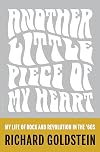
In 1966, twenty-two year old Goldstein walked into the Village Voice and invented the job he wanted: rock critic. During his time doing this, he had some amazing adventures and met a lot of the great rock innovators. He became friends with Janis Joplin, was a passenger in a car driven by a completely stoned Dennis Wilson (who at one point in the trip said “Whoa! The road is doing these weird things.”), and had the Velvet Underground play at his wedding. But in this time of social show more upheaval, music came to seem less important than politics and protests. His beat changed to protests, he became friends with Abbie Hoffman, and hung with the Black Panthers. Later he became a chronicler of pop culture, and then a worker for gay rights.
The book really only spans a few years, but so much happened during that time- the core of the hippie subculture came and went. Music went from being all about the music to selling out to commercial interests. The drug scene went from happy, smiling potheads to bikers selling the hard, injectable stuff. The innocence was lost.
The book is a personal memoir, but Goldstein’s life is inextricably meshed with so much of the history of the time that you cannot tease them apart. He changed as the times did.
I loved reading this book; I was born in 1954 so I was too young to appreciate much of what was happening in the world even though I was aware of it. This was a nice trip back through time, viewed through a critical eye. show less
The book really only spans a few years, but so much happened during that time- the core of the hippie subculture came and went. Music went from being all about the music to selling out to commercial interests. The drug scene went from happy, smiling potheads to bikers selling the hard, injectable stuff. The innocence was lost.
The book is a personal memoir, but Goldstein’s life is inextricably meshed with so much of the history of the time that you cannot tease them apart. He changed as the times did.
I loved reading this book; I was born in 1954 so I was too young to appreciate much of what was happening in the world even though I was aware of it. This was a nice trip back through time, viewed through a critical eye. show less
Another Little Piece of My Heart by Richard Goldstein is the second memoir in recent months by a pioneer of rock criticism. Goldstein, a nerdy, smart Jewish boy who grew up in a working-class family in the Bronx, looked to Manhattan, specifically Greenwich Village, as the "locus of a better life", the place to be with like-minded peers, to hear music, to be saved and to be" less alone'. Involved in the Civil Rights Movement, which further alienated him from his family and community, show more Goldstein went to the graduate program at Columbia University's School of Journalism. It is here that he fell in love with reporting and New Journalism and after graduation Goldstein convinced the Village Voice to give him a beat as their first rock critic. His astute and passionate portrayals of rising rock stars (especially of Janis Joplin) and insights into the developing rock scene allowed him access in New York, San Francisco and wherever he pleased. He writes fervidly of his own growth and development as a writer, critic and political person in the tumultuous 60's. As Goldstein states when describing his reason for being so effective, "it was my passion about the music and what it meant to me....it was about the longing and the craving, the need to possess and adore...I tried to evoke the mythic dimension." For me the heart of the memoir lay in his disillusionment when he saw how quickly rock music became capitalized, commercialized and part of consumer culture and his own role in it. Goldstein sees the impact that the "hype" has on musicians and critics alike and decides that rock music was "no longer a revolutionary force" by 1968. What I admire is his refusal to minimize his despair and the impact that the losses of the era had on him. This spoke to me as a person who is engaged in making political change and the sorrow this brings. It is authentic and real as is this memoir.
I thank NetGalley for giving me this opportunity to review this book. show less
I thank NetGalley for giving me this opportunity to review this book. show less
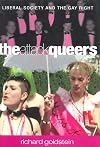
Goldstein warns of the end of the coalition of progressives and LGBTQIA people, and the rise of the queer right. While public opinion has become more conservative, it has not been the end of progressive actions. The SCOTUS rulings in Lawrence v. Texas and United States v. Windsor, have transformed the political landscape. Society has continued to become more progressive, of course climate change, international corporations, and conflicts outside the western world will bring new challenges.
Lists
Awards

You May Also Like


Associated Authors
Statistics
- Works
- 12
- Also by
- 4
- Members
- 327
- Popularity
- #72,481
- Rating
- 3.5
- Reviews
- 8
- ISBNs
- 33