
Andrew Sullivan (1) (1963–)
Author of Virtually Normal
For other authors named Andrew Sullivan, see the disambiguation page.
About the Author
Andrew Sullivan was born in southern England on August 10, 1963. He attended Magdalen College, Oxford, where he took a first in modern history and modern languages. In 1984, he won a Harkness Fellowship to Harvard's John F. Kennedy School of Government. He interned at the Centre for Policy Studies, show more where he wrote a policy paper on the environment entitled Greening the Tories. He received a master's degree in public administration and a Ph.D. in political science from Harvard University. His doctoral thesis, Intimations Pursued: The Voice of Practice in the Conversation of Michael Oakeshott, won the government department prize. He was a senior editor of The New Republic, a contributor to the New York Times Magazine, and a columnist for The Sunday Times (London). He is the author of several books including Virtually Normal: An Argument About Homosexuality, Same-Sex Marriage: Pro and Con, and Love Undetectable: Notes on Friendship, Sex and Survival. He is one of the world's most widely read bloggers. (Bowker Author Biography) show less
Image credit: Wikipedia
Works by Andrew Sullivan
Associated Works
The Columbia Reader on Lesbians & Gay Men in Media, Society, and Politics (1999) — Contributor — 86 copies
Tagged
Common Knowledge
- Legal name
- Sullivan, Andrew Michael
- Birthdate
- 1963-08-10
- Gender
- male
- Education
- University of Oxford (Magdalen College|BA|Modern History & Modern Languages)
Harvard University John F. Kennedy School of Government (MPA ∙ 1986) - Occupations
- journalist
blogger - Organizations
- The New Republic
The New York Times Magazine
Time
The Atlantic Monthly
The Daily Beast
New York - Nationality
- UK
- Birthplace
- Godstone, Surrey, England, UK
- Places of residence
- New York, New York, USA
East Grinstead, West Sussex, England, UK - Associated Place (for map)
- England, UK
Members
Reviews
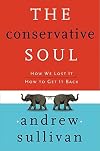
"The Conservative Soul" is a call for all, but especially those who self-apply the term "conservative", to return to a combination of economic liberalism, fiscal restraint, and socio-philosophical skepticism. I'm not sure I would identify that as any kind of "conservative" I've ever known, but it certainly overlaps a lot with the values I identify with.
Sullivan is basically calling for an embrace, or re-embrace as he would have it, of a kind of moderate liberalism (lowercase "l") with an show more extra dose of skepticism and guardedness against utopian thinking of any stripe. In this he reminds me a lot of the writings of John N Gray. He seems to have drawn his influences from other sources however; and Sullivan is explicitly Catholic (though of a very liberal and personal flavor.) I myself had to struggle a bit with his discussion of religion, which reminds me that my probably-anti-theistic attitudes are in many ways a prejudice. He does not go on at the same length, or with the same ill-thought out arguments that other liberal pro-religious writers and thinkers do (I'm thinking specifically of Chris Hedges, if only because I just finished a book by him within the last couple of weeks.)
He is one of a very small handful of conservatives who started pro-Iraq-war and have not only changed their attitude but said, with a few quibbles here or there, "I was wrong." Which, as most people know, are the hardest words to pronounce in just about any language. Separately from that, he also calls out the *refusal* (or inability?) in the modern political environment of people to change their minds, not only because of ideology, but because of the dreaded title "flip-flopper." This also wins him bonus points in my book. show less
Sullivan is basically calling for an embrace, or re-embrace as he would have it, of a kind of moderate liberalism (lowercase "l") with an show more extra dose of skepticism and guardedness against utopian thinking of any stripe. In this he reminds me a lot of the writings of John N Gray. He seems to have drawn his influences from other sources however; and Sullivan is explicitly Catholic (though of a very liberal and personal flavor.) I myself had to struggle a bit with his discussion of religion, which reminds me that my probably-anti-theistic attitudes are in many ways a prejudice. He does not go on at the same length, or with the same ill-thought out arguments that other liberal pro-religious writers and thinkers do (I'm thinking specifically of Chris Hedges, if only because I just finished a book by him within the last couple of weeks.)
He is one of a very small handful of conservatives who started pro-Iraq-war and have not only changed their attitude but said, with a few quibbles here or there, "I was wrong." Which, as most people know, are the hardest words to pronounce in just about any language. Separately from that, he also calls out the *refusal* (or inability?) in the modern political environment of people to change their minds, not only because of ideology, but because of the dreaded title "flip-flopper." This also wins him bonus points in my book. show less
I have always been a fan of The Daily Dish, Sullivan's blog which is hosted at the Atlantic website. To me Sullivan is the antithesis to much of the polemical and ideological rant which passes for political discourse in the media, both in the main stream press and the blogosphere.
Having been raised in a fairly political family and for many years holding what I believed were conservative beliefs, the rise of fundamentalism as a core principle of the Republican party has been difficult for me show more to understand. The attempt to reconcile what I believed to be conservative values of individual liberty with the parties continued assault on personal choice coupled with the expansion of regulation of our lives, proved troublesome.
So when I read Sullivan's book, it was like having the blinders removed. His emphasis on skepticism and reason over the fundamentalist reliance on blind faith resonated with my early Catholic and conservative values. In a day when the eloquent and well-reasoned position is denigrated as elitism, I for one, am proud to be a snob, if that is how one is to be described for preferring an intellectual approach to issues instead of the polemical and simplistic.
His frank discussion of Catholicism and conservatism resonated with me, as he addressed many of the irreconcilable questions that occur in our daily lives and what the proper role of government should be in addressing these issues.
show less
Having been raised in a fairly political family and for many years holding what I believed were conservative beliefs, the rise of fundamentalism as a core principle of the Republican party has been difficult for me show more to understand. The attempt to reconcile what I believed to be conservative values of individual liberty with the parties continued assault on personal choice coupled with the expansion of regulation of our lives, proved troublesome.
So when I read Sullivan's book, it was like having the blinders removed. His emphasis on skepticism and reason over the fundamentalist reliance on blind faith resonated with my early Catholic and conservative values. In a day when the eloquent and well-reasoned position is denigrated as elitism, I for one, am proud to be a snob, if that is how one is to be described for preferring an intellectual approach to issues instead of the polemical and simplistic.
His frank discussion of Catholicism and conservatism resonated with me, as he addressed many of the irreconcilable questions that occur in our daily lives and what the proper role of government should be in addressing these issues.
show less
The passage of 13 years hasn't diminished the quality of the reasoning Sullivan displays here. Nor has it seen a dramatic shift in the four political positions he describes. If anything, his skillful articulation of the strengths and weaknesses of these arguments are that much easier to observe as the debate about gay marriage continues (though the serious discussion about gays in the military has seen comparatively less public discussion). Though this is a book I probably should have read show more long ago, it was no less satisfying to see these ideas expressed. In fact, this was a pleasure to read, and will likely be a pleasure to re-read in the coming years. show less
There's a critique of conservatism that is an ahistoric ideology. That is, it's concerned with the sustaining of institutions, rather that than betting on some grand narrative that will sweep us to a brighter tomorrow.
It's a critique that can be claimed by both old-line National Review conservatives like Bill Buckley and Marxist theorists like Terry Eagleton. I'll leave it to whoever is reading this whether or not this is a useful approach to engagment with the world.
So where is conservatism show more now? Andrew Sullivan, a Thatcherite conservative, asks and doesn't like the answers he gets.
Sullivan thinks the GOP has largely abandoned the libertarian/Federalism lite (very, very lite) Gingrich vision of that launched the ascendancy of the modern GOP.
Suddenly "conservatives" are very comfortable with the idea of federal intervention in what were state domains, education, domestic contracts, etc.
Sullivan argues that conservatism could do well to reclaim some skepticism and humility, to stop claiming a mantle of absolute truth.
Seems like a reasonable thing to me.
Sullivan's prose is direct, thoughtful, and he's not afraid to engage readers with thorny issues. A satisfying book. show less
It's a critique that can be claimed by both old-line National Review conservatives like Bill Buckley and Marxist theorists like Terry Eagleton. I'll leave it to whoever is reading this whether or not this is a useful approach to engagment with the world.
So where is conservatism show more now? Andrew Sullivan, a Thatcherite conservative, asks and doesn't like the answers he gets.
Sullivan thinks the GOP has largely abandoned the libertarian/Federalism lite (very, very lite) Gingrich vision of that launched the ascendancy of the modern GOP.
Suddenly "conservatives" are very comfortable with the idea of federal intervention in what were state domains, education, domestic contracts, etc.
Sullivan argues that conservatism could do well to reclaim some skepticism and humility, to stop claiming a mantle of absolute truth.
Seems like a reasonable thing to me.
Sullivan's prose is direct, thoughtful, and he's not afraid to engage readers with thorny issues. A satisfying book. show less
Lists
Awards

You May Also Like


Associated Authors
Statistics
- Works
- 11
- Also by
- 10
- Members
- 1,400
- Popularity
- #18,343
- Rating
- 3.7
- Reviews
- 12
- ISBNs
- 35
- Languages
- 3