
Bruce Bawer
Author of Stealing Jesus: How Fundamentalism Betrays Christianity
About the Author
Works by Bruce Bawer
While Europe Slept: How Radical Islam is Destroying the West from Within (2006) 478 copies, 11 reviews
The Victims' Revolution: The Rise of Identity Studies and the Closing of the Liberal Mind (2012) 65 copies, 1 review
The Victims' Revolution: The Rise of Identity Studies and the Birth of the Woke Ideology (2023) 8 copies, 1 review
The New Quislings: How the International Left Used the Oslo Massacre to Silence Debate About Islam (2012) 4 copies
The Middle Generation: The Lives and Poetry of Delmore Schwartz, Randall Jarell, John Berryman and Robert Lowell (1986) 3 copies
Associated Works
Beyond the Boom: New Voices on American Life, Culture, and Politics (1990) — Contributor — 15 copies
Tagged
Common Knowledge
- Canonical name
- Bawer, Bruce
- Legal name
- Bawer, Theodore Bruce
- Birthdate
- 1956-10-31
- Gender
- male
- Education
- State University of New York, Stony Brook (BA|English, MA|English, PhD|English)
- Occupations
- journalist
writer
author - Nationality
- USA
- Birthplace
- New York, New York, USA
- Places of residence
- New York, New York, USA
Oslo, Norway
Amsterdam, Netherlands - Associated Place (for map)
- New York, New York, USA
Members
Reviews

Bruce Bawer, author of Diminishing Fictions and The Middle Generation delights the reader with literary essays of the highest order. He is an engaged and stylish critic who addresses readers with intelligence and wit. This collection includes fifteen boldly evaluative and truly humane essays (all collected from "The New Criterion"). He explicates philosophic, religious, mystical, and visionary concerns in a seemingly disparate group of 20th-century writers. The highest accolades go to such show more novelists as William Maxwell, who, with ``conspicuous humility,'' draws us to everyday wonders. Similarly, Penelope Fitzgerald, with her ``sublime sense of the transcendent,'' portrays characters with ``quiet fortitude'' and ``a sense of duty.'' Bawer also reminds us that Flannery O'Connor's masterly stories were grounded in her traditional faith. Always measuring fiction against a sense of reality, Bawer finds many of the most celebrated writers coming up short: For all his mesmerizing brilliance, John Fowles's ``philosophical promiscuity'' leads to much mystical inanity; a clever naturalist and storyteller, Peter Matthiessen indulges in much bad faith, and considers all primitive cultures closer to God. Bawer rightly ignores the accepted wisdom about Graham Greene, and reveals the psychopathological dimension to Greene's peculiar theology. Despite their relative achievements, Baldwin, Lessing, and Updike (in the later Rabbit novels) sacrifice their narrative strengths for questionable politics and sociology. In her best work, Jean Stafford turns her tragic childhood into objective art; Harold Brodkey, on the other hand, remains mired in his own mythology, mistaking ``lexical flatulence for divine afflatus.'' These are reasoned essays from a self-described ``old-fashioned liberal humanist''. Bawer understands that ideas have consequences--and that the best art aspires to something greater than ideology. show less
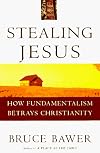
I love the first few chapters of this book with a passion. The next few are fascinating as Bawer traces the invention of millennial dispensationism, substitutionary atonement, and the Rapture in the 1800s in this country. As he moves up into modern day, I used to feel he became somewhat strident and overstating his position...but, among other things, after having a child come to me at work in an anxiety attack because her mother told her that Obama was the devil and the world would come to show more an end if he was elected (true thing--I couldn't make this up!), I am inclined to think that Bawer does not overstate. When I read Bawer, I love his discussion of the vertical dimension of religion as opposed to the horizontal dimension, and see a road to a living Christianity. show less
Stealing Jesus was a hugely wasted opportunity in my opinion. I bought the book because of (a) a recommendation, and (b) because it purports to show how fundamentalism is not the historical faith it claims to be. What I was hoping for was lots of discussion of the historical context that led to the distinctive American fundamentalist theology that we see today (and that is largely at odds with historical Christianity). To some extent this ground was covered in the chapters on Darby and the show more Scofield reference Bible. Even here though, this was not the best treatment I have seen on the subject. Martin Lloyd Jones, in the book “Prove all Things” [published 1985 but based on sermons he delivered in the 1950s], covers this same ground but also uncovers the development of the doctrine of the Secret Rapture from the Irvingite movement. Bawer’s account suggests that the doctrine is Darby’s invention entirely, which is wrong. Bawer’s suggestion that evangelicals are unaware of this development is also belied by the fact that Lloyd Jones and others have been making these same points for decades.
But Bawer’s ignorance of the evangelical tradition that opposes dispensational premillennialism also shows another major deficiency of this work. Bawer’s work is a classic case of over-reach. The book title suggests he is speaking about fundamentalism, but his polemic is delivered against not just fundamentalism but also conservative evangelicalism, Catholicism, Mormonism and indeed any section of the church that seems to hold to any credal statement. For this reason I was mystefied as to what the book intends to do.
To be clear, the book argues that much modern doctrine in the non liberal wing of the church is not historical Christianity. Inasmuch as the example of dispensationalism is presented, the case is well made – but to what end? Because we are invited at the end of the book to abandon any belief that suffers the “legalism” of orthodoxy for a faith that revolves entirely around a love for God and for one another (as Christ commanded of course). This he argues is found only in the liberal churches. But inasmuch as the book points out a lack of historical orthodoxy in modern fundamentalism, it returns in spades to his brand of Christianity which, in the course of this book, denies the doctrine of the virgin birth, the resurrection of Christ, the miracles, much of Paul’s thought, the place of the Old Testament, the authenticity of Ephesians and so much more. Without a doubt there is nothing historical about Bawer’s conception of Christianity either.
Bawer succumbs to the common problem of harking back to a golden age. He writes approvingly of the historical Baptists who stressed tolerance, and of St Francis of Assissi as genuine examples of what Christianity ought to be. But he is wrong if he thinks either of these examples would recognise his brand of Christianity as the historical faith.
To what extent does that matter? Some will argue that if Bawer’s Christianity is the better way then it is just a lamentable reflection on Church history that it took 2000 years to develop, when the Jesus of love is so clearly seen in the gospels. But what gospels? When Bawer discusses Matthew 23 he makes it clear that he feels that this is Matthew’s later addition and not the authentic Jesus. He has already jetisoned the physical resurrection. How do we know that Bawer’s conception of Jesus is the authentic one?
Marcion – the second century theological dualist – did something like what Bawer is doing. He started with a conception of God and then adjusted his Bible to match. The rejoinder was “Marcion reads scripture with a knife”. Bawer does the same. We are fond of saying “what would Jesus do”, but the problem is that the answer to that question is largely informed by our own preconceptions of Jesus. Bawer claims he is a Christian because he has fallen in love with Jesus and his teachings – but it really is not clear that what he considers to be Jesus and his teachings is the historical Jesus and his teachings. As such, this book is fundamentally flawed.
The book is fundamentally flawed also for its over-reach (as I said above). Bawer does something at the start of his book that is quite illegitimate. He writes:
*
‘But it seems to me that the difference between conservative and liberal Christianity may be succinctly summed up by the difference between two key scriptural concepts: law and love. Simply stated , conservative Christianity focuses primarily on law, doctrine and authority; liberal Christianity focuses on love, spiritual experience, and what Baptists call the priesthood of the believer. If the conservative Christians emphasize the Great Commission - the resurrected Christ’s injunction, at the end of the Gospe; according to Matthew, to “go to all nations and make them my disciples” - liberal Christians place more emphasis on the Great Commandment, which in Luke’s Gospel reads as follows: “Love the Lord your God with all your heart, and with all your soul, with all your strength and with all your mind; and your neighbour as yourself.”
‘Am I suggesting that conservative Christians are without love or the liberal Christians are lawless? No. I merely make the distinction: Conservative Christianity understands a Christian to be someone who subscribes to a specific set of the theological propositions about God and the afterlife, and who professes to believe that by subscribing to those propositions, accepting Jesus Christ as saviour, and (except in the case of the extreme separatist fundamentalists) evangelising, he or she evades God’s wrath and wins salvation (for Roman catholics, good works also count); liberal Christianity, meanwhile, tends to identify Christianity with the experience of God’s abundant love and with the commandment to love God and one’s neighbour. If, for conservative Christians, outreach generally means zealous proselytising of the “unsaved,” for liberal Christians it tends to mean social programmes directed at those in need.’
This phrase: “conservative Christianity focuses primarily on law, doctrine and authority; liberal Christianity focuses on love” is wrong in the way that the phrase: “Librarians are old harridans with horn rimmed spectacles and two piece suits” is wrong. We know its wrong because we can find plenty of exceptions to the rule. Nevertheless we have a wry smile because we at least recognise the stereotype.
But having created a stereotype, and having then argued that he is “merely making a distinction” he goes and casts his net wide and suggests that the out-group that will be the focus of his polemic will be henceforth called the legalists, and that this shall include all non liberal forms of Christianity. He misunderstands conservative Christian thought in his generalisation above though when he suggests that for all conservative Christians, salvation is by adherence to a set of propositions about the afterlife, and through evangelism as a work (and for Catholics other good works too). This completely misunderstands the central Protestant tenet of justification by grace through faith. The Protestant position is summed up by Paul’s words in Romans:
‘That if you confess with your mouth, “Jesus is Lord,” and believe in your heart that God raised him from the dead, you will be saved’ (Romans 10:9)
Interestingly Bawer suggests the original formulation of the doctrine (the one that he approves of) was just the profession that Jesus is Lord. He handily forgets: “and believe in your heart that God raised him from the dead”. He does not explain why he omits the latter. In fact generally his work is lamentably short of footnotes that might serve to explain his many leaps of logic that leave one scratching one’s head.
But in any case, insamuch as conservative protestants believe that we are justified by grace through faith alone, Bawer’s argument that these people should be called legalists entirely misses its mark. He is wrong to say that the belief of protestants is that the doctrines of the afterlife must be subscribed to, because it is quite clear that adherents to the doctrine of justification by faith agree with Hooker that one need not know they are justified by faith to be justified by faith.
I have written more detail on my blog:
http://safle.org/wordpress/2009/06/08/stealing-jesus-how-fundamentalism-betrays-... show less
But Bawer’s ignorance of the evangelical tradition that opposes dispensational premillennialism also shows another major deficiency of this work. Bawer’s work is a classic case of over-reach. The book title suggests he is speaking about fundamentalism, but his polemic is delivered against not just fundamentalism but also conservative evangelicalism, Catholicism, Mormonism and indeed any section of the church that seems to hold to any credal statement. For this reason I was mystefied as to what the book intends to do.
To be clear, the book argues that much modern doctrine in the non liberal wing of the church is not historical Christianity. Inasmuch as the example of dispensationalism is presented, the case is well made – but to what end? Because we are invited at the end of the book to abandon any belief that suffers the “legalism” of orthodoxy for a faith that revolves entirely around a love for God and for one another (as Christ commanded of course). This he argues is found only in the liberal churches. But inasmuch as the book points out a lack of historical orthodoxy in modern fundamentalism, it returns in spades to his brand of Christianity which, in the course of this book, denies the doctrine of the virgin birth, the resurrection of Christ, the miracles, much of Paul’s thought, the place of the Old Testament, the authenticity of Ephesians and so much more. Without a doubt there is nothing historical about Bawer’s conception of Christianity either.
Bawer succumbs to the common problem of harking back to a golden age. He writes approvingly of the historical Baptists who stressed tolerance, and of St Francis of Assissi as genuine examples of what Christianity ought to be. But he is wrong if he thinks either of these examples would recognise his brand of Christianity as the historical faith.
To what extent does that matter? Some will argue that if Bawer’s Christianity is the better way then it is just a lamentable reflection on Church history that it took 2000 years to develop, when the Jesus of love is so clearly seen in the gospels. But what gospels? When Bawer discusses Matthew 23 he makes it clear that he feels that this is Matthew’s later addition and not the authentic Jesus. He has already jetisoned the physical resurrection. How do we know that Bawer’s conception of Jesus is the authentic one?
Marcion – the second century theological dualist – did something like what Bawer is doing. He started with a conception of God and then adjusted his Bible to match. The rejoinder was “Marcion reads scripture with a knife”. Bawer does the same. We are fond of saying “what would Jesus do”, but the problem is that the answer to that question is largely informed by our own preconceptions of Jesus. Bawer claims he is a Christian because he has fallen in love with Jesus and his teachings – but it really is not clear that what he considers to be Jesus and his teachings is the historical Jesus and his teachings. As such, this book is fundamentally flawed.
The book is fundamentally flawed also for its over-reach (as I said above). Bawer does something at the start of his book that is quite illegitimate. He writes:
*
‘But it seems to me that the difference between conservative and liberal Christianity may be succinctly summed up by the difference between two key scriptural concepts: law and love. Simply stated , conservative Christianity focuses primarily on law, doctrine and authority; liberal Christianity focuses on love, spiritual experience, and what Baptists call the priesthood of the believer. If the conservative Christians emphasize the Great Commission - the resurrected Christ’s injunction, at the end of the Gospe; according to Matthew, to “go to all nations and make them my disciples” - liberal Christians place more emphasis on the Great Commandment, which in Luke’s Gospel reads as follows: “Love the Lord your God with all your heart, and with all your soul, with all your strength and with all your mind; and your neighbour as yourself.”
‘Am I suggesting that conservative Christians are without love or the liberal Christians are lawless? No. I merely make the distinction: Conservative Christianity understands a Christian to be someone who subscribes to a specific set of the theological propositions about God and the afterlife, and who professes to believe that by subscribing to those propositions, accepting Jesus Christ as saviour, and (except in the case of the extreme separatist fundamentalists) evangelising, he or she evades God’s wrath and wins salvation (for Roman catholics, good works also count); liberal Christianity, meanwhile, tends to identify Christianity with the experience of God’s abundant love and with the commandment to love God and one’s neighbour. If, for conservative Christians, outreach generally means zealous proselytising of the “unsaved,” for liberal Christians it tends to mean social programmes directed at those in need.’
This phrase: “conservative Christianity focuses primarily on law, doctrine and authority; liberal Christianity focuses on love” is wrong in the way that the phrase: “Librarians are old harridans with horn rimmed spectacles and two piece suits” is wrong. We know its wrong because we can find plenty of exceptions to the rule. Nevertheless we have a wry smile because we at least recognise the stereotype.
But having created a stereotype, and having then argued that he is “merely making a distinction” he goes and casts his net wide and suggests that the out-group that will be the focus of his polemic will be henceforth called the legalists, and that this shall include all non liberal forms of Christianity. He misunderstands conservative Christian thought in his generalisation above though when he suggests that for all conservative Christians, salvation is by adherence to a set of propositions about the afterlife, and through evangelism as a work (and for Catholics other good works too). This completely misunderstands the central Protestant tenet of justification by grace through faith. The Protestant position is summed up by Paul’s words in Romans:
‘That if you confess with your mouth, “Jesus is Lord,” and believe in your heart that God raised him from the dead, you will be saved’ (Romans 10:9)
Interestingly Bawer suggests the original formulation of the doctrine (the one that he approves of) was just the profession that Jesus is Lord. He handily forgets: “and believe in your heart that God raised him from the dead”. He does not explain why he omits the latter. In fact generally his work is lamentably short of footnotes that might serve to explain his many leaps of logic that leave one scratching one’s head.
But in any case, insamuch as conservative protestants believe that we are justified by grace through faith alone, Bawer’s argument that these people should be called legalists entirely misses its mark. He is wrong to say that the belief of protestants is that the doctrines of the afterlife must be subscribed to, because it is quite clear that adherents to the doctrine of justification by faith agree with Hooker that one need not know they are justified by faith to be justified by faith.
I have written more detail on my blog:
http://safle.org/wordpress/2009/06/08/stealing-jesus-how-fundamentalism-betrays-... show less

Bruce Bawer's follow-up to While Europe Slept takes on many of the same ideas concerning the clash of Islamic and Western values, yet in a much larger sense. I'm a big fan of this man's work, and the way he speaks out plainly and unabashedly about the real teachings of Islam is inspiring. Many times the book made me so frustrated at the PC-inspired establishments of various countries and their incredibly cowardly position that free speech should be reformed so as not to insult Muslims that I show more actually had to put the book down for a few minutes. A must-read for anyone not afraid of the truth about the most important international issue today. show less
Awards


You May Also Like


Associated Authors
Statistics
- Works
- 23
- Also by
- 3
- Members
- 1,824
- Popularity
- #14,100
- Rating
- 3.7
- Reviews
- 25
- ISBNs
- 33
- Languages
- 3
- Favorited
- 1