
Fred Halliday (1) (1946–2010)
Author of Iran: Dictatorship and Development
For other authors named Fred Halliday, see the disambiguation page.
About the Author
Fred Halliday is Professor of International Relations at the London School of Economics.
Works by Fred Halliday
The Middle East in International Relations: Power, Politics and Ideology (The Contemporary Middle East) (2005) 47 copies
Revolution and World Politics: The Rise and Fall of the Sixth Great Power (1999) 25 copies, 1 review
Threat from the East? Soviet Policy from Afghanistan and Iran to the Horn of Africa (1982) 10 copies
Cold War, Third World: Essays on Soviet-American Relations in the 1980's (Radius Books) (1989) 3 copies
Caamaño in London: The Exile of a Latin American Revolutionary (Institute for the Study of the Americas) (2011) 2 copies
Associated Works
MERIP reports, No. 87: Iran's Revolution: The Rural Dimension (1980) — Contributing Editor; Contributor — 1 copy
MERIP reports, No. 88: Iran's Revolution: The First Year (1980) — Contributor; Contributing Editor — 1 copy
Tagged
Common Knowledge
- Canonical name
- Halliday, Fred
- Legal name
- Halliday, Frederick
- Birthdate
- 1946-02-22
- Date of death
- 2010-04-26
- Gender
- male
- Education
- Ampleforth College
University of Oxford (Queen's College)
School of Oriental and African Studies
London School of Economics
Marist School, Dundalk - Occupations
- professor (International Relations)
author - Organizations
- London School of Economics
- Awards and honors
- British Academy (Fellow, 2002)
- Relationships
- Halliday, Jon (brother)
Molyneux, Maxine (ex-wife) - Nationality
- Ireland
- Birthplace
- Dublin, Ireland
- Places of residence
- Dublin, Ireland
England, UK - Place of death
- Barcelona, Spain
Members
Reviews
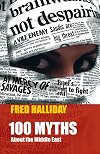
The author of this book (published in 2005) has clearly has it up to here with gross over-generalisations about politics, culture, and religion within the Middle East. As such, the tone of the book is determinedly pragmatic. To the point, indeed, of noting at one point that, 'It would be reasonable to assume that this is a conclusion with which no-one in the region, be they Jew, Arab, or Kurd, would concur.' This is in particular reference to a comment that Jerusalem has become, 'an show more overblown, chauvinistic fetish, and the object of arbitrarily intransigent nationalist demands on both sides'.
Probably the main message of the book is that the way religion is used by regimes, both in the Middle East, in Europe, and the US, reflects a careful assemblage of historic elements and traditions for political ends. There is definitely no inevitable clash of civilisations, rather a much more complicated and heterogeneous history of co-operation, trade, occupation, and conflict. This book doesn't attempt a huge depth of analysis, as the response to each of the 100 myths is kept to a few pages or less. It does, however, signpost the reader to further references. Since my knowledge of Middle Eastern history is patchy verging on non-existent, this book was helpful and informative.
I gave '100 Myths About the Middle East' three stars rather than four as the 100 myth structure does lead to a bit of incoherence. I would perhaps have preferred a narrative of longer chapters. On the other hand, the book reads as though written in response to a constant and tiresome barrage of misleading and oversimplified messages in politics and the media, so I can understand why it was structured in this way. It's also notable that it was written before the so-called Arab Spring; I'd be interested to read Halliday's thoughts on that. show less
Probably the main message of the book is that the way religion is used by regimes, both in the Middle East, in Europe, and the US, reflects a careful assemblage of historic elements and traditions for political ends. There is definitely no inevitable clash of civilisations, rather a much more complicated and heterogeneous history of co-operation, trade, occupation, and conflict. This book doesn't attempt a huge depth of analysis, as the response to each of the 100 myths is kept to a few pages or less. It does, however, signpost the reader to further references. Since my knowledge of Middle Eastern history is patchy verging on non-existent, this book was helpful and informative.
I gave '100 Myths About the Middle East' three stars rather than four as the 100 myth structure does lead to a bit of incoherence. I would perhaps have preferred a narrative of longer chapters. On the other hand, the book reads as though written in response to a constant and tiresome barrage of misleading and oversimplified messages in politics and the media, so I can understand why it was structured in this way. It's also notable that it was written before the so-called Arab Spring; I'd be interested to read Halliday's thoughts on that. show less

From the library
Lots of interesting books pass through my hands at the library and this was one of them. A study of Yemeni immigrants to the UK, I was attracted to it because it talked about people in Birmingham. Cardiff and South Shields were other important centres and there's a good longitidinal basis to the study, as we find that these people were very early immigrants to the UK, and how their experiences mirrored those of the larger populations who came later. Interesting and thoughtful.
Lots of interesting books pass through my hands at the library and this was one of them. A study of Yemeni immigrants to the UK, I was attracted to it because it talked about people in Birmingham. Cardiff and South Shields were other important centres and there's a good longitidinal basis to the study, as we find that these people were very early immigrants to the UK, and how their experiences mirrored those of the larger populations who came later. Interesting and thoughtful.

Revolutions & World Politics
The Rise and Fall of the Sixth Great Power
Halliday F. | ISBN-13: 9780333653296 | Publisher: MS&E UK
Paperback | Imprint: PALGRAVE UK PRINT | Publication Date: August 23, 1999
RRP: $74.95
The Rise and Fall of the Sixth Great Power
Halliday F. | ISBN-13: 9780333653296 | Publisher: MS&E UK
Paperback | Imprint: PALGRAVE UK PRINT | Publication Date: August 23, 1999
RRP: $74.95

Lists
You May Also Like


Associated Authors
Statistics
- Works
- 26
- Also by
- 6
- Members
- 576
- Popularity
- #43,501
- Rating
- 3.2
- Reviews
- 4
- ISBNs
- 105
- Languages
- 11