
Alan Rodgers (1) (1959–2014)
Author of Fire
For other authors named Alan Rodgers, see the disambiguation page.
Works by Alan Rodgers
Associated Works
Prom Night: All Original Tales of That Special, Once-In-A-Lifetime Night as No One Has Ever Experienced It! (1999) — Contributor — 81 copies
The Horror Writers Association Presents Peter Straub's Ghosts (1995) — Contributor — 62 copies, 1 review
Tagged
Common Knowledge
- Canonical name
- Rodgers, Alan
- Birthdate
- 1959-08-11
- Date of death
- 2014-03-08
- Gender
- male
- Occupations
- writer
science fiction writer
horror writer
poet
editor - Organizations
- Science Fiction and Fantasy Writers of America
- Awards and honors
- Dal Coger Memorial Hall of Fame Award (2006)
- Nationality
- USA
- Birthplace
- Montclair, New Jersey, USA
- Place of death
- Anaheim, California, USA
- Associated Place (for map)
- USA
Members
Reviews

The crash of an alien flying saucer at Roswell did result in the death of three aliens, but also the survival of one alien infant, whom the government names Pandora. She is hidden away in a secret bunker in Ohio. Even though Pandora is over 40 years old, she is still a child because time is distorted around her - she isn't moving through time the same way we do. Then an incident happens that causes Pandora to escape from her captors and the survival of the Earth may hang in the balance.
At show more the beginning of each chapter Rodger's mentions a modern myth or urban legend, for example: Roswell, the devil in a malls basement, zombies, UFOs, crop circles, haunted trains, and an alien invasion. The chapter then ties in the myth he mentions to the story of Pandora. This organization of the chapters has the capacity to be clever, but I'm sorry to say that once Pandora made her way to a shopping mall, started shopping, and kept calling herself a little space alien girl who is looking for her daddy, I could no longer take the story seriously. It became a comedy for me.
Despite my viewing the novel now as a comedy rather than sci fi/horror, it was intended to be, it certainly a compelling, entertaining story and kept my interest - and laughter. If you happen to find a copy, as I did in the clearance section of the local used book store, I'd recommend it as an entertaining book, but don't go out of your way to find it. http://shetreadssoftly.blogspot.com/ show less
At show more the beginning of each chapter Rodger's mentions a modern myth or urban legend, for example: Roswell, the devil in a malls basement, zombies, UFOs, crop circles, haunted trains, and an alien invasion. The chapter then ties in the myth he mentions to the story of Pandora. This organization of the chapters has the capacity to be clever, but I'm sorry to say that once Pandora made her way to a shopping mall, started shopping, and kept calling herself a little space alien girl who is looking for her daddy, I could no longer take the story seriously. It became a comedy for me.
Despite my viewing the novel now as a comedy rather than sci fi/horror, it was intended to be, it certainly a compelling, entertaining story and kept my interest - and laughter. If you happen to find a copy, as I did in the clearance section of the local used book store, I'd recommend it as an entertaining book, but don't go out of your way to find it. http://shetreadssoftly.blogspot.com/ show less
Fire by Alan Rodgers
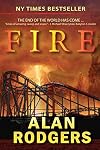
Very poor.
The opening almost isn't too bad, but then the author feels that he understands biology, which is an error. Mixing religion into it just doesn't make it work any better, and the massive continuity errors, complete failure of any form of conservation of matter, or basic physics just spirals the whole thing into farce. It's supposed to be revelation day Apocalypse is coming can our heroes save the day, sort of story, But frankly who cares about any of them.
In the same lab a show more scientist makes a genetically modified ecoli that can resurrect a trilobite from it's fossil, while an evil researcher is making the Beast from Revelation. But fails and so has to resort to surgery. The ecoli escapes and is far more powerful than expected, indestructible, it rises any corpse it comes across to a fully animate original, complete with personality and memories. For soem reason humans don't feel hungry or need food but all the animals do. Pigs regrow from cuts of pork, and go on the rampage. It's never clear whether the same pig is raised multiple times from a string of sausages or just once. This is a more interesting question than whether the evil religious scientists and his buddies including the president of the US can be stopped from precipitating nuclear war.
The silliness goes on. I did finish it, but only to find out how bad it was going to be. show less
The opening almost isn't too bad, but then the author feels that he understands biology, which is an error. Mixing religion into it just doesn't make it work any better, and the massive continuity errors, complete failure of any form of conservation of matter, or basic physics just spirals the whole thing into farce. It's supposed to be revelation day Apocalypse is coming can our heroes save the day, sort of story, But frankly who cares about any of them.
In the same lab a show more scientist makes a genetically modified ecoli that can resurrect a trilobite from it's fossil, while an evil researcher is making the Beast from Revelation. But fails and so has to resort to surgery. The ecoli escapes and is far more powerful than expected, indestructible, it rises any corpse it comes across to a fully animate original, complete with personality and memories. For soem reason humans don't feel hungry or need food but all the animals do. Pigs regrow from cuts of pork, and go on the rampage. It's never clear whether the same pig is raised multiple times from a string of sausages or just once. This is a more interesting question than whether the evil religious scientists and his buddies including the president of the US can be stopped from precipitating nuclear war.
The silliness goes on. I did finish it, but only to find out how bad it was going to be. show less
Fire by Alan Rodgers
I received this book as part of the Library Thing "Early Reviewers Program" in exchange for an honest and unbiased review.
The simple truth is that there is probably a very compelling 250-page book in here. The plot is compelling throughout. And while the general storyline isn't exactly original, Alan Rodgers has some wonderful scenes and an extremely imaginative take on a famous Biblical character. Unfortunately, the work desperately needed an editor who wasn't afraid to cut through some of show more the excess. There are some minor spelling and stylistic errors that pop up sporadically (e.g. "good will mission," or his use of "any more" when "anymore" was applicable), but my real concern here is the series of thoughts and asides from characters that serve no real purpose than to swell the page count.
There are multiple plot threads, as one would expect in a book of this size. I was certainly interested in some more than others -- without leaning too far into spoilers, I would have been happy to read an entire book about Dr. Bonner and his genetic experiments, while I thought that all of President Green's political actions in the first half of the book were too unrealistic to countenance. (Frankly, the House would have called for impeachment after the first sentence in Chapter 1, and I wish we'd never read anything from the President Green's perspective, as he was just too far off his rocker for us to ever believe he could have been elected in the first place.)
Since the book never explicitly specifies when these events take place, it's natural to assume that they're occurring in the present-day. And that's sort of true... but Fire was originally published in 1990. None of the references have been updated for this re-release (for instance, the author references listening to Paul Harvey, using a "laptop computer" to send a news story "over the telephone wire," and that the Iranian Embassy Siege had happened "a few years ago"). Simply stating a year would help readers who don't know about the book's history -- I didn't realize this was a re-release at first, so I kept wondering whether there were anachronisms in the storyline.
One aspect of the novel that bothered me was the author's account of a character stranded in New York City. The character's internal monologue makes it clear how scared he is to be white and in this neighborhood. At one point, the (Caucasian) character finds himself in Bed-Stuy, where a (presumably black) kid tells him, "There's people around here who'd skin you alive just to have a white man's hide hanging on their wall." The character's fear seemed pretty ridiculous in the first place (he had literally gotten on a bus that he perceived to have "BUS TO HELL" written on the side in blood -- the guy had more serious problems to be worried about). But then to have the ridiculous notion verified by another character ... well, that's just a really weird bias from the author that needed to be challenged by an editor. This lack of understanding of the culture is also indicated when that same black kid speaks. What sort of inner-city New York prepubescent refers to sex as "dirty stuff"?
In fact, the author dips into vernacular for the dialogue for several different characters who serve as protagonists for parts of the book. But it doesn't matter who the character is or what his background was -- janitor, President, genetic engineer, New York City black kid -- all of these guys talk like rural Midwesterners. I say "guys" because there are only a few female characters with speaking roles, and even they don't make an appearance until after the apocalypse starts.
In addition, there are a lot of things in the novel that just don't work the way that the author seems to think. Genetic engineers don't design new species and keep them caged in their offices. There's security in place when Air Force One gets refueled. You don't evacuate a high-ranking government official through a traffic jam. These scenarios keep the plot moving, but you have to avoid thinking about them too hard.
At one point the author mentions Hemingway's war dispatches from Spain. Like Rodgers, Hemingway wrote using short sentences and uncomplicated vocabulary/syntax. But Hemingway's writing worked specifically because of what he was NOT expressing. Hemingway doesn't tell you every single thing that his characters are thinking, or even most of what they're doing. He described one mundane activity, then left it up to the reader to decipher more based on the small amount of information given. Hemingway wrote less so you have to think more. In this novel, Rodgers wrote more and makes you think less. show less
The simple truth is that there is probably a very compelling 250-page book in here. The plot is compelling throughout. And while the general storyline isn't exactly original, Alan Rodgers has some wonderful scenes and an extremely imaginative take on a famous Biblical character. Unfortunately, the work desperately needed an editor who wasn't afraid to cut through some of show more the excess. There are some minor spelling and stylistic errors that pop up sporadically (e.g. "good will mission," or his use of "any more" when "anymore" was applicable), but my real concern here is the series of thoughts and asides from characters that serve no real purpose than to swell the page count.
There are multiple plot threads, as one would expect in a book of this size. I was certainly interested in some more than others -- without leaning too far into spoilers, I would have been happy to read an entire book about Dr. Bonner and his genetic experiments, while I thought that all of President Green's political actions in the first half of the book were too unrealistic to countenance. (Frankly, the House would have called for impeachment after the first sentence in Chapter 1, and I wish we'd never read anything from the President Green's perspective, as he was just too far off his rocker for us to ever believe he could have been elected in the first place.)
Since the book never explicitly specifies when these events take place, it's natural to assume that they're occurring in the present-day. And that's sort of true... but Fire was originally published in 1990. None of the references have been updated for this re-release (for instance, the author references listening to Paul Harvey, using a "laptop computer" to send a news story "over the telephone wire," and that the Iranian Embassy Siege had happened "a few years ago"). Simply stating a year would help readers who don't know about the book's history -- I didn't realize this was a re-release at first, so I kept wondering whether there were anachronisms in the storyline.
One aspect of the novel that bothered me was the author's account of a character stranded in New York City. The character's internal monologue makes it clear how scared he is to be white and in this neighborhood. At one point, the (Caucasian) character finds himself in Bed-Stuy, where a (presumably black) kid tells him, "There's people around here who'd skin you alive just to have a white man's hide hanging on their wall." The character's fear seemed pretty ridiculous in the first place (he had literally gotten on a bus that he perceived to have "BUS TO HELL" written on the side in blood -- the guy had more serious problems to be worried about). But then to have the ridiculous notion verified by another character ... well, that's just a really weird bias from the author that needed to be challenged by an editor. This lack of understanding of the culture is also indicated when that same black kid speaks. What sort of inner-city New York prepubescent refers to sex as "dirty stuff"?
In fact, the author dips into vernacular for the dialogue for several different characters who serve as protagonists for parts of the book. But it doesn't matter who the character is or what his background was -- janitor, President, genetic engineer, New York City black kid -- all of these guys talk like rural Midwesterners. I say "guys" because there are only a few female characters with speaking roles, and even they don't make an appearance until after the apocalypse starts.
In addition, there are a lot of things in the novel that just don't work the way that the author seems to think. Genetic engineers don't design new species and keep them caged in their offices. There's security in place when Air Force One gets refueled. You don't evacuate a high-ranking government official through a traffic jam. These scenarios keep the plot moving, but you have to avoid thinking about them too hard.
At one point the author mentions Hemingway's war dispatches from Spain. Like Rodgers, Hemingway wrote using short sentences and uncomplicated vocabulary/syntax. But Hemingway's writing worked specifically because of what he was NOT expressing. Hemingway doesn't tell you every single thing that his characters are thinking, or even most of what they're doing. He described one mundane activity, then left it up to the reader to decipher more based on the small amount of information given. Hemingway wrote less so you have to think more. In this novel, Rodgers wrote more and makes you think less. show less
 This review was written for LibraryThing Early Reviewers.
Fire by Alan Rodgers

A bit long, a bit melodramatic, a bit plodding, I found myself thinking fondly of Stephen King's The Stand as a more enjoyable apocalyptic story. Certainly more fun. This was a dark story, no sense of humor here at all. There were a lot of characters working towards one goal and they were mostly sympathetic, unlike the antagonist of the story who was poorly drawn, a caricature of the ultimate bad guy. There were no shades of grey here, just dark, dark, dark, and I found it a struggle to get show more through. show less
This review was written for LibraryThing Early Reviewers.Lists
Awards


You May Also Like


Associated Authors
Statistics
- Works
- 16
- Also by
- 32
- Members
- 212
- Popularity
- #104,833
- Rating
- 3.5
- Reviews
- 7
- ISBNs
- 71
- Languages
- 2
