

Paul Davies (1) (1946–)
Author of The Mind of God : The Scientific Basis for a Rational World
For other authors named Paul Davies, see the disambiguation page.
Paul Davies (1) has been aliased into P. C. W. Davies.
About the Author
Image credit: Wikipedia author Markus Pössel (Mapos)
Works by Paul Davies
Works have been aliased into P. C. W. Davies.
The Last Three Minutes: Conjectures About the Ultimate Fate of the Universe (1994) 799 copies, 5 reviews
The Matter Myth: Dramatic Discoveries That Challenge Our Understanding of Physical Reality (1991) 408 copies, 2 reviews
The Cosmic Blueprint: New Discoveries in Nature's Creative Ability to Order the Universe (1987) 357 copies, 1 review
Are We Alone?: Philosophical Implications of the Discovery of Extraterrestrial Life (1995) 275 copies, 5 reviews
Information and the Nature of Reality: From Physics to Metaphysics (2010) — Editor — 123 copies, 1 review
The Re-Emergence of Emergence: The Emergentist Hypothesis from Science to Religion (2006) — Editor — 43 copies
Associated Works
Works have been aliased into P. C. W. Davies.
Seeing Further: The Story of Science, Discovery, and the Genius of the Royal Society (2010) — Contributor — 1,155 copies, 19 reviews
Six Easy Pieces and Six Not-So-Easy Pieces (1963) — Introduction, some editions — 415 copies, 1 review
The Next Fifty Years: Science in the First Half of the Twenty-first Century (2002) — Contributor — 410 copies, 10 reviews
THINKING ABOUT GÖDEL AND TURING: Essays on Complexity, 1970-2007 (2007) — Foreword — 28 copies, 1 review
The Future of God: Personal Adventures in Spirituality With Thirteen of Today's Eminent Thinkers (1996) — Contributor — 27 copies
The guardian Science Course Part 1: The Universe — Contributor — 2 copies
Tagged
Common Knowledge
- Canonical name
- Davies, Paul
- Legal name
- Davies, Paul Charles William
- Other names
- DAVIES, Paul Charles William
DAVIES, Paul - Birthdate
- 1946-04-22
- Gender
- male
- Education
- Woodhouse Grammar School
University College London (BSc|Physics)
University College London (PhD|Physics)
University of Cambridge (postdoctorate) - Occupations
- physicist
author - Organizations
- Arizona State University
University of Cambridge
University of London
University of Newcastle-upon-Tyne
University of Adelaide
Macquarie University (show all 7)
International Academy of Astronautics - Awards and honors
- Templeton Prize (1995)
Kelvin Medal (2001)
Faraday Prize (2002)
Advance Australia Award
Order of Australia (2007) - Short biography
- Paul C. W. DAvies is a professor of natural philosophy in the Australian Centre for Astrobiology at Macquarie University, Sydney. His research spans the fields of cosmology, gravitation, and quantum field theory, with particular emphasis on black holes, the origin of the universe, and the origin of life. [from What We Believe But Cannot Prove (2006)]
- Nationality
- UK
- Birthplace
- London, England, UK
- Associated Place (for map)
- England, UK
Members
Reviews
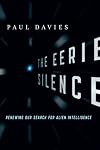
This was an engaging, enlightening but in the end almost depressing book. Beside the awesome physical impediments of distance and time to preclude meaningful communication with an alien civilization, Davies etches deeps the facet of this issue I have considered before: a civilization possibly a million years older than ours may be so advanced as to be incomprehensible/undetectable. Our radio telescope basis assumes primitive and lossy communications by others. We may as well use smoke show more signals.
Intriguing to me is the author's suggestions to look for alien artefacts, beacons. and extraterrestrial microbes thriving in extremeophile conditions or even common ocean water. show less
Intriguing to me is the author's suggestions to look for alien artefacts, beacons. and extraterrestrial microbes thriving in extremeophile conditions or even common ocean water. show less
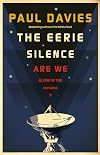
Book review by erasmusdarwin (Tim Jones): The Eerie Silence: Are We Alone in the Universe?
Author: Paul Davies
Hardcover: 260 pages
Publisher: Allen Lane (4 Mar 2010)
ISBN-10: 1846141427
ISBN-13: 978-1846141423
The search for extra-terrestrial intelligence, or SETI, is in a rut. That is Paul Davies’s message in ‘The Eerie Silence – Are we alone in the Universe’ – a thorough taking stock of the programme started by Frank Drake in 1959 to search for alien radio messages from outer show more space.
Davies wants a rethink from scratch, where we shake off the blinkers of anthropocentric thinking and question exactly what we should be looking for. Listening out for a direct radio message is fine, but lets extend the search to include more subtle evidence of alien legacy and the very origin of life.
ET has indeed been strangely quiet, and for Davies two rather extreme explanations for that are providing signposts to a ‘New SETI’.
Under the first option, we have to accept that life on Earth was born of a series of events so incredibly flukey they will never be repeated. Under the second, we face the chilling prospect that intelligent life pops up quite frequently, only to develop a propensity for technology fueled self-destruction.
Holding out hope for a middle way, and putting speculation over self-destructing aliens aside, Davies argues there is a raft of solid science we could be getting on with to better understand the scarcity of life. Those up for the task (and skilled enough to secure funding) will enter a field of polarised opinions and a paucity of hard evidence. The prize? – possibly the final word on the question of whether life is ubiquitous in the universe – a ‘cosmic imperative’ - or that you and I here on Earth are a one-off, somewhat lonesome, rarity.
We should still listen for radio messages, says Davies, enthusing over SETI’s groundbreaking Allen Telescope Array (ATA) of radio telescopes; but the emphasis should be on searching for new types of evidence of intelligence, both in space and closer to home – on Earth in fact.
If we can show life on Earth started independently more than once – a second genesis if you like - the fluke theory is destroyed and the prospect of life existing on the billion or so Earth-like planets in our galaxy increases immensely. Once life has started, there is pretty much universal agreement among scientists that Darwinian style evolution will, environmental factors willing, take over to produce complex life forms and probably intelligence and consciousness. Second (and third and fourth..) genesis life forms could be living alongside us today, unrecognised as a microbial ’shadow biosphere’ – the holy grail for researchers now culturing candidate samples from Mono Lake in California. Or we might find tell-tale markers of an extinct second genesis in geological records that we have seen but incorrectly interpreted. With so many work areas highlighted as candidates for inclusion in New SETI, a problem for potential researchers could be deciding where to focus their application. Presumably Davies is taking calls.
Moving from Petri dish to telescope dish, Davies believes our pre-conceptions of ET in space are causing us to define too narrow a target there also. Any intelligent biological life, he says, will quickly transition to an intellectually superior machine form having nothing in common with Homo sapiens and little to gain from interstellar chit-chat.
Or the aliens may have launched beacons that ping data packets only once a year. Or they may have sent probes – monolith fashion – to lurk around our solar system, programmed to spring to life when we learn to think up to their level. The point is we will only detect this kind of activity if we specifically look for it.
In his most futuristic speculation, Davies envisions life evolving into a quantum computer – an extended network of energy floating through space, amusing itself solving complex mathematical doodles. The implication of course, if such ‘beings’ exist, is that we are headed in the exact same direction. How do you fancy being a node in a pan-galactic thought matrix?
Among other thought-provoking revelations, we learn the Earth has for billions of years been happily swapping rocks, possibly with primitive life aboard, with other planets in the solar system – including Mars. That makes the potential discovery of life on that planet important, but not necessarily a game-changer for SETI, as Martian and Earth life could share the same unique origin.
Davies puts SETI into historical context on a quirkier note, recounting how the mathematician Karl Gauss, as early as the turn of the 19th century, planned to signal the Martians using huge shapes cut out of trees in the Siberian forest.
There is an implicit appeal in The Eerie Silence for scientists from different disciplines to work together on SETI and astrobiology – maybe a guiding principle for New SETI? Astronomers, biologists, geologists, engineers, astro-physicists and cosmologists all have a role in the search – as do non-scientists.
That also holds true for the post-detection task-group Davies leads, set up to advise an appropriate response in the event ET finally calls. In a chapter devoted to the implications of ‘first contact’, he asks how various groups: from the media, through politicians, the military, and religious believers might react. If we receive a targeted message, we should certainly think carefully about the reply. But that we already send the occasional burst of blindly targeted radio messages into space is a positive in Davies’s book; at least it makes people think about science, humanity, and what in our culture we value. Religion, and particularly Christianity, Davies believes, will struggle to reconcile dogma with the existence of intelligent aliens.
In his wind-up, Davies keeps all options open as to the chances of a positive outcome for SETI. But on balance, hardcore enthusiasts of radio SETI in particular may well find the The Eerie Silence a bit of a downer. Likewise, those looking for evidence to support more philosophical ideas around nature favouring life, or the existence of a life principle buried in the physics and chemistry of the universe – themes Davies has arguably been more sympathetic to in previous works – will be disappointed as he rejects each in turn.
To its credit, The Eerie Silence is as much about human motivations and psychology as it is about research and radio antennae. A chatty narrative with frequent episodes of self-examination strikes chords with thoughts and feelings most of us will have had: like the need for a sense of self, and a yearning for meaning. The search for ET is very much the search for what we are, what we may become, and what ‘it’ all means. A cliched theme maybe, but well supported here with relevant facts and reasoned speculation. Davies’s talent for projecting rock-solid scientific rationalism while not (entirely) closing the door on other perspectives has produced an absorbing read.
Originally posted at:
http://communicatescience.com/zoonomian/2010/03/26/book-review-the-eerie-silence... show less
Author: Paul Davies
Hardcover: 260 pages
Publisher: Allen Lane (4 Mar 2010)
ISBN-10: 1846141427
ISBN-13: 978-1846141423
The search for extra-terrestrial intelligence, or SETI, is in a rut. That is Paul Davies’s message in ‘The Eerie Silence – Are we alone in the Universe’ – a thorough taking stock of the programme started by Frank Drake in 1959 to search for alien radio messages from outer show more space.
Davies wants a rethink from scratch, where we shake off the blinkers of anthropocentric thinking and question exactly what we should be looking for. Listening out for a direct radio message is fine, but lets extend the search to include more subtle evidence of alien legacy and the very origin of life.
ET has indeed been strangely quiet, and for Davies two rather extreme explanations for that are providing signposts to a ‘New SETI’.
Under the first option, we have to accept that life on Earth was born of a series of events so incredibly flukey they will never be repeated. Under the second, we face the chilling prospect that intelligent life pops up quite frequently, only to develop a propensity for technology fueled self-destruction.
Holding out hope for a middle way, and putting speculation over self-destructing aliens aside, Davies argues there is a raft of solid science we could be getting on with to better understand the scarcity of life. Those up for the task (and skilled enough to secure funding) will enter a field of polarised opinions and a paucity of hard evidence. The prize? – possibly the final word on the question of whether life is ubiquitous in the universe – a ‘cosmic imperative’ - or that you and I here on Earth are a one-off, somewhat lonesome, rarity.
We should still listen for radio messages, says Davies, enthusing over SETI’s groundbreaking Allen Telescope Array (ATA) of radio telescopes; but the emphasis should be on searching for new types of evidence of intelligence, both in space and closer to home – on Earth in fact.
If we can show life on Earth started independently more than once – a second genesis if you like - the fluke theory is destroyed and the prospect of life existing on the billion or so Earth-like planets in our galaxy increases immensely. Once life has started, there is pretty much universal agreement among scientists that Darwinian style evolution will, environmental factors willing, take over to produce complex life forms and probably intelligence and consciousness. Second (and third and fourth..) genesis life forms could be living alongside us today, unrecognised as a microbial ’shadow biosphere’ – the holy grail for researchers now culturing candidate samples from Mono Lake in California. Or we might find tell-tale markers of an extinct second genesis in geological records that we have seen but incorrectly interpreted. With so many work areas highlighted as candidates for inclusion in New SETI, a problem for potential researchers could be deciding where to focus their application. Presumably Davies is taking calls.
Moving from Petri dish to telescope dish, Davies believes our pre-conceptions of ET in space are causing us to define too narrow a target there also. Any intelligent biological life, he says, will quickly transition to an intellectually superior machine form having nothing in common with Homo sapiens and little to gain from interstellar chit-chat.
Or the aliens may have launched beacons that ping data packets only once a year. Or they may have sent probes – monolith fashion – to lurk around our solar system, programmed to spring to life when we learn to think up to their level. The point is we will only detect this kind of activity if we specifically look for it.
In his most futuristic speculation, Davies envisions life evolving into a quantum computer – an extended network of energy floating through space, amusing itself solving complex mathematical doodles. The implication of course, if such ‘beings’ exist, is that we are headed in the exact same direction. How do you fancy being a node in a pan-galactic thought matrix?
Among other thought-provoking revelations, we learn the Earth has for billions of years been happily swapping rocks, possibly with primitive life aboard, with other planets in the solar system – including Mars. That makes the potential discovery of life on that planet important, but not necessarily a game-changer for SETI, as Martian and Earth life could share the same unique origin.
Davies puts SETI into historical context on a quirkier note, recounting how the mathematician Karl Gauss, as early as the turn of the 19th century, planned to signal the Martians using huge shapes cut out of trees in the Siberian forest.
There is an implicit appeal in The Eerie Silence for scientists from different disciplines to work together on SETI and astrobiology – maybe a guiding principle for New SETI? Astronomers, biologists, geologists, engineers, astro-physicists and cosmologists all have a role in the search – as do non-scientists.
That also holds true for the post-detection task-group Davies leads, set up to advise an appropriate response in the event ET finally calls. In a chapter devoted to the implications of ‘first contact’, he asks how various groups: from the media, through politicians, the military, and religious believers might react. If we receive a targeted message, we should certainly think carefully about the reply. But that we already send the occasional burst of blindly targeted radio messages into space is a positive in Davies’s book; at least it makes people think about science, humanity, and what in our culture we value. Religion, and particularly Christianity, Davies believes, will struggle to reconcile dogma with the existence of intelligent aliens.
In his wind-up, Davies keeps all options open as to the chances of a positive outcome for SETI. But on balance, hardcore enthusiasts of radio SETI in particular may well find the The Eerie Silence a bit of a downer. Likewise, those looking for evidence to support more philosophical ideas around nature favouring life, or the existence of a life principle buried in the physics and chemistry of the universe – themes Davies has arguably been more sympathetic to in previous works – will be disappointed as he rejects each in turn.
To its credit, The Eerie Silence is as much about human motivations and psychology as it is about research and radio antennae. A chatty narrative with frequent episodes of self-examination strikes chords with thoughts and feelings most of us will have had: like the need for a sense of self, and a yearning for meaning. The search for ET is very much the search for what we are, what we may become, and what ‘it’ all means. A cliched theme maybe, but well supported here with relevant facts and reasoned speculation. Davies’s talent for projecting rock-solid scientific rationalism while not (entirely) closing the door on other perspectives has produced an absorbing read.
Originally posted at:
http://communicatescience.com/zoonomian/2010/03/26/book-review-the-eerie-silence... show less
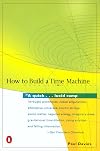
Perhaps it was inevitable that my fondness for novels involving time travel would lead me to this slim but fascinating non-fiction work by physicist, Paul Davies. Despite the provocative title, Davies doesn’t actually give step-by-step instructions for building a time machine in your garage, more’s the pity. But he does explain in plain English why we’re already time travelers (moving toward the future at the stately pace of one second per second) and how the universe just might allow show more us to do far more—eventually. Want to get to Year 3000 in a hurry? Build a rocket that can attain 99.999999999% of the speed of light and you’ll be there in six months. Want to get back now from then, or visit some other time that relative to now is in the past? You’ll need a wormhole and Davies provides helpful, if daunting instructions for building one. If a traveler from the future ever does show up, don’t be surprised if he’s got a copy of this book in his back pocket. show less
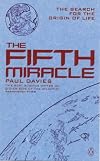
That our oldest known ancestors were organisms living in water is one thing; that life itself originated in water is quite another. It was the hypothesis emitted by Darwin himself, picked up by many since then, and yet... And yet, two relatively recent and major discoveries have completely blown away our preconceived ideas on the topic.
First, the existence of so-called extremophiles that is, organisms living within the depth of the Earth and at extreme temperatures. Since such organisms seem show more to have been protected, within such enclosed environment, from all sorts of cataclysmic events that had constantly impacted our planet about 4 billion years ago (comets, meteorites...) they defy the idea that life appeared in water to make the centre of the Earth a matrix as plausible. Studying them, then, could lead to more tangible results that what our hypothetical experiments in laboratories have been yielding so far (e.g. the Miller-Urey one, that the author retells here in critical passages....).
Then, the fact that some of these cosmic objects which came to crash themselves upon the surface of the Erath (e.g. the Murchison meteorite) contain elements necessary to life, including amino acids. Of course, the presence of such elements is far from proving the presence of life itself! But, nevertheless, it raises important questions -has life first appeared on Earth? Has it first appeared elsewhere in the universe, and journeyed to the Earth through a cosmic collusion? Or is it the product of a symbiosis between earthly elements and extra-terrestrials ones? Even more challenging: what are the probabilities for life, even under its most primitive forms, to exist elsewhere, on other planets? Paul Davies, here, delves particularly upon the case of Mars, since its conditions about 4 billions years ago seemed to have been more favourable to life than that of the Earth, with which, also, contacts were more frequents through more frequent cosmical impacts. These are fascinating questions indeed: are we an isolated accident, or, the logical product of a vast ecosystem (the Universe itself) whose conditions are favourable to life?
Engrossing from beginning to end, accessible, rich in details, the author knows how to showcase his arguments without falling into sensationalism or wild speculations, which is quite a feat given the nature of his hypothesis! His questioning, then, put forth with such precautions, make of this book a must read for anyone interested in such an enigma as the possible origins of life itself. Superb! show less
First, the existence of so-called extremophiles that is, organisms living within the depth of the Earth and at extreme temperatures. Since such organisms seem show more to have been protected, within such enclosed environment, from all sorts of cataclysmic events that had constantly impacted our planet about 4 billion years ago (comets, meteorites...) they defy the idea that life appeared in water to make the centre of the Earth a matrix as plausible. Studying them, then, could lead to more tangible results that what our hypothetical experiments in laboratories have been yielding so far (e.g. the Miller-Urey one, that the author retells here in critical passages....).
Then, the fact that some of these cosmic objects which came to crash themselves upon the surface of the Erath (e.g. the Murchison meteorite) contain elements necessary to life, including amino acids. Of course, the presence of such elements is far from proving the presence of life itself! But, nevertheless, it raises important questions -has life first appeared on Earth? Has it first appeared elsewhere in the universe, and journeyed to the Earth through a cosmic collusion? Or is it the product of a symbiosis between earthly elements and extra-terrestrials ones? Even more challenging: what are the probabilities for life, even under its most primitive forms, to exist elsewhere, on other planets? Paul Davies, here, delves particularly upon the case of Mars, since its conditions about 4 billions years ago seemed to have been more favourable to life than that of the Earth, with which, also, contacts were more frequents through more frequent cosmical impacts. These are fascinating questions indeed: are we an isolated accident, or, the logical product of a vast ecosystem (the Universe itself) whose conditions are favourable to life?
Engrossing from beginning to end, accessible, rich in details, the author knows how to showcase his arguments without falling into sensationalism or wild speculations, which is quite a feat given the nature of his hypothesis! His questioning, then, put forth with such precautions, make of this book a must read for anyone interested in such an enigma as the possible origins of life itself. Superb! show less
Lists
Awards


You May Also Like
Associated Authors
Statistics
- Works
- 29
- Also by
- 12
- Members
- 9,070
- Popularity
- #2,650
- Rating
- 3.8
- Reviews
- 102
- ISBNs
- 426
- Languages
- 21
- Favorited
- 10