
Jim Carroll (1) (1950–2009)
Author of The Basketball Diaries
For other authors named Jim Carroll, see the disambiguation page.
About the Author
As a teenager, Jim Carroll won a basketball scholarship to Trinity, an elite private school on the Upper West Side of Manhattan, where he discovered a love of writing and began spending time at the St. Mark's Poetry Project in the East Village. While at Trinity, he led a life that combined sports, show more drugs and poetry. He published a limited-edition pamphlet of poems, Organic Trains (1967) while still in his teens. He briefly attending Wagner College and Columbia University, but soon found his way to Andy Warhol's Factory, where he contributed dialogue for Warhol's films. Later he worked as a studio assistant for the painter Larry Rivers. He left New York in 1973 to escape drugs and settled in Bolinas, an artistic community north of San Francisco. He is best known for The Basketball Diaries, the journal he kept during high school and published in 1978. In 1995, it was adapted into a movie starring Leonardo DiCaprio. His other works include 4 Ups and 1 Down; Living at the Movies; Forced Entries: The Downtown Diaries, 1971-1973; The Book of Nods; Fear of Dreaming; and Void of Course, 1994-1997. In the late 1970's, he formed the Jim Carroll Band. Their albums include Catholic Boy (1980), Dry Dreams (1982) and I Write Your Name (1984). He also wrote lyrics for Blue Oyster Cult and Boz Scaggs. He died from a heart attack on September 11, 2009 at the age of 60. (Bowker Author Biography) show less
Image credit: Stephen Spera
Works by Jim Carroll
Associated Works
Life is a killer [sound recording] — Contributor — 2 copies
Tagged
Common Knowledge
- Canonical name
- Carroll, Jim
- Legal name
- Carroll, James Dennis
- Birthdate
- 1950-08-01
- Date of death
- 2009-09-11
- Gender
- male
- Education
- Trinity School
- Occupations
- poet
author
musician
songwriter - Nationality
- USA
- Birthplace
- New York, New York, USA
- Places of residence
- New York, New York, USA
Bolinas, California, USA - Place of death
- New York, New York, USA
- Burial location
- St. Peter's Cemetery, Haverstraw, New York, USA
- Associated Place (for map)
- New York, USA
Members
Reviews
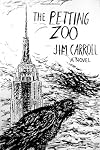
I had the pleasure of seeing Jim Carroll read at a local college in the 1990s. I was hooked. During that reading, he talked of this idea for a novel about an artist who is caught in a spiritual dilemma and is visited by the raven from Noah’s Ark. He then told the unfortunate events surrounding the artist’s sexual awakening, which was hilarious and shocking. You can hear a very similar telling on the spoken-word recording Praying Mantis. It’s a fascinating premise. That idea is the core show more of The Petting Zoo.
The novel opens with the protagonist, 38-year-old Billy Wolfram, rushing out of a Velázquez art exhibit at the Metropolitan Museum of Art. Billy is a mysterious star who quickly rose to the top of the New York art world in the 1980s. His work has never really been criticized, and he keeps virtually everyone at a safe emotional distance. He sees some form of spirituality in Velazquez’s paintings that causes him to question his own art and ability. He immediately has an emotional breakdown, which is the beginning of his inner journey to finding his own artistic spirituality.
After blindly running from the museum, Billy finds himself at a closed, run-down petting zoo and climbs the fence. There he encounters a talking raven who becomes something akin to Dante’s Virgil. This isn’t just any raven. It’s the raven Noah sent out before the dove, and the bird only shows up at just the right moments to try to guide Billy. Billy is forced to spend a few days in the psychiatric ward of the hospital, and then goes into seclusion in his loft. It is during this seclusion that Billy broods and meditates on his life and his art, and the reader learns what has brought Billy to this point.
While the book was in the final stages of editing last year, Carroll died while working at his desk. I’ll be honest. I don’t know that I can truly write an objective review. The novel is so infused with Carroll’s style, voice, and humor that I imagine anyone who already loves Carroll’s work will like the book, flaws and all. The writing is beautiful, as you would aspect from a poet of Carroll’s caliber. It’s full of everything that is infused in his poetry- hallucinatory imagery, artistic intelligence, street smarts; and references to religion, history, and mysticism.
Unfortunately, anyone who has never read Carroll will probably dislike the book. The first 80 pages or so of the novel are riveting as a traditional novel, but once Billy goes into seclusion, the book becomes Carroll’s meditation on art and the inner workings of the artist’s mind more than it is a traditional novel. I don’t know if that was his intent or if that would have changed with more editing. Billy’s seclusion is filled with long inner dialogues and memories that serve as characterization but make the narrative seem disjointed. The plot slips away as the novel progresses, and the end feels very unfinished and unsatisfying as a novel.
As a fan of Jim Carroll’s writing, those long inner dialogues and seemingly disjointed memories are important. They seem to give insight into Carroll’s own thoughts on the artistic mind and on his own life. If you know anything about Carroll’s life, it’s impossible not to see the biographical elements in his characters. It’s unfortunate that the book bears the flaws of an unfinished novel and will likely not garner much praise from critics or the casual reader, but I’m glad we have it. show less
The novel opens with the protagonist, 38-year-old Billy Wolfram, rushing out of a Velázquez art exhibit at the Metropolitan Museum of Art. Billy is a mysterious star who quickly rose to the top of the New York art world in the 1980s. His work has never really been criticized, and he keeps virtually everyone at a safe emotional distance. He sees some form of spirituality in Velazquez’s paintings that causes him to question his own art and ability. He immediately has an emotional breakdown, which is the beginning of his inner journey to finding his own artistic spirituality.
After blindly running from the museum, Billy finds himself at a closed, run-down petting zoo and climbs the fence. There he encounters a talking raven who becomes something akin to Dante’s Virgil. This isn’t just any raven. It’s the raven Noah sent out before the dove, and the bird only shows up at just the right moments to try to guide Billy. Billy is forced to spend a few days in the psychiatric ward of the hospital, and then goes into seclusion in his loft. It is during this seclusion that Billy broods and meditates on his life and his art, and the reader learns what has brought Billy to this point.
While the book was in the final stages of editing last year, Carroll died while working at his desk. I’ll be honest. I don’t know that I can truly write an objective review. The novel is so infused with Carroll’s style, voice, and humor that I imagine anyone who already loves Carroll’s work will like the book, flaws and all. The writing is beautiful, as you would aspect from a poet of Carroll’s caliber. It’s full of everything that is infused in his poetry- hallucinatory imagery, artistic intelligence, street smarts; and references to religion, history, and mysticism.
Unfortunately, anyone who has never read Carroll will probably dislike the book. The first 80 pages or so of the novel are riveting as a traditional novel, but once Billy goes into seclusion, the book becomes Carroll’s meditation on art and the inner workings of the artist’s mind more than it is a traditional novel. I don’t know if that was his intent or if that would have changed with more editing. Billy’s seclusion is filled with long inner dialogues and memories that serve as characterization but make the narrative seem disjointed. The plot slips away as the novel progresses, and the end feels very unfinished and unsatisfying as a novel.
As a fan of Jim Carroll’s writing, those long inner dialogues and seemingly disjointed memories are important. They seem to give insight into Carroll’s own thoughts on the artistic mind and on his own life. If you know anything about Carroll’s life, it’s impossible not to see the biographical elements in his characters. It’s unfortunate that the book bears the flaws of an unfinished novel and will likely not garner much praise from critics or the casual reader, but I’m glad we have it. show less
The last thing you'd expect from Jim Carroll is a light, breezy story, and this is definitely no light, breezy story. It's a raw story of Billy Wolfram, an artist, with numerous hard, personal dramas -- social awkwardness and reclusiveness, obsessive immersion in his work, traumatized and stunted sexual development, and the guidance of an immortal muse-like talking raven. This is an extremely introspective novel, like Carroll's journals, poetry, and music. It's hard to imagine anything could show more be more searingly autobiographical than those other, earlier works, but this is it.
It's not going to be to everybody's taste, too dark for most, and probably dismissed by some others as just another story of a "tortured artistic soul." But to me, it reads as authentic. Wolfram isn't Carroll in a straight-forward way, but Wolfram's inner life, his obsession and his difficulty in figuring out whether and how to feed it, must be Carroll's. It feels too real not to be.
I think it's a shame that Carroll may be best known for the movie version of Basketball Diaries -- that movie just seems a pale shadow of its original, much less this book. Carroll died while writing The Petting Zoo, so we won't hear again from him. show less
It's not going to be to everybody's taste, too dark for most, and probably dismissed by some others as just another story of a "tortured artistic soul." But to me, it reads as authentic. Wolfram isn't Carroll in a straight-forward way, but Wolfram's inner life, his obsession and his difficulty in figuring out whether and how to feed it, must be Carroll's. It feels too real not to be.
I think it's a shame that Carroll may be best known for the movie version of Basketball Diaries -- that movie just seems a pale shadow of its original, much less this book. Carroll died while writing The Petting Zoo, so we won't hear again from him. show less
I hate to speak ill of the recently dead, and Jim Carroll seems like he was a sincere and decent person, but we have to think about the happiness of the living, and that means it's incumbent upon me to warn the world of this unpleasant sludge of Catholic guilt, cliche-ridden homilies about the New York art world, and constant, constant telling you how it is. In keeping with his ponderous style--making much out of not much, like rolling your gruel around in your mouth to pretend it tastes show more like something--it takes Carroll 222 pages to write his way around to the point where the book names itself: "Denny didn't want to deflate Billy's enthusiasm by telling him that his ideas were not very original ... [t]he odd thing was that Billy was making all this out to be some big discovery, but these vague theories, which he clearly hoped would make an impression on Denny, were standard arcane trivia that Billy already knew." Billy's problem is also Carroll's problem, and the fact that he worked on this book for 20 years and this was the end result suggests he probably knew it. Like the tedious ass at the party--the guy who was super into, like, punk rock and never, ever moved on, who rolls out the same tired detritus about Walt Disney being cryogenically frozen or which sex scenes in which movies are unsimulated or Jimmy Page doing a girl with a red snapper--and that last one is a great example, because I looked it up on Wikipedia because what was that about again? and it's got a whole page under "Shark episode" and like, we all know exactly as much about that as we ever would want to, or in many cases probably much more, and some guys never got the memo and keep rolling it out, leeringly, as their stab at chitchat. You know? And Carroll isn't leering, but he is pedantically explaining everything to us, and it makes him crazy when people don't behave in the ways that he thinks are rational, and all his characters talk like him--like earnest Catholic boys who grew up in a time of ease and plenty, spent their lives trading on fucking scene cred, been dogmatic when young and stayed immature when old, and never gotten over a grievance against God for not making sure the world made sense.
I wish I could've asked Jim Carroll to stop making sense. It would have made this easier to take.Let's go to some random passages: "Later in his life, Billy still saw it as either the worst or the best day of his life, depending on how, why, and where he looked at it." Rambling repetition ("his life")--dude doesn't seem to understand the difference between writing and talking. Total unwillingness to let us connect the dots on our own--obsession with being understood--demand that we follow him closely, with the italics, with the pedantic unnecessariness of that whole last clause. Here, I'll rewrite that sentence: "Billy could never decide whether it was the worst day of his life or the best." Now it's just an egregious cliche. You want to excuse him for being sincere and wanting to communicate, but it's so solipsistic--only his precious thoughts and feelings matter. The garrulity of the failed raconteur.
I'm trying to avoid dialogue passages because it brings up the character/narrator/author distinction and I don't want to assume--but the fact is that all the characters talk the same, whether they're the Magic Old World Jewish Man or the all-forgiving, all-nurturing love interest or what. But there are SO MANY extended monologues in this book. It's fascinating as a character study, suffused as it is with the fear of aloneness, but how long can you spend being sympathetic before you just want to slap him and tell him to pep up? "'Anyway, it was the cliff that tempted you." This is a wise fucking spirit raven visiting to gloss everything for us and make sure we don't misinterpret Carroll's precious. "you had to test the limits of that shell's strength, as if you were calculating stress factors for a piece of steel sculpture." Totally unnecessary simile, not to mention that the word "calculating" drains all the tension from the scene, renders it bland and comical. (He is torturing a tortoise. The ol' "cruelty to animals as symbol of all that is irrational and terrifying in man" cliche. "The shell was so fragile that, after rushing down the stone face" (oh, thanks for filling us in that he did that. Couldn't we have figured it out on our own? It's like you think nothing happens unless you tell us about it. Creator anxiety. also, a second ago this was a fifteen-foot cliff; now you can rush down it) "you cried as you reached it. It was the same reptile you'd saved less than three hours earlier, and now it was shattered and dead." THANKS FOR THE RECAP, JACK. "You shouldn't feel guilt for doing this, though I see that you do." RAVEN EXPLAINS IT ALL, LIKE AN OLD-FASHIONED NON-PEDOPHILE PRIEST. SAY FIVE HAIL MARYS. "You are experiencing it this moment. But it is the way of all children. It is the way of mankind ... what they have done throughout history." Love those empty totalizing statements.
"A loud hum was rising from the circular clumps of chattering parvenus." Billy discovers the adjective. Carroll is also obsessed with poseurs, cred, and how things were better in the old days. you know what, man? I'm done. This is pissing me off. This book is shit, and neurotic Irish Catholic boys who just need total transcendent love and acceptance to deal with the incredible pain they feel at having to interact with a world they never made can eat it. I thought I was gonna feel better pulling out some of the most excruciating bits, but now I don't even wanna find them. Time for a walk.
Ha ha, oh, the title is stupid too. The petting zoo is where he goes after his freakout. It is symbolic of precisely nothing. Man, this review left me feeling sour. And I've still got the shakes. Time for a little hair of the dog! show less
I wish I could've asked Jim Carroll to stop making sense. It would have made this easier to take.Let's go to some random passages: "Later in his life, Billy still saw it as either the worst or the best day of his life, depending on how, why, and where he looked at it." Rambling repetition ("his life")--dude doesn't seem to understand the difference between writing and talking. Total unwillingness to let us connect the dots on our own--obsession with being understood--demand that we follow him closely, with the italics, with the pedantic unnecessariness of that whole last clause. Here, I'll rewrite that sentence: "Billy could never decide whether it was the worst day of his life or the best." Now it's just an egregious cliche. You want to excuse him for being sincere and wanting to communicate, but it's so solipsistic--only his precious thoughts and feelings matter. The garrulity of the failed raconteur.
I'm trying to avoid dialogue passages because it brings up the character/narrator/author distinction and I don't want to assume--but the fact is that all the characters talk the same, whether they're the Magic Old World Jewish Man or the all-forgiving, all-nurturing love interest or what. But there are SO MANY extended monologues in this book. It's fascinating as a character study, suffused as it is with the fear of aloneness, but how long can you spend being sympathetic before you just want to slap him and tell him to pep up? "'Anyway, it was the cliff that tempted you." This is a wise fucking spirit raven visiting to gloss everything for us and make sure we don't misinterpret Carroll's precious. "you had to test the limits of that shell's strength, as if you were calculating stress factors for a piece of steel sculpture." Totally unnecessary simile, not to mention that the word "calculating" drains all the tension from the scene, renders it bland and comical. (He is torturing a tortoise. The ol' "cruelty to animals as symbol of all that is irrational and terrifying in man" cliche. "The shell was so fragile that, after rushing down the stone face" (oh, thanks for filling us in that he did that. Couldn't we have figured it out on our own? It's like you think nothing happens unless you tell us about it. Creator anxiety. also, a second ago this was a fifteen-foot cliff; now you can rush down it) "you cried as you reached it. It was the same reptile you'd saved less than three hours earlier, and now it was shattered and dead." THANKS FOR THE RECAP, JACK. "You shouldn't feel guilt for doing this, though I see that you do." RAVEN EXPLAINS IT ALL, LIKE AN OLD-FASHIONED NON-PEDOPHILE PRIEST. SAY FIVE HAIL MARYS. "You are experiencing it this moment. But it is the way of all children. It is the way of mankind ... what they have done throughout history." Love those empty totalizing statements.
"A loud hum was rising from the circular clumps of chattering parvenus." Billy discovers the adjective. Carroll is also obsessed with poseurs, cred, and how things were better in the old days. you know what, man? I'm done. This is pissing me off. This book is shit, and neurotic Irish Catholic boys who just need total transcendent love and acceptance to deal with the incredible pain they feel at having to interact with a world they never made can eat it. I thought I was gonna feel better pulling out some of the most excruciating bits, but now I don't even wanna find them. Time for a walk.
Ha ha, oh, the title is stupid too. The petting zoo is where he goes after his freakout. It is symbolic of precisely nothing. Man, this review left me feeling sour. And I've still got the shakes. Time for a little hair of the dog! show less
 This review was written for LibraryThing Early Reviewers.
The Petting Zoo, Jim Carroll's posthumous published novel, is an ardent, intimate, and somewhat autobiographical ode that the poet and novelist had been weaving and reconstructing for the last decade. In an ironical twist, Carroll died of a heart attack a year before he could experience and revel in the lyrical effect his first and last novel would have on the world, albeit in a quiet way. Some argue that The Petting Zoo is the troubled Carroll's farewell to the world.
In The Petting Zoo, show more Carroll's novel is juxtaposed with his previous chef d'oeuvre, The Basketball Diaries, which chronicles memoirs of a poetic addict whose beatific soul shines through. In the novel, protagonist Billy Wolfram, artist and emotional hermit, experiences an anxiety attack during an art exhibition at the Met. Billy's fraught emotional balance makes him increasingly self-deprecating bordering on insecure and tethering on the edge wherein his art and his very sanity hang in the balance. Without giving the eloquent though harried novel away, this oddly touching, ultimately tragic and heartbreakingly humane tale deserves intense discussion time and time again. show less
In The Petting Zoo, show more Carroll's novel is juxtaposed with his previous chef d'oeuvre, The Basketball Diaries, which chronicles memoirs of a poetic addict whose beatific soul shines through. In the novel, protagonist Billy Wolfram, artist and emotional hermit, experiences an anxiety attack during an art exhibition at the Met. Billy's fraught emotional balance makes him increasingly self-deprecating bordering on insecure and tethering on the edge wherein his art and his very sanity hang in the balance. Without giving the eloquent though harried novel away, this oddly touching, ultimately tragic and heartbreakingly humane tale deserves intense discussion time and time again. show less
This review was written for LibraryThing Early Reviewers.Lists
You May Also Like


Associated Authors
Statistics
- Works
- 15
- Also by
- 3
- Members
- 2,325
- Popularity
- #11,035
- Rating
- 3.8
- Reviews
- 51
- ISBNs
- 81
- Languages
- 9
- Favorited
- 9

