
John Lewis (1) (1940–2020)
Author of March: Book One
For other authors named John Lewis, see the disambiguation page.
About the Author
John Lewis is the U.S. Representative for Georgia's 5th district, a position he has held since 1987. Michael Droso is the author of sixteen books, which include Oceana, Plundering Paradise, and The Cost of Courage. His work has been featured or reviewed in The New Yorker, Time, Newsweek, and Sports show more Illustrated, among other publications. show less
Series
Works by John Lewis
Associated Works
His Truth Is Marching On: John Lewis and the Power of Hope (2020) — Afterword, some editions — 634 copies, 13 reviews
A Call to Conscience: The Landmark Speeches of Dr. Martin Luther King, Jr. (2001) — Introduction — 350 copies, 8 reviews
Tagged
Common Knowledge
- Legal name
- Lewis, John Robert
- Birthdate
- 1940-02-21
- Date of death
- 2020-07-17
- Gender
- male
- Education
- American Baptist Theological Seminary
Fisk University (BS|Religion & Philosophy) - Occupations
- politician
Civil rights activist - Organizations
- Student Nonviolent Coordinating Committee
U.S. House of Representatives
Phi Beta Sigma
Field Foundation
Southern Regional Council
Voter Education Project - Awards and honors
- Presidential Medal of Freedom (2011)
Profile in Courage Award (2001) - Cause of death
- pancreatic cancer
- Nationality
- USA
- Birthplace
- Troy, Alabama, USA
- Places of residence
- Georgia, USA
Washington, D.C., USA - Place of death
- Atlanta, Georgia, USA
- Burial location
- South View Cemetery, Atlanta, Georgia, USA
- Associated Place (for map)
- Georgia, USA
Members
Reviews
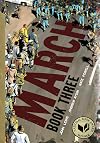
What an historic, critically important graphic series this is. March Book Three, the third volume on the U.S. civil rights movement from the perspective of Congressman John Lewis, lives up to the first two volumes and then some. Lewis, who recently led a House Democratic sit-in over gun control, tells the story of his participation in the movement, which followed principles of non-violence. Lewis himself got beaten and imprisoned many times over in asserting rights of equality for blacks. show more Much of this volume concerns the constitutional right to vote, which for black voters was impeded in every way possible in Alabama (under Governor George Wallace) and other Southern states. The non-voters in the recent election (nearly half our country's population, including many minority voters) must break Lewis's heart. But, as these volumes show, it has been broken so many times I suppose he can handle anything.
While many of us lived through that time, he provides insight, context and immediacy to the events in an unmatched way. These volumes also give a perspective on the Black Lives Matter movement, and underscore the struggles to make what progress exists in racial equality. There are villains aplenty, one of the worst being Jim Clark, a vicious and determined segregationist sheriff in Dallas County, Alabama. Lewis writes that Clark, “was made all the more dangerous by the sundry gang of white men he deputized for the sole purpose of doing whatever it took to stop black people from voting.”
The Deep South resisted recognizing constitutional rights, and the federal government in Washington, under President Lyndon Johnson, dithered. Tv news replays of the brutality and injustice, as police beat and in some instances killed nonviolent protestors, helped forge public opinion and force a governmental response. Lewis and Dr. Martin Luther King and others simply refused to give up, knowing their cause was right, and believing in this country more than it believed in itself. Johnson finally rose to the occasion, and a federal judge permitted the famous march to Selma. What Lewis and others went through to vindicate their right to vote is jaw-dropping.
Nate Powell's art is just right throughout, and the story well-paced.
If the subject matter holds any interest for you, you'll want to read this stunning series. show less
While many of us lived through that time, he provides insight, context and immediacy to the events in an unmatched way. These volumes also give a perspective on the Black Lives Matter movement, and underscore the struggles to make what progress exists in racial equality. There are villains aplenty, one of the worst being Jim Clark, a vicious and determined segregationist sheriff in Dallas County, Alabama. Lewis writes that Clark, “was made all the more dangerous by the sundry gang of white men he deputized for the sole purpose of doing whatever it took to stop black people from voting.”
The Deep South resisted recognizing constitutional rights, and the federal government in Washington, under President Lyndon Johnson, dithered. Tv news replays of the brutality and injustice, as police beat and in some instances killed nonviolent protestors, helped forge public opinion and force a governmental response. Lewis and Dr. Martin Luther King and others simply refused to give up, knowing their cause was right, and believing in this country more than it believed in itself. Johnson finally rose to the occasion, and a federal judge permitted the famous march to Selma. What Lewis and others went through to vindicate their right to vote is jaw-dropping.
Nate Powell's art is just right throughout, and the story well-paced.
If the subject matter holds any interest for you, you'll want to read this stunning series. show less

this picks up after the freedom rides, starting at the church bombing in birmingham (where people literally celebrated the deaths of those little girls), and takes us through the civil rights act of 1964 and the voting rights act of 1965. this is such important history. i am so disgusted all over again that we've more or less rolled back the voting rights act, and that we are no longer protecting the rights of all americans to vote. specifically, of course, the black vote is being targeted. show more after all these people went through to secure the vote, and we just forget the history and continue to make it harder for black voices to be heard. white supremacy is despicable.
i understand the push/pull between nonviolent groups and people like malcolm x, but it's surprising to me that sncc and the sclc didn't see more eye to eye. and that the naacp was so much further to the right than sncc. i guess the naacp is like the older, more conservative, slower moving mature folks that are overtaken by the younger more radical folks who get things moving faster that i was struck by in the first book. they are still important but can be usurped by younger, newer ideas.
there's a quote from a mlk speech where he says that every black person who passively accepts segregation without a fight is partially responsible for the death of those who are fighting for integration. i can't get on board with victim blaming. it's not the job of those who are just trying to survive to bring about the end of their own oppression; it's the job of those who have the power and do the oppression to end it. i understand the concept and his point, but it sits with me very uncomfortably.
as a series, these books are excellent. they are enlightening and show in such an in-your-face way all that these people went through to achieve what should have, in a respectable society, been freely given. there were parts where i would have liked more detail, but those were few, and that information can be found elsewhere if i wanted to dig deeper. i rarely feel like graphic novels/memoirs give enough information, but these are (in general) a great exception. it would help if the people the drawings represent looked more like the actual people, so a reader doesn't have to pause to make sure who is speaking or being shown, but that's really my only complaint about the art. these drawings are so powerful and show so much. john lewis (and so many others in sncc and the sclc) was an absolute hero. show less
i understand the push/pull between nonviolent groups and people like malcolm x, but it's surprising to me that sncc and the sclc didn't see more eye to eye. and that the naacp was so much further to the right than sncc. i guess the naacp is like the older, more conservative, slower moving mature folks that are overtaken by the younger more radical folks who get things moving faster that i was struck by in the first book. they are still important but can be usurped by younger, newer ideas.
there's a quote from a mlk speech where he says that every black person who passively accepts segregation without a fight is partially responsible for the death of those who are fighting for integration. i can't get on board with victim blaming. it's not the job of those who are just trying to survive to bring about the end of their own oppression; it's the job of those who have the power and do the oppression to end it. i understand the concept and his point, but it sits with me very uncomfortably.
as a series, these books are excellent. they are enlightening and show in such an in-your-face way all that these people went through to achieve what should have, in a respectable society, been freely given. there were parts where i would have liked more detail, but those were few, and that information can be found elsewhere if i wanted to dig deeper. i rarely feel like graphic novels/memoirs give enough information, but these are (in general) a great exception. it would help if the people the drawings represent looked more like the actual people, so a reader doesn't have to pause to make sure who is speaking or being shown, but that's really my only complaint about the art. these drawings are so powerful and show so much. john lewis (and so many others in sncc and the sclc) was an absolute hero. show less
The March graphic novels start out relatively light, and grow heavier and heavier as they get deeper into America's troubled civil rights history. While reading book three I could only manage a bit at a time, before needing to step away. It was horrifying--and horrifyingly familiar--how the fact that Black women and men had the right to vote since the 1940's, that they were still treated like animals and the government and every day citizens manipulated laws and turned quickly to violence to show more keep them from exercising those rights. As a country we have come a long way since that time, but anyone who reads it will be painfully aware that we have not come far enough. show less
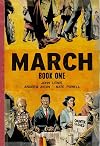
In March: Book One John Lewis, Andrew Aydin, and Nate Powell tell the story of John Lewis' youth in Alabama, how he developed his sense of justice, and his early work to help desegregate lunch counters. Visiting with his Uncle Otis in Buffalo, NY helped open Lewis' eyes to a world in which blacks and white lived side-by-side in a major city and could shop and eat together. The trip North also showed him how inhospitable parts of the racist South were as his Uncle had to plan his trip based show more on where they could and could not stop for fear of violence. Lewis uses the inauguration of President Barack Obama in 2009 as a framing device, perhaps to create a sense of how the historic inauguration of America's first African American president was but one instant in a long line of historic feats. Lewis refers to the "spirit of history taking hold of [his] life" (pg. 73) and his use of the inauguration as a framing device serves to link all the struggles of the past with the successes of the present. It also cautions that the successes are not a foregone conclusion. This book brilliantly tells its narrative and Powell's art conveys the emotions Lewis experienced in his youth and the horrors he witnessed far better than simple prose could. In this, the book works as a teaching tool, much like the Martin Luther King and the Montgomery Story comic from 1956 that Lewis read in his youth. show less
Lists
Graphic Novels (1)
1900s: America (1)
Youth: BLM (4)
Awards


You May Also Like


Associated Authors
Statistics
- Works
- 16
- Also by
- 9
- Members
- 10,206
- Popularity
- #2,329
- Rating
- 4.5
- Reviews
- 412
- ISBNs
- 283
- Languages
- 9
- Favorited
- 5

