
Norman Lewis (1) (1912–2006)
Author of The New Roget's Thesaurus in Dictionary Form
For other authors named Norman Lewis, see the disambiguation page.
Works by Norman Lewis
ROGET'S THESAURUS 14 copies
The New American Dictionary of Good English: An A-Z Guide to Grammar and Correct Usage (1987) 14 copies
The New Read-aloud Handbook 4 copies
Dictionary of modern pronunciation 3 copies
RSVP, Reading, Spelling, Vocabulary, Pronunciation, Book 3, Completely Revised and Expanded (1982) 1 copy
Word Power Made Easy How to Read Better and Faster Instant Word Power (Set of 3 books) (2020) 1 copy
SPEED READING MADE EASY 1 copy
Tagged
Common Knowledge
- Birthdate
- 1912-12-30
- Date of death
- 2006-09-08
- Gender
- male
- Education
- City College of New York
Columbia University - Occupations
- author
- Organizations
- Rio Hondo College
New York University
City College of New York - Awards and honors
- The Heywood Hill Literary Prize (1998)
- Nationality
- USA
- Places of residence
- New York, New York, USA
Whittier, California, USA - Associated Place (for map)
- USA
Members
Reviews

I must say this was, to me, an extremely useful book. Much more than anticipated. I thought I was a quick reader before, but thanks to the excercises in this book, I managed to increase my speed by another 20% on average.
Yes, it is lengthy, but it really takes you step by step, giving good guidance and excercises. And even though it was originally written in 1944 (I read the 1958 completly revised 3rd edition), it is far from antiquated. In fact, apart from the obviously dated selection of show more articles for the reading excercises, the whole was fairly modern.
e.g. p 348 At the beginning of the section about reading critically, the author states that every writer wants to convince the reader of his philosophy, attitude, POV. Even in fiction, a writer is a "special pleader." He continues:
"And, of course, it is almost impossible to pick up a magazine or newspaper today without being bombarded by special pleading. As you turn the pages, almost every writer is saying to you, directly or by implication, "This si what I think; or, This is how I feel; or, This is how I interpret a situation; or, These are the conclusions I draw from the (selected) facts; This is how I solve a problem; or, This is how to do the job; or, This is how I react to what has happened; or, This is how you should react; or, this is the furniture, clothing, perfume, cereal, book, soap, cigarette, automobile, or liquor you should buy, the transportation you should use, the play or motion picture you should see, the vacation you should take, or the charity you should contribute to"; and so on and on, in endless, infinite variety."
And this was written way before the social media age.
Yes, the author uses lengthy sentences at times (and here it serves its purpose), but it is worth the effort.
I also appreciated the author´s thoughts about why to read (both for furthering education, as well as entertainment), and in the chapter about skipping and skimming (which in my opinion is sacrilige), he made an appealing case, and argued that these techniques should be used sparsely, if at all.
So, all in all, yes, these almost 400 pages take a while to get through (ironically), it is worth the effort, in my opinion. show less
Yes, it is lengthy, but it really takes you step by step, giving good guidance and excercises. And even though it was originally written in 1944 (I read the 1958 completly revised 3rd edition), it is far from antiquated. In fact, apart from the obviously dated selection of show more articles for the reading excercises, the whole was fairly modern.
e.g. p 348 At the beginning of the section about reading critically, the author states that every writer wants to convince the reader of his philosophy, attitude, POV. Even in fiction, a writer is a "special pleader." He continues:
"And, of course, it is almost impossible to pick up a magazine or newspaper today without being bombarded by special pleading. As you turn the pages, almost every writer is saying to you, directly or by implication, "This si what I think; or, This is how I feel; or, This is how I interpret a situation; or, These are the conclusions I draw from the (selected) facts; This is how I solve a problem; or, This is how to do the job; or, This is how I react to what has happened; or, This is how you should react; or, this is the furniture, clothing, perfume, cereal, book, soap, cigarette, automobile, or liquor you should buy, the transportation you should use, the play or motion picture you should see, the vacation you should take, or the charity you should contribute to"; and so on and on, in endless, infinite variety."
And this was written way before the social media age.
Yes, the author uses lengthy sentences at times (and here it serves its purpose), but it is worth the effort.
I also appreciated the author´s thoughts about why to read (both for furthering education, as well as entertainment), and in the chapter about skipping and skimming (which in my opinion is sacrilige), he made an appealing case, and argued that these techniques should be used sparsely, if at all.
So, all in all, yes, these almost 400 pages take a while to get through (ironically), it is worth the effort, in my opinion. show less
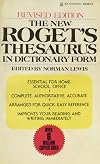
English is not my first language, and I was always a bit stumped by the subtle difference between similar words. Learning there is such a thing as a thesaurus (as opposed to a dictionary) came later in my English comprehension years, and I was thrilled to bits with this. My Roget’s is a well-worn copy that have provided me numerous word options which I then cross-referenced back to a dictionary seeking the subtle meanings and hence the perfect word to express my thoughts. I have a Webster show more also but always found the Roget’s to provide just what I need. This is the version that I’d recommend for a thesaurus. show less
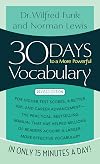
30 Days...is pretty interesting. Some of the vocabulary has changed definitions over the years (for instance, chauvinistic no longer means obsessive love of your country. And I don't think schizophrenia has ever meant multiple personality disorder (now dissociative identity disorder); that's one of those Hollywood things). But it's pretty engaging for a book on vocabulary.
Some of the words this book teaches have had changes in meaning since it was first published, some others are just dated in general. Regardless, I would say that at least 95% of the material is very useful. I used this book in high school and many of the words I learned from it are still part of my daily vocabulary.
You May Also Like


Associated Authors
Statistics
- Works
- 33
- Members
- 3,571
- Popularity
- #7,096
- Rating
- 4.0
- Reviews
- 19
- ISBNs
- 363
- Languages
- 12
- Favorited
- 3