
Thomas B. Allen (1) (1929–2018)
Author of George Washington, Spymaster: How the Americans Outspied the British and Won the Revolutionary War
For other authors named Thomas B. Allen, see the disambiguation page.
About the Author
Thomas B. Allen is the author of numerous history books, including George Washington, Spy-master and Remember Valley Forge. A frequent contributor to Smithsonian Magazine, National Geographic, Military History Quarterly, Military History, Naval History, the U.S. Naval Institute's Proceedings show more magazine, and other publications, he lives in Bethesda, Maryland. show less
Series
Works by Thomas B. Allen
George Washington, Spymaster: How the Americans Outspied the British and Won the Revolutionary War (2004) 663 copies, 9 reviews
Harriet Tubman, Secret Agent: How Daring Slaves and Free Blacks Spied for the Union During the Civil War (2006) 439 copies, 3 reviews
Mr. Lincoln's High-Tech War: How the North Used the Telegraph, Railroads, Surveillance Balloons, Ironclads, High-Powered Weapons, and More to Win the Civil War (2009) 164 copies, 9 reviews
Code-Name Downfall: The Secret Plan to Invade Japan-And Why Truman Dropped the Bomb (1995) 141 copies, 1 review
Remember Pearl Harbor: American and Japanese Survivors Tell Their Stories (2001) 114 copies, 3 reviews
Newseum: the official guide 1 copy
Connecticut 1 copy
Xinjiang 1 copy
The Silk Road's Lost World 1 copy
Associated Works
National Geographic Field Guide to the Birds of North America (1983) — Photographer, some editions — 2,357 copies, 15 reviews
MHQ: The Quarterly Journal of Military History — Spring 1995 (1995) — Co-Author "The Voice of the Crane" — 23 copies
MHQ: The Quarterly Journal of Military History — Summer 1992 (1992) — Co-Author "Arms and Men: The LST" — 20 copies
MHQ: The Quarterly Journal of Military History — Winter 1990 (1989) — Author "Twilight Zone at the Pentagon" — 16 copies
MHQ: The Quarterly Journal of Military History — Autumn 1997 (1997) — Co-Author "Gassing Japan" — 13 copies
MHQ: The Quarterly Journal of Military History — Summer 1994 (1994) — Author "Little Wars" and "The Battlefield of Business" — 11 copies
MHQ: The Quarterly Journal of Military History — Winter 2011 (2010) — Author "In Review: The Civil War of 1812" — 7 copies
MHQ: The Quarterly Journal of Military History — Winter 2014 (2013) — Author "Saboteurs at Work" and "Knut Haugland's Kon-Tiki Adventure" — 4 copies
MHQ: The Quarterly Journal of Military History — Spring 2015 (2015) — Author "Surgery in the Front Lines", some editions — 3 copies
MHQ: The Quarterly Journal of Military History — Spring 2012 (2012) — Author "The Enemy Among Us", some editions — 1 copy
Tagged
Common Knowledge
- Legal name
- Allen, Thomas Benton
- Birthdate
- 1929-03-20
- Date of death
- 2018-12-11
- Gender
- male
- Education
- Fairfield University (no degree)
University of Bridgeport (BA, Journalism) - Occupations
- historian
author
editor - Organizations
- National Geographic Society
Bridgeport Herald
New York Daily News
Montgomery College
U.S. Navy - Relationships
- Allen, Roger MacBride (son)
- Short biography
- Thomas B. Allen is the author of 30 books on subjects ranging from military history to sharks. He lives in Bethesda, Maryland, where he is a founding member of the Writer's Center. [adapted from George Washington, Spymaster (2004)]
- Nationality
- USA
- Birthplace
- Bridgeport, Connecticut, USA
- Places of residence
- Bethesda, Maryland, USA
- Associated Place (for map)
- USA
Members
Reviews

Fascinating, if very mid-80s look at the role of war gaming in the defense establishment. Allen managed to FOIA a number of typically classified Pentagon simulation, and these transcripts, along with interviews of the major players and a few made-for-TV public war games with actual politicians, provide a fascinating overview of how the United States trained for political and military crises, up to and including global thermonuclear war. Allen's history leaps around a little bit, from the show more kriegspiel of the Prussian general staff, to pre-World War 2 tabletop naval exercises, to the serious computer simulations of the Rand corporation, and the similarities and differences between military games and hobbyist publishers like Avalon Hill.
The major problem with this book (aside from being a period piece), is that Allen vacillates between three perspectives on war gaming. The most charitable is that they are uncannily predictive and effective tools for preparing for the real world, training government officials to deal with terrorism and political crises, and revealing rigidity and weakness in real mobilization plans. Less charitably, they're a way for a cadre of mid-ranking officers and academics to pretend that they're doing something useful, when really they're just pushing around chits on a board. The array of gaming centers is a waste of resources, but hey, it's a rounding error compared to aerospace procurement boondoggles. The worst perspective is that the games are dangerous lies: based on unverified models, full of outright errors in rules and worldview, biased to support ever higher military budgets, justify an unwarranted sense of American superiority, and a dangerous lack of concern for triggering an actual nuclear war.
All of these perspectives are to some extent true, and I wish Allen had done a better job contextualizing them, but this is still a great little book for any one interested in the use of serious games, of the late Cold War. My favorite little anecdote is Col. Trevor Dupuy, one of the deans of wargaming, explaining how to calculate out the Theoretical Lethality Index for a sword (23) and a one megaton airburst (695,385,000) based on a long series of multiplied statistics based on... guesswork. show less
The major problem with this book (aside from being a period piece), is that Allen vacillates between three perspectives on war gaming. The most charitable is that they are uncannily predictive and effective tools for preparing for the real world, training government officials to deal with terrorism and political crises, and revealing rigidity and weakness in real mobilization plans. Less charitably, they're a way for a cadre of mid-ranking officers and academics to pretend that they're doing something useful, when really they're just pushing around chits on a board. The array of gaming centers is a waste of resources, but hey, it's a rounding error compared to aerospace procurement boondoggles. The worst perspective is that the games are dangerous lies: based on unverified models, full of outright errors in rules and worldview, biased to support ever higher military budgets, justify an unwarranted sense of American superiority, and a dangerous lack of concern for triggering an actual nuclear war.
All of these perspectives are to some extent true, and I wish Allen had done a better job contextualizing them, but this is still a great little book for any one interested in the use of serious games, of the late Cold War. My favorite little anecdote is Col. Trevor Dupuy, one of the deans of wargaming, explaining how to calculate out the Theoretical Lethality Index for a sword (23) and a one megaton airburst (695,385,000) based on a long series of multiplied statistics based on... guesswork. show less

“War is older than history,” the author, Thomas B. Allen, reminds his readers, and within every raging conflict, vivid in epic poetry and chronicles, is a secret war the actions of which often are not written about. Fortunately for historians and novelists, however, (if unfortunate for spies and intelligence analysts) documents are created in the pursuit of war planning and operations, that eventually do come to light, intentioned or not. Allen’s Declassified: 50 Top-Secret Documents show more that Changed History (Washington, DC: National Geographic, May 2008, $26 Hardcover) is a compilation ranging from the sixteenth-century Spanish Armada against England to an 8 August 2001 routine President’s Daily Brief which discussed the possibility of an attack on the United States by Al-Qa’ida in retaliation for US missile strikes on terrorist training facilities in Afghanistan in 1998, which attack occurred on 11 September.
Each topic is arranged first, with a facsimile of the document or a page there from; secondly, discussion of its background: how it came to be created, encoded, decoded, hidden, transmitted, exposed, etc., and the machinations of the handlers of such, the spies (or “intelligencer” as Sir Francis Walsingham, Queen Elizabeth I’s, principal spy was called); and thirdly, with a succinct summary of the impact of the document’s information on the course of history. In the case of Catholic Spain’s King Philip II, plans to invade Protestant England, devised in 1586 were copied, presumably by a valet employed by the Spanish admiralty, whose brother worked for Walsingham’s intelligencer, Anthony Standen, an English Catholic in exile from England and with access to Spain’s Catholic elite. A letter from Standen to Walsingham included detailed plans (ships, company, equipment, routes) of the armada. England, with such fore knowledge, in July 1588, set ablaze eight “Hell Burners”, old ships loaded with tar and gun powder, amidst the 130-ship Spanish Armada, scattering it in the English Channel and thwarting the attack. The outcome of this battle, Allen informs us, was the end of Spain’s anti-Protestant crusade, a weakening of Papal influence, and the growth of English sea power with Britannia ruling the waves to mid-twentieth century.
Some documents included in Declassified will be familiar to us. One is the encrypted letter of Continental Army Major General Benedict Arnold to British Major Andre that proposed turning the garrison overlooking a strategic bend in the Hudson River – West Point – to the British, which if it succeeded, would have divided General Washington’s forces and broken the Continental Army’s major line of communication, north-south.
Another document familiar to us is the 1917 telegram, sent by the German Foreign Minister, Arthur Zimmerman to the German Ambassador to the United States, who was to relay it to the German envoy in Mexico. The telegram was sent this way to minimize British access to it (Britain had been at war with Germany since 1914) and the Americans were told its contents had to do with a peace offering. Unencrypted, the Zimmerman Telegram so-called, begins: “We [Germany] intend to begin unrestricted submarine warfare on the first of February [1917] . . . .” It also proposed an alliance between Germany and Mexico. By March 1917, President Wilson, recently re-elected to office on a platform that included the policy of remaining neutral with regard to the war then raging in Europe, released the telegram to the public, which became outraged at Germany. In April, the U.S. Congress declared war on Imperial Germany.
Allen has included several declassified documents that provide examples of the complexities of espionage and counter espionage and the operations of double agents, those who work for one intelligence agency while in secret actually work against it in the service of another, enemy agency.
One such is a set of dispatches from Confederate President Jefferson Davis to a Confederate sabotage operation in Canada. The information gathered was intended to influence the outcome of the re-election of Union President Abraham Lincoln. Double agent Richard Montgomery, who couriered secret dispatches for Davis, actually was working for Lincoln’s Assistant Secretary of War, Charles Dana. To keep the Confederates from catching on, Montgomery at one point was intercepted by Union forces, imprisoned, and even fired upon and wounded.
Another is the memorandum for record by the handler of British Double-Cross agent Nathalie Sergueiew, born in Russia, raised in France, and a journalist in Nazi Germany. During her transfer from Nazi Germany to England, ‘Treasure’ (her code name) learned that her dog Frisson, which she had to leave behind, had not been smuggled out of Germany as promised by her British handlers. In her anger, Treasure told MI5 that her Nazi handlers had given her a secret signal that if transmitted by Morse code would reveal that she was sending under duress. This was three weeks before the impending launch of the Allied invasion of Europe. Although Allied intelligence feared the worst, it turned out that Treasure had not compromised the Double-Cross system the purpose of which was the intricate deception plan for D-Day 6 June 1944.
The array of Allen’s declassified documents is varied and extensive, to include four of my favorites:
• Acting Assistant Secretary of the Navy Theodore Roosevelt’s 1898 cable to Admiral George Dewey ordering preparation for offensive action in the Philippine Islands in the event war is declared against Spain following the destruction of the U.S.S. Maine in Havana Harbor. TR’s boss, President McKinley, at the time was interested in maintaining peaceful relations with Spain!
• The Sykes-Picot Agreement (May 1916) that established British and French “priority of right of enterprise” in the Middle East while unbeknownst to T. E. Lawrence (of Arabia) who was leading the Arab Revolt against the Ottoman Empire. The map annexed to this agreement did not show an Arab ‘state’ and when the secret agreement was exposed (by Russia’s revolutionary leader, Lenin) in 1917; Arab distrust of the West was sewn.
• FDR’s letter to his Secretary of State authorizing US ships for the British fleet, August 1940, just a month before the start of the Battle of Britain.
• The legacy of the Pentagon Papers, Daniel Ellsberg’s photocopies of pages from a classified report on US involvement in the war in Southeast Asia, published in the New York Times (1971), and which eventually led to the Nixon administration’s involvement in the Watergate break in of the Democratic National Committee headquarters (1972) and to the resignation of President Nixon (August 1974).
Declassified is an informative, researched account of the murky waters of stealth, intrigue, deception, disinformation, and the business of establishing that essential “bodyguard of lies” around precious truth, to quote Allen’s quote of Winston Churchill. I look forward to its sequel. show less
Each topic is arranged first, with a facsimile of the document or a page there from; secondly, discussion of its background: how it came to be created, encoded, decoded, hidden, transmitted, exposed, etc., and the machinations of the handlers of such, the spies (or “intelligencer” as Sir Francis Walsingham, Queen Elizabeth I’s, principal spy was called); and thirdly, with a succinct summary of the impact of the document’s information on the course of history. In the case of Catholic Spain’s King Philip II, plans to invade Protestant England, devised in 1586 were copied, presumably by a valet employed by the Spanish admiralty, whose brother worked for Walsingham’s intelligencer, Anthony Standen, an English Catholic in exile from England and with access to Spain’s Catholic elite. A letter from Standen to Walsingham included detailed plans (ships, company, equipment, routes) of the armada. England, with such fore knowledge, in July 1588, set ablaze eight “Hell Burners”, old ships loaded with tar and gun powder, amidst the 130-ship Spanish Armada, scattering it in the English Channel and thwarting the attack. The outcome of this battle, Allen informs us, was the end of Spain’s anti-Protestant crusade, a weakening of Papal influence, and the growth of English sea power with Britannia ruling the waves to mid-twentieth century.
Some documents included in Declassified will be familiar to us. One is the encrypted letter of Continental Army Major General Benedict Arnold to British Major Andre that proposed turning the garrison overlooking a strategic bend in the Hudson River – West Point – to the British, which if it succeeded, would have divided General Washington’s forces and broken the Continental Army’s major line of communication, north-south.
Another document familiar to us is the 1917 telegram, sent by the German Foreign Minister, Arthur Zimmerman to the German Ambassador to the United States, who was to relay it to the German envoy in Mexico. The telegram was sent this way to minimize British access to it (Britain had been at war with Germany since 1914) and the Americans were told its contents had to do with a peace offering. Unencrypted, the Zimmerman Telegram so-called, begins: “We [Germany] intend to begin unrestricted submarine warfare on the first of February [1917] . . . .” It also proposed an alliance between Germany and Mexico. By March 1917, President Wilson, recently re-elected to office on a platform that included the policy of remaining neutral with regard to the war then raging in Europe, released the telegram to the public, which became outraged at Germany. In April, the U.S. Congress declared war on Imperial Germany.
Allen has included several declassified documents that provide examples of the complexities of espionage and counter espionage and the operations of double agents, those who work for one intelligence agency while in secret actually work against it in the service of another, enemy agency.
One such is a set of dispatches from Confederate President Jefferson Davis to a Confederate sabotage operation in Canada. The information gathered was intended to influence the outcome of the re-election of Union President Abraham Lincoln. Double agent Richard Montgomery, who couriered secret dispatches for Davis, actually was working for Lincoln’s Assistant Secretary of War, Charles Dana. To keep the Confederates from catching on, Montgomery at one point was intercepted by Union forces, imprisoned, and even fired upon and wounded.
Another is the memorandum for record by the handler of British Double-Cross agent Nathalie Sergueiew, born in Russia, raised in France, and a journalist in Nazi Germany. During her transfer from Nazi Germany to England, ‘Treasure’ (her code name) learned that her dog Frisson, which she had to leave behind, had not been smuggled out of Germany as promised by her British handlers. In her anger, Treasure told MI5 that her Nazi handlers had given her a secret signal that if transmitted by Morse code would reveal that she was sending under duress. This was three weeks before the impending launch of the Allied invasion of Europe. Although Allied intelligence feared the worst, it turned out that Treasure had not compromised the Double-Cross system the purpose of which was the intricate deception plan for D-Day 6 June 1944.
The array of Allen’s declassified documents is varied and extensive, to include four of my favorites:
• Acting Assistant Secretary of the Navy Theodore Roosevelt’s 1898 cable to Admiral George Dewey ordering preparation for offensive action in the Philippine Islands in the event war is declared against Spain following the destruction of the U.S.S. Maine in Havana Harbor. TR’s boss, President McKinley, at the time was interested in maintaining peaceful relations with Spain!
• The Sykes-Picot Agreement (May 1916) that established British and French “priority of right of enterprise” in the Middle East while unbeknownst to T. E. Lawrence (of Arabia) who was leading the Arab Revolt against the Ottoman Empire. The map annexed to this agreement did not show an Arab ‘state’ and when the secret agreement was exposed (by Russia’s revolutionary leader, Lenin) in 1917; Arab distrust of the West was sewn.
• FDR’s letter to his Secretary of State authorizing US ships for the British fleet, August 1940, just a month before the start of the Battle of Britain.
• The legacy of the Pentagon Papers, Daniel Ellsberg’s photocopies of pages from a classified report on US involvement in the war in Southeast Asia, published in the New York Times (1971), and which eventually led to the Nixon administration’s involvement in the Watergate break in of the Democratic National Committee headquarters (1972) and to the resignation of President Nixon (August 1974).
Declassified is an informative, researched account of the murky waters of stealth, intrigue, deception, disinformation, and the business of establishing that essential “bodyguard of lies” around precious truth, to quote Allen’s quote of Winston Churchill. I look forward to its sequel. show less
 This review was written for LibraryThing Early Reviewers.
A fascinating look at the subject of demonic possession, through an examination of the case history that inspired The Exorcist. The author is an agnostic ex-Catholic, so he has the background to understand the ritual and the Church but looks at it critically. He also usually writes about military matters, and his background as a journalist helps him to weigh the facts and consider what conclusions are best supported.
Briefly, the book tells the story of a boy in Georgetown, in Washington, show more D.C. From a Lutheran family, his family was urged by a Lutheran priest with an interest in the paranormal to get the boy to a Catholic after a series of disturbing events. Allen had access to the diary of the priest who exorcised the boy and also interviewed many of those who were involved in the events detailed. He judges claims (like those that the boy spoke in languages he didn't know) based on who made the assertions and what access they would have to information. He also examines critically but impartially the apparently paranormal phenomena that occurred surrounding the boy. And he does all this while also looking at the Church's official stance on demonic obsession, possession, and exorcism. In short, a fascinating and very readable book, and a good introduction to exorcism in the Catholic Church.
(An aside on the made-for-TV film adaptation starring Timothy Dalton: That was a horrible movie which does no justice to the book. Conflicts over the priest's faith that don't appear in the book are invented. The movie sensationalizes the book, rather than do what Allen does, which is take an impartial view and examine the evidence. Perhaps worst of all, the film is bland. I'd rather watch The Exorcist.) show less
Briefly, the book tells the story of a boy in Georgetown, in Washington, show more D.C. From a Lutheran family, his family was urged by a Lutheran priest with an interest in the paranormal to get the boy to a Catholic after a series of disturbing events. Allen had access to the diary of the priest who exorcised the boy and also interviewed many of those who were involved in the events detailed. He judges claims (like those that the boy spoke in languages he didn't know) based on who made the assertions and what access they would have to information. He also examines critically but impartially the apparently paranormal phenomena that occurred surrounding the boy. And he does all this while also looking at the Church's official stance on demonic obsession, possession, and exorcism. In short, a fascinating and very readable book, and a good introduction to exorcism in the Catholic Church.
(An aside on the made-for-TV film adaptation starring Timothy Dalton: That was a horrible movie which does no justice to the book. Conflicts over the priest's faith that don't appear in the book are invented. The movie sensationalizes the book, rather than do what Allen does, which is take an impartial view and examine the evidence. Perhaps worst of all, the film is bland. I'd rather watch The Exorcist.) show less
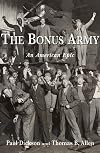
As this is not my best period in American history, I'm reluctant to wax too authoritative about this work. However, Dickson & Allen are at their best in giving the flavor of what it was like to be a participant in this great mass protest, and how the rank and file tried to maintain their dignity while at the same time doing their level best to prevent those in authority from ignoring their plight. What particularly stands out is that this was an integrated protest, and how the main body of show more protestors themselves worked to keep Communist agitators at arms-length (not that Douglas MacArthur and the Army's Military Intelligence Division noticed).
Perhaps one anecdote sums up the book best, as when a new bonus army arrived in Washington, DC in 1933, FDR's response was to treat the protestors as constituents (no matter his unwillingness to privilege their demands), instead of as a threat, as Hoover did. The observation from one participant being that: "Hoover sent the army. Roosevelt sent his wife."
From there the work winds down as the authors work through the immediate aftermath of the veterans' protests, of how the ghastly disaster of work camps filled with veterans being obliterated in Key West during the Labor Day Hurricane of 1935 finally paved the way for the bonus to be paid, to the creation of the GI Bill, and ending with the continuing tradition of mass protest descending on Washington in the spirit of petition. show less
Perhaps one anecdote sums up the book best, as when a new bonus army arrived in Washington, DC in 1933, FDR's response was to treat the protestors as constituents (no matter his unwillingness to privilege their demands), instead of as a threat, as Hoover did. The observation from one participant being that: "Hoover sent the army. Roosevelt sent his wife."
From there the work winds down as the authors work through the immediate aftermath of the veterans' protests, of how the ghastly disaster of work camps filled with veterans being obliterated in Key West during the Labor Day Hurricane of 1935 finally paved the way for the bonus to be paid, to the creation of the GI Bill, and ending with the continuing tradition of mass protest descending on Washington in the spirit of petition. show less
Lists
Awards


You May Also Like


Associated Authors
Statistics
- Works
- 50
- Also by
- 21
- Members
- 4,856
- Popularity
- #5,171
- Rating
- 4.0
- Reviews
- 67
- ISBNs
- 164
- Languages
- 6
