
Henry T. Brown (–1906)
Author of 507 Mechanical Movements
Works by Henry T. Brown
Tagged
Common Knowledge
- Date of death
- 1906-03-18
- Gender
- male
- Occupations
- lawyer
writer - Nationality
- USA
- Places of residence
- New York, USA
- Place of death
- Brooklyn, New York, USA
- Associated Place (for map)
- New York, USA
Members
Reviews

I guess that this book is not your everyday reading of a NY Times “best seller of the year”. But in its own way I found it fascinating. It was first published in 1903 and therefore is now about 120 years old and the technology was also that old: it comes from an era of steam engines and early machine tools and many of the patents mentioned appear to correspond with the advent of the steam engine and water wheels. That is from the late 1700’s and into the 1800’s. As the blurb at the show more front states, the book is about: “Five Hundred and Seven Mechanical Movements Embracing all those which are most important in Dynamics, Hydraulics, Hydrostatics, Pneumatics, Steam Engines, Mill and other Gearing, Presses, Horology, and Miscellaneous Machinery; and including many movements never before published and several which have only recently come into use.” It’s by Henry T. Brown and originally published by Brown & Seward, 1903 This edition is copyright © 2012.
Brown writes in his preface: .....”The want of a comprehensive collection of illustrations and descriptions of Mechanical Movements has long been seriously felt by artisans, inventors, and students of the mechanic arts. It was the knowledge of this want which induced the compilation of the collection here presented. The movements which it contains have been already illustrated and described in occasional instalments scattered through five volumes of the American Artisan, by the readers of which their publication was received with so much favour as was believed to warrant the expense of their reproduction with some revision in a separate volume.
Although the collection embraces about three times as many movements as have ever been contained in any previous American publication, and a considerably larger number than has ever been contained in any foreign one, it has not been the object of the compiler to merely swell the number, but he has endeavoured to select only such as may be of really practical value; and with this end in view, he has rejected many which are found in nearly all the previously published collections, but which he has considered only applicable to some exceptional want.
So if you really want to find some sort of mechanism that will convert reciprocating motion into rotation you will find it here. And vice versa. But not only simple stuff like this: you’ll also find the “Mangle Mechanism” ..which I found really hard to mentally conceive which will give rotation in one direction followed by rotation int the other direction.
The index (at the front of the book) gives a good idea of the coverage. In this index the numerals do not indicate the pages, but they refer to the engravings. Here is a short extract:
A. Æolipile, 474.
B. Balance, compensation, 319.
Barometer, 501.
Blower, fan, 497. Brake, friction, 242.
C. Cams, 95, 96, 97, 117, 130, 138, 149, 150, 165, 217, 272, 276. Capstans, 412, 491.
Centrolinead, 408.
Clutches, 47, 48, 52, 53, 361.
Chasers, 375.
Clamps, bench, 174, 180, 381.
Clamps, screw, 190.
Cock, four-way, 395.
Column, oscillating, 445, 446.
Compasses, proportion, 409.
All the movements are accompanied by engravings with labelled parts and generally they are relatively easily followed. Though I did notice that in a few examples the labelling seemed incorrect of was missing even though it was referred to in the text. For example
With 478. He says “Another steam trap (Ray’s patent). Valve, a, closes and opens by longitudinal expansion and contraction of waste-pipe, A, which terminates in the middle of an attached hollow sphere”. OK all very well but there is no “a” in the diagram. A decent proof reading should have picked this up.
But, in general, the text and the diagrams work well together and he’s gone to a lot of trouble to give us text descriptions which are very thorough and helpful in interpreting the diagrams. Here is his last example of all. By itself it is incomprehensible. And by itself, the diagram is also incomprehensible but the two complement each other well and even I was able to understand how it works.
“507. Another form of epicyclic train designed for producing a very slow motion. m is a fixed shaft upon which is loosely fitted a long sleeve, to the lower end of which is fixed a wheel, D, and to the upper end a wheel, E. Upon this long sleeve there is fitted a shorter one which carries at its extremities the wheels, A and H. A wheel, C, gears with both D and A, and a train-bearing arm, m, n which revolves freely upon the shaft, m, p, carries upon a stud at n the united wheels, F and G. If A have 10 teeth, C 100, D 10, E 61, F, 49, G 41, and H 51, there will be 25,000 revolutions of the train-bearing arm, m, n, for one of the wheel, C.”
I was fascinated to note how many inventions and variations on inventions that there were around at the time. And I’ve pondered how this spate of inventiveness has not slowed down and what a catalogue of mechanical movements would look like today ..especially if one combines the mechanical with the electric and electronic. I think about photo-copiers and electronic printers and the devices for advancing and reversing the paper feed. And I think about the modern automobiles...especially the hybrid which I now drive and the anti-skid mechanisms and mechanisms for autonomous driving. Remarkable stuff. Clearly, the equivalent modern catalogue would be simple massive. Too big for a book.
Will I ever use anything in the book? Probably not....though the “mangle wheel and pinion” remains semi -engraved in my memory. (Though “mangle doesn’t make the index and I had to rely on modern word search to find it).
Overall, I rate it four stars. It certainly won’t appeal to many. But I found it interesting and informative. show less
Brown writes in his preface: .....”The want of a comprehensive collection of illustrations and descriptions of Mechanical Movements has long been seriously felt by artisans, inventors, and students of the mechanic arts. It was the knowledge of this want which induced the compilation of the collection here presented. The movements which it contains have been already illustrated and described in occasional instalments scattered through five volumes of the American Artisan, by the readers of which their publication was received with so much favour as was believed to warrant the expense of their reproduction with some revision in a separate volume.
Although the collection embraces about three times as many movements as have ever been contained in any previous American publication, and a considerably larger number than has ever been contained in any foreign one, it has not been the object of the compiler to merely swell the number, but he has endeavoured to select only such as may be of really practical value; and with this end in view, he has rejected many which are found in nearly all the previously published collections, but which he has considered only applicable to some exceptional want.
So if you really want to find some sort of mechanism that will convert reciprocating motion into rotation you will find it here. And vice versa. But not only simple stuff like this: you’ll also find the “Mangle Mechanism” ..which I found really hard to mentally conceive which will give rotation in one direction followed by rotation int the other direction.
The index (at the front of the book) gives a good idea of the coverage. In this index the numerals do not indicate the pages, but they refer to the engravings. Here is a short extract:
A. Æolipile, 474.
B. Balance, compensation, 319.
Barometer, 501.
Blower, fan, 497. Brake, friction, 242.
C. Cams, 95, 96, 97, 117, 130, 138, 149, 150, 165, 217, 272, 276. Capstans, 412, 491.
Centrolinead, 408.
Clutches, 47, 48, 52, 53, 361.
Chasers, 375.
Clamps, bench, 174, 180, 381.
Clamps, screw, 190.
Cock, four-way, 395.
Column, oscillating, 445, 446.
Compasses, proportion, 409.
All the movements are accompanied by engravings with labelled parts and generally they are relatively easily followed. Though I did notice that in a few examples the labelling seemed incorrect of was missing even though it was referred to in the text. For example
With 478. He says “Another steam trap (Ray’s patent). Valve, a, closes and opens by longitudinal expansion and contraction of waste-pipe, A, which terminates in the middle of an attached hollow sphere”. OK all very well but there is no “a” in the diagram. A decent proof reading should have picked this up.
But, in general, the text and the diagrams work well together and he’s gone to a lot of trouble to give us text descriptions which are very thorough and helpful in interpreting the diagrams. Here is his last example of all. By itself it is incomprehensible. And by itself, the diagram is also incomprehensible but the two complement each other well and even I was able to understand how it works.
“507. Another form of epicyclic train designed for producing a very slow motion. m is a fixed shaft upon which is loosely fitted a long sleeve, to the lower end of which is fixed a wheel, D, and to the upper end a wheel, E. Upon this long sleeve there is fitted a shorter one which carries at its extremities the wheels, A and H. A wheel, C, gears with both D and A, and a train-bearing arm, m, n which revolves freely upon the shaft, m, p, carries upon a stud at n the united wheels, F and G. If A have 10 teeth, C 100, D 10, E 61, F, 49, G 41, and H 51, there will be 25,000 revolutions of the train-bearing arm, m, n, for one of the wheel, C.”
I was fascinated to note how many inventions and variations on inventions that there were around at the time. And I’ve pondered how this spate of inventiveness has not slowed down and what a catalogue of mechanical movements would look like today ..especially if one combines the mechanical with the electric and electronic. I think about photo-copiers and electronic printers and the devices for advancing and reversing the paper feed. And I think about the modern automobiles...especially the hybrid which I now drive and the anti-skid mechanisms and mechanisms for autonomous driving. Remarkable stuff. Clearly, the equivalent modern catalogue would be simple massive. Too big for a book.
Will I ever use anything in the book? Probably not....though the “mangle wheel and pinion” remains semi -engraved in my memory. (Though “mangle doesn’t make the index and I had to rely on modern word search to find it).
Overall, I rate it four stars. It certainly won’t appeal to many. But I found it interesting and informative. show less
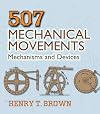
Like many Dover books, this is a reprint of a much older book. Unfortunately the older book is meant for trained mechanics in the 19th century. The drawings are great, but if you want to actually know what all these gears, etc. do and you don't already have extensive knowledge in that area, this book isn't going to help you.
Five Hundred and Seven (507) Mechanical Movements: Embracing All Those Which are Most Important in Dynamics, Hydraulics, Hydrostatics, Pneumatics, Steam Engines, Mill and Other Gearing, Pressses, Horology, and Miscellaneous MacHinery by Henry T. Brown

To add to the understanding of this book and my special love of it, I submit this, which is not meant to be academic; I am not an engineer, although my father was, my copy was published in 1873 although originally published in 1868. It was likely purchased new by my great grandfather in 1875. Complex mechanical devices we consider common today were not in the 1800s, understanding different mechanical movements helped you create the complex movements needed to create new machinery necessary show more for the mechanical age of the 1800s. By 1875 my grandfather had a number of patents for mechanical devices, the concept of which are still incorporated and in use today. I imagine this book was of use, interest and mind expanding to him. I treasure it.
.
.
In response to aulsmith's review, which wasn't bad or exceptionally critical, it is an old book that could not contain 21st century information, so criticizing it for being old, and not containing current 21st Century pictures is hardly a criticism or a reason to down grade it. Without much mechanical insight it does make you see the transfer of motion, if you didn't learn it in High School. It is history, and apparently accurate history, so saying he doesn't like history and expected an old book to have modern insight in it would be more logical, although absurd. show less
.
.
In response to aulsmith's review, which wasn't bad or exceptionally critical, it is an old book that could not contain 21st century information, so criticizing it for being old, and not containing current 21st Century pictures is hardly a criticism or a reason to down grade it. Without much mechanical insight it does make you see the transfer of motion, if you didn't learn it in High School. It is history, and apparently accurate history, so saying he doesn't like history and expected an old book to have modern insight in it would be more logical, although absurd. show less
You May Also Like


Statistics
- Works
- 4
- Members
- 476
- Popularity
- #51,803
- Rating
- 3.7
- Reviews
- 3
- ISBNs
- 26
- Languages
- 2