
Matsuo Bashō (1644–1694)
Author of The Narrow Road to the Deep North and Other Travel Sketches
About the Author
The greatest of Japan's haiku poets and the greatest poet of his age, Basho raised the genre from a mediocre entertainment to serious verse and contributed greatly to its poetics. The work of his peak period is characterized by evocations of humankind's ultimate harmony with nature. He traveled show more widely, recording his journeys in his lyrical poetic diaries. He had numerous disciples, and haiku has remained a vigorous form of poetry to the present. (Bowker Author Biography) show less
Works by Matsuo Bashō
Basho's Narrow Road: Spring and Autumn Passages (Rock Spring Collection of Japanese Literature) (1996) 103 copies, 3 reviews
Haiku Illustrated: Classic Japanese Short Poems (Chinese Bound Classics) (2020) — Contributor — 46 copies, 1 review
Morning Mist: Through the Seasons With Matsuo Basho and Henry David Thoreau (Inklings) (1993) 17 copies
The Four Seasons 7 copies
Cool Melon — Author — 5 copies
The narrow road to Oku 4 copies
Oku no hosomichi = Oku no hosomichi = Ścieżkami Północy - w poszukiwaniu korzeni poezji (2022) 3 copies
O Gosto Solitário do Orvalho 2 copies
Full Moon Is Rising: Lost Haiku of Matsuo Basho (1644-1694 and Travel Haiku of Matsuo Bashio a New Rendering) (1976) 2 copies
Oinokobumi (Japanese Edition) 2 copies
Basho's Haiku: Literal Translations for Those Who Wish to Read the Original Japanese Text, with Gra (2014) 2 copies
Le Sac à charbon 1 copy
奥の細道 他四篇 (対訳古典シリーズ) 1 copy
Stikhi 1 copy
Bashō bunshū 1 copy
দূর প্রদেশের সংকীর্ণ পথ 1 copy
Verzamelde haiku's 1 copy
Poems 1 copy
おくのほそ道(全) 1 copy
Haïkus Et Notes De Voyage 1 copy
Fuyu, estampes d'hiver 1 copy
La lumière des bambous : 60 haïkaï de Bashô et de son école précédé d'un almanach japonais (1988) 1 copy
Note de drumeție 1 copy
O gosto solitário do orvalho 1 copy
Haïkai de Bashô et de ses disciples. Traduction de Kuni Matsuo et Steinilber-Oberlin. Illustrations de Foujita (1936) 1 copy
A Haiku Journey 1 copy
Haikais de Bashô 1 copy
Uttar Ki Yatrayen (Pb) 1 copy
JAIKAIS 1 copy
奥の細道、その他、芭蕉翁紀行集 1 copy
Oku no hosomichi おくのほそ道 1 copy
Associated Works
Literature: An Introduction to Fiction, Poetry, and Drama (1995) — Contributor, some editions — 1,017 copies, 7 reviews
World Poetry: An Anthology of Verse from Antiquity to Our Time (1998) — Contributor — 501 copies, 2 reviews
Sources of Japanese Tradition, Vol. 1: From Earliest Times to 1600 (1958) — Contributor — 285 copies, 3 reviews
The Sound of Water: Haiku by Basho, Buson, Issa, and Other Poets (Shambhala Centaur Editions) (1995) — Contributor — 138 copies
Classic Haiku: The Greatest Japanese Poetry from Basho, Buson, Issa, Shiki, and Their Followers (2007) — Contributor — 91 copies, 1 review
Haiku: Gems of Intimate Beauty in a New Collection of Classic Japanese Poetry (1970) — Contributor — 54 copies
Born of a Dream: Fifty Haiku by Basho, Buson, Taigi, Issa, Shiki (1989) — Contributor — 7 copies, 1 review
Little Enough: 49 Haiku by Basho, Sodo, Ransetsu, Buson, Ryokan, Issa, Shiki (1991) — Contributor — 4 copies
De zomermaan en andere Japanse kettingverzen : uit de school van Matsuo Basho (1984) — Cover artist, some editions — 3 copies
Tagged
Common Knowledge
- Canonical name
- Bashō, Matsuo
- Legal name
- Munefusa, Matsuo
- Other names
- Bashoo, Matsuo
- Birthdate
- 1644
- Date of death
- 1694-11-28
- Gender
- male
- Occupations
- monk, Zen Buddhist
poet - Cause of death
- stomach illness
- Nationality
- Japan
- Birthplace
- Ueno, Iga province, Japan
- Place of death
- Osaka, Japan
- Burial location
- Ōtsu, Japan
- Associated Place (for map)
- Japan
Members
Reviews

Me and my son did a thing with this book where whenever we'd set out on a walk or an adventure or a wagon ride or what have you we'd start with a haiku. It was the best and I am craving short nature poems to take Basho's place now (John Clare doesn't quite cut it, although I guess there's really no reason we couldn't start again with Basho from the start). It also gave us a lot of time to sit with the genre--he doesn't know most words and so I did a lot of explaining the meanings of the show more poems, and realized the really obvious thing that the highly constrained nature of the form makes them more, not less, open to different interpretations, as all the connecting information is left out and they are distilled to a series of vivid juxtapositions. Makes you notice the world around you. show less
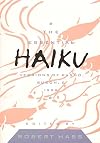
I took a class from Robert Haas during my undergrad. He was a vague teacher but his lectures were careful, rigorous, and were often delivered with a gentleness that made what would otherwise be burdensome topics graceful. So it is with this collection of Haiku by Buson, Basho, and Issa. Among the projects he set forth in the this edition, Haas wanted to show through contrast, how each master's personality and style comes through their work however restricted the form. The effect of reading show more this collection is that the differences become clear:
Issa's comical voice:
I'm going out,
Flies, so relax,
Make love.
Buson's imagery:
The spring sea rising
and falling, rising
and falling all day.
Basho's philosophical melancholy:
First day of spring-
I keep thinking about
the end of Autumn.
I highly recommend this collection for anyone interested in the Haiku form. Though there are some cultural and translational fault lines mapping the boundaries of this style of poetry the main ideas come through, often in unexpected ways: a flash of imagery or setting will set off a spontaneous feeling of sorrow or happiness, frustration or guilt. show less
Issa's comical voice:
I'm going out,
Flies, so relax,
Make love.
Buson's imagery:
The spring sea rising
and falling, rising
and falling all day.
Basho's philosophical melancholy:
First day of spring-
I keep thinking about
the end of Autumn.
I highly recommend this collection for anyone interested in the Haiku form. Though there are some cultural and translational fault lines mapping the boundaries of this style of poetry the main ideas come through, often in unexpected ways: a flash of imagery or setting will set off a spontaneous feeling of sorrow or happiness, frustration or guilt. show less
I took a class from Robert Haas during my undergrad. He was a vague teacher but his lectures were careful, rigorous, and were often delivered with a gentleness that made what would otherwise be burdensome topics graceful. So it is with this collection of Haiku by Buson, Basho, and Issa. Among the projects he set forth in the this edition, Haas wanted to show through contrast, how each master's personality and style comes through their work however restricted the form. The effect of reading show more this collection is that the differences become clear:
Issa's comical voice:
I'm going out,
Flies, so relax,
Make love.
Buson's imagery:
The spring sea rising
and falling, rising
and falling all day.
Basho's philosophical melancholy:
First day of spring-
I keep thinking about
the end of Autumn.
I highly recommend this collection for anyone interested in the Haiku form. Though there are some cultural and translational fault lines mapping the boundaries of this style of poetry the main ideas come through, often in unexpected ways: a flash of imagery or setting will set off a spontaneous feeling of sorrow or happiness, frustration or guilt. show less
Issa's comical voice:
I'm going out,
Flies, so relax,
Make love.
Buson's imagery:
The spring sea rising
and falling, rising
and falling all day.
Basho's philosophical melancholy:
First day of spring-
I keep thinking about
the end of Autumn.
I highly recommend this collection for anyone interested in the Haiku form. Though there are some cultural and translational fault lines mapping the boundaries of this style of poetry the main ideas come through, often in unexpected ways: a flash of imagery or setting will set off a spontaneous feeling of sorrow or happiness, frustration or guilt. show less
Poem selection is average. Aesthetically, the translations are merely passable. (At one point he quote's Amy Lowell's version of a Buson poem, which only has the unintended consequence of making his appear inferior.) But the real problem here are the notes.
Whether it requires it or not, each poem is accompanied by a paragraph or more of only marginally useful notes. Well, notes is probably not entirely correct, as that would suggest that they help to explain the meaning of obscure terms or show more references. Sometimes, perhaps even the majority of the time, they do. (His note on Basho's famous helmet/cricket poem is an example of a good one, for instance.) But a decent amount of the time they serve as little more than an excuse for the author to meander off on whatever tangent the poem has reminded him of — his travels, his life, what he thinks the poet was feeling at the time. Often this is interwoven into the insightful bits, but sometimes the notes serve no purpose but this meandering stream of consciousness.
Eventually, somewhere in the section on Issa, I just stopped reading them. My enjoyment of the collection went up after that.
My final verdict? Find another anthology instead. show less
Whether it requires it or not, each poem is accompanied by a paragraph or more of only marginally useful notes. Well, notes is probably not entirely correct, as that would suggest that they help to explain the meaning of obscure terms or show more references. Sometimes, perhaps even the majority of the time, they do. (His note on Basho's famous helmet/cricket poem is an example of a good one, for instance.) But a decent amount of the time they serve as little more than an excuse for the author to meander off on whatever tangent the poem has reminded him of — his travels, his life, what he thinks the poet was feeling at the time. Often this is interwoven into the insightful bits, but sometimes the notes serve no purpose but this meandering stream of consciousness.
Eventually, somewhere in the section on Issa, I just stopped reading them. My enjoyment of the collection went up after that.
My final verdict? Find another anthology instead. show less
Lists
Awards


You May Also Like


Associated Authors
Statistics
- Works
- 159
- Also by
- 23
- Members
- 5,234
- Popularity
- #4,763
- Rating
- 4.0
- Reviews
- 97
- ISBNs
- 208
- Languages
- 19
- Favorited
- 31

