
Alan Marshall (1) (1902–1984)
Author of I Can Jump Puddles
For other authors named Alan Marshall, see the disambiguation page.
About the Author
Image credit: Alan Marshall
Series
Works by Alan Marshall
Pull down the blind 2 copies
Alan Marshall's Battlers 1 copy
Associated Works
Reader's Digest Condensed Books 1978 v01: Snowbound Six / The Summer of the Spanish Woman / Elephants in the Livingroom, Bears in the Canoe / Arrest Sitting Bull / I Can Jump… (1978) — Author — 29 copies
The Paths I've Trod - Autobiography of an Australian Nurse (1981) — Foreword, some editions — 9 copies
Tagged
Common Knowledge
- Birthdate
- 1902-05-02
- Date of death
- 1984-01-21
- Gender
- male
- Nationality
- Australia
- Birthplace
- Noorat, Victoria, Australia
- Place of death
- Melbourne, Victoria, Australia
- Associated Place (for map)
- Victoria, Australia
Members
Reviews

Strange Australian fairy tale — pretty good fun, really, and very imaginative, but honestly, the princess rescuing trope and her reaction of perfect delight at the prospect of marrying Peter in order to cook and clean for him was not my favorite. I appreciated that the introduction addressed that, and I was impressed with the kangaroo with the the magic pouch — who wouldn’t want a friend like that?
Advanced Readers Copy provided by Edelweiss.
Advanced Readers Copy provided by Edelweiss.

Never having read the Classic, I Can Jump Puddles, I was keen to start this collection that has been sitting ignored, on my shelf for too long. Alan Marshall has an easy way with words and is recalling stories from his teenage years, mostly about adventures he had with his best mate Joe. Kids used to go out and have adventures back then. I know, even for me, if I wasn’t at school, I was always ‘outside’ doing kid stuff! These are definitely Australian flavoured stories, can you have a show more flavoured story? about ordinary Australian people from small rural towns, eccentrics, shearers, farmers and their families. Towards the end there’s one about ten ostriches coming to town! What a hoot! show less
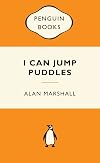
This book remains an enduring children’s classic for many reasons. Life lessons, family and friendship, determination – these all shine through. It offers insights into a way of life at the beginning of the twentieth century; a time that is long gone but important for understanding aspects of the Australian character.
Alan Marshall was the author of the book I Can Jump Puddles (1955) — which everyone my age knew about because we all read it at school. We read it because it was an inspirational memoir of a boy from the bush who was crippled by polio and transcended his disabilities, learning to ride and swim and rampage about in the bush with his mates. The father may just have been being polite, but I was still pleased when he said he would try to find a copy and read it. (You can read a review of I Can show more Jump Puddles here.)
Everyone my age knew children and adults who had disabilities from polio, a disease now almost eradicated by the vaccination which became available in the 1950s. Alan Marshall AM (1902-1984) was one of many who had no alternative but to make the best of things at a time when services for the disabled were rudimentary. As a teenager he won a scholarship to study in Melbourne and he eventually began work as an accountant and married and had a family. He went on to make a career as a journalist, and as a writer of short stories, memoir and a novel. He received the ALS Short Story Award three times, the first in 1933, but his politics were radical and according to the Australian Dictionary of Biography (ADB) many of his contributions to left-wing journals went unpaid.
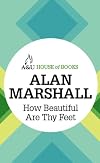
When Marshall published How Beautiful Are Thy Feet in 1949, it was a story set within living memory of his adult readers, and it's consistent with what the ADB says about his interest in depicting lives blighted by prevailing economic conditions. Drawing on his experience as an accountant at the Trueform Boot and Shoe Company in inner-urban Melbourne, and written in the social realist style of the 1940s and 1950s, it's the story of workers in a failing shoe factory during the Depression.
McCormack, whose crutches are mentioned almost as an afterthought, is mostly referred to as The Accountant, as if to emphasise that he is an observant outsider. He's not a factory worker, he's not in sales, and he's not in management. But he is privy to the financial disaster that is looming, and without breaking the confidentiality of his position, he enables some of the workers to get out with good references before the axe falls. It is not until the end of the novel that he makes a significant intervention which saves three shareholder houses that formed security for the factory from the bank. (I think what he did would be illegal today, (as was continuing to trade when management knew the business was insolvent) but Marshall's sympathies were obviously not with the bank!)
How Beautiful Are Thy Feet vividly depicts working conditions that would not be tolerated today,
To read the rest of my review please visit https://anzlitlovers.com/2023/06/12/how-beautiful-are-thy-feet-1949-by-alan-mars... show less
Everyone my age knew children and adults who had disabilities from polio, a disease now almost eradicated by the vaccination which became available in the 1950s. Alan Marshall AM (1902-1984) was one of many who had no alternative but to make the best of things at a time when services for the disabled were rudimentary. As a teenager he won a scholarship to study in Melbourne and he eventually began work as an accountant and married and had a family. He went on to make a career as a journalist, and as a writer of short stories, memoir and a novel. He received the ALS Short Story Award three times, the first in 1933, but his politics were radical and according to the Australian Dictionary of Biography (ADB) many of his contributions to left-wing journals went unpaid.
When Marshall published How Beautiful Are Thy Feet in 1949, it was a story set within living memory of his adult readers, and it's consistent with what the ADB says about his interest in depicting lives blighted by prevailing economic conditions. Drawing on his experience as an accountant at the Trueform Boot and Shoe Company in inner-urban Melbourne, and written in the social realist style of the 1940s and 1950s, it's the story of workers in a failing shoe factory during the Depression.
McCormack, whose crutches are mentioned almost as an afterthought, is mostly referred to as The Accountant, as if to emphasise that he is an observant outsider. He's not a factory worker, he's not in sales, and he's not in management. But he is privy to the financial disaster that is looming, and without breaking the confidentiality of his position, he enables some of the workers to get out with good references before the axe falls. It is not until the end of the novel that he makes a significant intervention which saves three shareholder houses that formed security for the factory from the bank. (I think what he did would be illegal today, (as was continuing to trade when management knew the business was insolvent) but Marshall's sympathies were obviously not with the bank!)
How Beautiful Are Thy Feet vividly depicts working conditions that would not be tolerated today,
The dust from the Naumkeg machine had given Tom Seddon a cough. The blowing system of the Modern Shoe Company was not efficient. It only drew away part of the dust. The remainder floated around his machine.
An inflated pad covered with emery paper revolved at terrific speed before him. He held the sole of a shoe against it. It grated and vibrated. The accountant passed. Tom looked up quickly and called out 'Hey!' He concentrated on his shoe again.
The accountant stopped and watched him. The operation raised a fine nap on the sole so that the paint put on in the finishing room would penetrate the surface. This enabled the finisher to bring up the sole smooth and glossy.
A large galvanised iron funnel gaped over the spinning pad. Emery and leather dust flew from the shoe and was sucked into the blower's mouth. A dull roar came from the cavity. Behind it was a large tube stretched like a snake along the wall, and out into a collector standing in the yard.
Dust that escaped the uprush of air floated around Tom's head. His hair was sprinkled with dust. It clung to the edges of his nostrils and to his lips. (p.66)
To read the rest of my review please visit https://anzlitlovers.com/2023/06/12/how-beautiful-are-thy-feet-1949-by-alan-mars... show less
Lists
Awards


You May Also Like


Associated Authors
Statistics
- Works
- 34
- Also by
- 9
- Members
- 671
- Popularity
- #37,613
- Rating
- 3.9
- Reviews
- 11
- ISBNs
- 150
- Languages
- 8
- Favorited
- 1