
Bruce Chatwin (1940–1989)
Author of The Songlines
About the Author
Works by Bruce Chatwin
Op reis met — Contributor — 6 copies
Süddeutsche Zeitung eBibliothek: Die Road Novels: Traumpfade / Apostoloff / Unterwegs nach Bagadag / Treibeis / Die Autonauten auf der Kosmobahn (2014) 4 copies
Auf und davon nach Timbuktu 4 copies
No title 1 copy
La via dei canti 1 copy
Drpor 1 copy
Στην Παταγωνία 1 copy
O vice-rei de Ajudá 1 copy
A coup a story 1 copy
Mondo nomade 1 copy
Un colpo di Stato 1 copy
Chatwin Bruce 1 copy
Co ja tu taj robię? 1 copy
Bruce Chatwin, der Wanderer 1 copy
Associated Works
A Visit to Don Otavio: A Traveller's Tale from Mexico (1953) — Introduction, some editions — 419 copies, 5 reviews
The Company They Kept, Volume Two: Writers on Unforgettable Friendships (2011) — Contributor — 25 copies
Tagged
Common Knowledge
- Canonical name
- Chatwin, Bruce
- Legal name
- Chatwin, Charles Bruce
- Birthdate
- 1940-05-13
- Date of death
- 1989-01-18
- Gender
- male
- Education
- Marlborough College
University of Edinburgh (no degree) - Occupations
- art porter
journalist
travel writer
director, Sotheby's - Organizations
- Sotheby's
The Sunday Times - Awards and honors
- E. M. Forster Award (1979)
- Relationships
- Leigh Fermor, Patrick (friend)
Chanler, Elizabeth (spouse) - Short biography
- Bruce Chatwin was born in 1940 in the Shearwood Road nursing home in Sheffield, England, and his first home was his grandparents' house in Dronfield, near Sheffield. His mother, Margharita (née Turnell), had moved back to her parents' home when Chatwin's father, Charles Chatwin, went away to serve with the Royal Naval Reserve.
- Cause of death
- fungal infection (Talaromyces marneffei)
- Nationality
- UK
- Birthplace
- Sheffield, South Yorkshire, England, UK
- Places of residence
- Birmingham, England, UK
London, Middlesex, England, UK - Place of death
- Nice, Alpes-Maritimes, France
- Burial location
- cremated, ashes scattered (near Kardamyli, Peloponnese, Greece)
- Map Location
- England, UK
Members
Discussions
BRITISH AUTHOR CHALLENGE - SHEFFIELD in 75 Books Challenge for 2017 (June 2017)
Songlines, From the Notebooks in Le Salon Littéraire du Peuple pour le Peuple (March 2012)
Songlines, Chapters 16-30 in Le Salon Littéraire du Peuple pour le Peuple (March 2012)
Songlines, Chapters 1-15 in Le Salon Littéraire du Peuple pour le Peuple (March 2012)
Songlines, by Bruce Chatwin in Le Salon Littéraire du Peuple pour le Peuple (February 2012)
Reviews
Utz by Bruce Chatwin

“Anything was better than to be loved for one's things.”
Utz, the eponymous main character of this novel is a minor aristocrat and a collector of Meissen porcelain in Czechoslovakia during its period of Soviet rule under Stalin. Although he has multiple opportunities to emigrate, he cannot bear to separate himself for long from his porcelain. So Utz becomes a study into the psychology of obsession and private collecting of art
Utz through various machinations avoids the excesses of both show more Nazism and Communism yet despite stating that he abhors violence strangely seems to welcome these epochs as they "offer excellent opportunities for the collector." Yet Utz's main enemy are museum curators. He asserts that art trapped behind glass die “of suffocation and the public gaze" whereas the private collector, by contrast, “restores to the object the life-giving touch of its maker.”I return for being left alone with his collection Utz agrees that the museum in Prague will have it after his death yet when he supposedly dies, only two people see his dead body or attend his funeral, the porcelain mysteriously disappears which along with earlier talk of alchemy and the elixir of life seems to suggest that porcelain may have super-natural powers. So the reader is left wondering whether or not Utz destroyed the collection before 'his death' to stop it from dying in a museum or because he was so obsessed with it that he was unwilling to share it or conversely he managed to smuggle it out somewhere and then faked his own death. Chatwin leaves this for the reader to decide.
The novel perhaps encourage readers to examine the interrelationships of art, collecting, passion, love, creation, life, and death. That said and done, whilst I enjoyed the author's writing style and tightly controlled prose I struggled to really enjoy it and somehow failed to really engage with it. Perhaps it was just too deep for me. show less
Utz, the eponymous main character of this novel is a minor aristocrat and a collector of Meissen porcelain in Czechoslovakia during its period of Soviet rule under Stalin. Although he has multiple opportunities to emigrate, he cannot bear to separate himself for long from his porcelain. So Utz becomes a study into the psychology of obsession and private collecting of art
Utz through various machinations avoids the excesses of both show more Nazism and Communism yet despite stating that he abhors violence strangely seems to welcome these epochs as they "offer excellent opportunities for the collector." Yet Utz's main enemy are museum curators. He asserts that art trapped behind glass die “of suffocation and the public gaze" whereas the private collector, by contrast, “restores to the object the life-giving touch of its maker.”I return for being left alone with his collection Utz agrees that the museum in Prague will have it after his death yet when he supposedly dies, only two people see his dead body or attend his funeral, the porcelain mysteriously disappears which along with earlier talk of alchemy and the elixir of life seems to suggest that porcelain may have super-natural powers. So the reader is left wondering whether or not Utz destroyed the collection before 'his death' to stop it from dying in a museum or because he was so obsessed with it that he was unwilling to share it or conversely he managed to smuggle it out somewhere and then faked his own death. Chatwin leaves this for the reader to decide.
The novel perhaps encourage readers to examine the interrelationships of art, collecting, passion, love, creation, life, and death. That said and done, whilst I enjoyed the author's writing style and tightly controlled prose I struggled to really enjoy it and somehow failed to really engage with it. Perhaps it was just too deep for me. show less

Bruce Chatwin didn't actually spend much time out of his four or five decades on earth in Australia - so he is no expert on Australia and its cultures and landscapes. On the other hand his few weeks in and around Alice Springs in the early 1980s brushing with traditional Australians in the desert and recording a journalistic slice of their life does give him an insight in Aboriginal Australia I don't have myself as an Australian. I think this comes from Chatwin's immense confidence and sense show more of purpose as a travel writer. And that sense of confidence and purpose is something all of us writer's should try to have more of - life is whistling by and if we don't stand up from our desks right now and go and stride into our interests on the ground then history will pass us by. Thanks for this reminder Bruce.
But this book is of value to me more for its thoughts on nomadism. A large slab of the book is basically his 'commonplace book', his literary scrapbook, for fragments of writing, his own and others, that adumbrate why and how we humans are fundamentally restless and travel loving as a species. He recalls chatting with a nomad in the deserts of Sudan, and then quotes something about Cain and Abel from the bible, then gives us a bit of a letter by Flaubert. It is compelling stuff - for the same reason his best work is. He conjures the romance of travel through glimpses and images and mutterings, in the way only a mystically propelled and slightly misanthropic aesthete like himself could do. show less
But this book is of value to me more for its thoughts on nomadism. A large slab of the book is basically his 'commonplace book', his literary scrapbook, for fragments of writing, his own and others, that adumbrate why and how we humans are fundamentally restless and travel loving as a species. He recalls chatting with a nomad in the deserts of Sudan, and then quotes something about Cain and Abel from the bible, then gives us a bit of a letter by Flaubert. It is compelling stuff - for the same reason his best work is. He conjures the romance of travel through glimpses and images and mutterings, in the way only a mystically propelled and slightly misanthropic aesthete like himself could do. show less
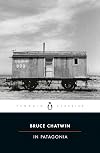
A collection of 97 vignettes from Chatwin's travels in Patagonia after he famously wrote his editor that he was taking off there on a whim. Thinking back, I recall finding the lack of narrative thread frustrating, but equally being impressed by the spare prose. As with all of his books, there are many who criticise what is invented and what is omitted. But there are more than enough worthy, boring travelogues in this world. Chatwin could write beautifully, and his selective and show more impressionistic tales often capture something essential about the nature of people and place. show less
Chatwin's writing is delightful and fun to read. He writes very vividly about small details, but tends to leave the larger picture murky. Although this is travel literature, it in no way really lets you know what to expect in Patagonia. It is a series of snapshots - he describes some of the people he encounters in vivid detail, and explores some historical anecdotes (especially around Butch Cassidy) and local legends (without clarifying where history ends and legend begins, rendering himself show more an unreliable narrator).
This book is racist in the way that only a British imperialist can be racist: that is, the native people of Patagonia are basically details of the landscape, like the livestock, and he focuses entirely on the European inhabitants of South America. Granted, it is fascinating how many cultural pockets he encounters - villages that remain entirely Welsh or German in language and culture - but Chatwin all but ignores the locals.
All in all, this is a strange book, but worth reading for the quality of the writing. show less
This book is racist in the way that only a British imperialist can be racist: that is, the native people of Patagonia are basically details of the landscape, like the livestock, and he focuses entirely on the European inhabitants of South America. Granted, it is fascinating how many cultural pockets he encounters - villages that remain entirely Welsh or German in language and culture - but Chatwin all but ignores the locals.
All in all, this is a strange book, but worth reading for the quality of the writing. show less
Lists
Five star books (1)
Down on the Farm (1)
My TBR (1)
Backlisted (1)
First Novels (1)
Allie's Wishlist (1)
Country Life (1)
Spirit of Place (1)
Books with Twins (1)
A Novel Cure (1)
Folio Society (2)
Read These Too (1)
1970s (1)
Sense of place (1)
Shaking a Leg (1)
Booker Prize (1)
Awards


You May Also Like


Associated Authors
Statistics
- Works
- 54
- Also by
- 14
- Members
- 14,587
- Popularity
- #1,576
- Rating
- 3.8
- Reviews
- 313
- ISBNs
- 422
- Languages
- 23
- Favorited
- 59

