
Kate Atkinson
Author of Life After Life
About the Author
Kate Atkinson was born in York, and studied English Literature at the University of Dundee. She earned her Masters Degree from Dundee in 1974. She then went on to study for a doctorate in American Literature but she failed at the viva (oral examination) stage. After leaving the university, she took show more on a variety of jobs from home help to legal secretary and teacher. Her first novel, Behind the Scenes at the Museum, won the 1995 Whitbread Book of the Year ahead of Salman Rushdie's The Moor's Last Sigh and Roy Jenkins's biography of William Ewart Gladstone. It went on to be a Sunday Times bestseller. Since then, she has published another five novels, one play, and one collection of short stories. Her work is often celebrated for its wit, wisdom and subtle characterisation, and the surprising twists and plot turns. Her most recent work has featured the popular former detective Jackson Brodie. In 2009, she donated the short story Lucky We Live Now to Oxfam's 'Ox-Tales' project, four collections of UK stories written by 38 authors. Atkinson's story was published in the 'Earth' collection. In March 2010, Atkinson appeared at the York Literature Festival, giving a world-premier reading from an early chapter from her forthcoming novel Started Early, Took My Dog, which is set mainly in the English city of Leeds. Atkinson's bestselling novel, Life after Life, has won numerous awards, including the COSTA Novel Award for 2013. The follow-up to Life After Life is A God in Ruins and was published in 2015. This title won a Costa Book Award 2015 in the novel category. (Bowker Author Biography) show less
Series
Works by Kate Atkinson
Wentworth : Season 8 : Part 1 2 copies
Creepy Crawlies 1 copy
Lucky We Live Now - story 1 copy
Lineup 1 copy
Affairs of the Heart 1 copy
Tracce d'amore 1 copy
Associated Works
The Book That Changed My Life: 71 Remarkable Writers Celebrate the Books That Matter Most to Them (2006) — Contributor — 411 copies, 18 reviews
Freedom: Stories Celebrating the Universal Declaration of Human Rights (2009) — Contributor — 85 copies, 2 reviews
Tagged
Common Knowledge
- Birthdate
- 1951-12-20
- Gender
- female
- Education
- University of Dundee (1974)
- Occupations
- legal secretary
teacher
novelist - Awards and honors
- British Book Award (Newcomer of the Year ∙ 1997)
E. M. Forster Award (1998)
Order of the British Empire (Member ∙ 2011)
Whitbread First Novel Award (1995)
Whitbread Book of the Year Prize (1995) - Agent
- Peter Straus
- Relationships
- Hixon, Andy (partner or husband)
- Short biography
- She was born in York, and studied English Literature at the University of Dundee, gaining her Masters Degree in 1974. During her final year of this course, she was married for the first time. The marriage lasted only two years, but produced Atkinson's first daughter, Eve, who was born in 1975. She subsequently studied for a doctorate in American Literature which she failed at the viva stage. After leaving university, she took on a variety of miscellaneous jobs from home help to legal secretary and teacher. She lived in Whitby, Yorkshire for a time, but now lives in Edinburgh.
- Nationality
- UK
- Birthplace
- York, Yorkshire, England, UK
- Places of residence
- Whitby, Yorkshire, England, UK
Edinburgh, Scotland, UK - Map Location
- England, UK
Members
Discussions
BRITISH AUTHOR CHALLENGE - OCTOBER 2016 - ATKINSON & GOLDING in 75 Books Challenge for 2016 (October 2016)
"Life After Life": Is it worth a read? in Girlybooks (September 2015)
Life after Life - Kate Atkinson in Orange January/July (May 2014)
Reviews

Just when we thought Kate Atkinson had finished with Jackson Brodie, along comes Death at the Sign of the Rook. And this time, Atkinson delivers a mystery infused with her superb wit. Jackson Brodie, now a private investigator, is hired to investigate the theft of a painting from the home of Dorothy Padgett, an elderly woman who recently died. At the same time, the Milton family is hosting a “murder mystery weekend” at Burton Makepeace, their country estate hotel. We also meet the local show more vicar and others who are tenants on the Milton estate. As Atkinson builds this world she pokes fun at English society and mannerisms while dropping clues that may or may not relate to the theft. And Jackson is reunited with Reggie Chase, a delightful recurring character who is now a police officer.
Eventually the murder mystery weekend becomes intertwined with actual crimes, and turns into a slapstick caper. Various people find their way to Burton Makepeace, either on purpose (for the murder mystery) or for other more coincidental reasons, and then a huge snowstorm holds them all captive. The mystery is solved, but you may have forgotten about that stolen painting and become much more interested in other related storylines. It doesn’t matter – just have fun. show less
Eventually the murder mystery weekend becomes intertwined with actual crimes, and turns into a slapstick caper. Various people find their way to Burton Makepeace, either on purpose (for the murder mystery) or for other more coincidental reasons, and then a huge snowstorm holds them all captive. The mystery is solved, but you may have forgotten about that stolen painting and become much more interested in other related storylines. It doesn’t matter – just have fun. show less

I’ve read most of Kate Atkinson’s books, but I didn’t rush out to buy this one, as the reviews all focussed on the “branching narrative” thing and made it sound as if it would be rather gimmicky. It is gimmicky, of course, but now I finally get around to reading it (the book club picked it for this month) I have to admit that Atkinson is a good enough writer to get away with being gimmicky. It’s a very professionally assembled historical novel that gives us — multiple — show more convincing pictures of what it might have been like to grow up as the daughter of a middle-class Home Counties family in the first half of the 20th century.
We move pretty seamlessly from a Forster-ish view of the Todd family in its idyllic outer-suburban retreat ca. 1910 to a Stephen Spender view of the London Blitz (plus additional graphic horror that no-one writing at the time would have put in, but which we need because most of us nowadays haven’t actually lived through that kind of experience ourselves). Along the way, Atkinson gets us to think about things like the position of domestic servants, violence against women, and the limitation of educational and career opportunities for girls, all without ever seeming to be pressing any obviously anachronistic buttons. (Atkinson is from a similar background and generation to me, and her knowledge about England in the first half of the century must come from much the same kind of sources as mine, so it’s perhaps not surprising that it all rings so true…)
I’m not sure if the “multiple lives” thing actually adds much, but perhaps it does allow Atkinson to play with a wider range of ideas and settings than might comfortably have fitted into a simple linear narrative. And it does raise some interesting ideas about the arbitrariness of the kind of small events that dictate how our lives will turn out, even if we ignore all the slightly silly reincarnation and déjà-vu and “what if I went back to assassinate Hitler?” stuff. show less
We move pretty seamlessly from a Forster-ish view of the Todd family in its idyllic outer-suburban retreat ca. 1910 to a Stephen Spender view of the London Blitz (plus additional graphic horror that no-one writing at the time would have put in, but which we need because most of us nowadays haven’t actually lived through that kind of experience ourselves). Along the way, Atkinson gets us to think about things like the position of domestic servants, violence against women, and the limitation of educational and career opportunities for girls, all without ever seeming to be pressing any obviously anachronistic buttons. (Atkinson is from a similar background and generation to me, and her knowledge about England in the first half of the century must come from much the same kind of sources as mine, so it’s perhaps not surprising that it all rings so true…)
I’m not sure if the “multiple lives” thing actually adds much, but perhaps it does allow Atkinson to play with a wider range of ideas and settings than might comfortably have fitted into a simple linear narrative. And it does raise some interesting ideas about the arbitrariness of the kind of small events that dictate how our lives will turn out, even if we ignore all the slightly silly reincarnation and déjà-vu and “what if I went back to assassinate Hitler?” stuff. show less
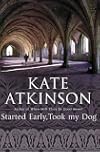
If there was a way of giving this book more than five stars, I would. It is breath-takingly good fiction.
It works as a satisfying crime novel and as a mainstream examination both of how we live with the consequences of the choices that we make and the mores and attitudes of Britain now and in 1975.
The prose is beautiful. The voice of each character is distinct and believable. Time and place are evoked with an almost clinical clarity. The interior monologues, particularly that of "Silly show more Tilly" who is slipping into dementia are intimate, accurate and yet easy to read. The shifts along the timeline and between characters' point of view are well crafted so that the reader's understanding of the story and characters of the people evolves into something richly textured and authentic.
Despite the gritty nature of some of the themes and the gruesome start to the chain of events that the novel unravels, this remains an optimistic book that can make you laugh as easily as it can make you cry.
Perhaps it's because this book describes my own generation but I felt deep empathy with the newly-retired police woman, coming to terms with the gap between what she wants and where her choices have taken her. Tilly's tale also stays in memory, not just because of the skilful way in which dementia is evoked but because of the betrayals and disappointments that she has endured. "The Kid" Coutrney/Lucy slices her way into the reader's heart with thumbs-ups and star hand waves and tiny trove of perosanl treasures that she lays out like an act of prayer.
The book is full of people who make the wrong decision or trust the wrong person and pay the price. It is a sign of Kate Atkinson's skill that we come to understand and empathise with these people rather than judging them
The back of the book tells me that this is the fourth book featuring Jackson Brodie. but my lack of knowledge of the previous books didn't mar my enjoyment of this one. Jackson is a curious character, a lightning-rod for stange events that he reacts to with remarkable passivity. A man who would like insight into himself but can only find it in the words of his ex-wife. A man who is surprised to find that the company of a dog is good for the soul
This was my first Kate Akinson book, but it certainly won't be my last show less
It works as a satisfying crime novel and as a mainstream examination both of how we live with the consequences of the choices that we make and the mores and attitudes of Britain now and in 1975.
The prose is beautiful. The voice of each character is distinct and believable. Time and place are evoked with an almost clinical clarity. The interior monologues, particularly that of "Silly show more Tilly" who is slipping into dementia are intimate, accurate and yet easy to read. The shifts along the timeline and between characters' point of view are well crafted so that the reader's understanding of the story and characters of the people evolves into something richly textured and authentic.
Despite the gritty nature of some of the themes and the gruesome start to the chain of events that the novel unravels, this remains an optimistic book that can make you laugh as easily as it can make you cry.
Perhaps it's because this book describes my own generation but I felt deep empathy with the newly-retired police woman, coming to terms with the gap between what she wants and where her choices have taken her. Tilly's tale also stays in memory, not just because of the skilful way in which dementia is evoked but because of the betrayals and disappointments that she has endured. "The Kid" Coutrney/Lucy slices her way into the reader's heart with thumbs-ups and star hand waves and tiny trove of perosanl treasures that she lays out like an act of prayer.
The book is full of people who make the wrong decision or trust the wrong person and pay the price. It is a sign of Kate Atkinson's skill that we come to understand and empathise with these people rather than judging them
The back of the book tells me that this is the fourth book featuring Jackson Brodie. but my lack of knowledge of the previous books didn't mar my enjoyment of this one. Jackson is a curious character, a lightning-rod for stange events that he reacts to with remarkable passivity. A man who would like insight into himself but can only find it in the words of his ex-wife. A man who is surprised to find that the company of a dog is good for the soul
This was my first Kate Akinson book, but it certainly won't be my last show less
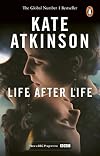
Kate Atkinson's Life After Life is a wonderful, wonderful novel, and I absolutely loved it. Ursula is the third child of Sylvie and Hugh, born just before WW1, and this is the story of her many lives. Not reincarnation, not time travel (although the book's structure is time-hopping all over the place), but deja vu taken to the extreme, where she gets the chance to live bits of her life over again with different outcomes. It's very cleverly done - Ursula doesn't necessarily know what awful show more thing is going to happen, but the deja vu feeling means that she does *something* to change the outcome of what could have happened (and did, in another parallel life). There are a lot of difficult events - war, rape, backstreet abortion, Nazism, teenage pregnancy, murder, suicide, domestic violence, amongst others - and poor Bridget, the family maid, has a particularly hard time as Ursula tries several times to stop her from catching the Spanish flu at the end of WW1 and infecting the household. In some lives Ursula is a mother, in others she is a maiden aunt with a history, in some she lives in Nazi Germany, in others she is in London, but throughout, each timeline is believable even as you know you're suspending disbelief. I'll definitely be picking up her related novel, A God in Ruins (primarily about Ursula's brother Teddy - thank goodness it's not about her brother Maurice!), in the next few months before the characters start to fade in my mind. show less
Lists
Female Author (6)
Thrillers (1)
100 New Classics (1)
BBC Big Read (1)
Ryan's Books (1)
Magic Realism (1)
Family Drama (1)
5 Best 5 Years (1)
READ in 2023 (1)
Read in 2016 (1)
io9 Book Club (1)
Same Title (1)
Netgalley Reads (1)
First Novels (1)
READ IN 2022 (1)
British Mystery (2)
. (2)
Unread books (2)
Favourite Books (2)
Favorite Series (1)
Carole's List (1)
Women's Stories (1)
Movies/Shows (1)
Best Spy Fiction (1)
War Literature (1)
Awards


You May Also Like


Associated Authors
Statistics
- Works
- 39
- Also by
- 14
- Members
- 52,499
- Popularity
- #291
- Rating
- 3.8
- Reviews
- 2,475
- ISBNs
- 699
- Languages
- 29
- Favorited
- 228

