
Yutang Lin (1895–1976)
Author of The Importance of Living
About the Author
Though he was never considered to be a serious original thinker or a leading writer in his native China, Lin Yu-t'ang's role as an essayist and popularizer of things Chinese in the West is worthy of attention. He was a native of Changchow in Amoy, son of a Presbyterian minister, and show more third-generation Christian. He was brought up in a strict household and prepared for the ministry, and after middle school he was sent to the Protestant College of Amoy. In 1911 he entered the famous St. John's University in Shanghai, and it was during his time there that he became disillusioned with the choice of a religious career and renounced Christianity. After graduation (with a rather weak academic record), Lin Yu-t'ang became a professor of English at Tsinghua University because his grounding in foreign languages was much stronger than in classical Chinese. In 1919 he decided to pursue further study in the United States, where he spent one year at Harvard University and then went on to France where he worked for the YMCA. He moved to Germany for a term, and at last in 1923 earned a Ph.D. in Leipzig in the field of archaic Chinese phonology. Lin Yu-t'ang then returned home and tried out various teaching posts, and in 1927 became secretary to the Ministry of Foreign Affairs in the Wuhan government. But politics was not to his liking, and he resigned in the following year. In 1932 he founded the Analects Fortnightly, a magazine of wit and satire that proved to be an instant popular success. Two years later he began another periodical, This Human World, which contained short essays. Unfortunately, his satire angered intellectuals on both the Left and the Right, and this was the beginning of his lifelong friction with Chinese literary and academic circles. In 1936, feeling hostility at home but an increased demand for his writings in the West, Lin Yu-t'ang went to New York City and remained there until 1943, when he went back home to lecture briefly and again became embroiled in controversy. However, in the United States, his essays and ideas were greeted with great enthusiasm. Early in 1954 he was appointed chancellor of the new Chinese University in Singapore, but, because of a disagreement with the trustees on policy, he and his staff left early in 1955 before the university opened its doors. Not long after this, in New York, he and his wife publicly announced their reconversion to Christianity. In addition to his many books of essays, Lin Yu-t'ang published a novel, Moment in Peking, a saga about a Chinese family spanning the years 1900--38. He also published a number of translations of classical Chinese works, the best of which is perhaps Shen Fu's Six Chapters of a Floating Life, the moving autobiographical account of a happy marriage marred by parental disapproval and the tragic early death of the wife. Lin Yu-t'ang's writings are marked by an appreciation of both Eastern and Western culture, and their sparkling, idiomatic English style has endeared him to thousands of Western readers. (Bowker Author Biography) show less
Image credit: Library of Congress
Works by Yutang Lin
Widow, Nun and Courtesan: Three Novelettes (1964) — some editions; some editions; Author, some editions — 26 copies, 1 review
Imperial Peking: Seven centuries of China; with an essay on the art of China by Peter C.Swann (1961) 18 copies
Peking, Teil 1 und 2 3 copies
ENTRE LAGRIMAS Y RISAS 2 copies
Sabiduría China 2 copies
支那のユーモア 2 copies
Mi patria y mi pueblo 2 copies
Peace is in the heart 2 copies
Egy múló pillanat regény I.kötet 2 copies
La sabiduría de Lao Tsé 1 copy
Sống đẹp 1 copy
Sabiduría Hindú 1 copy
Lin YuTang Chinese-English Bilingual Edition: Harvest Moon on West Lake (Bilingual literature) (2009) 1 copy
Lin Yutang Chinese-English Bilingual Edition Selected Poems and Prose of Su Tungpo (Lin Yutang Chine (2008) 1 copy
Wisdom of China and India 1 copy
Uma Fôlha na Tempestade 1 copy
京華煙雲 1 copy
Pureland Daily Practice 1 copy
Boundless 1 copy
The First Steps of Vajrayana 1 copy
生活的藝術 1 copy
信仰之旅 1 copy
風聲鶴唳 1 copy
朱門 1 copy
紅牡丹 1 copy
武則天 1 copy
生活的藝術 1 copy
Punainen portti 1 copy
Life when the case: the latest revision of hardcover commemorative Collector's Edition!(Chinese Edition) (2014) 1 copy
China 1 copy
O portão vermelho 1 copy
El nombre secreto 1 copy
Un Genio Alegre 1 copy
行素集 1 copy
Famous Chinese Stories 1 copy
Memoirs Of An Octogenarian 1 copy
A Brief Introduction to Setting up a Buddhist Altar — Author — 1 copy
勵志人生 1 copy
The Dog-Meat General 1 copy
京華煙雲 1 copy
Lai bo ying 賴伯英 1 copy
Un momento en Pekín 1 copy
La oportunidad de Eurídice 1 copy
Una hoja en la tormenta 1 copy
Communion of Tang with Jin Dynasties (Translated by Lin Yutang) (English and Chinese Edition) (2015) 1 copy
Sabiduría Hidú 1 copy
La emperatriz Wu 1 copy
Falevél a viharban - regény 1 copy
Diamond Wisdom 1 copy
A Sabedoria da América 1 copy
Momento em Pekim - 2 Volumes 1 copy
支那のユーモア 1 copy
Associated Works
The Water Margin: Outlaws of the Marsh: The Epic Tale of Brotherhood, Bravery and Rebellion in Imperial China (1300) — Introduction, some editions — 1,050 copies, 19 reviews
Out of the Best Books: An Anthology of Literature, Vol. 5: Community Responsibility (1969) — Contributor — 30 copies
The Best of Both Worlds: An Anthology of Stories for All Ages (1968) — Translator — 25 copies, 1 review
Tagged
Common Knowledge
- Canonical name
- Lin, Yutang
- Legal name
- Lin, Yutang
林語堂 - Birthdate
- 1895-10-10
- Date of death
- 1976-03-26
- Gender
- male
- Education
- St. John's University - Shanghai
Harvard University
University of Leipzig - Occupations
- Professor of English Literature
translator
inventor - Nationality
- China
- Birthplace
- Banzi, China
- Places of residence
- Banzi, China (birth)
Yangmingshan, Taipei, Taiwan - Burial location
- at his home in Yangmingshan, Taipei, Taiwan
- Associated Place (for map)
- Banzi, China
Members
Reviews

I found this in Browsers' Bookstore and decided to pick it up after flipping through a few pages and laughing. (would strongly encourage flipping through and bringing home old books- they can surprise you!)
I'd never heard of Lin Yutang before, and it's a shame I hadn't. With Love and Irony is a collection of his essays and satire that he wrote in English, some from various magazines he published in between 1930 and 1940. 80 years later, his sense of humor still reads sharp, and he remains show more relatively optimistic in spite of the Second Sino-Japanese War and occupation contemporary to his work. In "Mickey Mouse", he chides the college revolutionaries that sometimes art can just be for enjoyment and that not all literature needs to be political propaganda, recommending they take a break with comic strips. "The Coolie Myth" skewers Western perceptions on Chinese laborers. A lot of essays compare and contrast "traditional Chinese" culture to their English and American counterparts, in addition to the invading neighbors from Japan.
I felt sad reading "The Future of China", thinking about how he thought post-war nationalism would buoy future prospects only for the Chinese Civil War to resume and dash all those dreams.
Would recommend. It also makes me wonder what an equivalent would be today- like if someone in 2060 decided to read a Dave Barry collection? Would it age as well, or stymie the reader in temporally specific references and metaphor? show less
I'd never heard of Lin Yutang before, and it's a shame I hadn't. With Love and Irony is a collection of his essays and satire that he wrote in English, some from various magazines he published in between 1930 and 1940. 80 years later, his sense of humor still reads sharp, and he remains show more relatively optimistic in spite of the Second Sino-Japanese War and occupation contemporary to his work. In "Mickey Mouse", he chides the college revolutionaries that sometimes art can just be for enjoyment and that not all literature needs to be political propaganda, recommending they take a break with comic strips. "The Coolie Myth" skewers Western perceptions on Chinese laborers. A lot of essays compare and contrast "traditional Chinese" culture to their English and American counterparts, in addition to the invading neighbors from Japan.
I felt sad reading "The Future of China", thinking about how he thought post-war nationalism would buoy future prospects only for the Chinese Civil War to resume and dash all those dreams.
Would recommend. It also makes me wonder what an equivalent would be today- like if someone in 2060 decided to read a Dave Barry collection? Would it age as well, or stymie the reader in temporally specific references and metaphor? show less

Peonia, giovane vedova felice della libertà ritrovata, è uno spirito libero e insaziabile, alla ricerca continua di un amore perfetto. Una Madame Bovary "made in China", ma indifferente alle costrizioni sociali e alla ricerca attiva della propria felicità. Consapevole della propria fisicità e delle proprie emozioni, talvolta crudele nel suo essere totalmente sincera con gli altri e con se stessa, Peonia si fa beffe della "forma" e segue il proprio cuore, non i dettami di una società show more tradizionalista ed estremamente formale come quella cinese del diciannovesimo (?) secolo.
Mi aspettavo un lieto fine: tutto il romanzo tendeva verso una conclusione felice per Peonia. In un certo senso, le mie aspettative sono state rispettate. In un certo senso.
Molto bello, mi è piaciuto :) show less
Mi aspettavo un lieto fine: tutto il romanzo tendeva verso una conclusione felice per Peonia. In un certo senso, le mie aspettative sono state rispettate. In un certo senso.
Molto bello, mi è piaciuto :) show less
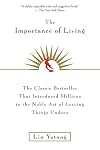
Sternness of appearance and correctness of behavior are what we moderns tend to assume when thinking of the Confucian way in pre-modern China. However, Chinese thought and character have a lighter side which is explained in "The Importance of Living" (1937) by Lin Yutang (1895-1976). The book is a collection of essays with titles such as “On Having a Stomach,âÂ? âÂÂThe Cult of the Idle Life,âÂ? âÂÂOn Being Wayward and Incalculable,âÂ? and âÂÂGood show more Taste in Knowledge.âÂ? It was a best seller in the mid-1930s, as Americans were sympathetic with the Chinese who were suffering at the hand of Japanese invaders (JapanâÂÂs war against China cost about 20 million Chinese lives).
Lin mistrusted the arrogance of the intellect and scientism, the belief that the investigative methods of the physical sciences are applicable or justifiable in all fields of inquiry, such as psychology and politics. He writes:
"Philosophy in the Western sense seems to the Chinese eminently idle. ⦠In its preoccupation with logic, which concerns itself with the method of arrival at knowledge, and epistemology, which poses the question of possibility of knowledge, it has forgotten to deal with the knowledge of life itself. . . . The German philosophers are the most frivolous of all; they court truth like ardent lovers, but seldom propose to marry her."
In the Taoist tradition, Lin says the point is not to âÂÂhave a great philosophy or have a few great philosophersâÂ? but rather it is âÂÂto take things philosophically,âÂ? to live in a way that makes life not only bearable but delightful. Reading is key to enjoying life: âÂÂ⦠[I]f one knows the enjoyment of reading, one can study anywhere, even in the best schools.âÂ?
Aside from the sage advice of âÂÂEasy does it,âÂ? the other appeal of this book is that Lin provides translations of Chinese poets and idlers that readers would never find on their own. For instance, his passages from poet and âÂÂgay geniusâÂ? Su Tungpo are wonderful. Su's four maxims for long life are in fact attainable: having leisure equals having power, going to bed early equals having wealth, a leisurely stroll is as enjoyable as a drive, and eating late is as good as eating meat. As Lin was bilingual, the translations are trustworthy and smooth. Anyway, this book is a delight. show less
Lin mistrusted the arrogance of the intellect and scientism, the belief that the investigative methods of the physical sciences are applicable or justifiable in all fields of inquiry, such as psychology and politics. He writes:
"Philosophy in the Western sense seems to the Chinese eminently idle. ⦠In its preoccupation with logic, which concerns itself with the method of arrival at knowledge, and epistemology, which poses the question of possibility of knowledge, it has forgotten to deal with the knowledge of life itself. . . . The German philosophers are the most frivolous of all; they court truth like ardent lovers, but seldom propose to marry her."
In the Taoist tradition, Lin says the point is not to âÂÂhave a great philosophy or have a few great philosophersâÂ? but rather it is âÂÂto take things philosophically,âÂ? to live in a way that makes life not only bearable but delightful. Reading is key to enjoying life: âÂÂ⦠[I]f one knows the enjoyment of reading, one can study anywhere, even in the best schools.âÂ?
Aside from the sage advice of âÂÂEasy does it,âÂ? the other appeal of this book is that Lin provides translations of Chinese poets and idlers that readers would never find on their own. For instance, his passages from poet and âÂÂgay geniusâÂ? Su Tungpo are wonderful. Su's four maxims for long life are in fact attainable: having leisure equals having power, going to bed early equals having wealth, a leisurely stroll is as enjoyable as a drive, and eating late is as good as eating meat. As Lin was bilingual, the translations are trustworthy and smooth. Anyway, this book is a delight. show less
The Importance of Living is a number of essays about the importance of enjoying life and ways to do so. In some ways, the author's ideas are kind of silly, but they are presented in such a non-pushy way that they the unpleasant ideas are easy to forget. However, his attitudes towards women are infuriating. At one point the author talks about how it is best for people to be natural... and women require lipstick to be natural. At another point, he makes this statement
This book may have been first published in 1937, but I still find the attitude towards women in this book excessively condescending.
Still, the general message of the book was nice, although not particularly noteworthy or inspiring. I agree that it is good to take things easily and to notice the world around us and appreciate nature and each other. It is good to make sure one's truths are consistent with human nature as well as with logic. show less
Is it merely because womanshow more
is more charming and more graceful in a chiffon dress than in a business jacket, or is it merely my imagination? The gist of the matter seems to lie in the fact that women at home are like fish in water. Clothe women in business jackets and men will regard them as coworkers with the right to criticize, but let them float about in georgette or chiffon one out of the seven office hours in the day and men will give up any idea of competing with them, and will merely sit back and wonder and gasp.
This book may have been first published in 1937, but I still find the attitude towards women in this book excessively condescending.
Still, the general message of the book was nice, although not particularly noteworthy or inspiring. I agree that it is good to take things easily and to notice the world around us and appreciate nature and each other. It is good to make sure one's truths are consistent with human nature as well as with logic. show less
Lists
Awards


You May Also Like


Associated Authors
Statistics
- Works
- 162
- Also by
- 10
- Members
- 3,314
- Popularity
- #7,720
- Rating
- 3.8
- Reviews
- 51
- ISBNs
- 241
- Languages
- 12
- Favorited
- 8