
Janet Asimov (1926–2019)
Author of The Norby Chronicles
About the Author
Janet Opal Jeppson Asimov was born on August 6, 1926. She received a bachelor's degree from Stanford University and a medical degree from New York University Medical School. After completing a residency in psychiatry, she continued her education at the William Alanson White Institute of show more Psychoanalysis, where she accepted a job upon graduating. She was an author, psychiatrist, and psychoanalyst. She wrote fiction and nonfiction books including The Second Experiment, The Last Immortal, Mind Transfer, and The Mysterious Cure and Other Stories of Pshrinks Anonymous. She and her husband Isaac Asimov wrote the Norby Chronicles series. She edited a selection of her husband's letters entitled It's Been a Good Life: Isaac Asimov. She also wrote books under the pen name J. O. Jeppson. After her husband's death, she took over writing his science column for the Los Angeles Times Syndicate. She died on February 25, 2019 at the age of 92. (Bowker Author Biography) show less
Series
Works by Janet Asimov
Laughing Space: An Anthology of Science Fiction Humour (1982) — Editor; Contributor — 62 copies, 3 reviews
A Pestilence Of Psychoanalysts 3 copies
The Contagion 2 copies
Norby 2 copies
The Time-warp Trauma 1 copy
Relics [short fiction] 1 copy
Associated Works
Analog Science Fiction/Science Fact: Vol. CVI, No. 13 (Mid-December 1986) (1986) — Author, some editions — 19 copies
Tagged
Common Knowledge
- Legal name
- Jeppson, Janet Opal
- Other names
- Jeppson, J O
Asimov, Janet
Asimov, Janet Opal Jeppson
Asimov, Janet Jeppson - Birthdate
- 1926-08-06
- Date of death
- 2019-02-25
- Gender
- female
- Education
- Stanford University (BA)
New York University Medical School (MD) - Occupations
- psychoanalyst
writer - Relationships
- Asimov, Isaac (spouse)
- Nationality
- USA
- Birthplace
- Ashland, Pennsylvania, USA
- Places of residence
- Ashland, Pennsylvania, USA
- Place of death
- New York, New York, USA
- Associated Place (for map)
- Pennsylvania, USA
Members
Reviews

Didn't pass my "60 Page Rule": Grab my interest by page 60 or you get tossed. Read like self-published fan fiction with clunky dialogue, cardboard characters, and a pedestrian plot (at least for sci-fi), all of which go to prove that being married to a great author doesn't necessarily make YOU a great author.
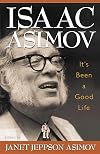
It should be said right up front that this is sort of a strange book. This is not his autobiography as Asimov wrote it. During his life Asimov published three volumes of autobiography. After he died, his (second) wife edited these volumes, supplementing with letters she and Asimov exchanged, and also added an afterword. There is often very little and sometimes no transition between excerpts from his original volumes, which can be jarring. In places, it feels as if you're always coming in show more during the middle of a story. I do not know how much was cut out, or why, but given the strength of Asimov's writing on nearly every subject, I cannot imagine that the missing material was dry or uninteresting. Perhaps Janet (his wife) felt there was just too much of it.
That issue aside, Good Life is a fascinating and enjoyable read. I had enjoyed all of Asimov's work that I had read before -- The Foundation Trilogy and some of his robot stories, but I had absolutely no idea how tiny a portion of his writings this made up! He wrote hundreds of books -- both fiction and nonfiction, as well as edited probably dozens of anthologies and his own SF journal. While he was a scientist, he was a far better writer and educator than researcher, so it wasn't long before he managed to get out of his research duties altogether in order to devote himself to his true calling -- that of amassing, processing, and conveying information. He could become an expert on virtually any topic, write a book on it, then move on to the next interesting idea. As much as he is known for his SF, his fiction writing seemed often to be something that was squeezed in when time allowed rather than the focus of his life.
He's just plain brilliant and funny, and that comes across very well in this book. I was away from home for a few days while I read this, and I kept a list on the back of my bookmark of all the anecdotes and their page numbers that I had to read to Andrew when I got home.
Also included was his favorite short story (that he wrote), which was indeed wonderful (and which I cannot read aloud without at least verging on tears.) And in the afterword -- Janet reveals for the first time that what Asimov finally died of was AIDS (contracted via blood transfusion during an operation.) They kept it quiet for fear of prejudice, and because another public figure had recently revealed they had AIDS -- so they didn't feel the revelation would add anything to the cause or the public good.
I must just go back to say it was a particular joy to read Asimov speak of "the problem" of women in science fiction -- particularly why he had so few female characters in his early writing, but then as he was married and began to know other women professionally, his work included more and stronger women. I also really enjoyed when he briefly wrote about the other popular SF writers in that age of SF when Asimov, Heinlein, Dick, etc. were churning out novels. I would so love to read a history of that period -- those men and their relations, how their writing was affected by the Cold War and the dawn of nukes, etc. I wonder if such a book exists?
Anyway, even for the choppiness of some of the material, the uneven way different periods and subjects were treated, etc., on the whole, this book was pretty delightful. I was left convicted that I need to increase the size of my Asimov library -- and look for that book on the early greats of science fiction! show less
That issue aside, Good Life is a fascinating and enjoyable read. I had enjoyed all of Asimov's work that I had read before -- The Foundation Trilogy and some of his robot stories, but I had absolutely no idea how tiny a portion of his writings this made up! He wrote hundreds of books -- both fiction and nonfiction, as well as edited probably dozens of anthologies and his own SF journal. While he was a scientist, he was a far better writer and educator than researcher, so it wasn't long before he managed to get out of his research duties altogether in order to devote himself to his true calling -- that of amassing, processing, and conveying information. He could become an expert on virtually any topic, write a book on it, then move on to the next interesting idea. As much as he is known for his SF, his fiction writing seemed often to be something that was squeezed in when time allowed rather than the focus of his life.
He's just plain brilliant and funny, and that comes across very well in this book. I was away from home for a few days while I read this, and I kept a list on the back of my bookmark of all the anecdotes and their page numbers that I had to read to Andrew when I got home.
Also included was his favorite short story (that he wrote), which was indeed wonderful (and which I cannot read aloud without at least verging on tears.) And in the afterword -- Janet reveals for the first time that what Asimov finally died of was AIDS (contracted via blood transfusion during an operation.) They kept it quiet for fear of prejudice, and because another public figure had recently revealed they had AIDS -- so they didn't feel the revelation would add anything to the cause or the public good.
I must just go back to say it was a particular joy to read Asimov speak of "the problem" of women in science fiction -- particularly why he had so few female characters in his early writing, but then as he was married and began to know other women professionally, his work included more and stronger women. I also really enjoyed when he briefly wrote about the other popular SF writers in that age of SF when Asimov, Heinlein, Dick, etc. were churning out novels. I would so love to read a history of that period -- those men and their relations, how their writing was affected by the Cold War and the dawn of nukes, etc. I wonder if such a book exists?
Anyway, even for the choppiness of some of the material, the uneven way different periods and subjects were treated, etc., on the whole, this book was pretty delightful. I was left convicted that I need to increase the size of my Asimov library -- and look for that book on the early greats of science fiction! show less

Years and years and years ago, I was in Boy Scouts. When you’re in Boy Scouts, you get a free subscription to Boys’ Life magazine. The magazine had a serialized comic of Isaac Asimov’s Norby the Robot. I never found out how it ended.
Isaac Asimov is famous for forming our collective idea of robots. The not-using-contractions, super-smart-but-unable-to-understand-social-cues kind. This book adds a little comedy/levity to those grim I, Robot stories. Our star is a young man in a space show more force academy. I guess Earth is fairly militant now, but in a good way? This young man buys a sassy robot from a junk shop. Said sassy robot turns out to have all kinds of powers, like flying, teleportation, and time travel. But no one knows how he does it. And then there’s dinosaurs.
Isaac Asimov did not write this book. His name is on the cover, but it’s obvious his wife Janet did all the work and it only got published because her husband’s name could be on the cover. I’m not even that much of an Asimov-phile and I can tell this has none of his insight or innovation. This is a children’s book for children of the fifties. The ones who were into Buck Rogers and Captain Billy’s Whiz Bang. The writing is like that too. The bad guy is a Ming the Merciless cult leader with as much relationship to the protagonist as the Care Bears had to Darkheart. There’s no character development. No one has a past or secrets or wants or needs. It’s just meaningless adventures in space with pirates and dragons and other things boys like. show less
Isaac Asimov is famous for forming our collective idea of robots. The not-using-contractions, super-smart-but-unable-to-understand-social-cues kind. This book adds a little comedy/levity to those grim I, Robot stories. Our star is a young man in a space show more force academy. I guess Earth is fairly militant now, but in a good way? This young man buys a sassy robot from a junk shop. Said sassy robot turns out to have all kinds of powers, like flying, teleportation, and time travel. But no one knows how he does it. And then there’s dinosaurs.
Isaac Asimov did not write this book. His name is on the cover, but it’s obvious his wife Janet did all the work and it only got published because her husband’s name could be on the cover. I’m not even that much of an Asimov-phile and I can tell this has none of his insight or innovation. This is a children’s book for children of the fifties. The ones who were into Buck Rogers and Captain Billy’s Whiz Bang. The writing is like that too. The bad guy is a Ming the Merciless cult leader with as much relationship to the protagonist as the Care Bears had to Darkheart. There’s no character development. No one has a past or secrets or wants or needs. It’s just meaningless adventures in space with pirates and dragons and other things boys like. show less

This YA series about Norby, the Mixed-Up Robot, was one of my favorite reads as a child, not to mention my introduction to Isaac Asimov (even if Janet actually did do all the writing). Occasionally, I come upon paperback versions in used bookstores that collect two of them together, and I snatch them up instantly. This one collects Norby and the Queen's Necklace (what I remembered as my favorite) and Norby Finds a Villain. It's excellent YA literature, with a decent breadth of imagination on show more display in just these two stories. Jeff and Norby and a variety of other characters find themselves in the near future, pre-Revolutionary France, Roman times, prehistoric times, far-future utopias, far-future dystopias, hyperspace, aberrant future versions of Mars, and dangerous alternate realities just within the confines of these two short tales! Norby himself is as fun as ever, and the supporting cast doesn't disappoint. The Queen's Necklace isn't quite as good as I remember (not all of the temporal shenanigans actually work out in the end), but it's solid fun, as is Finds a Villain. (originally written December 2007) show less
Lists
Awards

You May Also Like


Associated Authors
Statistics
- Works
- 34
- Also by
- 11
- Members
- 2,706
- Popularity
- #9,494
- Rating
- 3.4
- Reviews
- 34
- ISBNs
- 89
- Languages
- 6
- Favorited
- 2