
Laura Adams Armer (1874–1963)
Author of Waterless Mountain
About the Author
Works by Laura Adams Armer
In Navajo Land 2 copies
Moo Sooy Yun a chinese actor 1 copy
Associated Works
Tagged
Common Knowledge
- Other names
- Adams, Laura May (birth)
- Birthdate
- 1874-01-12
- Date of death
- 1963-03-16
- Gender
- female
- Education
- University of California, Berkeley
California School of Design - Occupations
- photographer
artist
book illustrator
novelist
children's book author - Short biography
- Laura Adams Armer was born in Sacramento, California, and moved to San Francisco with her family as a child. She was educated in public schools and by private tutors. She attended the California School of Design and spent a year at the University of California, Berkeley. She opened her own photography studio in 1899, and achieved rapid success as a society portraitist. Her work was exhibited to great acclaim in San Francisco, New York, and other cities. In 1902, she sold her studio and traveled around the Southwest with her sister. Later that year, she married Sidney Armer, also an artist, with whom she had two children, and moved to Berkeley. She continued her photography there and in 1905, illustrated the book Leaves From an Argonaut's Note Book by Theodore Elden Jones. After the death of her baby daughter in 1905, she retired briefly, and then returned to to active participation in the Berkeley art colony. In 1919-1920, she began to document systematically the Hopi and Navajo peoples of the Southwest, which resulted in numerous publications on their societies, religion, folklore, and art -- especially sand paintings. She compiled volumes of notes, which she used in painting, photographs, and books that she wrote and illustrated solo or with her husband. These included Waterless Mountain (1932), for which she won the Newbury Award, Southwest (1935), The Traders Children (1937), The Forest Pool (1938), and In Navajo Land (1962). She also made a documentary film in 1928, The Mountain Chant.
- Nationality
- USA
- Birthplace
- Sacramento, California, USA
- Places of residence
- San Francisco, California, USA
- Associated Place (for map)
- California, USA
Members
Reviews

Younger Brother, called Little Singer by his medicine-man Uncle, was an unusual child, attuned from a young age to the deeper realities of the world around him, and observant of all its beauty, both natural and man-made. Marked out as a future medicine man himself, and tutored by Uncle in the traditional songs and beliefs of his people, the young Navajo boy came of age in the small circle of his loving family, living with them under the great Waterless Mountain. The rhythms of their daily show more life - Younger Brother's shepherding of the sheep, Mother's weaving, and her cooking for the family, Father's silversmithing - and the interruptions to those rhythms - Elder Brother's marriage to their neighbor's daughter, Younger Brother's epic journey to the far western water, in search of Turquoise Woman's house - are depicted here in a gentle, contemplative narrative that is suffused with a quiet joy.
The Newbery Medal Winner in 1932, Laura Adams Armer's Waterless Mountain was praised, at the time of its publication, for its lyrically sympathetic portrayal of Navajo religious beliefs and customs. As someone almost wholly unacquainted with those beliefs, I feel ill-equipped to judge Armer's depiction, from a factual standpoint. I found the book well written, and the narrative engaging enough, but there could be glaring errors of fact or tone here, and I would never know it. More generally, it's difficult to know whether Armer successfully captured a young Navajo boy's perspective, or whether her text is an outsider's imposition. Given the history of misrepresentation of America's indigenous peoples in vintage children's literature, it's tempting to assume that it was the latter, but it's impossible for me to judge with any certainty. I'd love to get the viewpoint of a Navajo reader on the subject! According to what little I have read of Armer, she was well-respected enough, by some Navajo elders, that she was allowed to reproduce a number of sacred sand paintings - a privilege not previously accorded to any outsider, from my understanding.
Although unable to come to any definitive conclusion, as it concerns Armer's depiction of traditional Navajo beliefs, I can say that her Euro-American characters, particularly the "Big Man," seemed unrealistically positive, giving a sense that white traders on Indian reservations were benign and benevolent forces for good, something that does not at all accord with my own understanding of the history. The inclusion of this kind of "Great White Trader" figure is problematic. I also think that, if this had been a genuine Navajo narrative, the feelings of the people, about The Long March, and their forced exile from their homelands, as well as Kit Carson's scorched earth campaign against them, would have been much more strongly expressed, and not as easily dismissed, in the brief exchange between Younger Brother and the Big Man, toward the end of the book.
I vacillated, in rating this book. It does have some good qualities, and I found some of the passages quite beautiful. But it is also, unfortunately, a little bit dated, and I'm not sure that it does what it sets out to do, in communicating a genuine Navajo worldview. The "Great White Hunter" theme, here transformed into a "Great White Trader," also gives me significant pause. In the end, I think this is one I would recommend primarily to Newbery completists like myself... show less
The Newbery Medal Winner in 1932, Laura Adams Armer's Waterless Mountain was praised, at the time of its publication, for its lyrically sympathetic portrayal of Navajo religious beliefs and customs. As someone almost wholly unacquainted with those beliefs, I feel ill-equipped to judge Armer's depiction, from a factual standpoint. I found the book well written, and the narrative engaging enough, but there could be glaring errors of fact or tone here, and I would never know it. More generally, it's difficult to know whether Armer successfully captured a young Navajo boy's perspective, or whether her text is an outsider's imposition. Given the history of misrepresentation of America's indigenous peoples in vintage children's literature, it's tempting to assume that it was the latter, but it's impossible for me to judge with any certainty. I'd love to get the viewpoint of a Navajo reader on the subject! According to what little I have read of Armer, she was well-respected enough, by some Navajo elders, that she was allowed to reproduce a number of sacred sand paintings - a privilege not previously accorded to any outsider, from my understanding.
Although unable to come to any definitive conclusion, as it concerns Armer's depiction of traditional Navajo beliefs, I can say that her Euro-American characters, particularly the "Big Man," seemed unrealistically positive, giving a sense that white traders on Indian reservations were benign and benevolent forces for good, something that does not at all accord with my own understanding of the history. The inclusion of this kind of "Great White Trader" figure is problematic. I also think that, if this had been a genuine Navajo narrative, the feelings of the people, about The Long March, and their forced exile from their homelands, as well as Kit Carson's scorched earth campaign against them, would have been much more strongly expressed, and not as easily dismissed, in the brief exchange between Younger Brother and the Big Man, toward the end of the book.
I vacillated, in rating this book. It does have some good qualities, and I found some of the passages quite beautiful. But it is also, unfortunately, a little bit dated, and I'm not sure that it does what it sets out to do, in communicating a genuine Navajo worldview. The "Great White Hunter" theme, here transformed into a "Great White Trader," also gives me significant pause. In the end, I think this is one I would recommend primarily to Newbery completists like myself... show less
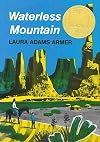
Waterless Mountain follows Younger Brother, the middle of three children in a Navajo family — a boy who got to be 8 years old without ever having seen a white man or a chair — as he grows into adulthood. Younger Brother tends the sheep for his family, but he lives in a magical world — literally, in his case. He believes in the old Navajo religion and sees good fortune as a gift from the gods and nature. Laura Adams Armer’s book serves as a window into a world that existed for show more centuries in the American Southwest, examining the everyday life of a Navajo family of the time, as well as their cultural folkways and religion. I had trouble putting the book down!
Is the book a bit sentimental? A wee bit, but it’s never cloying; there is a hint of abusive Navajo boarding schools, and the book spends time on the tragic Long Walk of the Navajo. And there’s a foreshadowing of the plague that alcohol would play in the future of Native Americans of all tribes.
The book has not aged well for children; however, adults will delight in immersing themselves in the world of the Navajo people from long ago. Five stars for adults; two, for kids. show less
Is the book a bit sentimental? A wee bit, but it’s never cloying; there is a hint of abusive Navajo boarding schools, and the book spends time on the tragic Long Walk of the Navajo. And there’s a foreshadowing of the plague that alcohol would play in the future of Native Americans of all tribes.
The book has not aged well for children; however, adults will delight in immersing themselves in the world of the Navajo people from long ago. Five stars for adults; two, for kids. show less

Awakened from a lovely dream in which he is about to learn the secret of Montezuma's cloak from a fluttering hummingbird, Diego is at first put out. But then his friend Popo arrives with exciting news about an iguana he has discovered in the nearby forest, and the two boys set out, together with Diego's parrot, Polly, to capture it. Their clumsy efforts yield little success - the iguana escapes to a nearby pool - but then the two boys enlist the aid of Diego's father. Is having an iguana show more worth all the trouble, or is he better off in the forest?
Chosen as a Caldecott Honor Book in 1939 - the other honorees that year were Andy and the Lion, Barkis, Snow White and the Seven Dwarfs, and Wee Gillis - this short story about two young Mexican boys is gorgeously illustrated with colorful paintings that reminded me a bit of Diego Rivera. With vivid colors and stylized folkloric composition, Laura Adams Armer's artwork is just beautiful - well deserving of the Caldecott Honor it won! The story itself is less engaging: there's nothing really wrong with it (although it does feel a little dated), but it just didn't appeal to me. If I were rating based on narrative alone, I'd give this two stars, but the outstanding illustrations are worth seeking out, and make this a solid three-star title. Recommended to Caldecott completists like myself, as well as to readers who enjoy muralistic paintings in the style of Diego Rivera. show less
Chosen as a Caldecott Honor Book in 1939 - the other honorees that year were Andy and the Lion, Barkis, Snow White and the Seven Dwarfs, and Wee Gillis - this short story about two young Mexican boys is gorgeously illustrated with colorful paintings that reminded me a bit of Diego Rivera. With vivid colors and stylized folkloric composition, Laura Adams Armer's artwork is just beautiful - well deserving of the Caldecott Honor it won! The story itself is less engaging: there's nothing really wrong with it (although it does feel a little dated), but it just didn't appeal to me. If I were rating based on narrative alone, I'd give this two stars, but the outstanding illustrations are worth seeking out, and make this a solid three-star title. Recommended to Caldecott completists like myself, as well as to readers who enjoy muralistic paintings in the style of Diego Rivera. show less

A young Navajo boy is destined to be a medicine man as he has the right spirit for the job. Set in present day (that being early 1930s based on the publication date) this is reminiscent of a number of Newbery books from that era when the committee favored historical fiction and books that told about other cultures. The plot is minimal. Mainly, we move around over a period of a few years seeing what life was like in the Navajo lands of the first half of the 20th century. Since books from that show more era would never portray white Americans as bad, the one white character, referred to usually as "the Big Man," is a kind and generous merchant, who cares deeply about the Navajo people he trades with. I rather suspect such a benevolent merchant was not to be found trading with the Native Americans in the 1930s.
Not a bad book, but not good enough to recommend unless the reader has a particular interest in Native American cultures. show less
Not a bad book, but not good enough to recommend unless the reader has a particular interest in Native American cultures. show less
Lists
Awards


You May Also Like


Associated Authors
Statistics
- Works
- 9
- Also by
- 1
- Members
- 438
- Popularity
- #55,889
- Rating
- 3.3
- Reviews
- 16
- ISBNs
- 9
- Languages
- 1
