
Dhan Gopal Mukerji (1890–1936)
Author of Gay Neck: The Story of a Pigeon
About the Author
Image credit: https://en.wikipedia.org/wiki/Dhan_Gopal_Mukerji
Works by Dhan Gopal Mukerji
Devotional Passages from the Hindu Bible - Adapted Into English by Dhan Gopal Mukerji (1929) 8 copies
Disillusioned India 3 copies
Džungļos : [stāsti] 2 copies
The Song of God 2 copies
Sandy 1 copy
Österns hemliga lyssnare 1 copy
The Master monkey 1 copy
Indijas džungļu noslēpumi 1 copy
Rajani : songs of the night 1 copy
Chief Of The Herd 1 copy
Pryhody Khorobroho Holuba 1 copy
ঘরের ছেলে বাইরে 1 copy
Mladost v džungli 1 copy
Associated Works
Tagged
Common Knowledge
- Birthdate
- 1890-07-06
- Date of death
- 1936-07-14
- Gender
- male
- Education
- Scottish Church Collegiate School, Calcutta
University of Calcutta
Tokyo University
University of California, Berkeley
Stanford University - Nationality
- India
- Associated Place (for map)
- India
Members
Discussions
Found: WW1 or WW2 about a carrier pigeon? in Name that Book (February 2025)
Reviews
I liked it - and I would have loved it, as a 'tween avid reader in the late 60s. I loved learning about other cultures - and the culture here is not just the Buddhist & Indian, but also that of carrier pigeons. And I would have just loved the nifty big words. But yes, the Buddhist philosophy would have made a big impact on me.
Yes it's akin to Kipling's Just So Stories but also to Felix Salten's stories, like Bambi and Perri. (Salten was another author disturbed by war, a Jew, whose books show more were banned by Hitler.)
The illustrations are also wonderful. I probably would have attempted to create my own, as inspired by them. The abstract designs look doable, even by someone with my limited talents - and the birds, elephant, etc are amazing.
I think it seemed odd" or "dated" to some because they were expecting more of a novel. Once I started to read it as Philosophical Memoir I was more comfortable and appreciative.
The more I think about it, the more it sings to my heart. Though as I was reading I was thinking 3*s, by the time I'm done writing this review I'm sure it'll be at least 4*s.
And now for the book-dart marked passages:
"It is a pity that we have to win our pigeons' confidence by feeding their stomachs, but alas! I have noticed that there are many men and women who resemble pigeons in this respect!" (Gay-Neck)
Speaking of the geese, Gay-Neck says, "Compared with them, we pigeons seem paragons of cleverness."
The pigeon also says, provocatively, "Why is there so much killing and inflicting of pain by birds and beasts on one another? I don't think all of you men hurt each other. Do you? But birds and beasts do. All that makes me so sad." Well, Gay-Neck was in old India at the time, among vegetarian Buddhists. I'm sure he wised up when he became a carrier pigeon in France in WWI.
The author/main character says of the Hindu tradition of cremation, "Their ashes are scattered to the winds, and no place is marked or burdened with their memory." Lovely thought, imo.
He also observes, about zoos, "What a pity that most young people... must derive their knowledge of God's creatures from their appearance in prisons! If we cannot perceive any right proportion of man's moral nature by looking at prisoners in a jail, how do we manage to think that we know all about an animal by gazing at him penned in a cage?"
And even scavengers have a fitting place in the ecology, as Mukerji tried to show us decades before the Green movement, "They had already learned that someone had died and they must clean up the jungle."
Yup, the more I think about this book and look it over and reread bits, the more I'm enchanted by it. I do wish I'd read it when I was a child. I hope I've talked you into spending some time with it.
" show less
Yes it's akin to Kipling's Just So Stories but also to Felix Salten's stories, like Bambi and Perri. (Salten was another author disturbed by war, a Jew, whose books show more were banned by Hitler.)
The illustrations are also wonderful. I probably would have attempted to create my own, as inspired by them. The abstract designs look doable, even by someone with my limited talents - and the birds, elephant, etc are amazing.
I think it seemed odd" or "dated" to some because they were expecting more of a novel. Once I started to read it as Philosophical Memoir I was more comfortable and appreciative.
The more I think about it, the more it sings to my heart. Though as I was reading I was thinking 3*s, by the time I'm done writing this review I'm sure it'll be at least 4*s.
And now for the book-dart marked passages:
"It is a pity that we have to win our pigeons' confidence by feeding their stomachs, but alas! I have noticed that there are many men and women who resemble pigeons in this respect!" (Gay-Neck)
Speaking of the geese, Gay-Neck says, "Compared with them, we pigeons seem paragons of cleverness."
The pigeon also says, provocatively, "Why is there so much killing and inflicting of pain by birds and beasts on one another? I don't think all of you men hurt each other. Do you? But birds and beasts do. All that makes me so sad." Well, Gay-Neck was in old India at the time, among vegetarian Buddhists. I'm sure he wised up when he became a carrier pigeon in France in WWI.
The author/main character says of the Hindu tradition of cremation, "Their ashes are scattered to the winds, and no place is marked or burdened with their memory." Lovely thought, imo.
He also observes, about zoos, "What a pity that most young people... must derive their knowledge of God's creatures from their appearance in prisons! If we cannot perceive any right proportion of man's moral nature by looking at prisoners in a jail, how do we manage to think that we know all about an animal by gazing at him penned in a cage?"
And even scavengers have a fitting place in the ecology, as Mukerji tried to show us decades before the Green movement, "They had already learned that someone had died and they must clean up the jungle."
Yup, the more I think about this book and look it over and reread bits, the more I'm enchanted by it. I do wish I'd read it when I was a child. I hope I've talked you into spending some time with it.
" show less

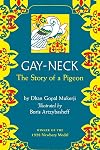
Originally published in 1927, Dhan Gopal Mukerji's Gay-Neck: The Story of a Pigeon was awarded the Newbery Medal in 1928, the seventh book to be so honored. As the sub-title suggests, it is the story of a pigeon, his early experiences in India, where he was hatched and trained, his service as a carrier-pigeon on the battle fields of World War I, and his eventual return to India, where he finds healing and peace through the kind offices of a Buddhist monk and abbott.
Chitra-griva, or Gay-Neck show more - Chitra meaning "painted in gay colors," and griva meaning "neck" - is an interesting choice for main character, particularly as the narration is rather uneven, alternating between the young Indian boy who trained him, and his own "imagined" pigeon viewpoint. As my goodreads friend Wendy notes, you never really get much of a sense of the human narrator, although the character of Ghond - the hunter extraodinaire who guides the young narrator through the dangers of the jungle, and the Himalayan highlands, and accompanies Gay-Neck to war - does come alive. Oddly, the reader gets as little of an internal view of Gay-Neck himself, even in those chapters told from his perspective.
In fact, I would say that the chief weakness of this juvenile novel - which I suspect won't appeal greatly to today's young readers - is its external quality. I found the details of pigeon life and training fascinating, enjoyed reading about the trips into the Himalayas, and found the battlefield scenes involving. I also thought that Mukerji's writing itself, particularly the descriptive passages focusing on the natural world, was just beautiful, as were the illustrations by Boris Artzybasheff. But this is a book that holds the reader at a bit of a distance, from its human narrator, and from its avian hero. I can't help wondering, in light of Mukerji's suicide in 1936, just nine years after its composition, if this sense of distance somehow reflected the author's sense of isolation and alienation in his new homeland. Or perhaps Gay-Neck, and other such children's novels set in the India of his youth (Kari the Elephant, and the like), represent an effort - obviously unsuccessful - to recapture a sense of home.
In any case, I'm glad to have read this, both because of its status as an early Newbery Medal winner, and because Mukerji was one of the first authors of South Asian descent to be successful in the United States. I think I might have to read his autobiography, Caste and Outcast, at some point. show less
Chitra-griva, or Gay-Neck show more - Chitra meaning "painted in gay colors," and griva meaning "neck" - is an interesting choice for main character, particularly as the narration is rather uneven, alternating between the young Indian boy who trained him, and his own "imagined" pigeon viewpoint. As my goodreads friend Wendy notes, you never really get much of a sense of the human narrator, although the character of Ghond - the hunter extraodinaire who guides the young narrator through the dangers of the jungle, and the Himalayan highlands, and accompanies Gay-Neck to war - does come alive. Oddly, the reader gets as little of an internal view of Gay-Neck himself, even in those chapters told from his perspective.
In fact, I would say that the chief weakness of this juvenile novel - which I suspect won't appeal greatly to today's young readers - is its external quality. I found the details of pigeon life and training fascinating, enjoyed reading about the trips into the Himalayas, and found the battlefield scenes involving. I also thought that Mukerji's writing itself, particularly the descriptive passages focusing on the natural world, was just beautiful, as were the illustrations by Boris Artzybasheff. But this is a book that holds the reader at a bit of a distance, from its human narrator, and from its avian hero. I can't help wondering, in light of Mukerji's suicide in 1936, just nine years after its composition, if this sense of distance somehow reflected the author's sense of isolation and alienation in his new homeland. Or perhaps Gay-Neck, and other such children's novels set in the India of his youth (Kari the Elephant, and the like), represent an effort - obviously unsuccessful - to recapture a sense of home.
In any case, I'm glad to have read this, both because of its status as an early Newbery Medal winner, and because Mukerji was one of the first authors of South Asian descent to be successful in the United States. I think I might have to read his autobiography, Caste and Outcast, at some point. show less
I really enjoyed this book. This is surprising for me. I just have the goal of reading all Newbery winners and so I picked this up not knowing a thing about it. I found out it was about a pigeon. I hate birds. I hate pigeons the most. I was not at all interested and it sat around for a good while.
I started reading and couldn't believe that I was on the edge of my seat at times. I mean...for crying out loud, it's a story about a pigeon! Things shouldn't be this dang tense. But they were and show more the images of India were beautifully described and the actions of war were full of suspense and dread. Dhan Gopal Mukerji did justice for the country, India, that you just don't see in other books. Yes, great images there but they really don't talk about the people and the culture in a human and positive way. Here, he does and it is wonderful and beautiful.
There are several gems in this book and here are a few of my favorites:
(After being told to place Gay Neck on his shoulder and say a prayer for courage) If you do that for a while, one day your heart, mind and soul will become pure through and through. That instant the power of your soul, now without fear, without hate, without suspicion, will enter the pigeon and make him free. He who purifies himself to the greatest extent can put into the world the greatest spiritual force....You have been told by Ghond, who knows animals better than any other man, that our fear frightens other so that they attack us. Your pigeon is so frightened that the thinks the whole sky is going to attack him. No leaf tumbles without frightening him. Not a shadow falls without driving panic into his soul. Yet what is causing him suffering is himself. -Gay Neck
May the north wind bring healing unto you,
May the south wind bring healing unto you,
May the winds of east and west pour healing into you.
Fear flees from you,
Hate flees from you,
And suspicion flees from you.
Courage like a rushing tide gallops through you;
Peace possesses your entire being,
And serenity and strength have become your two wings.
In your eyes shines courage;
Power and prowess dwell in your heart!
You are healed,
You are healed,
You are healed!
Peace, peace, peace.-Gay Neck
Whatever we think and feel will colour what we say or do. He who fears, even unconsciously, or has his least little dream tainted with hate, will inevitably, sooner or later, translate these two qualities into his action. Therefore, my brothers, live courage, breathe courage and give courage. Think and feel love so that you will be able to pour out of yourselves peace and serenity as naturally as a flower gives forth fragrance.
Peace be unto all!-Gay Neck
I won't be remembering this story word for word, but I will remember that at this time in my life this is what my heart and soul needed. show less
I started reading and couldn't believe that I was on the edge of my seat at times. I mean...for crying out loud, it's a story about a pigeon! Things shouldn't be this dang tense. But they were and show more the images of India were beautifully described and the actions of war were full of suspense and dread. Dhan Gopal Mukerji did justice for the country, India, that you just don't see in other books. Yes, great images there but they really don't talk about the people and the culture in a human and positive way. Here, he does and it is wonderful and beautiful.
There are several gems in this book and here are a few of my favorites:
(After being told to place Gay Neck on his shoulder and say a prayer for courage) If you do that for a while, one day your heart, mind and soul will become pure through and through. That instant the power of your soul, now without fear, without hate, without suspicion, will enter the pigeon and make him free. He who purifies himself to the greatest extent can put into the world the greatest spiritual force....You have been told by Ghond, who knows animals better than any other man, that our fear frightens other so that they attack us. Your pigeon is so frightened that the thinks the whole sky is going to attack him. No leaf tumbles without frightening him. Not a shadow falls without driving panic into his soul. Yet what is causing him suffering is himself. -Gay Neck
May the north wind bring healing unto you,
May the south wind bring healing unto you,
May the winds of east and west pour healing into you.
Fear flees from you,
Hate flees from you,
And suspicion flees from you.
Courage like a rushing tide gallops through you;
Peace possesses your entire being,
And serenity and strength have become your two wings.
In your eyes shines courage;
Power and prowess dwell in your heart!
You are healed,
You are healed,
You are healed!
Peace, peace, peace.-Gay Neck
Whatever we think and feel will colour what we say or do. He who fears, even unconsciously, or has his least little dream tainted with hate, will inevitably, sooner or later, translate these two qualities into his action. Therefore, my brothers, live courage, breathe courage and give courage. Think and feel love so that you will be able to pour out of yourselves peace and serenity as naturally as a flower gives forth fragrance.
Peace be unto all!-Gay Neck
I won't be remembering this story word for word, but I will remember that at this time in my life this is what my heart and soul needed. show less
While this 1927 Newbery Medal winner is not one of my favorites, it is worth the time spent reading the poetic, beautiful allegorical, lyrical language of the author.
The setting is 1914 with war looming ever present. It is the story of a carrier pigeon named Gay Neck and his owner, a young 14 year old Indian boy.
As Gay Neck's owner trains him to be a carrier pigeon, they travel many miles throughout Indian jungle wherein both lives are in danger. Weaving between the voice of the owner and show more then the pigeon, the reader soars with the vivid images of war waged both man against man and beast against beast. show less
The setting is 1914 with war looming ever present. It is the story of a carrier pigeon named Gay Neck and his owner, a young 14 year old Indian boy.
As Gay Neck's owner trains him to be a carrier pigeon, they travel many miles throughout Indian jungle wherein both lives are in danger. Weaving between the voice of the owner and show more then the pigeon, the reader soars with the vivid images of war waged both man against man and beast against beast. show less
Lists
Awards

You May Also Like


Associated Authors
Statistics
- Works
- 36
- Also by
- 2
- Members
- 675
- Popularity
- #37,410
- Rating
- 3.4
- Reviews
- 18
- ISBNs
- 46
- Languages
- 2