
Chen Qiufan
Author of Waste Tide
About the Author
Image credit: 陈楸帆2015
Works by Chen Qiufan
The smog society (short story) 3 copies
Atık İnsanları 2 copies
The Year of the Rat 1 copy
Forger Mr. Z 1 copy
Associated Works
Broken Stars: Contemporary Chinese Science Fiction in Translation (2019) — Contributor — 457 copies, 12 reviews
Loosed upon the World: The Saga Anthology of Climate Fiction (2015) — Contributor — 130 copies, 4 reviews
The Reincarnated Giant: An Anthology of Twenty-First-Century Chinese Science Fiction (2018) — Contributor — 50 copies
Clarkesworld: Issue 163 (April 2020) (2020) — Narrator, some editions; Contributor — 5 copies, 1 review
Asimov's Science Fiction: Vol. 44, No. 11 & 12 [November/December 2020] (2020) — Contributor — 4 copies
Tagged
Common Knowledge
- Other names
- Chan, Stanley
- Birthdate
- 1981-11-30
- Gender
- male
- Nationality
- China
- Birthplace
- Shantou, Guangdong Province, China
- Associated Place (for map)
- Guangdong Province, China
Members
Reviews
'Waste Tide' is a thrilling and atmospheric Chinese cyberpunk novel. It features a lot of elements that are familiar from American cyberpunk: virtual reality, technologically enhanced bodies, wealth inequality, brutal violence, fancy motorbikes, AI, hackers tangling with powerful people, etc. It was interesting to revisit these in the setting of Silicon Isle, a dumping ground for the world's discarded electronic technology. The vivid and lyrical descriptions of the place, polluted and show more squalid as it was, made the book memorable for me. The cultural and linguistic world-building both build upon this to provide thoughtful commentary on pollution, economic development, immigration, and structural inequality. The plot includes a great deal of action and violence, which is done well without being particularly original. The multiple character points of view keep the pace up, while also giving an intriguing range of perspectives on Silicon Isle. I appreciated the inclusion of detail on how its economy worked: clans of local people bid on containers of e-waste, which they employ poorly paid immigrants (the 'waste people') to sort and recover valuable materials from. This is of course not futuristic at all and actually happens to discarded Western technology. One plot thread involved an American corporation seeking to take over Silicon Isle, offering environmental remediation in return for capturing major profits.
Although I have no objection to the volume of action, although the violence was horrific at times, my favourite moments were quiet and included unsettling images like this:
Although I have no objection to the volume of action, although the violence was horrific at times, my favourite moments were quiet and included unsettling images like this:
They were in a mass graveyard. A few random wooden plaques stuck into the dark-coloured soil indicated that bodies were buried in this plot of land. However, the plaques contained only the year of death; there was no year of birth or name. Scattered here and there were a few slips of ghost money and some bits of burnt incense and candles. In the pale light of the moon, the sight seemed especially ghastly. Mimi put her hands together, lowered her eyes, and muttered a prayer.show less
"These are..." Kaizong lowered his voice, as though afraid to disturb the nameless, homeless ghosts.
"They're anonymous bodies washed ashore by the tides; some were trying to smuggle themselves into Hong Kong; some were supposed to be women and children killed by the natives in their... ceremonies..."
Despite being a staunch atheist, Kaizong shuddered at this. However, he quickly calmed himself down: This is surely nothing more than an urban legend made up by the migrant workers to smear the natives.
"You dragged me all the way out here in the middle of the night just for this?"
"Of course not. Look! Over there!" Mimi tilted her head, indicating an immense shadow in one corner of the graveyard.
"Wow." Kaizen stopped in front of the object, stunned by its size and eerie appearance.
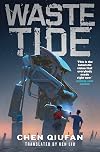
He took out his ruggedised mobile phone and wiped off the condensation. The screen emitted a pale glow that illuminated this Buddhist-Daoist guardian of the graveyard - an almost three-metre-tall exoskeleton robot, a mecha. The alloy armour was covered by Daoist charms so that it was no longer possible to tell the armour's original paint colour; from every protrusion in the armour hung strings of plastic or wooden Buddhist prayer beads that struck each other in the breeze like wind chimes; even the joints were covered with bright red ribbons representing wishes for good fortune.
https://nwhyte.livejournal.com/3820462.html
It's a grim contemporary tale of pollution off the Chinese coast, in a community that has grown up from migrant workers who have come to process waste, and something non-human that has also emerged in the meantime. The metaphor of monsters living in the rubbish dump goes at least as far back as ancient human societies, but I felt this pulled that old story together with the contemporary structural problems of China, both managing its own growing and show more demanding society and dealing with America. Ken Liu's translation has its quirks - I don't really need to know about the precise tonal pronunciation of words that are used only a couple of times - but it's fluent and seems to catch a time and place, fictional but closely related to today's China. Recommended. show less
It's a grim contemporary tale of pollution off the Chinese coast, in a community that has grown up from migrant workers who have come to process waste, and something non-human that has also emerged in the meantime. The metaphor of monsters living in the rubbish dump goes at least as far back as ancient human societies, but I felt this pulled that old story together with the contemporary structural problems of China, both managing its own growing and show more demanding society and dealing with America. Ken Liu's translation has its quirks - I don't really need to know about the precise tonal pronunciation of words that are used only a couple of times - but it's fluent and seems to catch a time and place, fictional but closely related to today's China. Recommended. show less
An interesting story that gets bogged down a bit and lost its grip on me before it's not-really-climax. A critique of the usual suspects (particularly Americans, but capitalists more generally, the Japanese) but also Chinese that exploit other Chinese, ex-pats, and buried amongst all that perhaps an overall critique of "China today", environmental destruction, and maybe just the modern world. Some of that seems clearly aimed at Chinese targets (the clan leader who returned to China after show more suffering racism/belittlement only to turn around and practice the same x100 on internal migrants, with the full participation of his co-regionalists, etc.)
Some of it smacks of a certain kind of common (and therefore, perhaps misread on my part?) pro-Chinese/anti-US Japan Western Filipino etc. bias. Definitely a case of SF as social commentary, it's just a little hard for me to interpret with confidence what that commentary consists of.
The story itself left me wanting a bit more...so an AI popped into existence... so maybe the "A" part of that is actually not appropriate. An intelligence popped into existence as a side effect of an experimental virus and heavy metal poisoning... cool, cool. It is not-quite-evil-not-quite-good... it is like a human in that respect... cool, cool. But it is kind of evil... it sure seems like. Yeah, probably. So kill it... okay, cool, I guess. As my brother once called it, "The Heinlein approach."
But, WTF. Was it? Is it? What? And then what? Tell me more. I want to know more about that.
EDIT (a few hours after initial post): I suppose one way of interpreting some of the uncertainty and inconclusiveness is that the various things at stake (traditional vs modernized/ing society; globalized, capitalist exchange vs. older forms of exchange; development's winners vs. development's losers; short term suffering vs longer-term gain; not just technology, but a technologized world vs. a "softer"/slower/more human world; etc. etc. etc.) are still uncertain.Was Mimi 1 "evil"? Mimi 0 ultimately thought so, but Mimi 1 certainly claimed that from a vaster perspective she had great things to offer. So, too, do Scott and TerraGreen, the "evil" Americans. And, to save the world, Mimi 0 --the Chinese, the 'waste person'-- did have to all but die.
I dunno. Maybe I'm searching too hard for a deeper meaning. But worth noting that maybe some of the dissipation, or lack, of a climax is because the book is getting at the point that things are provisional, murky, even undecidable.
Maybe? show less
Some of it smacks of a certain kind of common (and therefore, perhaps misread on my part?) pro-Chinese/anti-US Japan Western Filipino etc. bias. Definitely a case of SF as social commentary, it's just a little hard for me to interpret with confidence what that commentary consists of.
The story itself left me wanting a bit more...
But, WTF. Was it? Is it? What? And then what? Tell me more. I want to know more about that.
EDIT (a few hours after initial post): I suppose one way of interpreting some of the uncertainty and inconclusiveness is that the various things at stake (traditional vs modernized/ing society; globalized, capitalist exchange vs. older forms of exchange; development's winners vs. development's losers; short term suffering vs longer-term gain; not just technology, but a technologized world vs. a "softer"/slower/more human world; etc. etc. etc.) are still uncertain.
I dunno. Maybe I'm searching too hard for a deeper meaning. But worth noting that maybe some of the dissipation, or lack, of a climax is because the book is getting at the point that things are provisional, murky, even undecidable.
Maybe? show less
3.5 stars
.5 for the incredible imagination of this author. Silicon Isle is a place somewhere in southeast China where The Waste People sort all the ecycling of the industrial world. Of course, their bodies ingest the heavy metals, chemicals and plastics of the waste they are sorting. But they are The Waste People: so what?
The island is controlled by three clans: Lin, Len, and Chen. An American has come to meet with the heads of the three clans, offering to clean up the toxic environment, in show more return for a share of the recovered product from the eWaste. Just empty words that mean more exploitation. The native of Silicon Isle, employed by the American as translator, left his home as a teenager to study in Boston. He becomes a key part in the conflict when he falls in love with Mimi.
Mimi is a Waste Girl. She belongs to the Lin clan industry, and by accident, becomes involved in a war between the natives of Silicon Isle (read: wealthy residents) and the eWaste workers. She is kidnapped and tortured, then left for dead by Boss Lin's goons. By some kind of osmosis (or palirromancy) the heavy metals in her lungs move to her brain, when she's lying, buried alive, on Tide Gazing Beach. Now, she's got super powers, that turns her into the leader of the war for the rights of the Waste People.
Some notable quotes:
P.24:
"Scott had no appetite, especially after he learned how duck liver, pig lung, cow tongue, goose intestines, and other organ meats have been prepared. He chose plain rice porridge and soup - choices that appeared to offer the least risk of accumulated heavy metals. He restrained the impulse to pull out the field testing kit."
P.45:
"on the campus of Boston University, next to the Charles River, he was in a class on world history taught by professor Toby Jameson. The old man, with his head of white hair that made him look like Colonel Sanders, asked, 'who can give me an example of globalization?' The young man he called on stuttered for a while before picking up a half-eaten hamburger and said, 'Mickey D's.'
the whole class laughed.
'very good,' said professor Jameson. 'that answer is better than you might realize.
'this isn't just a cliche from a list: McDonald's, Nike, Hollywood films, Android phones... No, when you walk into a McDonald's and order a meal for $5.95, what do you get? Potatoes from the Andes, corn from Mexico, black pepper from India, coffee from Ethiopia, chicken from China, and of course, America's unique contribution: Coca-Cola.
'now do you understand what I'm getting at? Globalization is not something new. It's a trend that has been going on for hundreds, thousands of years. You can see it through the age of exploration, through commerce, through writing and religion, through insects, migratory birds and wind, even through bacteria and viruses. But the problem is that we've never achieved consensus, never tried to build a fair system so that everyone would benefit. Instead, we've engaged in a Perpetual cycle of looting, exploitation, and forceful extraction: from the Amazon, from Africa, from Southeast Asia, the middle East, Antarctica, even outer space.
'in this age of globalization, there are no permanent winners. Whatever you've obtained, you'll lose some day, and you'll have to pay it back with interest.' "
P.84:
"Fate ultimately guided all. faced with signs of unfairness in the real world, people tried to Marshall all kinds of evidence to comfort themselves: if heaven endowed some with status, wealth, Beauty, talent, health... Then it was certain to take away something else as a price. When such evidence couldn't be found, the theory of reincarnation was invented so that there was an infinite time to tally up the counters of lifetime to achieve eventual balance. Kaizong had once Scoffed at the theory of conservation of destinies, but perhaps people needed such a theory not because it was the truth, but because it offered solace in their limited lives."
P.120-1:
"the ancient people of silicon isle believed that as living beings drowned in the tides, they linked to the spirit world and became extremely sensitive and receptive of messages from the future, turning into powerful tools for diviners to derive more precise visions of what was to come.
"The unique lagoon formed by the shoal of silicon isle was the ideal location for palirromancy. The ancient inhabitants of silicon isle stood at the end of the tentacle and tossed The living sacrifice into the water and then waited on tide gazing Beach for the drowning creature to be tossed ashore. it was said that earlier, the beach had been artificially divided into 12 equal sections and marked with granite slabs carved with sigils to Aid in the divination effort, but during the cultural revolution, all the markings had been destroyed.
" 'then... The sacrifices they used...' Kaizong had trouble speaking and cleared his throat.
" 'newborn calves and lambs, or dogs," the elder answered. 'most of the time, at least.'
The sacrifice was bound with special ropes and knots so that the creature could not escape by swimming or treading water, but had plenty of room to struggle and thrash to prolong the drowning process. In death, their long, painful journey through The Sea left their bodies twisted into hideous postures, as though they had suffered injuries in their dialogue with the spirit world: terrifying expressions, empty gazes, sodden souls.
"If the sacrifice arrived on shore still alive, then it's fate depended on the message it brought from the spirits. if the augury was suspicious, then people waited until the creature died and then buried it with the proper rites; on the other hand, if the augury was inauspicious, then people killed it by stoning and buried the carcass in some random desolate spot, leaving behind no marking to prevent the ill-fortune from following any trails to the house of the soothsayer."
P.187-8:
"a middle-aged man appeared onscreen. His face was blurred out and his voice altered to disguise his identity. The subtitle indicated that he was an American Sergeant, a veteran in one of the gulf wars. Due to damage to his gas mask, he had breathed in a substantial amount of QNB. He had been discharged more than 10 years ago and now worked in the logistics industry.
"interviewer (off camera): how did you feel when it happened?
"Man (silence, heavy breathing)... 'I still suffer nightmares, sometimes. The doctors tells me it's PTSD... But I know it's not. Have you read anything by Lovecraft? Cthulhu? My dreams are like that. (quickened breathing, louder) darkness, chaos, filth – it as if something wants to rip you apart in your brain. Look, I'm not talking about physical suffering; I'm not. You wake up and see the boundless sky full of stars outside your window: that's the opening in its Iris. It's staring at me all the time. Do you know how that feels? Do you f****** know?
"(the camera zooms: the arteries in his neck are pulsing wildly. Fade to Black.)
"3 weeks after this interview, David m Friedman (Sergeant USA) was found dead in his apartment, having shot himself through the mouth. He was 38." show less
.5 for the incredible imagination of this author. Silicon Isle is a place somewhere in southeast China where The Waste People sort all the ecycling of the industrial world. Of course, their bodies ingest the heavy metals, chemicals and plastics of the waste they are sorting. But they are The Waste People: so what?
The island is controlled by three clans: Lin, Len, and Chen. An American has come to meet with the heads of the three clans, offering to clean up the toxic environment, in show more return for a share of the recovered product from the eWaste. Just empty words that mean more exploitation. The native of Silicon Isle, employed by the American as translator, left his home as a teenager to study in Boston. He becomes a key part in the conflict when he falls in love with Mimi.
Mimi is a Waste Girl. She belongs to the Lin clan industry, and by accident, becomes involved in a war between the natives of Silicon Isle (read: wealthy residents) and the eWaste workers. She is kidnapped and tortured, then left for dead by Boss Lin's goons. By some kind of osmosis (or palirromancy) the heavy metals in her lungs move to her brain, when she's lying, buried alive, on Tide Gazing Beach. Now, she's got super powers, that turns her into the leader of the war for the rights of the Waste People.
Some notable quotes:
P.24:
"Scott had no appetite, especially after he learned how duck liver, pig lung, cow tongue, goose intestines, and other organ meats have been prepared. He chose plain rice porridge and soup - choices that appeared to offer the least risk of accumulated heavy metals. He restrained the impulse to pull out the field testing kit."
P.45:
"on the campus of Boston University, next to the Charles River, he was in a class on world history taught by professor Toby Jameson. The old man, with his head of white hair that made him look like Colonel Sanders, asked, 'who can give me an example of globalization?' The young man he called on stuttered for a while before picking up a half-eaten hamburger and said, 'Mickey D's.'
the whole class laughed.
'very good,' said professor Jameson. 'that answer is better than you might realize.
'this isn't just a cliche from a list: McDonald's, Nike, Hollywood films, Android phones... No, when you walk into a McDonald's and order a meal for $5.95, what do you get? Potatoes from the Andes, corn from Mexico, black pepper from India, coffee from Ethiopia, chicken from China, and of course, America's unique contribution: Coca-Cola.
'now do you understand what I'm getting at? Globalization is not something new. It's a trend that has been going on for hundreds, thousands of years. You can see it through the age of exploration, through commerce, through writing and religion, through insects, migratory birds and wind, even through bacteria and viruses. But the problem is that we've never achieved consensus, never tried to build a fair system so that everyone would benefit. Instead, we've engaged in a Perpetual cycle of looting, exploitation, and forceful extraction: from the Amazon, from Africa, from Southeast Asia, the middle East, Antarctica, even outer space.
'in this age of globalization, there are no permanent winners. Whatever you've obtained, you'll lose some day, and you'll have to pay it back with interest.' "
P.84:
"Fate ultimately guided all. faced with signs of unfairness in the real world, people tried to Marshall all kinds of evidence to comfort themselves: if heaven endowed some with status, wealth, Beauty, talent, health... Then it was certain to take away something else as a price. When such evidence couldn't be found, the theory of reincarnation was invented so that there was an infinite time to tally up the counters of lifetime to achieve eventual balance. Kaizong had once Scoffed at the theory of conservation of destinies, but perhaps people needed such a theory not because it was the truth, but because it offered solace in their limited lives."
P.120-1:
"the ancient people of silicon isle believed that as living beings drowned in the tides, they linked to the spirit world and became extremely sensitive and receptive of messages from the future, turning into powerful tools for diviners to derive more precise visions of what was to come.
"The unique lagoon formed by the shoal of silicon isle was the ideal location for palirromancy. The ancient inhabitants of silicon isle stood at the end of the tentacle and tossed The living sacrifice into the water and then waited on tide gazing Beach for the drowning creature to be tossed ashore. it was said that earlier, the beach had been artificially divided into 12 equal sections and marked with granite slabs carved with sigils to Aid in the divination effort, but during the cultural revolution, all the markings had been destroyed.
" 'then... The sacrifices they used...' Kaizong had trouble speaking and cleared his throat.
" 'newborn calves and lambs, or dogs," the elder answered. 'most of the time, at least.'
The sacrifice was bound with special ropes and knots so that the creature could not escape by swimming or treading water, but had plenty of room to struggle and thrash to prolong the drowning process. In death, their long, painful journey through The Sea left their bodies twisted into hideous postures, as though they had suffered injuries in their dialogue with the spirit world: terrifying expressions, empty gazes, sodden souls.
"If the sacrifice arrived on shore still alive, then it's fate depended on the message it brought from the spirits. if the augury was suspicious, then people waited until the creature died and then buried it with the proper rites; on the other hand, if the augury was inauspicious, then people killed it by stoning and buried the carcass in some random desolate spot, leaving behind no marking to prevent the ill-fortune from following any trails to the house of the soothsayer."
P.187-8:
"a middle-aged man appeared onscreen. His face was blurred out and his voice altered to disguise his identity. The subtitle indicated that he was an American Sergeant, a veteran in one of the gulf wars. Due to damage to his gas mask, he had breathed in a substantial amount of QNB. He had been discharged more than 10 years ago and now worked in the logistics industry.
"interviewer (off camera): how did you feel when it happened?
"Man (silence, heavy breathing)... 'I still suffer nightmares, sometimes. The doctors tells me it's PTSD... But I know it's not. Have you read anything by Lovecraft? Cthulhu? My dreams are like that. (quickened breathing, louder) darkness, chaos, filth – it as if something wants to rip you apart in your brain. Look, I'm not talking about physical suffering; I'm not. You wake up and see the boundless sky full of stars outside your window: that's the opening in its Iris. It's staring at me all the time. Do you know how that feels? Do you f****** know?
"(the camera zooms: the arteries in his neck are pulsing wildly. Fade to Black.)
"3 weeks after this interview, David m Friedman (Sergeant USA) was found dead in his apartment, having shot himself through the mouth. He was 38." show less
Lists
Awards


You May Also Like


Associated Authors
Statistics
- Works
- 22
- Also by
- 20
- Members
- 455
- Popularity
- #53,950
- Rating
- 3.7
- Reviews
- 21
- ISBNs
- 24
- Languages
- 7