
Kim Stanley Robinson
Author of Red Mars
About the Author
Kim Stanley Robinson was born in Orange County, California on March 23, 1952. He received a B. A. and Ph. D. from the University of California at San Diego and an M. A. from Boston University. His first trilogy of books, Orange County, collectively won a Nebula Award and two Hugo Awards. His other show more works include the Mars trilogy, 2312, and Aurora. He has won an Asimov Award, a World Fantasy Award, a Locus Reader's Poll Award, and a John W. Campbell Award. (Bowker Author Biography) show less
Series
Works by Kim Stanley Robinson
A Martian Romance 10 copies
Green Mars [short fiction] 10 copies
Blue Mars and The Martians 5 copies
[unidentified works] 4 copies
Our Town 4 copies
Exploring Fossil Canyon 3 copies
Michel in Antarctica 2 copies
Coyote Makes Trouble 2 copies
Michel in Provence 2 copies
Big Man in Love 2 copies
Four Teleogical Trails 2 copies
The Constitution of Mars 2 copies
Maya and Desmond 2 copies
The Way the Land Spoke to Us 2 copies
Jackie on Zo 2 copies
Keeping the Flame 2 copies
Saving Noctis Dam 2 copies
Salt and Fresh 2 copies
The Archaea Plot 2 copies
To Leave a Mark 2 copies
Odessa 2 copies
Enough is as Good as a Feast 2 copies
What Matters 2 copies
Coyote Remembers 2 copies
Sax Moments 2 copies
Purple Mars 2 copies
Sixty Days 1 copy
Ślepy geometra 1 copy
The Memorial (short story) 1 copy
Chaman 1 copy
Collected Short Fiction 1 copy
A rizs és a só évei 1 copy
Gelecek Bakanlığı 1 copy
Short, Sharp Shock 1 copy
In Pierson's Orchestra 1 copy
How Science Saved the World 1 copy
The Kingdom Underground 1 copy
New Scientist Sci-fi Special 1 copy
On the North Pole of Pluto 1 copy
The Mars Trilogy Red Mars, Green Mars, Blue Mars AND The Martians (The Mars Trilogy, 1-3 plus The Martians) (1990) 1 copy
A Story 1 copy
The Soundtrack {short story} 1 copy
Rainbow Bridge {short story} 1 copy
A Transect {short story} 1 copy
Anarchism's Possibilities 1 copy
Associated Works
Journey to the Centre of the Earth (1867) — Introduction, some editions — 17,619 copies, 264 reviews
The Best Alternate History Stories of the 20th Century (2001) — Contributor — 617 copies, 10 reviews
The Year's Best Science Fiction: Seventeenth Annual Collection (2000) — Contributor — 557 copies, 2 reviews
The Big Book of Science Fiction: The Ultimate Collection (2016) — Contributor — 520 copies, 8 reviews
The Year's Best Science Fiction: Ninth Annual Collection (1992) — Contributor — 456 copies, 4 reviews
The Norton Book of Science Fiction: North American Science Fiction, 1960-1990 (1993) — Contributor — 345 copies, 6 reviews
The Year's Best Science Fiction: Third Annual Collection (1986) — Contributor — 250 copies, 1 review
The Year's Best Science Fiction: Fourth Annual Collection (1987) — Contributor — 222 copies, 1 review
What Might Have Been, Volumes 1 & 2: Alternate Empires, Alternate Heroes (1990) — Contributor — 185 copies, 2 reviews
The Way It Wasn't : Great Science Fiction Stories of Alternate History (1996) — Contributor — 163 copies, 4 reviews
The Year's Best Science Fiction: First Annual Collection (1984) — Contributor — 148 copies, 1 review
The Ends of the Earth: An Anthology of the Finest Writing on the Arctic and the Antarctic (2007) — Contributor — 137 copies, 8 reviews
Loosed upon the World: The Saga Anthology of Climate Fiction (2015) — Contributor — 130 copies, 4 reviews
Mythmakers and Lawbreakers: Anarchist Writers on Fiction (2010) — Introduction — 111 copies, 1 review
I'm With the Bears: Short Stories from a Damaged Planet (2011) — Contributor — 107 copies, 4 reviews
Alternate Americas (What Might Have Been, Vol. 4) (1992) — Contributor, some editions — 101 copies, 1 review
The Prentice Hall Anthology of Science Fiction and Fantasy (2000) — Contributor — 100 copies, 2 reviews
Cyberpunk: Stories of Hardware, Software, Wetware, Evolution, and Revolution (1995) — Contributor — 95 copies, 1 review
The Best Fantasy Stories from the Magazine of Fantasy & Science Fiction (1985) — Contributor — 77 copies, 2 reviews
Why I Left Harry's All-Night Hamburgers and Other Stories from Isaac Asimov's Science Fiction Magazine (1992) — Contributor — 68 copies
ParaSpheres: Extending Beyond the Spheres of Literary and Genre Fiction: Fabulist and New Wave Fabulist Stories (2006) — Contributor — 65 copies
Asimov's Science Fiction Magazine: 30th Anniversary Anthology (2007) — Contributor — 60 copies, 1 review
The Best Science Fiction and Fantasy of the Year, Volume 10 (2016) — Contributor — 60 copies, 3 reviews
Nebula Awards 29: SFWA's Choices For The Best Science Fiction And Fantasy Of The Year (Nebula Awards Showcase) (1995) — Contributor — 57 copies
Before They Were Giants: First Works from Science Fiction Greats (2010) — Contributor — 54 copies, 2 reviews
Field of Fantasies: Baseball Stories of the Strange and Supernatural (2014) — Contributor — 46 copies
Send My Love and a Molotov Cocktail! Stories of Crime, Love, and Rebellion (2011) — Contributor — 37 copies
Nebula Awards 20: SFWA's Choices for the Best Science Fiction and Fantasy 1984 (1985) — Contributor — 28 copies
Visions, Ventures, Escape Velocities: A Collection of Space Futures (2017) — Contributor — 22 copies, 1 review
Asimov's Science Fiction: Vol. 23, No. 10 & 11 [October/November 1999] (1999) — Contributor — 14 copies
Isaac Asimov's Science Fiction Magazine: Vol. 13, No. 12 [December 1989] (1989) — Author — 14 copies
The Magazine of Fantasy and Science Fiction November 1982, Vol. 63, No. 5 (1982) — Contributor — 13 copies
The Magazine of Fantasy and Science Fiction March 1990, Vol. 78, No. 3 (1990) — Author — 12 copies, 1 review
Uneven Futures: Strategies for Community Survival from Speculative Fiction (2022) — Contributor — 12 copies
Brave New Worlds {Second Edition ebook} — Contributor, some editions — 11 copies
Transfusion — Translator, some editions — 10 copies
Everything Change, Volume II: An Anthology of Climate Fiction (2018) — Foreword — 9 copies, 1 review
Mondaugen — Contributor — 1 copy
Locus Nr.492 2002.01 — Contributor — 1 copy
Science Fiction Eye #08, Winter 1991 — Contributor — 1 copy
Tagged
Common Knowledge
- Legal name
- Robinson, Kim Stanley
- Birthdate
- 1952-03-23
- Gender
- male
- Education
- University of California, San Diego (BA - Literature)
Boston University (MA - English)
University of California, San Diego (PhD - English) - Occupations
- science fiction writer
- Organizations
- Mars Society
- Awards and honors
- Jack Williamson Lectureship (2006)
Robert A. Heinlein Award (2016)
Arthur C. Clarke Foundation Award, Imagination in Service to Society (2017) - Agent
- Christopher Schelling (Select Artists)
- Nationality
- USA
- Birthplace
- Waukegan, Illinois, USA
- Places of residence
- Washington, D.C., USA
Switzerland
Davis, California, USA - Associated Place (for map)
- USA
Members
Discussions
Kim Stanley Robinson article in The New Yorker in Science Fiction Fans (April 2022)
Red Mars in Science Fiction Fans (August 2013)
Reviews

Green Mars is the second volume in Kim Stanley Robinson’s Mars Trilogy. We are now approaching fifty years since the first settlers landed on Mars. The First Hundred were cut down to size in the aftermath of the failed revolution of 2061, and the survivors live either in hidden settlements or under false identities. The changes wrought by CO2 fixing organisms are beginning to show results, and mining the hidden aquifers and other sources of water ice offers the possibility of seas and show more rivers on the Martian surface. And new generations of native-born Martians are coming of age and have their own ideas about their world and what to do with it.
In this novel, we meet new characters, and we see something of the situation on Earth, caught in the throes of megacorporation rivalry that is expressed in open warfare. But then catastrophic climate change intervenes, and Mars suddenly takes on a new significance as a possible bolt-hole for those with the resources to make the journey and the benefit of the longevity treatments to enjoy their new-found security. Various factions on Mars see that as a threat. Events move on from there.
Despite that summary of the broad action of the novel, do not think that this is a novel of thrills and intrigue. It remains a story about sciency people doing sciency things. There is a lot of political theory in this book, as well as a continuing and loving description of the evolving Martian biosphere. The characters are drawn quite broadly, though there is no need for detailed pen portraits in a novel extending over more than 500 pages; rather, Robinson lets the characters speak for themselves through their words and actions. One of the main proponents of terraforming Mars, Sax Russell, has his own section of the book, entitled “The Scientist as Hero". Suffice it to say that there is more science in this than heroism. Yet this section ends with one of the novel's action sequences, where Russell is outed as one of the First Hundred, demonised by the megacorporations as instigators of the 2061 rebellion; is captured, tortured and then rescued by other Martian pioneers.
Another section of the novel is named “What is to be Done?”, which some will recognise as the title of one of Lenin's key tracts on the evolution of revolutionary politics. It recounts the events of a conference of the various underground groups to decide on a political agenda for an independent Mars, and will test the tolerance of many readers for rules fetishism. But those readers who have had any contact with political or campaigning movements will recognise the processes, the debates and the factionalisms on show here, and find themselves in familiar territory.
Although this is the middle book of a trilogy, it doesn’t have “middle book syndrome”, because it talks about key events in the evolution of the new Mars. By the end of the book, people are able to survive on the surface of Mars with only facemasks and warm outer clothing, though this is an extreme measure forced on them by a man-made disaster; but it is a pointer to the future.
I've made this book sound very dry. But it held me gripped. Then again, I've lived a big part of my life in a political environment and can relate to people planning, and influencing, and debating to make things happen. Yet the author also shows us people relating to the beauty of Mars; the whole argument in this book as in the previous one, is the conflict between those who wish to leave Mars as untouched as possible and those who want Mars to become habitable for people – the Reds versus the Greens. And Robinson is quite happy to stop and show us how people react to their new environment. One of the inventions in Red Mars was the areophany – a ritual involving dance and the recitation of the names of Mars in all the different languages of Earth. At the end of the conference I referred to earlier, one of the First Hundred, widely regarded by her colleagues as the high priestess of the emergent Martian biosphere, makes a ceremonial appearance involving this areophany, to remind all the delegates of just what it is that they should be working towards, and I found myself getting a little emotional.
I am coming to the conclusion that Kim Stanley Robinson's Mars Trilogy is probably the work that modern science fiction should be judged by. It doesn’t do a lot of things that readers demand of novels nowadays – no easily relatable characters, no journey of self-discovery, no obvious life lessons or personal revelations. But it speaks very directly about how we should think about our lives, the economy, the environment, and how each of those things interacts with the others. By placing the action in a setting where the environment is what we make it, and extremely fragile to boot, it makes us think about how we would behave if our very ability to walk around in the open air was something to aspire to rather than something we take for granted. So many things follow from that premise.
There are billionaires who want to settle Mars in their lifetimes. It is widely assumed that the Mars trilogy has been part of their essential background reading. Yet Robinson's research has been so thorough that the scale of capital outlay needed to support a Mars colony is clearly shown to be immense, well beyond the capacity of even a billionaire to facilitate. There is a “tech bro” in Green Mars; he is painted as a fairly benevolent character, but he is an outlier within his own billionaire community. And those who see this book and the other volumes in the trilogy as a blueprint ignore at their risk that this book, in particular, describes the formation and the rise of the “Mars Underground”; and that when people make plans, other people have the capacity to derail those plans just through their natural reactions. If we are to have a future as a multi-planet civilisation, there will be points in our future that will seem very much like the events of Green Mars; but they will take their own direction and events will never fall the way people think they will. No plan survives first contact with reality. Green Mars shows us that, and anyone who sees this book as some sort of guide to the future would do well to bear that in mind. show less
In this novel, we meet new characters, and we see something of the situation on Earth, caught in the throes of megacorporation rivalry that is expressed in open warfare. But then catastrophic climate change intervenes, and Mars suddenly takes on a new significance as a possible bolt-hole for those with the resources to make the journey and the benefit of the longevity treatments to enjoy their new-found security. Various factions on Mars see that as a threat. Events move on from there.
Despite that summary of the broad action of the novel, do not think that this is a novel of thrills and intrigue. It remains a story about sciency people doing sciency things. There is a lot of political theory in this book, as well as a continuing and loving description of the evolving Martian biosphere. The characters are drawn quite broadly, though there is no need for detailed pen portraits in a novel extending over more than 500 pages; rather, Robinson lets the characters speak for themselves through their words and actions. One of the main proponents of terraforming Mars, Sax Russell, has his own section of the book, entitled “The Scientist as Hero". Suffice it to say that there is more science in this than heroism. Yet this section ends with one of the novel's action sequences, where Russell is outed as one of the First Hundred, demonised by the megacorporations as instigators of the 2061 rebellion; is captured, tortured and then rescued by other Martian pioneers.
Another section of the novel is named “What is to be Done?”, which some will recognise as the title of one of Lenin's key tracts on the evolution of revolutionary politics. It recounts the events of a conference of the various underground groups to decide on a political agenda for an independent Mars, and will test the tolerance of many readers for rules fetishism. But those readers who have had any contact with political or campaigning movements will recognise the processes, the debates and the factionalisms on show here, and find themselves in familiar territory.
Although this is the middle book of a trilogy, it doesn’t have “middle book syndrome”, because it talks about key events in the evolution of the new Mars. By the end of the book, people are able to survive on the surface of Mars with only facemasks and warm outer clothing, though this is an extreme measure forced on them by a man-made disaster; but it is a pointer to the future.
I've made this book sound very dry. But it held me gripped. Then again, I've lived a big part of my life in a political environment and can relate to people planning, and influencing, and debating to make things happen. Yet the author also shows us people relating to the beauty of Mars; the whole argument in this book as in the previous one, is the conflict between those who wish to leave Mars as untouched as possible and those who want Mars to become habitable for people – the Reds versus the Greens. And Robinson is quite happy to stop and show us how people react to their new environment. One of the inventions in Red Mars was the areophany – a ritual involving dance and the recitation of the names of Mars in all the different languages of Earth. At the end of the conference I referred to earlier, one of the First Hundred, widely regarded by her colleagues as the high priestess of the emergent Martian biosphere, makes a ceremonial appearance involving this areophany, to remind all the delegates of just what it is that they should be working towards, and I found myself getting a little emotional.
I am coming to the conclusion that Kim Stanley Robinson's Mars Trilogy is probably the work that modern science fiction should be judged by. It doesn’t do a lot of things that readers demand of novels nowadays – no easily relatable characters, no journey of self-discovery, no obvious life lessons or personal revelations. But it speaks very directly about how we should think about our lives, the economy, the environment, and how each of those things interacts with the others. By placing the action in a setting where the environment is what we make it, and extremely fragile to boot, it makes us think about how we would behave if our very ability to walk around in the open air was something to aspire to rather than something we take for granted. So many things follow from that premise.
There are billionaires who want to settle Mars in their lifetimes. It is widely assumed that the Mars trilogy has been part of their essential background reading. Yet Robinson's research has been so thorough that the scale of capital outlay needed to support a Mars colony is clearly shown to be immense, well beyond the capacity of even a billionaire to facilitate. There is a “tech bro” in Green Mars; he is painted as a fairly benevolent character, but he is an outlier within his own billionaire community. And those who see this book and the other volumes in the trilogy as a blueprint ignore at their risk that this book, in particular, describes the formation and the rise of the “Mars Underground”; and that when people make plans, other people have the capacity to derail those plans just through their natural reactions. If we are to have a future as a multi-planet civilisation, there will be points in our future that will seem very much like the events of Green Mars; but they will take their own direction and events will never fall the way people think they will. No plan survives first contact with reality. Green Mars shows us that, and anyone who sees this book as some sort of guide to the future would do well to bear that in mind. show less

My relationship with KSR's books since the "Mars" Trilogy has been a mixed bag, and even with "Blue Mars" the didacticism of it all was starting to get to me. "Years of Salt and Rice" left me wondering what I had just read, and I just bounced off "2312" and "Red Moon." So, it was with a certain sense of grim determination that I approached this novel, but I figured that if anyone was going to tackle the "Long Emergency" in the depth it deserves it was going to be KSR, and, you know, the man show more didn't let me down.
Sure, all the issues that people have had with Robinson's writing are still in play, but in giving you a vision of how coping with world climate disaster might play out in a relatively positive way, while at the same time assuming the orneriness of events as a constant, this is the current gold standard for near-term science fiction and the most important issue facing human survival; apart from World War III. In that respect, the book might be a little too optimistic! I suspect that what makes this book work in the end is the character of Mary Murphy, a hard-headed international official who approaches her job as being the bearer of bad news and hard solutions with real vim and vigor. show less
Sure, all the issues that people have had with Robinson's writing are still in play, but in giving you a vision of how coping with world climate disaster might play out in a relatively positive way, while at the same time assuming the orneriness of events as a constant, this is the current gold standard for near-term science fiction and the most important issue facing human survival; apart from World War III. In that respect, the book might be a little too optimistic! I suspect that what makes this book work in the end is the character of Mary Murphy, a hard-headed international official who approaches her job as being the bearer of bad news and hard solutions with real vim and vigor. show less

Since Blue Mars is the third volume of a trilogy, I'll start with some remarks about the whole set, now that I have it in complete view. These books are an account of the settlement and terraforming of Mars, along with the areoformation (marsifying, that is) of human politics, economics, and culture there. They are rich with ideas, settings, and characters. Taken as a whole, they may be the most profoundly optimistic science fiction I have ever read, in terms of a prospect for humanity's show more management of our own survival and increased objective welfare. The chronological scope of the three books is the adult lifetime of the "first hundred" Martian settlers, which, thanks to technological advances in the course of the story, is about two centuries. The period covered by this third book also includes the human settlement of many portions of the solar system besides Mars, a period called the accelerando. (I had previously read Charles Stross's novel of the same name, without realizing that it took the cue for its title from Robinson.)
These books are really a monumental accomplishment within the science fiction genre. The precedents they set have already been notable in the work of excellent writers such as the aforementioned Stross and Ian McDonald, and it would not be undeserving if they came to have an influence on early 21st-century sf comparable to that of The Lord of the Rings on late 20th-century fantasy. In addition to the high literary quality and philosophical substance of these books, the futurism of the story has weathered the subsequent decades better than any other sf (of a similar scale) that I can recall.
Blue Mars is a much gentler book than the two earlier volumes. I had hypothesized occult infrastructures for the others: Egyptian myth in Red Mars and alchemy in Green Mars. Notice that even in those two points there is a progression from the theological to the naturalistic, and in this third phase, the power in question -- the conception of viriditas, as Robinson denominates the fundamental life force -- has become even more immanent to humanity and our worlds. There are tastes of the folkloric in each volume, descending from the epic to the quotidian: the Gargantuan Big Man who created the Martian landscape, the Lilliputian little men who subliminally areoform human society on Mars, and the legendary projections of the first hundred themselves. Seen from the esoteric pattern laid down in the first book, however, the series progresses from the reign of Osiris (John Boone), to the work of Isis (Hiroko Ai), and finally to the generation's end still watched over by Anubis (Desmond "Coyote" Hawkins).
The final leg of the journey featured the surprising, but to me completely believable, manifestation of an intimate bond between two main characters seen mostly as antagonists over the two hundred years of the preceding story. I had glossed Ann Claybourne and Sax Russell as Maat and Ptah, respectively, when I read the first book, and they came to be emblematic of the polar opposition between Reds and Greens in the second. Their vexed yet fruitful romance in Blue Mars was a reading experience that will stick with me for a long time.
The earlier books had already distanced Robinson's Mars from the escapist entertainment that some identify with science fiction, and in Blue Mars the customary open-ended serial form is declined, in favor of a completed work of impressive scope and integrity. show less
These books are really a monumental accomplishment within the science fiction genre. The precedents they set have already been notable in the work of excellent writers such as the aforementioned Stross and Ian McDonald, and it would not be undeserving if they came to have an influence on early 21st-century sf comparable to that of The Lord of the Rings on late 20th-century fantasy. In addition to the high literary quality and philosophical substance of these books, the futurism of the story has weathered the subsequent decades better than any other sf (of a similar scale) that I can recall.
Blue Mars is a much gentler book than the two earlier volumes. I had hypothesized occult infrastructures for the others: Egyptian myth in Red Mars and alchemy in Green Mars. Notice that even in those two points there is a progression from the theological to the naturalistic, and in this third phase, the power in question -- the conception of viriditas, as Robinson denominates the fundamental life force -- has become even more immanent to humanity and our worlds. There are tastes of the folkloric in each volume, descending from the epic to the quotidian: the Gargantuan Big Man who created the Martian landscape, the Lilliputian little men who subliminally areoform human society on Mars, and the legendary projections of the first hundred themselves. Seen from the esoteric pattern laid down in the first book, however, the series progresses from the reign of Osiris (John Boone), to the work of Isis (Hiroko Ai), and finally to the generation's end still watched over by Anubis (Desmond "Coyote" Hawkins).
The earlier books had already distanced Robinson's Mars from the escapist entertainment that some identify with science fiction, and in Blue Mars the customary open-ended serial form is declined, in favor of a completed work of impressive scope and integrity. show less
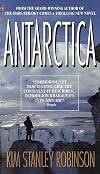
Is 'landscape writer' a thing? Kim Stanley Robinson makes it his thing, and in this book he takes us to Antarctica, continent of ice and rock, the last great wilderness, a beautiful and deadly place.
I've been there, just as a tourist during one of the nicest summers on record, but KSR nails the ineffable qualities of the place and the strangeness of light and distance. Robinson spent a season in Antarctica with the NSF's Artists and Writer's Program, and it was time well spent on all sides. show more By far my favorite character was Ta Shu, a feng shui geomancer and artistic resident streaming the landscape back to an audience of millions with a running commentary on its five-dimensional harmony and nano-poems. Ta Shu feels both entirely authentic and very alien.
blue sky
white snow
There are more mundane people as well, and the A plot concerns the future of the Antarctica and the Earth, as scientists wrestle with evidence for the last warm period, support staff grumble under the feudal structure of science, oil exploration teams prepare to extract natural resources, 'native Antarcticans' try to stay below the radar, and ecological saboteurs plan a massive attack in the name of the planet. There's a sorta a love triangle between X, a blue collar General Field Assistant, Val, an elite expedition guide, and Wade, senator's aide, but the characters, while round and unique, feel somewhat muted compared to the landscape and the simply trials of getting anywhere alive on the continent. The only true shared culture of Antarctica; the early expeditions of Scott, Shackleton, and Amundsen, come through again and again, along with the disagreements between different political factions. Though this is science fiction, the issues that Robinson explores are still very much alive. show less
I've been there, just as a tourist during one of the nicest summers on record, but KSR nails the ineffable qualities of the place and the strangeness of light and distance. Robinson spent a season in Antarctica with the NSF's Artists and Writer's Program, and it was time well spent on all sides. show more By far my favorite character was Ta Shu, a feng shui geomancer and artistic resident streaming the landscape back to an audience of millions with a running commentary on its five-dimensional harmony and nano-poems. Ta Shu feels both entirely authentic and very alien.
blue sky
white snow
There are more mundane people as well, and the A plot concerns the future of the Antarctica and the Earth, as scientists wrestle with evidence for the last warm period, support staff grumble under the feudal structure of science, oil exploration teams prepare to extract natural resources, 'native Antarcticans' try to stay below the radar, and ecological saboteurs plan a massive attack in the name of the planet. There's a sorta a love triangle between X, a blue collar General Field Assistant, Val, an elite expedition guide, and Wade, senator's aide, but the characters, while round and unique, feel somewhat muted compared to the landscape and the simply trials of getting anywhere alive on the continent. The only true shared culture of Antarctica; the early expeditions of Scott, Shackleton, and Amundsen, come through again and again, along with the disagreements between different political factions. Though this is science fiction, the issues that Robinson explores are still very much alive. show less
Lists
io9 Book Club (1)
al.vick-series (1)
Best Dystopias (1)
Generation Ship (1)
Obama Reads (1)
Urban Fiction (1)
Hurricane Books (1)
Best Beach Reads (1)
Solar System (1)
Favourite Books (1)
Asia (1)
Favorite Series (1)
Climate Change (2)
Read Next (2)
Forced Exposure (2)
Nebula Award (3)
Read These Too (3)
Unread books (3)
Classic Sci-Fi (1)
Five star books (1)
Gimmicks (1)
Awards


You May Also Like


Associated Authors
Statistics
- Works
- 139
- Also by
- 124
- Members
- 49,449
- Popularity
- #313
- Rating
- 3.8
- Reviews
- 1,380
- ISBNs
- 608
- Languages
- 21
- Favorited
- 160

