
Ilya Prigogine (1917–2003)
Author of Order Out of Chaos
About the Author
Image credit: Prof. Ilya Prigogine http://www.nobelprize.org/nobel_prizes/chemistry/laureates/1977/prigogine-autobi...
Series
Works by Ilya Prigogine
Temps et devenir: A partir de l'euvre d'Ilya Prigogine : actes du colloque international de 1983 (1988) 3 copies
Do ser ao devir 2 copies
The Excited State in Chemical Physics, Part 1 (Advances in Chemical Physics, Vol. 28) (1975) 2 copies
Tempo ed entropia 1 copy
O Fim das Incertezas 1 copy
Associated Works
Complexity and self-organization in social and economic systems : proceedings of the International Conference on Complexity and Self-Organization in Social and Economic Systems,… (1997) — Introduction — 5 copies
Mexique, terre des dieux : trésors de l'art precolombien : Musee Rath, 8 octobre 1998-24 janvier 1999 (1998) — Preface — 4 copies
Tagged
Common Knowledge
- Canonical name
- Prigogine, Ilya
- Legal name
- Prigogine, Ilya Romanovich
- Other names
- Пригожин, Илья Романович
- Birthdate
- 1917-01-25
- Date of death
- 2003-05-28
- Gender
- male
- Education
- Free University of Brussels (MA|1939|Ph.D|Chemistry|1941)
- Occupations
- physicist
chemist
professor - Organizations
- International Academy of Science
University of Chicago
University of Texas
Free University of Brussels - Awards and honors
- Nobel Prize (Chemistry, 1977)
Franqui Prize (Exact Science, 1950)
Rumford Medal (1976)
Viscount (1989) - Nationality
- Russia (birth)
Belgium (naturalized 1949) - Birthplace
- Moscow, Russian Empire
- Places of residence
- Moscow, Russia (birth)
Brussels, Belgium
Austin, Texas, USA - Place of death
- Brussels, Belgium
Members
Reviews
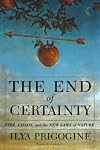
At the heart of this book is a challenge to the bedrock of our current scientific thinking. Newton's science, and indeed that of quantum physics contains no arrow of time. Whilst it may be true that knowing the current movement of balls on a pool table not only reveals where they will go, but also where they have come from, in contrast all around us we see a world that is deeply time irreversible. Smoke and embers do not spontaneously form into pieces of wood and fragments of glass do not show more leap onto tables to form the shape of a vase.
As Prigigone points out, all of our time reversible equations describe a simplification of what actually occurs in nature. We live our lives with eyes blinkered, dismissing reality as the exception to our neatly formed approximations.
Nobel laureate Prigigone does his best to avoid the mathematics as he describes ground breaking ideas that challenge and redefine science and through it the way we comprehend our world. In doing so it shakes the foundations of our knowledge and points not just to new understanding but new ways of understanding a universe governed by probabilities.
In my case at least, Prigigone did not fully succeed and there are parts of the book in which my lack of mathematical knowledge left me floundering. However don't be put off and feel free to skip the middle chapters. The key ideas all shine through even without the maths and will feed the open mind of those seeking a real understanding of the natural world. show less
As Prigigone points out, all of our time reversible equations describe a simplification of what actually occurs in nature. We live our lives with eyes blinkered, dismissing reality as the exception to our neatly formed approximations.
Nobel laureate Prigigone does his best to avoid the mathematics as he describes ground breaking ideas that challenge and redefine science and through it the way we comprehend our world. In doing so it shakes the foundations of our knowledge and points not just to new understanding but new ways of understanding a universe governed by probabilities.
In my case at least, Prigigone did not fully succeed and there are parts of the book in which my lack of mathematical knowledge left me floundering. However don't be put off and feel free to skip the middle chapters. The key ideas all shine through even without the maths and will feed the open mind of those seeking a real understanding of the natural world. show less
On a scientific philosophical scale, Prigogine accomplishes what Whitehead or Bergson could not. On a scientific scale, he somewhat rescues all those who are incessantly struggling in the quagmire of Quantum paradox as well as limitations of classical Newtonian mechanics. He also rescues those probabilistic realists who have a deterministic idealist lurking deep inside, i.e., with respect to conceptualization of time. Finally he rescues some essential aspects of nature, namely the Time, show more Memory and History; and he rescues them in the context of their physicality. Drawing a lot from Poincare and Operator Theory, he lays out mathematical tools which establish a demarcation between sheer poetic metaphor and real science.
Sadly, the book cannot be accessed easily by a layreader and even if you have an experience with modelling of dynamical systems and familiarity with the phase space, Hamiltonians and spectral decompositions, you need to bring out a paper and pen to work around some of the mathematics that he stretches out for the reader. However, it's not more than that and it's not very tough. I disagree with the reviewers who believe that Prigogine should have toned down the mathematical element to make it more accessible for a layreader. His reasoning is primarily mathematical and his apriori assumptions are phenomenologically consistent with observation. This is how popular science should be written to separate it from prevailing popular science genre, which basically compromises too much in my opinion. In this aspect, Prigogine is a conservative scientist-writer like Roger Penrose or Norbert Weiner. show less
Sadly, the book cannot be accessed easily by a layreader and even if you have an experience with modelling of dynamical systems and familiarity with the phase space, Hamiltonians and spectral decompositions, you need to bring out a paper and pen to work around some of the mathematics that he stretches out for the reader. However, it's not more than that and it's not very tough. I disagree with the reviewers who believe that Prigogine should have toned down the mathematical element to make it more accessible for a layreader. His reasoning is primarily mathematical and his apriori assumptions are phenomenologically consistent with observation. This is how popular science should be written to separate it from prevailing popular science genre, which basically compromises too much in my opinion. In this aspect, Prigogine is a conservative scientist-writer like Roger Penrose or Norbert Weiner. show less
Contrary to what the book description says, this text is not entirely suited for the general reader. A good half of the book is incomprehensible for a layman. Still, very big, world-changing ideas lie within, including those that challenge wide accepted views such as determinism, the Big Bang, and fundamental blocks of quantum mechanics and relativity. Alas, understanding the proof given by Prigogine to these claims is directly proportional to your expertise with mathematics.

A thorough, but sometimes dense introduction to non-equilibrium thermodynamics. The author raises some interesting issues, especially with respect to the concept of time. The main problems with the book are some of the connections between philosophy, sociology and natural science, which seem quite a stretch, and the final chapters, which are supposed to show that the "arrow of time" exists at the microscopic scale, but fail to be convincing.
Awards

You May Also Like


Associated Authors
Statistics
- Works
- 104
- Also by
- 3
- Members
- 2,019
- Popularity
- #12,739
- Rating
- 3.7
- Reviews
- 18
- ISBNs
- 365
- Languages
- 14
- Favorited
- 6


