
Richard Hallion
Author of Designers and Test Pilots
About the Author
Richard Hallion has written many books about aviation history, including Storm over Iraq. He lives in Virginia Michael Gorn is chief historian of NASA Dryden Flight Research Center and author of many books about aeronautics and spaceflight. He lives in California
Image credit: Richard Hallion [credit: Australian War Memorial]
Series
Works by Richard Hallion
Taking Flight: Inventing the Aerial Age, from Antiquity through the First World War (2003) 73 copies, 2 reviews
The Wright Flyers 1899–1916: The kites, gliders, and aircraft that launched the “Air Age” (X-Planes) (2019) 13 copies, 1 review
Associated Works
Air Power for Patton's Army : The XIX Tactical Air Command in the Second World War (2002) — Foreword — 18 copies, 1 review
Probing the Sky : Selected NACA Research Airplanes and Their Contributions to Flight (2014) — Contributor — 10 copies
MHQ: The Quarterly Journal of Military History — Summer 2000 (2000) — Author "Arms and Men: Aircraft of the Korean War" — 7 copies
Tagged
Common Knowledge
- Legal name
- Hallion, Richard Paul
- Other names
- Hallion, Richard P.
- Birthdate
- 1948-05-17
- Gender
- male
- Education
- University of Maryland
Federal Executive Institute
Harvard University - Occupations
- senior adviser for air and space issues
military historian
policy analyst
museum curator
aerospace analyst - Organizations
- United States Air Force
Pentagon Directorate for Security
University of Maryland
National Air and Space Museum
Air Force Association
American Institute of Aeronautics and Astronautics (show all 13)
National Defense Industrial Association
Royal United Services Institute for Defence and Security Studies
Military Operations Research Society
Precision Strike Association
National Association of Scholars
Exchange Club of Capitol Hill
Florida Polytechnic University - Awards and honors
- Lt. Col. Roy Mase Trophy (1984)
Meritorious Civilian Service Medal (1986)
Commander's Award for Public Service (1988)
Ira Eaker Award (1990)
Aviation Space Writers Association Premier Award for defense aviation coverage (1993)
Annual Award of the Conference of Historic Aviation Writers (2005) - Nationality
- USA
- Associated Place (for map)
- USA
Members
Reviews

Close air support--attacking targets on the ground with guns, bombs, and rockets, usually at very low altitudes--is the forgotten branch of combat aviation. There are hundreds of books about high-altitude bombers, fighters, and naval strike aircraft . . . but only a handful about ground attack. This is by far the best of that handful: A comprehensive, all-nations history of the rise of close air support doctrine and the development of airplanes to carry it out. The German blitzkrieg and the show more Allied domination of French airspace after D-Day both receive due attention, but so do lesser-known topics like World War I trench strafing, the development of air-ground coordination by the U. S. Marines in the "Banana Wars" of the 1930s, and the spectacular successes of Soviet pilots against German armored forces on the Eastern Front. This is essential reading for any serious student of air power . . . we can only hope that Hallion (or somebody) gets around to a sequel covering 1946-now. show less
Taking Flight: Inventing the Aerial Age, from Antiquity through the First World War by Richard P. Hallion
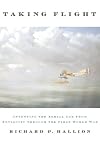
Richard Hallion's book offers its readers an encyclopedic overview of the history of flight, from the earliest legends through the First World War. Though his focus is on heavier-than-air flight, he also includes extensive coverage of the development of lighter-than-air craft and how it influenced aeronautical development. Throughout this book, Hallion demonstrates both an impressive range of knowledge and a welcome capacity for explaining some of the more technical details of aerodynamics - show more one that is especially welcome when it comes to explaining why so many of the Wrights' predecessors failed in their attempts to master flight.
The portrait Hallion paints is a fascinating one. He conveys the extent to which the Wright brothers built upon the achievements of both their predecessors and their contemporaries. Developments were reaching a critical mass, which - as Hallion repeatedly asserts - would almost certainly have led to heavier-than-air flight by 1910 (with the first flight most likely taking place in France). Nevertheless, the author does not underrate the Wrights' considerable accomplishment and its contribution to our history. Even after Europeans were first taking to the air in heavier-than-air craft, the Wrights' Flyer was still considerably superior to its counterparts on the other side of the Atlantic - as Wilbur Wright himself demonstrated in his 1908 tour of Europe.
As Hallion shows, however, Wilbur's tour represented the pinnacle of the Wrights' achievement. He describes the year 1909 as the year when the invention of flight ended and its refinement begins. In this phase the Europeans had a considerable advantage, for as the Wrights were pioneering flight the Europeans were focusing more on the scientific study of aerodynamics, something which Hallion sees as integral to the shift in aeronautical advancement from the New World back to the Old. Wedded to an increasingly obsolescent (and inherently dangerous) design, the Wrights no longer represented the leading edge of airplane development, one that was moving forward at a dramatic rate. Before the First World War ended, airplanes were already demonstrating speed, endurance, and applications that most people take for granted today but which almost none of the early pioneers had imagined were possible.
Yet while Hallion's book is one of the best histories of its subject, at times it suffers from an excess of detail. Hallion's knowledge of virtually every nugget of information is reflected in the text, even if it adds little to the reader's understanding of aeronautics. Hallion's book also suffers from his tendency to overemphasize the historical impact of the airplane, especially in the First World War, implying, for example, that the course of events at the battles of Tannenberg and the Marne was altered because of the use of airplanes, yet he offers no evidence to substantiate this claim beyond stressing the role the planes played as scouts while understating the other sources of information available to the commanders. These flaws, however, don't detract from the book's overall value as a description of humanity's long journey to flight and how ultimately it was achieved. show less
The portrait Hallion paints is a fascinating one. He conveys the extent to which the Wright brothers built upon the achievements of both their predecessors and their contemporaries. Developments were reaching a critical mass, which - as Hallion repeatedly asserts - would almost certainly have led to heavier-than-air flight by 1910 (with the first flight most likely taking place in France). Nevertheless, the author does not underrate the Wrights' considerable accomplishment and its contribution to our history. Even after Europeans were first taking to the air in heavier-than-air craft, the Wrights' Flyer was still considerably superior to its counterparts on the other side of the Atlantic - as Wilbur Wright himself demonstrated in his 1908 tour of Europe.
As Hallion shows, however, Wilbur's tour represented the pinnacle of the Wrights' achievement. He describes the year 1909 as the year when the invention of flight ended and its refinement begins. In this phase the Europeans had a considerable advantage, for as the Wrights were pioneering flight the Europeans were focusing more on the scientific study of aerodynamics, something which Hallion sees as integral to the shift in aeronautical advancement from the New World back to the Old. Wedded to an increasingly obsolescent (and inherently dangerous) design, the Wrights no longer represented the leading edge of airplane development, one that was moving forward at a dramatic rate. Before the First World War ended, airplanes were already demonstrating speed, endurance, and applications that most people take for granted today but which almost none of the early pioneers had imagined were possible.
Yet while Hallion's book is one of the best histories of its subject, at times it suffers from an excess of detail. Hallion's knowledge of virtually every nugget of information is reflected in the text, even if it adds little to the reader's understanding of aeronautics. Hallion's book also suffers from his tendency to overemphasize the historical impact of the airplane, especially in the First World War, implying, for example, that the course of events at the battles of Tannenberg and the Marne was altered because of the use of airplanes, yet he offers no evidence to substantiate this claim beyond stressing the role the planes played as scouts while understating the other sources of information available to the commanders. These flaws, however, don't detract from the book's overall value as a description of humanity's long journey to flight and how ultimately it was achieved. show less

Written immediately after the end of the 1991 Gulf War, this remains the best single-volume history of how air power defined the shape of the war. Hallion's overarching thesis is that the U. S. Air Force, stung by its failure to achieve decisive victory in Vietnam, reinvented itself as a force dedicated to precision strikes that could paralyze an enemy's military machine in a matter of days rather than grinding it down over months or years. Hallion--with good reason--sees the Gulf War as a show more stunning vindication of the Air Force's new approach to war-fighting, and his narrative of the war is shaped by that idea.
Chief of the USAF historical branch, Hallion is understandably proud of what "his" service accomplished in 1991, and it shows. Unfortunately, it (and the lack of the "long" view) sometimes causes him to overstate the effectiveness of Air Force's new weapons and tactics and to slight the contributions of the ground forces. Even so, Storm Over Iraq ranks along with Rick Atkinson's Crusade and Tom Clancy's Every Man A Tiger as one of the essential books on air power in the Gulf. show less
Chief of the USAF historical branch, Hallion is understandably proud of what "his" service accomplished in 1991, and it shows. Unfortunately, it (and the lack of the "long" view) sometimes causes him to overstate the effectiveness of Air Force's new weapons and tactics and to slight the contributions of the ground forces. Even so, Storm Over Iraq ranks along with Rick Atkinson's Crusade and Tom Clancy's Every Man A Tiger as one of the essential books on air power in the Gulf. show less

In the years following the success Wilbur and Orville Wright achieved at Kitty Hawk, aviation entered a dangerous age of trial and error. Up until this time, designers flew their own aircraft since there were no other experienced aviators available to fly the aircraft for them. But with some aircraft manufacturers producing aircraft for sale and flight schools turning out aviators anxious to put their skills to use, the first professional test pilots arrived on the aviation scene.
Rapid show more advancements in aircraft design led to a pursuit of both speed and reliability. Air races attracted designers such as Giuseppe Bellanca and Jack Northrop who, with the support of companies such as Boeing, Douglas, and Lockheed, transformed civil aviation and made America the world leader, squarely in the forefront of aircraft development.
But as the airplane was evolving into practical civil transportation, the world was on the brink of war and military aircraft took shape on the designers’ drawing boards. Speed, maneuverability, and the ability to climb quickly were the hallmarks of the fighters.
As designers sought ways to increase the speed of their aircraft, the breaking of the sound barrier became the prized goal. Flying the X-1, test pilot Chuck Yeager became the first man to fly faster than the speed of sound. For designers looking to extend the capabilities of their aircraft, wind tunnels became a tool for aerodynamic research.
Soon jet aircraft, benefiting from rocket-plane research, flew at twice the speed of sound. A series of X-planes, designed to fly at more than six times the speed of sound and at altitudes up to 200,000 feet, led to the X-15, a harbinger of the space age. Test pilot Scott Crossfield flew the X-15’s first successful glide flight as well as its first powered flight; his many X-15 flights helped pave the way for the space shuttle.
Filled with photographs and diagrams, “Designers and Test Pilots” tells the story of aircraft development and highlights the accomplishments of the brave test pilots that helped advance aircraft design. A special section looks at Howard Hughes’s Spruce Goose while several pages offer pictures of warplanes designed but never developed. Part of The Epic of Flight series, here are the aircraft architects and the daring test pilots who played an essential role in aircraft development and design.
Recommended for readers interested in aircraft designers and/or test flights and the pilots who flew these planes. show less
Rapid show more advancements in aircraft design led to a pursuit of both speed and reliability. Air races attracted designers such as Giuseppe Bellanca and Jack Northrop who, with the support of companies such as Boeing, Douglas, and Lockheed, transformed civil aviation and made America the world leader, squarely in the forefront of aircraft development.
But as the airplane was evolving into practical civil transportation, the world was on the brink of war and military aircraft took shape on the designers’ drawing boards. Speed, maneuverability, and the ability to climb quickly were the hallmarks of the fighters.
As designers sought ways to increase the speed of their aircraft, the breaking of the sound barrier became the prized goal. Flying the X-1, test pilot Chuck Yeager became the first man to fly faster than the speed of sound. For designers looking to extend the capabilities of their aircraft, wind tunnels became a tool for aerodynamic research.
Soon jet aircraft, benefiting from rocket-plane research, flew at twice the speed of sound. A series of X-planes, designed to fly at more than six times the speed of sound and at altitudes up to 200,000 feet, led to the X-15, a harbinger of the space age. Test pilot Scott Crossfield flew the X-15’s first successful glide flight as well as its first powered flight; his many X-15 flights helped pave the way for the space shuttle.
Filled with photographs and diagrams, “Designers and Test Pilots” tells the story of aircraft development and highlights the accomplishments of the brave test pilots that helped advance aircraft design. A special section looks at Howard Hughes’s Spruce Goose while several pages offer pictures of warplanes designed but never developed. Part of The Epic of Flight series, here are the aircraft architects and the daring test pilots who played an essential role in aircraft development and design.
Recommended for readers interested in aircraft designers and/or test flights and the pilots who flew these planes. show less
Lists
You May Also Like


Associated Authors
Statistics
- Works
- 40
- Also by
- 4
- Members
- 705
- Popularity
- #35,923
- Rating
- 3.9
- Reviews
- 8
- ISBNs
- 61
- Languages
- 1


