
Nicholson Baker
Author of The Mezzanine
About the Author
Nicholson Baker lives in Maine. Nicholson Baker was born in New York City on January 7, 1957. He briefly attended the Eastman School of Music before receiving a B.A. in philosophy from Haverford College. He is the author of both fiction and nonfiction works including The Mezzanine (1988); Room show more Temperature (1990); Vox (1992); The Fermata (1994); The Everlasting Story of Nory (1998); Checkpoint (2004); and The Anthologist (2009). His nonfiction work, Double Fold: Libraries and the Assault on Paper, won a National Book Critics Circle Award in 2001. (Bowker Author Biography) show less
Series
Works by Nicholson Baker
The World on Sunday : Graphic Art in Joseph Pulitzer's Newspaper (1898 - 1911) (2005) 111 copies, 4 reviews
Subsoil [short fiction] 3 copies
"Deadline: The Author's Desperate Bid to Save America's Past." New Yorker, July 24, 2000, pp. 42-61. 2 copies
Author vs. the Library 1 copy
The Mezzanine 1 copy
Глас 1 copy
Associated Works
For the Love of Books: 115 Celebrated Writers on the Books They Love Most (1999) — Contributor — 479 copies, 4 reviews
The Year's Best Fantasy and Horror: Eighth Annual Collection (1995) — Contributor — 329 copies, 6 reviews
War No More: Three Centuries of American Antiwar and Peace Writing (2016) — Contributor — 109 copies, 2 reviews
Significant Objects: 100 Extraordinary Stories about Ordinary Things (2012) — Contributor — 63 copies, 1 review
Tagged
Common Knowledge
- Birthdate
- 1957-01-07
- Gender
- male
- Education
- Eastman School of Music
Haverford College (B.A.|1979) - Occupations
- novelist
non-fiction writer
essayist - Organizations
- American Newspaper Repository (founder)
- Awards and honors
- Katherine Anne Porter Award (2004)
James Madison Freedom of Information Award (1997)
Calw Hermann Hesse Prize (2014)
National Book Critics Circle Award (2001) - Agent
- Melanie Jackson
- Nationality
- USA
- Birthplace
- New York, New York, USA
- Places of residence
- South Berwick, Maine, USA
New York, New York, USA
Rochester, New York, USA - Map Location
- New York, USA
Members
Reviews
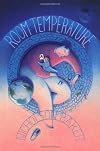
Novel.
Nicholson Baker writes in 360-degree Sensurround--his descriptions of the seemingly banal awakening the most jaded of senses into recognition, admiration, and amusement. In Room Temperature, his self-deprecating, endlessly curious narrator is at home giving his baby girl a bottle and allowing his mind to wander. Uppermost in his thoughts are his wife and daughter, but there is also that obsession with commas and some concern with tiny taboos like nose-picking and stealing change from show more his parents. Truth-telling is the operative mode; at one point he tries to get his wife to explain a doodle by quoting a review of early Yeats: "Always true is always new." Room Temperature is a rare novel of domestic pleasure and stability, with a twist. "Was there ever a limit between us? Would disgust ever outweigh love?" Baker's alter ego asks, and seems determined to find out. show less
Nicholson Baker writes in 360-degree Sensurround--his descriptions of the seemingly banal awakening the most jaded of senses into recognition, admiration, and amusement. In Room Temperature, his self-deprecating, endlessly curious narrator is at home giving his baby girl a bottle and allowing his mind to wander. Uppermost in his thoughts are his wife and daughter, but there is also that obsession with commas and some concern with tiny taboos like nose-picking and stealing change from show more his parents. Truth-telling is the operative mode; at one point he tries to get his wife to explain a doodle by quoting a review of early Yeats: "Always true is always new." Room Temperature is a rare novel of domestic pleasure and stability, with a twist. "Was there ever a limit between us? Would disgust ever outweigh love?" Baker's alter ego asks, and seems determined to find out. show less
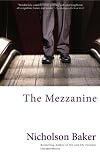
Nicholson Baker's novels are examples of of trying to imbue the minute trivialities of modern life with unseen philosophical and personal significance. Exhibiting an affinity for minutiae and ponderous disquisition, he is noted for transforming otherwise banal human activities into finely wrought descriptions of thought and serious consideration. His technique of extreme magnification and loitering contemplation has been described as creating a “clogging” effect in his fiction, thus show more slowing narrative time to a near standstill while retraining the reader's attention on otherwise overlooked objects and minor events, all presented through Baker's scrupulous authorial subjectivity. The effect of this in The Mezzanine, an essentially plotless, stream-of-consciousness novel, which examines in great detail the lunch-hour activities of a young office worker named Howie is bracing for about two pages. His simple lunch—a hot dog, cookie, and milk—and purchase of a new pair of shoelaces are juxtaposed against his reading of a paperback edition of Marcus Aurelius's Meditations. Baker's digressive novel contains copious footnotes, some of which are several pages long, while following the ruminations of Howie as he contemplates a variety of everyday objects and occurrences, including how paper milk cartons replaced glass milk bottles, the miracle of perforation, and the nature of plastic straws, vending machines, paper towel dispensers, and popcorn poppers. That he would take more than eighty per cent of the novel to reach his epiphany from a random passage in the Meditations, which lasts less than a page before he returns to memories of cookies and milk as a youth, gives you some idea of the misadventure that this slight novel encompasses. The author's hubris at thinking that his disquisition on drinking straws and shoelaces constitutes a novel of humor or ideas or anything else is merely a symptom of the artistic morass of literature at the end of the twentieth century. show less
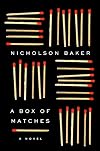
A Box of Matches stands as a brilliant example of the urge to write in the face of the quotidian. But author Nicholson Baker turns mundane activity into deep imaginative realms and far-fetched speculations: an inchoate blaze in a fireplace becomes a far-off corner of a violent universe; a burning Quaker Oats box becomes a coastal British fort. Such are the pathways of Baker’s mind and observations. And they prove once again that it’s not the subject matter that counts in fiction, it’s show more the way the subject matter is presented. For me, Baker has yet to disappoint. Far from it.
He greets us each morning with the time and sometimes adds an observation about the weather. It’s winter in the Northeast of the U.S., so cold and snow occupy the land and lives. And because cold is a factor, our narrator builds a fire in the fireplace each morning, and he uses a box of strike-anywhere matches during the course of the book. The business of this novel is the minutiae of daily life. But far from boring, Baker leavens his prose with not only thought-provoking observations, but takes journeys out over the town, the landscape, and the history of his area, to destinations philosophic and speculative.
I love Nicholson Baker’s work. He makes startling and original revelations about everyday objects and activities, and in his hands these ordinary things and events take on a mysticism, an inherently more meaningful and illuminative existence. A Box of Matches is no exception, and I urge you to take it up and be charmed with very little investment in time. show less
He greets us each morning with the time and sometimes adds an observation about the weather. It’s winter in the Northeast of the U.S., so cold and snow occupy the land and lives. And because cold is a factor, our narrator builds a fire in the fireplace each morning, and he uses a box of strike-anywhere matches during the course of the book. The business of this novel is the minutiae of daily life. But far from boring, Baker leavens his prose with not only thought-provoking observations, but takes journeys out over the town, the landscape, and the history of his area, to destinations philosophic and speculative.
I love Nicholson Baker’s work. He makes startling and original revelations about everyday objects and activities, and in his hands these ordinary things and events take on a mysticism, an inherently more meaningful and illuminative existence. A Box of Matches is no exception, and I urge you to take it up and be charmed with very little investment in time. show less

An office-worker goes out to buy replacement shoelaces in his lunch-hour. With footnotes.
That’s basically it — a glorious, subtly-funny 130-page study of the trivial thoughts that fill our minds for most of the day. Staplers, escalators, office washroom fittings, the way store cashiers put things into bags, the ritual of office banter, and the eternal mystery of how and when shoelaces choose to fail. And a celebration of the joys of excessively-footnoted text.
That’s basically it — a glorious, subtly-funny 130-page study of the trivial thoughts that fill our minds for most of the day. Staplers, escalators, office washroom fittings, the way store cashiers put things into bags, the ritual of office banter, and the eternal mystery of how and when shoelaces choose to fail. And a celebration of the joys of excessively-footnoted text.
… the great scholarly orshow more
anecdotal footnotes of Lecky, Gibbon, or Boswell, written by the author of the book himself to supplement, or even correct over several later editions, what he says in the primary text, are reassurances that the pursuit of truth doesn't have clear outer boundaries: it doesn't end with the book; restatement and self-disagreement and the enveloping sea of referenced authorities all continue. Footnotes are the finer-suckered surfaces that allow tentacular paragraphs to hold fast to the wider reality of the library.show less
Lists
Awards


You May Also Like


Associated Authors
Statistics
- Works
- 30
- Also by
- 14
- Members
- 14,316
- Popularity
- #1,606
- Rating
- 3.6
- Reviews
- 356
- ISBNs
- 247
- Languages
- 12
- Favorited
- 55

