
Cyril Connolly (1903–1974)
Author of The Unquiet Grave: A Word Cycle by Palinurus
About the Author
Cyril Connolly (1903-74), one of the most influential critics of his time, wrote for such publications as the New Statesman, the Observer, and the Sunday Times. He is the author of many books, including The Rock Pool and The Unquiet Grave
Series
Works by Cyril Connolly
Horizon stories 6 copies
The Modern Movement. One Hundred Key Books from England, France and America 1880-1950 (1965) 3 copies
Horizon 21 (September 1941) 2 copies
Horizon 57 2 copies
Horizon 59 (November 1944) 2 copies
La tumba son sosiego 1 copy
Horizon 17 1 copy
Horizon 44 1 copy
Horizon 45 1 copy
Horizon 52 1 copy
DAS GRAB OHNE FRIEDEN. 1 copy
Horizon 34 1 copy
Horizon 40 1 copy
Horizon 22 1 copy
Horizon 61 1 copy
Horizon 62 1 copy
Horizon 60 1 copy
Horizon 37 1 copy
Horizon 38 1 copy
Horizon 39 1 copy
Horizon 41 1 copy
Horizon 19 1 copy
Horizon 43 1 copy
Horizon 42 1 copy
Horizon 55 1 copy
Horizon 9 1 copy
Horizon 56 1 copy
Horizon 63 1 copy
Horizon 31 1 copy
Horizon 18 1 copy
Horizon 23 1 copy
Horizon 53 1 copy
Horizon 32 1 copy
Horizon 25 1 copy
Horizon 51 1 copy
Horizon 54 1 copy
HORIZON. VOL. 1. NO.2. 1 copy
Horizon 36 1 copy
Horizon 35 1 copy
Horizon 14 1 copy
Associated Works
The London Magazine : April 1963, New series Volume 3, No. 1 — Contributor — 1 copy
Tagged
Common Knowledge
- Canonical name
- Connolly, Cyril
- Legal name
- Connolly, Cyril Vernon
- Other names
- Palinurus
- Birthdate
- 1903-09-10
- Date of death
- 1974-11-26
- Gender
- male
- Education
- Eton College, Eton, Berkshire, England, UK
University of Oxford (Balliol College)
St Cyprian's School, Eastbourne, Sussex, England, UK - Occupations
- editor
critic
novelist - Organizations
- American Academy of Arts and Letters (Foreign Honorary, Literature, 1974)
- Awards and honors
- Royal Society of Literature (Companion of Literature)
Order of the British Empire (Commander) - Relationships
- Orwell, George (schoolmate)
Skelton, Barbara (wife) - Nationality
- England
UK - Birthplace
- Coventry, Warwickshire, England, UK
- Places of residence
- Eastbourne, Sussex, England, UK
Bath, Somerset, England, UK
South Africa
Clontarf, Ireland - Place of death
- St Vincent's Hospital, Ladbroke Grove, London, UK
- Burial location
- St. Michael and All Angels Churchyard Berwick, Wealden District, East Sussex, England
- Associated Place (for map)
- England, UK
Members
Reviews

While it is the story of Palinurus, the helmsman of Aeneas's ship in Virgil's Aeneid, which Cyril Connolly uses to frame his uncategorisable book The Unquiet Grave, it is another legend of antiquity which occurs to me as I try to review my reading experience. It is the story of the sea nymph Thetis, who refuses to marry a human, Peleus. Peleus subdues her and holds tight to her even as she rages violently, changing into fire, water, a snake and a lioness in an attempt to break free. The show more product of their union later becomes renowned in war as the dauntless Achilles.
This particular legend occurred to me as The Unquiet Grave is also difficult to grasp. Subtitled as 'A Word Cycle', the book also changes shape through each of its four chapters in a way that can unnerve, or at least bewilder, the reader. (The reader is Peleus in this analogy.) It is hard to say what the book is: certainly not a novel, but neither is it an essay or piece of criticism (though it contains elements of those). It is almost Nietzschean in its style – Connolly has provided an unorthodox lyrical performance in these pages – and yet it seems wrong to label it as philosophy, even though it communicates ideas. The book's genesis was as a series of unconnected vignettes written in a diary by Connolly in wartime Britain, and then stitched together with some sort of underlying structure divined by the writer, in order to provide something approaching narrative force. This is not necessarily a bad thing (Meditations by Marcus Aurelius had a similar genesis, and it's fair to say that worked out well), but I'd be lying if I said I wasn't often longing for a more flowing and consistent prose. The shapeshifting nature of the book was such that I'm still not sure there's an Achilles at the end of the struggle.
What I can be sure of is that I didn't regret grappling with it. If it's never all that clear how it all hangs together, it is at least fascinating from moment to moment. The book is very quotable and opinionated, with an unapologetically high-class demeanour that modern writers wouldn't even dare to approach. Connolly is classically educated and old-school, and he makes allusions to myths, literature and philosophical ideas as though you are already at least somewhat acquainted with them. He expects (not arrogantly, but as a result of having standards) that readers will seek to attain the plain he is writing on, rather than spoon-feeding the sort of self-effacing dumbing-down that too often passes for an author/reader dialogue nowadays.
This allows for an original and wide-ranging discussion and, even though I was alienated sometimes by the structure or by the untranslated passages in French, I never felt stupid or inferior. I was only stimulated by the challenge, by the opportunity to learn more. Ernest Hemingway is on the record as saying that The Unquiet Grave is "a book which, no matter how many readers it will have, will never have enough", and while this may be in part because Connolly praises Hemingway's greatness in these pages (pg. 85), it is also the rare blurb that provides an astute, nuanced observation. Writing of real calibre, that pushes you beyond your comfort zone and encourages you to learn more about things – the story of Palinurus, for example – is writing to be cherished, particularly as it is becoming rarer than giants. Civilisation gurgles in the drain of mediocrity, but you can still sometimes find something that recognises objective standards, that thinks highly of itself but matches that opinion with ability and moves with grace. And such writing will never find enough readers.
Indeed, it is this tragedy, this cultural crisis of the West, which Connolly is diagnosing and commenting on, however oblique that communication often appears. In the final (and, alas, shortest) chapter, Connolly finally confronts the Palinurus motif directly. Palinurus was the "master pilot" (pg. 127) of Aeneas's ship as it travelled stormy oceans, and Connolly speculates on the reason for his alienation and withdrawal, his disenchantment with his captain's voyage, and his eventual death. Not only is the latter a parallel for Connolly's own (admittedly eloquent) mid-life crisis as he navigates his forties ("no true knowledge of anything, no ideals, no inspiration… a decaying belly washed up on the shore" (pg. 24)), but Palinurus's crisis of meaning mirrors the immediately identifiable (and compelling) idea that Western culture is in decline.
I have mentioned Nietzsche already, but remember that Connolly's avatar of choice is Palinurus, not Zarathustra. Nietzsche's ideas of Western philosophical crisis and his proposed cure of the 'superman' are well-known, but Connolly is more cautious. Rather than proposing a superman for what ails ya, Connolly identifies (but certainly does not advocate) the emergence of "a new conception: the Group Man" (pg. 27). He predicts (with depressing accuracy, in my opinion) the decline of appreciation for individual thought, in favour of an indistinguishable communal mass. Not sheep, but "a leap from the poorly organized wolf-pack and sheep-flock into an insect society, a community in which the individual is not merely a gregarious unit, but a cell in the body itself" (pg. 27).
Now, this thread of argument is harder to identify in The Unquiet Grave than my review might suggest, in no small part due to that shapeshifting vignette structure I mentioned earlier. But once you finish the book and look back on it, many of the pieces you thought were broken shards seem to have arrayed themselves into an interesting mosaic. The use of Palinurus as a framing device often seemed obscure in the reading of the book; but, at the end, in light of the above idea of the Group Man, it becomes clearer. Palinurus is the pilot of the ship, not the captain. He doesn't determine the course, but he has an essential role in the success of the voyage. His disenchantment reflects the disenchantment of Connolly, the cultural critic and public intellectual. He's not sure he likes where things are going. Standards are being lowered: "Today our literature is suffering from the decay of poetry and the decline of fiction, yet never have there been so many novelists and poets" (pp 20-21). The modern peasant is now an urban-dweller: "the village idiot walks in Leicester Square" (pg. 35) and we will surely reach a time when, as far as cultural standards are concerned, "the position is reached that whatever the common man does not understand is treason" (pg. 55).
We are, of course, there now; Connolly's 1944 diagnosis has, unfortunately, proved sound. He would be shamed as an 'elitist' nowadays, perhaps for not agreeing that YA is real literature, or for saying that we should expect better music for our ears than Cardi B's 'WAP', or something other than yet another superhero movie on our screens. But his argument is not elitist; rather, Connolly recognises the importance of true art in revivifying a culture. "Art is made by the alone for the alone," (pg. 73), and yet the moribund culture nixes individual creativity in favour of the 'Group Man'. Modern man is in a quasi-Nietzschean catch-22: if we regress to the supernatural religiosity of the past, "we end by stocking our library with the prophecies of Nostradamus and the calculations on the Great Pyramid. [But] if instead we choose to travel via Montaigne and Voltaire, then we choke among the brimstone aridities of the Left Book Club" (pg. 32).
Connolly identifies one of the tragedies in this state of affairs; the awareness that increasingly haunts Palinurus as he tries to follow the captain's orders and steer the ship through stormy waters. True artists, able to pilot through such waters with skill, are starved of connection to a spiritually bereft audience, and the result – for everyone – can only be a frighteningly unarrested decline – if not collapse. We "reward our men of genius" with only "a posthumous curiosity"; our society has "condemned these men to death… out of its own ignorance and malformation, it has persecuted those who were potential saviours" and who could have "brought us back into harmony with ourselves" (pg. 124). Both artist and society are in a "downward rush towards… suicide" (pg. xiv); the society unconsciously so, but the artist, muzzled and in despair, actively contemplating it. For Palinurus, for the educated man, for the artist or man of skill, the horror is not in being tortured, but in being tortured by unworthy men. For all its shapeshifting and its odd vignettes, The Unquiet Grave reminds us that behind every piece of art there is an artist howling. show less
This particular legend occurred to me as The Unquiet Grave is also difficult to grasp. Subtitled as 'A Word Cycle', the book also changes shape through each of its four chapters in a way that can unnerve, or at least bewilder, the reader. (The reader is Peleus in this analogy.) It is hard to say what the book is: certainly not a novel, but neither is it an essay or piece of criticism (though it contains elements of those). It is almost Nietzschean in its style – Connolly has provided an unorthodox lyrical performance in these pages – and yet it seems wrong to label it as philosophy, even though it communicates ideas. The book's genesis was as a series of unconnected vignettes written in a diary by Connolly in wartime Britain, and then stitched together with some sort of underlying structure divined by the writer, in order to provide something approaching narrative force. This is not necessarily a bad thing (Meditations by Marcus Aurelius had a similar genesis, and it's fair to say that worked out well), but I'd be lying if I said I wasn't often longing for a more flowing and consistent prose. The shapeshifting nature of the book was such that I'm still not sure there's an Achilles at the end of the struggle.
What I can be sure of is that I didn't regret grappling with it. If it's never all that clear how it all hangs together, it is at least fascinating from moment to moment. The book is very quotable and opinionated, with an unapologetically high-class demeanour that modern writers wouldn't even dare to approach. Connolly is classically educated and old-school, and he makes allusions to myths, literature and philosophical ideas as though you are already at least somewhat acquainted with them. He expects (not arrogantly, but as a result of having standards) that readers will seek to attain the plain he is writing on, rather than spoon-feeding the sort of self-effacing dumbing-down that too often passes for an author/reader dialogue nowadays.
This allows for an original and wide-ranging discussion and, even though I was alienated sometimes by the structure or by the untranslated passages in French, I never felt stupid or inferior. I was only stimulated by the challenge, by the opportunity to learn more. Ernest Hemingway is on the record as saying that The Unquiet Grave is "a book which, no matter how many readers it will have, will never have enough", and while this may be in part because Connolly praises Hemingway's greatness in these pages (pg. 85), it is also the rare blurb that provides an astute, nuanced observation. Writing of real calibre, that pushes you beyond your comfort zone and encourages you to learn more about things – the story of Palinurus, for example – is writing to be cherished, particularly as it is becoming rarer than giants. Civilisation gurgles in the drain of mediocrity, but you can still sometimes find something that recognises objective standards, that thinks highly of itself but matches that opinion with ability and moves with grace. And such writing will never find enough readers.
Indeed, it is this tragedy, this cultural crisis of the West, which Connolly is diagnosing and commenting on, however oblique that communication often appears. In the final (and, alas, shortest) chapter, Connolly finally confronts the Palinurus motif directly. Palinurus was the "master pilot" (pg. 127) of Aeneas's ship as it travelled stormy oceans, and Connolly speculates on the reason for his alienation and withdrawal, his disenchantment with his captain's voyage, and his eventual death. Not only is the latter a parallel for Connolly's own (admittedly eloquent) mid-life crisis as he navigates his forties ("no true knowledge of anything, no ideals, no inspiration… a decaying belly washed up on the shore" (pg. 24)), but Palinurus's crisis of meaning mirrors the immediately identifiable (and compelling) idea that Western culture is in decline.
I have mentioned Nietzsche already, but remember that Connolly's avatar of choice is Palinurus, not Zarathustra. Nietzsche's ideas of Western philosophical crisis and his proposed cure of the 'superman' are well-known, but Connolly is more cautious. Rather than proposing a superman for what ails ya, Connolly identifies (but certainly does not advocate) the emergence of "a new conception: the Group Man" (pg. 27). He predicts (with depressing accuracy, in my opinion) the decline of appreciation for individual thought, in favour of an indistinguishable communal mass. Not sheep, but "a leap from the poorly organized wolf-pack and sheep-flock into an insect society, a community in which the individual is not merely a gregarious unit, but a cell in the body itself" (pg. 27).
Now, this thread of argument is harder to identify in The Unquiet Grave than my review might suggest, in no small part due to that shapeshifting vignette structure I mentioned earlier. But once you finish the book and look back on it, many of the pieces you thought were broken shards seem to have arrayed themselves into an interesting mosaic. The use of Palinurus as a framing device often seemed obscure in the reading of the book; but, at the end, in light of the above idea of the Group Man, it becomes clearer. Palinurus is the pilot of the ship, not the captain. He doesn't determine the course, but he has an essential role in the success of the voyage. His disenchantment reflects the disenchantment of Connolly, the cultural critic and public intellectual. He's not sure he likes where things are going. Standards are being lowered: "Today our literature is suffering from the decay of poetry and the decline of fiction, yet never have there been so many novelists and poets" (pp 20-21). The modern peasant is now an urban-dweller: "the village idiot walks in Leicester Square" (pg. 35) and we will surely reach a time when, as far as cultural standards are concerned, "the position is reached that whatever the common man does not understand is treason" (pg. 55).
We are, of course, there now; Connolly's 1944 diagnosis has, unfortunately, proved sound. He would be shamed as an 'elitist' nowadays, perhaps for not agreeing that YA is real literature, or for saying that we should expect better music for our ears than Cardi B's 'WAP', or something other than yet another superhero movie on our screens. But his argument is not elitist; rather, Connolly recognises the importance of true art in revivifying a culture. "Art is made by the alone for the alone," (pg. 73), and yet the moribund culture nixes individual creativity in favour of the 'Group Man'. Modern man is in a quasi-Nietzschean catch-22: if we regress to the supernatural religiosity of the past, "we end by stocking our library with the prophecies of Nostradamus and the calculations on the Great Pyramid. [But] if instead we choose to travel via Montaigne and Voltaire, then we choke among the brimstone aridities of the Left Book Club" (pg. 32).
Connolly identifies one of the tragedies in this state of affairs; the awareness that increasingly haunts Palinurus as he tries to follow the captain's orders and steer the ship through stormy waters. True artists, able to pilot through such waters with skill, are starved of connection to a spiritually bereft audience, and the result – for everyone – can only be a frighteningly unarrested decline – if not collapse. We "reward our men of genius" with only "a posthumous curiosity"; our society has "condemned these men to death… out of its own ignorance and malformation, it has persecuted those who were potential saviours" and who could have "brought us back into harmony with ourselves" (pg. 124). Both artist and society are in a "downward rush towards… suicide" (pg. xiv); the society unconsciously so, but the artist, muzzled and in despair, actively contemplating it. For Palinurus, for the educated man, for the artist or man of skill, the horror is not in being tortured, but in being tortured by unworthy men. For all its shapeshifting and its odd vignettes, The Unquiet Grave reminds us that behind every piece of art there is an artist howling. show less
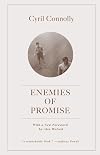
This is a unique combination of autobiography and literary criticism, with a dash of ideas. It is also a commentary on writers and the art of writing. A book that can be dipped into as there are interesting bits on every page.

On the upside, the next time anyone complains about how The Literary Establishment has always forced people to write in single genres and thus distorted the Genius Writer, I can point to one more book as showing what rubbish that statement is. On the downside, I now know why this is more cult classic and less just classic. I was led to expect much more.
I thought the first section by far the most interesting. Connolly's understanding of literature, and particularly literary history, was show more ahead of its time and light years ahead of most contemporary polemicists, who continue to insist that there's some everlasting ideal of literature and that we'll only get to that if we [insert your least favorite literary trend here; I go with 'write memoirs'.] Connolly knew the truth: literary trends are entirely reactive. Naturalism was followed by modernism, which was followed by various anti-modernist reactions, which were followed by 'post-modernism,' which is now being followed by various returns to either a) sincerity or b) modernist technique. Each movement--other than naturalism, for me--will produce a few books worth reading. Cyril read everything of his time, it seems, and his simple categories still work today, as we swing between 'vernacular' (naturalism, anti-modernism, sincerity) and 'mandarin' (decadence, modernism, post-modernism, neo-modernism). And he comes up with some odd pairings; for instance, Maugham, Joyce and Lawrence, all of whom were fixated on the word 'grey.' On the 'vernacular' side, he splices together sentences by Orwell, Isherwood and Hemingway, which is a pretty convincing way of showing how dull they can be.
The second section describes the 'situation of the author,' and is fairly dull.
The third section is memoir meant to fulfill the rules laid down in part one. It doesn't succeed; I'd much rather read Powell's autobiography; four times over I'd rather read Powell's Dance to the Music of Time. But that's mainly because I don't really think high school is a formative experience for most people; it might have been for Connolly, but that doesn't come through all that much. I should probably re-read it, though.
Special bonus marks for recognizing that 18th century prose was the high point of English literature. show less
I thought the first section by far the most interesting. Connolly's understanding of literature, and particularly literary history, was show more ahead of its time and light years ahead of most contemporary polemicists, who continue to insist that there's some everlasting ideal of literature and that we'll only get to that if we [insert your least favorite literary trend here; I go with 'write memoirs'.] Connolly knew the truth: literary trends are entirely reactive. Naturalism was followed by modernism, which was followed by various anti-modernist reactions, which were followed by 'post-modernism,' which is now being followed by various returns to either a) sincerity or b) modernist technique. Each movement--other than naturalism, for me--will produce a few books worth reading. Cyril read everything of his time, it seems, and his simple categories still work today, as we swing between 'vernacular' (naturalism, anti-modernism, sincerity) and 'mandarin' (decadence, modernism, post-modernism, neo-modernism). And he comes up with some odd pairings; for instance, Maugham, Joyce and Lawrence, all of whom were fixated on the word 'grey.' On the 'vernacular' side, he splices together sentences by Orwell, Isherwood and Hemingway, which is a pretty convincing way of showing how dull they can be.
The second section describes the 'situation of the author,' and is fairly dull.
The third section is memoir meant to fulfill the rules laid down in part one. It doesn't succeed; I'd much rather read Powell's autobiography; four times over I'd rather read Powell's Dance to the Music of Time. But that's mainly because I don't really think high school is a formative experience for most people; it might have been for Connolly, but that doesn't come through all that much. I should probably re-read it, though.
Special bonus marks for recognizing that 18th century prose was the high point of English literature. show less
The book addresses the situation of "writers of promise"-- that is to say, it's a book about writing for writers who are neither beginners nor satisfied merely to make a living from their work (even when it's a very good living). What does it take, Connolly wonders in the first chapter, to write a book "that will hold good for ten years afterwards"?
Part 1, "Predicament," discusses the hazards that entangle every aspect of writing, placing a special emphasis on style and the continual shifts show more in literary fashion that sweep respected and even popular works into the dustbin of obscurity. His elucidation of style is fascinating and makes great sense to me (perhaps at least partly because it resonates powerfully with my recent reading in ms of the revised edition of Delany's Jewel-Hinged Jaw, which Wesleyan will be publishing next spring.) Some of it is a bit dated, and obviously its scope is restricted to early twentieth-century English literature, but there's much here to interest writers and critics today.
Part 2, "The Charlock's Shade," analyzes "the conditions which govern the high rate of mortality among contemporary writers"-- specifically politics, daydreams, conversation, drink and other narcotics, the "clarion call of journalism" (which includes writing reviews), worldly success, sex with its obsessions, and the ties of duty and domesticity. And he begins by citing Samuel Butler: "What ruins young writers is over-production. The need for money is what causes overproduction." His analysis, of course, is (unconsciously) gendered. Though women writers face the same obstacles men writers face, their resources and internal obstacles tend to be different from those of men writers, and these create differences it doesn't occur to Connolly to attend to.
Part 3, which is fully half of the book, "A Georgian Boyhood," is autobiography that culminates with an intense, almost novelistic description and analysis of his years at Eton. (His schoolmate George Orwell appears as a figure that haunts its margins.) It is only after finishing Part 3 and returning to the first two parts of the book that one realizes that an unstated reason for Connolly's writing the book must have been his need to explain to himself the dissipation of his own "promise" as a writer (ironically, of course, since the book was reprinted in 1948 and then again another 60 years later).
I recommend this book to writers with ambition, and anyone interested in the writing life. show less
Part 1, "Predicament," discusses the hazards that entangle every aspect of writing, placing a special emphasis on style and the continual shifts show more in literary fashion that sweep respected and even popular works into the dustbin of obscurity. His elucidation of style is fascinating and makes great sense to me (perhaps at least partly because it resonates powerfully with my recent reading in ms of the revised edition of Delany's Jewel-Hinged Jaw, which Wesleyan will be publishing next spring.) Some of it is a bit dated, and obviously its scope is restricted to early twentieth-century English literature, but there's much here to interest writers and critics today.
Part 2, "The Charlock's Shade," analyzes "the conditions which govern the high rate of mortality among contemporary writers"-- specifically politics, daydreams, conversation, drink and other narcotics, the "clarion call of journalism" (which includes writing reviews), worldly success, sex with its obsessions, and the ties of duty and domesticity. And he begins by citing Samuel Butler: "What ruins young writers is over-production. The need for money is what causes overproduction." His analysis, of course, is (unconsciously) gendered. Though women writers face the same obstacles men writers face, their resources and internal obstacles tend to be different from those of men writers, and these create differences it doesn't occur to Connolly to attend to.
Part 3, which is fully half of the book, "A Georgian Boyhood," is autobiography that culminates with an intense, almost novelistic description and analysis of his years at Eton. (His schoolmate George Orwell appears as a figure that haunts its margins.) It is only after finishing Part 3 and returning to the first two parts of the book that one realizes that an unstated reason for Connolly's writing the book must have been his need to explain to himself the dissipation of his own "promise" as a writer (ironically, of course, since the book was reprinted in 1948 and then again another 60 years later).
I recommend this book to writers with ambition, and anyone interested in the writing life. show less
Lists
Awards


You May Also Like


Associated Authors
Statistics
- Works
- 116
- Also by
- 4
- Members
- 1,759
- Popularity
- #14,630
- Rating
- 3.7
- Reviews
- 19
- ISBNs
- 88
- Languages
- 6
- Favorited
- 9