
Timothy Truman
Author of X1: The Isle of Dread
About the Author
Series
Works by Timothy Truman
Wilderness: The True Story of Simon Girty, the Renegade, Book 2: Bloody Ground (1990) — Author — 12 copies
Conan (2003) # 43 6 copies
Grimjack: Killer Instinct #3 — Illustrator — 5 copies
Conan (2003) # 41 5 copies
Conan (2003) # 33 5 copies
Grimjack: Killer Instinct #5 — Illustrator — 4 copies
Grimjack: Killer Instinct #6 — Illustrator — 4 copies
Grimjack Casefiles #2 — Illustrator — 2 copies
Scout #23 2 copies
Scout: War Shaman 01 2 copies
Scout: War Shaman 07 2 copies
Scout #16 2 copies
Star Wars #28 2 copies
Grimjack: The Manx Cat #1 2 copies
Grimjack: The Manx Cat #4 2 copies
Grimjack: Blood And Thunder 1 copy
Grimjack: Buried Past 1 1 copy
Grimjack: Buried Past 2 1 copy
Grimjack: Buried Past 3 1 copy
Grimjack: Mortal Gods 1 copy
Gavião Negro # 02 1 copy
Grimjack: Old Friends 1 copy
Gavião Negro # 01 1 copy
Grimjack Casefiles #4 — Illustrator — 1 copy
Grimjack: The Manx Cat #2 1 copy
Starslayer #18 — Illustrator — 1 copy
Grimjack: The Manx Cat #3 1 copy
Starslayer #17 — Illustrator — 1 copy
Starslayer #16 — Illustrator — 1 copy
Starslayer #15 — Illustrator — 1 copy
Starslayer #14 — Illustrator — 1 copy
Grimjack: The Manx Cat #5 1 copy
Grimjack: The Manx Cat #6 1 copy
Grimjack #24 — Illustrator — 1 copy
The Prowler: White Zombie #1 1 copy
Scout #9 1 copy
Scout #24 1 copy
Scout #2 1 copy
Scout #3 1 copy
Scout #4 1 copy
Scout #5 1 copy
Scout #6 1 copy
Scout #7 1 copy
Scout #8 1 copy
Scout #10 1 copy
Scout: War Shaman #5 1 copy
Scout: War Shaman #11 1 copy
Scout #12 1 copy
Scout #13 1 copy
Scout #14 1 copy
Scout #15 1 copy
Scout #17 1 copy
Scout #19 1 copy
Scout #18 1 copy
Scout #20 1 copy
Scout: War Shaman #4 1 copy
Scout: War Shaman #6 1 copy
Scout #22 1 copy
Tarzan # 17 1 copy
Star Wars: The Story of Four 1 copy
The Black Lamb #4 1 copy
Gavião Negro 1 copy
Scout: War Shaman #8 1 copy
Scout: War Shaman #9 1 copy
Scout: War Shaman #10 1 copy
Scout: War Shaman #13 1 copy
Scout: War Shaman #12 1 copy
Scout: War Shaman #3 1 copy
Scout: War Shaman #2 1 copy
Scout: War Shaman #16 1 copy
Scout: War Shaman #15 1 copy
Scout #21 1 copy
Revenge of the Prowler #3 1 copy
Star Wars (1998-2002) #7 1 copy
Star Wars (1998-2002) #8 1 copy
Star Wars (1998-2002) #9 1 copy
Star Wars (1998-2002) #10 1 copy
Star Wars (1998-2002) #11 1 copy
Star Wars (1998-2002) #12 1 copy
Wolverine n° 29 1 copy
Gavião Negro #1-3: Hawkworld 1 copy
The Black Lamb #6 1 copy
Santana 1 copy
Prowler, No. 1, July, 1987 1 copy
Rei Conan - volume 04 1 copy
Gavião Negro # 03 1 copy
Associated Works
Official Advanced Dungeons and Dragons, Unearthed Arcana (1985) — Illustrator, some editions — 624 copies, 2 reviews
The Big Book of the Weird Wild West: How the West was Really Won! (Factoid Books) (1998) — Illustrator — 117 copies
Mr. Fox and Other Feral Tales (Anthology) (2005) — Cover artist, some editions — 44 copies, 1 review
The Sky Done Ripped (Ned the Seal) (2019) — Illustrator, cover artist, some editions — 38 copies, 1 review
The World of Krynn, Dl16 (Advanced Dungeons & Dragons Dragonlance Accessory) (1988) — Interior art — 26 copies
Tagged
Common Knowledge
- Canonical name
- Truman, Timothy
- Birthdate
- 1956-02-09
- Gender
- male
- Education
- Joe Kubert School of Cartoon and Graphic Art (1981)
- Occupations
- artist
musician - Nationality
- USA
- Birthplace
- Gauley Bridge, West Virginia, USA
- Places of residence
- Gauley Bridge, West Virginia, USA (birth)
Lancaster, Pennsylvania, USA - Associated Place (for map)
- USA
Members
Reviews

Access a version of the below that includes illustrations on my blog.
Hawkworld is definitely of its time. Like Green Arrow: The Longbow Hunters (1987), Black Orchid (1989), Adam Strange: The Man of Two Worlds (1990), Twilight (1990-91), and probably others I don't know about, Hawkworld was a miniseries of three double-length issues that dusted off a slightly moribund character (or characters) for a new era, by going darker and more intense. All of these series except Man of Two Worlds show more resulted in follow-ups, if not ongoings, so clearly something about this formula worked.
Hawkworld is a little different from the formula, though. Longbow Hunters, Black Orchid, and Man of Two Worlds all acknowledge the history of their characters, even as they tweak it-- they're more what we might call re-origin stories, crucibles that take pre-existing characters and give them a new set-up for ongoing adventures. Hawkworld, however, presents a new origin for Katar "Hawkman" Hol. In fact, strictly speaking, there's no superheroics in this book at all, as Hol adopts no secret identity; the book is entirely set on his homeworld of Thanagar.
I don't know much about Hawkman, to be honest, but this is the most intrigued I've ever been by him, and I found the depiction of Thanagar much more interested than what was seen in some of the 2000s space comics I've read. Thanagar is the capital of an interstellar empire, but one where cultural rot has set in. It's a morally complex set-up: our protagonist is the one who's afraid of outside cultural influences! The Thanagarian elite no longer produce anything worthwhile themselves, but depend on other worlds for their food, music, and entertainment, especially mind-altering drugs. They also import slave labor, but when the laborers have served their purpose, they get dumped onto the surface, the "Downside" away from the towers where the elite fly. Katar is a Thanagarian police officer, the son of Thanagar's foremost scientist, who asks for a job patrolling the Downside even though he could have had a cushy desk position. Unlike others, Katar cares about the history of his people-- a consistent mark of the story are monuments to Thanagar's past that only Katar cares about.
As you might imagine, Katar discovers more and more about the rot of his civilization, even as he rots himself, tempted into taking alien drugs by the attractive Shayera, the intriguing daughter of one of his father's friends. The story itself is pretty standard stuff, to be honest, but writer and penciller Timothy Truman elevates it by telling it well, with lots of details of writing and art alike. We actually don't know a whole lot about Thanagar beyond the broad strokes, but it feels like a fully lived in, real world. My only real objection is that Katar's principal opponent, Byth, seems a little conveniently too responsible for all the evils of an entire decadent civilization. Though one of the things I did like is the extent to which Katar himself is shown to be culpable, and how he spends a long time coming to terms with that culpability and making restitution for it. Until he's forced to fight again, Katar doesn't want to take down the government or anything; he wants to supply medicine and food to the inhabitants of the Downside.
The story ends with a set-up for new adventures; Katar and Shayera learn Byth has escaped to "some small green planet far beyond the borders of the empire." It also ends with Katar attempted to improve the plight of the Downside by working the society from the inside. All of this was followed up on in the Hawkworld ongoing; I've read the first issue thus far, and I look forward to seeing how the world introduced here is developed, though I'm disappointed that Katar heads off to Earth in issue #1, as I'd like to see more of this Thanagar. I know Hawkworld is notorious for its continuity issues, but as a story on its own merits, it's a solid re-imagining of a character I didn't care about, and I can see why a follow-up was commissioned.
DC Comics Space Heroes: « Previous in sequence | Next in sequence » show less
Hawkworld is definitely of its time. Like Green Arrow: The Longbow Hunters (1987), Black Orchid (1989), Adam Strange: The Man of Two Worlds (1990), Twilight (1990-91), and probably others I don't know about, Hawkworld was a miniseries of three double-length issues that dusted off a slightly moribund character (or characters) for a new era, by going darker and more intense. All of these series except Man of Two Worlds show more resulted in follow-ups, if not ongoings, so clearly something about this formula worked.
Hawkworld is a little different from the formula, though. Longbow Hunters, Black Orchid, and Man of Two Worlds all acknowledge the history of their characters, even as they tweak it-- they're more what we might call re-origin stories, crucibles that take pre-existing characters and give them a new set-up for ongoing adventures. Hawkworld, however, presents a new origin for Katar "Hawkman" Hol. In fact, strictly speaking, there's no superheroics in this book at all, as Hol adopts no secret identity; the book is entirely set on his homeworld of Thanagar.
I don't know much about Hawkman, to be honest, but this is the most intrigued I've ever been by him, and I found the depiction of Thanagar much more interested than what was seen in some of the 2000s space comics I've read. Thanagar is the capital of an interstellar empire, but one where cultural rot has set in. It's a morally complex set-up: our protagonist is the one who's afraid of outside cultural influences! The Thanagarian elite no longer produce anything worthwhile themselves, but depend on other worlds for their food, music, and entertainment, especially mind-altering drugs. They also import slave labor, but when the laborers have served their purpose, they get dumped onto the surface, the "Downside" away from the towers where the elite fly. Katar is a Thanagarian police officer, the son of Thanagar's foremost scientist, who asks for a job patrolling the Downside even though he could have had a cushy desk position. Unlike others, Katar cares about the history of his people-- a consistent mark of the story are monuments to Thanagar's past that only Katar cares about.
As you might imagine, Katar discovers more and more about the rot of his civilization, even as he rots himself, tempted into taking alien drugs by the attractive Shayera, the intriguing daughter of one of his father's friends. The story itself is pretty standard stuff, to be honest, but writer and penciller Timothy Truman elevates it by telling it well, with lots of details of writing and art alike. We actually don't know a whole lot about Thanagar beyond the broad strokes, but it feels like a fully lived in, real world. My only real objection is that Katar's principal opponent, Byth, seems a little conveniently too responsible for all the evils of an entire decadent civilization. Though one of the things I did like is the extent to which Katar himself is shown to be culpable, and how he spends a long time coming to terms with that culpability and making restitution for it. Until he's forced to fight again, Katar doesn't want to take down the government or anything; he wants to supply medicine and food to the inhabitants of the Downside.
The story ends with a set-up for new adventures; Katar and Shayera learn Byth has escaped to "some small green planet far beyond the borders of the empire." It also ends with Katar attempted to improve the plight of the Downside by working the society from the inside. All of this was followed up on in the Hawkworld ongoing; I've read the first issue thus far, and I look forward to seeing how the world introduced here is developed, though I'm disappointed that Katar heads off to Earth in issue #1, as I'd like to see more of this Thanagar. I know Hawkworld is notorious for its continuity issues, but as a story on its own merits, it's a solid re-imagining of a character I didn't care about, and I can see why a follow-up was commissioned.
DC Comics Space Heroes: « Previous in sequence | Next in sequence » show less
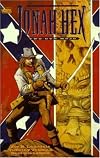
Revisiting my own collection, here's a beauty. Joe R Lansdale and Tim Truman on the scarred ex-Confederate Civil War veteran bounty hunter. Hex is one of those fought-for-my-land-not-for-slavery types one tends to look on with some skepticism nowadays, but there isn't much in the way of soft nostalgia for ol' Dixie in these pages. The whole thing is mean and ornery and wild and violent.
Two Gun Mojo sees Hex, after a run-in with a town-turned-lynch-mob, gunning after a travelling circus show more wagon run by the strange and horrible Doc Williams. Williams may or may not be reviving the dead in some sort of voodoo mojo, or he may be just giving people brain damage, either way he has his little gang of zombie slves, including someone who may or may not be Wild Bill Hickock, and Hex intends to put and end to him.
Lansdale and Truman make a terrific team, the dialogue is funny and the yarn is downright demented. show less
Two Gun Mojo sees Hex, after a run-in with a town-turned-lynch-mob, gunning after a travelling circus show more wagon run by the strange and horrible Doc Williams. Williams may or may not be reviving the dead in some sort of voodoo mojo, or he may be just giving people brain damage, either way he has his little gang of zombie slves, including someone who may or may not be Wild Bill Hickock, and Hex intends to put and end to him.
Lansdale and Truman make a terrific team, the dialogue is funny and the yarn is downright demented. show less

I can still recall my entry to comics reading as an adult. It began with the early issues of Grimjack from Chicago-based First Comics, written by John Ostrander, with art by Timothy Truman. That book got me excited about the comics medium in a way that traditional capes never could, and I really liked Truman's art. In the many years since, I've come to respect Truman's own talents as a writer, and I've been pleased with the work I've seen him do on the Dark Horse Conan books. Ironically, my show more affection for him as an artist has not been so durable. The Free Companions collection of issues 14 and 16 through 21 of the Conan the Cimmerian title does a fine job of showcasing Truman's writing, while his art suffers by comparison to the two other artists whose work is presented in the same volume: Joe Kubert and Tomas Giorello.
Kubert's distinctive style is well-suited to sword and sorcery, and his contribution is a frame-story for "Home for the Hunt": Kubert shows the court of Khoraja, while Truman's interior tale is a recollection of Conan's Cimmerian youth. The body of the book is the "Free Companions" novella, recounting Conan's early blunders in national politics. Truman's art is central here, but it is framed by a story in Giorello's images, which continues into the epilogue "Kozaki." There are also some full-page interstitial pieces by artists Cary Nord and Joseph Michael Linsner. Of all these artists, Giorello and Nord do the best job of capturing Conan and the Hyborian Age, as far as I'm concerned.
Truman's development of a continuous narrative to cover the activities of the still-young adventuring Conan invites comparison to the many such developed by pastiche writers since the 1950s. Truman does as well as any and better than most. His work as a comics scripter is doubtless informed by his experience as an artist, and he is adept at letting the pictures carry the bulk of the storytelling, while his dialogue is credible and dynamic, and his narrator's voice captures the feel of the Robert E. Howard original. show less
Kubert's distinctive style is well-suited to sword and sorcery, and his contribution is a frame-story for "Home for the Hunt": Kubert shows the court of Khoraja, while Truman's interior tale is a recollection of Conan's Cimmerian youth. The body of the book is the "Free Companions" novella, recounting Conan's early blunders in national politics. Truman's art is central here, but it is framed by a story in Giorello's images, which continues into the epilogue "Kozaki." There are also some full-page interstitial pieces by artists Cary Nord and Joseph Michael Linsner. Of all these artists, Giorello and Nord do the best job of capturing Conan and the Hyborian Age, as far as I'm concerned.
Truman's development of a continuous narrative to cover the activities of the still-young adventuring Conan invites comparison to the many such developed by pastiche writers since the 1950s. Truman does as well as any and better than most. His work as a comics scripter is doubtless informed by his experience as an artist, and he is adept at letting the pictures carry the bulk of the storytelling, while his dialogue is credible and dynamic, and his narrator's voice captures the feel of the Robert E. Howard original. show less
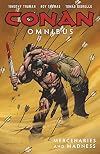
Normally, I really enjoy reading Conan. With this omnibus, I have mixed feelings.
On the positive side, the quality of the art is very good. A lot of detail goes into important images, he uses the page changes well and mixes the image formats on each page in a pleasing manner.
I also like the pacing. I find most comics paced too fast. The authors don’t make good use of timing or pacing.
The stories are decent, I wouldn’t rate them much above that. It’s moderately typical of Conan stories show more and they can become generic. These stories had a lot of the generic qualities.
On the negative side, I didn’t really feel like this is the same Conan as the Robert Howard stories. There is much more emphasis on the violence and his relationship to Crom is completely different. That doesn’t detract from the value of the story unless you are looking for a traditional Conan.
The other element that bothered me was a setting error. In a place where clocks are a rare wonder and, if I remember correctly, never appears in the original stories, Conan casually blurted out “I’ll be back in an hour or two.” Although minor to many, this really detracted from the setting for me. I doubt Conan has ever nor would ever have need nor understand mechanical time.
Overall, the book is a mild diversion, I can’t recommend it if you like the original Conan. show less
On the positive side, the quality of the art is very good. A lot of detail goes into important images, he uses the page changes well and mixes the image formats on each page in a pleasing manner.
I also like the pacing. I find most comics paced too fast. The authors don’t make good use of timing or pacing.
The stories are decent, I wouldn’t rate them much above that. It’s moderately typical of Conan stories show more and they can become generic. These stories had a lot of the generic qualities.
On the negative side, I didn’t really feel like this is the same Conan as the Robert Howard stories. There is much more emphasis on the violence and his relationship to Crom is completely different. That doesn’t detract from the value of the story unless you are looking for a traditional Conan.
The other element that bothered me was a setting error. In a place where clocks are a rare wonder and, if I remember correctly, never appears in the original stories, Conan casually blurted out “I’ll be back in an hour or two.” Although minor to many, this really detracted from the setting for me. I doubt Conan has ever nor would ever have need nor understand mechanical time.
Overall, the book is a mild diversion, I can’t recommend it if you like the original Conan. show less
Lists
Awards


You May Also Like


Associated Authors
Statistics
- Works
- 355
- Also by
- 33
- Members
- 3,349
- Popularity
- #7,626
- Rating
- 3.7
- Reviews
- 52
- ISBNs
- 187
- Languages
- 7
- Favorited
- 3