
Leo Baeck (1873–1956)
Author of The Essence of Judaism
About the Author
Leo Baeck was born in Lissa (now Leszno), Poland, in 1873, to a family of distinguished rabbis. He studied at the Conservative Jewish Theological Seminary of Breslau and then at the Hochschule fur die Wissenschaft des Judentums in Berlin. In 1905 he wrote The Essence of Judaism in response to The show more Essence of Christianity by Adolf von Harnack and to the general mood of Christian chauvinism and anti-Semitism. Baeck was the most prominent Jewish leader in Germany when the Nazis came to power in 1933. He remained as the outspoken leader of the Berlin Jewish community until he was deported to the Theresienstadt concentration camp in 1943. After the war, he became the chair of the World Union of Progressive Judaism in London and occasionally taught at the Reform Seminary in Cincinnati. (Bowker Author Biography) show less
Works by Leo Baeck
Changes in Jewish Outlook 2 copies
God and Man in Judaism 1 copy
Judendomens kärna 1 copy
Das Evangelium 1 copy
Leo Baeck: Werke / 5: Nach der Schoa - warum sind Juden in der Welt? Schriften aus der Nachkriegszeit (2002) 1 copy
God and Man in Judaism 1 copy
Associated Works
Wrestling with Zion: Progressive Jewish-American Responses to the Israeli-Palestinian Conflict (2003) — Contributor — 84 copies, 1 review
Tagged
Common Knowledge
- Canonical name
- Baeck, Leo
- Legal name
- Baeck, Leo
- Birthdate
- 1873-05-23
- Date of death
- 1956-11-02
- Gender
- male
- Education
- Hochschule für die Wissenschaft des Judentums, Berlin, Germany
- Occupations
- rabbi
scholar
philosopher
Holocaust survivor
author - Relationships
- Dilthey, Wilhelm (teacher)
Jonas, Regina (colleague) - Short biography
- Leo Baeck was born to a large Jewish family in Lissa, in the German Province of Posen (present-day Leszno, Poland). His parents were Eva (Placzek) and Rabbi Samuel Baeck and he had 10 siblings. After completing his traditional Jewish education, in 1894 Leo moved to Breslau (present-day Wrocław, Poland) to enroll at the Jewish Theological Seminary there. He also studied philosophy there and subsequently with Wilhelm Dilthey at the University of Berlin. In Berlin, he also studied at the Reform-oriented Higher Institute for Jewish Studies (Hochschule für die Wissenschaft des Judentums), where he received his rabbinic diploma in 1897. He served as a rabbi in Oppeln (now Opole), Düsseldorf, and Berlin. In 1905, Rabbi Baeck published The Essence of Judaism, which made him famous, and he became the most prominent Jewish leader in Germany. During World War I, Rabbi Baeck served as a chaplain in the German Imperial Army on both the eastern and western fronts. In 1933, after the Nazi regime took power, Rabbi Baeck refused all offers of escape. He was elected founding president of the Representative Council of German Jews, and worked tirelessly to provide social services to the Jewish community. In January 1943, he was arrested and deported to the Nazi concentration camp at Terezín (Theresienstadt) in Czechoslovakia. There he was put to hard labor; all four of his sisters all died in the camp. Rabbi Baeck was appointed honorary head of the Jewish Council of Elders (Ältestenrat) in Terezín. He gave talks from memory on classic works of Western philosophy, was active in interfaith dialogue, and worked in youth care. Although he received word of the fate awaiting Jews in the Nazi death camps, he made the decision — criticized after the war — not to share this knowledge with the other prisoners. After Terezín was liberated at the end of World War II, Baeck remained for a while to minister to the sick and dying. He then moved to London, where he accepted the presidency of the North Western Reform Synagogue. He taught periodically at Hebrew Union College in Cincinnati, Ohio. Eventually, he became chairman of the World Union for Progressive Judaism. In 1955, he published his second major work, This People Israel: The Meaning of Jewish Existence, which he had partially written while at Terezín. That same year, the Leo Baeck Institute was founded by leading German-Jewish émigré intellectuals, including Martin Buber, Max Grunewald, Hannah Arendt, and Robert Weltsch, to preserve the history and culture of German-speaking Jews that was nearly destroyed in the Holocaust. Rabbi Baeck became its first international president. The Institute now includes branches around the world including the Leo Baeck Institute of New York City, and the Leo Baeck Institute of London. The Leo Baeck Medal, created in his memory in 1978, is awarded each year by the Leo Baeck Institute NYC.
- Nationality
- Germany (birth)
- Birthplace
- Lissa, Province of Posen, Germany
- Places of residence
- Theresienstadt concentration camp
- Place of death
- London, England, UK
- Burial location
- Weissensee Jewish Cemetery , Berlin, Germany
- Associated Place (for map)
- Germany
Members
Reviews

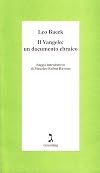
In questo saggio, pubblicato nel 1938, in piena dittatura hitleriana, Leo Baeck si pone un doppio obiettivo: reinserire i Vangeli nel loro contesto originale ebraico e rivendicare per le parole e le gesta di Gesù la loro reale fonte: l'autentica Tradizione ebraica. Baeck sostiene che l'insegnamento di Gesù, prendendo come base i Vangeli originali, non conteneva alcuna messa in discussione fondamentale dell'ebraismo, ma che fu soprattutto Paolo il responsabile della deriva antiebraica della show more Chiesa primitiva, colui che incarnò lo spirito pagano al punto da far trionfare il pagano-cristianesimo sul giudeo-cristianesimo. Leggendo questo libro, si ha come l'impressione che Baeck amasse il cristianesimo originale perché era ricco di nuove prospettive e si poneva come il crogiolo di un rinnovamento e non come un salto nell'ignoto. Il saggio è preceduto da un'ampia introduzione di Maurice-Ruben Hayoun che inquadra tutta l'opera di Leo Baeck nel contesto del pensiero ebraico-tedesco. (fonte: retro di copertina) show less
Nov 15, 2022 (Edited)Italian
You May Also Like


Associated Authors
Statistics
- Works
- 31
- Also by
- 2
- Members
- 572
- Popularity
- #43,782
- Rating
- 3.9
- Reviews
- 2
- ISBNs
- 24
- Languages
- 6
- Favorited
- 2
