
Allen Buchanan
Author of From Chance to Choice: Genetics and Justice
About the Author
Allen Buchanan is the author of eleven books on bioethics and political philosophy. He has served on the Advisory Council for the National Human Genome Research Institute, Staff Philosopher for the President's Commission on Medical Ethics, and as consultant to President Barack Obama's Presidential show more Commission for the Study of Bioethical Issues. show less
Works by Allen Buchanan
Justice, Legitimacy, and Self-Determination: Moral Foundations for International Law (2004) 32 copies, 1 review
Deciding for Others: The Ethics of Surrogate Decision Making (Studies in Philosophy and Health Policy) (1990) 31 copies, 2 reviews
Secession: The Morality Of Political Divorce From Fort Sumter To Lithuania And Quebec (1991) 23 copies
Associated Works
Tagged
Common Knowledge
- Birthdate
- 1948
- Gender
- male
- Education
- University of North Carolina, Chapel Hill (Ph.D., Philosophy)
- Organizations
- Professor of Philosophy and Public Policy, Duke University
Members
Reviews
Better than Human: The Promise and Perils of Enhancing Ourselves (Philosophy in Action) by Allen Buchanan

Better Than Human is a slim philosophical volume that lays out Buchanan's positions in favor of human enhancement, and particularly against the arguments of Michael Sandel (next on my reading list). Buchanan takes the line that future biotechnological enhancements to humanity, such as genetic enhancement, expansion of emotional and cognitive capacities by drugs, and cybernetic implants, is not qualitatively different than the traditional ways that humans have enhanced themselves and their show more environment through technologies like literature and agriculture. This statement is grounding in an idea of evolution as blind and clumsy, and human beings as resilient. There are many areas where evolution has produced "good enough" adaptations, because genotypes are trapped on local peaks of fitness, and any harms that occur after reproduction are not sorted against. The rapid cultural evolution of humans (10,000 years of agriculture, 150 years of industrialization, and now post-industrialism) means that our genetic heritage may not yet be able to reach capabilities within reach of some humans, but out of reach of the species as a whole.
Buchanan takes particular ire at the bad arguments of bioconservatives (Kass, Fukuyama, Sandel), in particular for a weak understanding of the facts of evolution and biology, for assuming that an eternal "human nature" exactly matches early 21st century Republican positions on the family and bioethics, and for raising issues of concern that do not rise to the level of a persuasive argument. Buchanan acknowledges that no development is risk free, but that a conscious choice to engage with the complexities of enhancement technologies and their public risks and benefits is likelier to produce positive outcomes than the existing system, which allows access only through the creation of new diseases, and may be most aggressively pursued by countries with weak ethical governance regimes.
In full candor, I'm personally aligned with Buchanan's position. I agree with his counter to the bioconservatives, but I'm not sure that his version of evolution and the "good" of enhancing human capacities is any less of a "just-so" story than what he argues against. show less
Buchanan takes particular ire at the bad arguments of bioconservatives (Kass, Fukuyama, Sandel), in particular for a weak understanding of the facts of evolution and biology, for assuming that an eternal "human nature" exactly matches early 21st century Republican positions on the family and bioethics, and for raising issues of concern that do not rise to the level of a persuasive argument. Buchanan acknowledges that no development is risk free, but that a conscious choice to engage with the complexities of enhancement technologies and their public risks and benefits is likelier to produce positive outcomes than the existing system, which allows access only through the creation of new diseases, and may be most aggressively pursued by countries with weak ethical governance regimes.
In full candor, I'm personally aligned with Buchanan's position. I agree with his counter to the bioconservatives, but I'm not sure that his version of evolution and the "good" of enhancing human capacities is any less of a "just-so" story than what he argues against. show less
Beyond Humanity?: The Ethics of Biomedical Enhancement (Uehiro Series in Practical Ethics) by Allen E. Buchanan

Buchanan intends this book as a philosophical counter to the typical anti-enhancement tomes, Fukuyama's "Our Posthuman Future" and the Leon Kass-chaired President's Council on Bioethics report. He rigorously dismantles the bioconservative arguments, blowing their models of human nature, evolutionary biology, and the motives of potential transhumans apart. This book would make an admirable companion to one of these texts in an upper-level bioethics class on enhancement.
Where this book is less show more effective is in advancing a positive rational for human enhancement, beyond a vague notion of "correcting nature's error", or noting that human beings, the environment, and technology have been continually interacting and evolving. Indeed, Buchanan sidesteps entirely one of the most critical issues in human enhancement: how enhancement research might be done without violating human subject research codes, including the Helsinki declaration, which explicitly bans non-curative research.
The last chapter, on ameliorating the distributive justice effects innovation through a Global Institute for Justice and Innovation modeled on the World Trade Organization is so detached from the realities of poverty and technological power as to be laughable. The 'bottom billion' isn't poor because of a lack of technology; it's a lack of governance and maintenance of well-understood technologies, and an inability to compete with the first world on a global commodity market, for example in oil. The GIJI is a nice utopian ideal, but has no bearing on how technologies actually embody power: Robert Moses' bridges, or software end-use license agreements, for example.
Laying out and demolishing the anti-enhancement claim from a philosophically rigorous position is a useful good, but this book provides relatively little guidance on what it might be like to be an ethical transhuman, or how we as a civilization might get to that point. show less
Where this book is less show more effective is in advancing a positive rational for human enhancement, beyond a vague notion of "correcting nature's error", or noting that human beings, the environment, and technology have been continually interacting and evolving. Indeed, Buchanan sidesteps entirely one of the most critical issues in human enhancement: how enhancement research might be done without violating human subject research codes, including the Helsinki declaration, which explicitly bans non-curative research.
The last chapter, on ameliorating the distributive justice effects innovation through a Global Institute for Justice and Innovation modeled on the World Trade Organization is so detached from the realities of poverty and technological power as to be laughable. The 'bottom billion' isn't poor because of a lack of technology; it's a lack of governance and maintenance of well-understood technologies, and an inability to compete with the first world on a global commodity market, for example in oil. The GIJI is a nice utopian ideal, but has no bearing on how technologies actually embody power: Robert Moses' bridges, or software end-use license agreements, for example.
Laying out and demolishing the anti-enhancement claim from a philosophically rigorous position is a useful good, but this book provides relatively little guidance on what it might be like to be an ethical transhuman, or how we as a civilization might get to that point. show less
Justice, Legitimacy, and Self-Determination: Moral Foundations for International Law (Oxford Political Theory) by Allen Buchanan

This is a fascinating moral argument for reforming international law, especially on matters of secession and autonomy. The author argues that states must be instruments of justice. Insofar as states fail to meet this duty, they should become liable to international intervention by (a league of) rights-respecting states. Nations or peoples oppressed by unjust states should be permitted to secede under certain conditions. Parts two and three of the book provide extended specifications and show more qualifications for these theses. International relations have not been discussed much in political philosophy, so as far as I know the author really breaks new ground on many fronts. The moral challenges he presents to established pre-conceptions about "national interests", "self-determination" and current international law should be read by everyone involved or interested in international affairs.
I do wonder how many readers will persevere to the second half of the book, where the real argument begins, because the author is regrettably slow in getting to the point. At just over 70 pages, the introductory chapters are much longer than they need to be. The ensuing Part One: Justice contains another 160 pages of painstaking interpretations of earlier moral theory, particularly John Rawls' works. I think these discussions are a bit out of place in this work. A far simpler conception of justice would clearly have sufficed for the main arguments concerning international law. In fact a prospective reader could easily start reading this book exactly at the halfway point, at the beginning of Part Two, and immediately be up to speed on the main argument. show less
I do wonder how many readers will persevere to the second half of the book, where the real argument begins, because the author is regrettably slow in getting to the point. At just over 70 pages, the introductory chapters are much longer than they need to be. The ensuing Part One: Justice contains another 160 pages of painstaking interpretations of earlier moral theory, particularly John Rawls' works. I think these discussions are a bit out of place in this work. A far simpler conception of justice would clearly have sufficed for the main arguments concerning international law. In fact a prospective reader could easily start reading this book exactly at the halfway point, at the beginning of Part Two, and immediately be up to speed on the main argument. show less
Better than Human: The Promise and Perils of Biomedical Enhancement (Philosophy in Action) by Allen Buchanan
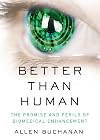
This was a fascinating read regarding that particularly touched on the issue of performance enhancing drugs. The perspective that this offered was equivocal and meaningful. I felt this was a good read, but it was not perfect. There was brevity in it, almost too short for comfort, and it lacked the poignancy that I expected from a book detailing these types of matters. Nonetheless, a good read.
You May Also Like


Associated Authors
Statistics
- Works
- 24
- Also by
- 1
- Members
- 397
- Popularity
- #61,077
- Rating
- 3.7
- Reviews
- 10
- ISBNs
- 66
- Languages
- 2