
Charles Kenny (1)
Author of The Plague Cycle: The Unending War Between Humanity and Infectious Disease
For other authors named Charles Kenny, see the disambiguation page.
About the Author
Charles Kenny is a senior fellow at the Center for Global Development; a former senior economist at the World Bank; the author of two previous books about human progress, Getting Better and The Upside of Down; and a contributor to such publications as the Wall Street Journal, Time, The Atlantic, show more The Economist, and Foreign Policy. He has taught at the Johns Hopkins School of Advanced International Studies and has a PhD in development studies from the University of Cambridge. show less
Works by Charles Kenny
The Plague Cycle: The Unending War Between Humanity and Infectious Disease (2021) 122 copies, 2 reviews
Getting Better: Why Global Development Is Succeeding--And How We Can Improve the World Even More (2011) 70 copies, 2 reviews
Life, Liberty, and the Pursuit of Utility: Happiness in Philosophical and Economic Thought (St. Andrews Studies in Philo (2006) — Editor — 14 copies
Tagged
Common Knowledge
- Gender
- male
- Occupations
- economist
- Nationality
- USA
- Places of residence
- Washington, D.C., USA
- Associated Place (for map)
- D.C., USA
Members
Reviews
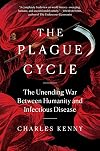
The Plague Cycle: The Unending War Between Humanity and Infectious Disease by Charles Kenny is a highly recommended overview of the history of infectious diseases with some discussion of them in light of the Covid-19 pandemic.
The good news is that recent history suggests "humanity’s response to the new threat can be rapid and effective if we so choose. And that reassures us that humanity in the twenty-first century is in a considerably better position in the fight against infection than show more earlier generations. Because for most of humanity’s time on the planet, effective responses never came." For most of history plagues and diseases were the leading cause of death. Today it is heart attacks and strokes.
As Kenny points out, humanity is very resilient even in the face of even the most incredible stress created by large scale epidemics, pandemics and plague outbreaks. People lived through numerous epidemics over the years- the Black Death, typhus, measles, small pox, without resorting to social chaos and throwing morality aside. Agriculture and civilization set off a global firestorm of disease, especially once urbanization started. Before we started taking sanitary practices seriously, the only effective way to exposure to diseases was to quarantine the sick or refuse their entry to your area. Then, once we understood hygiene, it became possible to have more urbanization, which was further helped by medical advancements (sterilized medical treatment, antibiotics, vaccinations, etc.) and the understanding of how to combat infectious diseases.
As our world is becoming more globally connected, it is now more important to address our vulnerabilities to new emerging infectious diseases and potential plagues. For example, we need to address the overuse of antibiotics which has led to a strains of antibiotic-resistant bacteria. The global reaction to Covid-19 showcases the need for international cooperation on several different areas.
As someone who has read many books of various infectious diseases, plagues, and epidemics it should be noted that this is not meant to be a complex or complete history of infectious diseases. It is a nice overview for the general reader who wants more information on the subject and the text flows smoothly from one chapter to the next. It is a well-rounded overview written for the lay person. For more information, Kenny has a bibliography of his sources or look at the notes included in the text for subjects you might want to pursue further. Kenny is the director of technology and development at the Center for Global Development.
Disclosure: My review copy was courtesy of Scribner.
http://www.shetreadssoftly.com/2021/01/the-plague-cycle.html
https://www.goodreads.com/review/show/3752979795 show less
The good news is that recent history suggests "humanity’s response to the new threat can be rapid and effective if we so choose. And that reassures us that humanity in the twenty-first century is in a considerably better position in the fight against infection than show more earlier generations. Because for most of humanity’s time on the planet, effective responses never came." For most of history plagues and diseases were the leading cause of death. Today it is heart attacks and strokes.
As Kenny points out, humanity is very resilient even in the face of even the most incredible stress created by large scale epidemics, pandemics and plague outbreaks. People lived through numerous epidemics over the years- the Black Death, typhus, measles, small pox, without resorting to social chaos and throwing morality aside. Agriculture and civilization set off a global firestorm of disease, especially once urbanization started. Before we started taking sanitary practices seriously, the only effective way to exposure to diseases was to quarantine the sick or refuse their entry to your area. Then, once we understood hygiene, it became possible to have more urbanization, which was further helped by medical advancements (sterilized medical treatment, antibiotics, vaccinations, etc.) and the understanding of how to combat infectious diseases.
As our world is becoming more globally connected, it is now more important to address our vulnerabilities to new emerging infectious diseases and potential plagues. For example, we need to address the overuse of antibiotics which has led to a strains of antibiotic-resistant bacteria. The global reaction to Covid-19 showcases the need for international cooperation on several different areas.
As someone who has read many books of various infectious diseases, plagues, and epidemics it should be noted that this is not meant to be a complex or complete history of infectious diseases. It is a nice overview for the general reader who wants more information on the subject and the text flows smoothly from one chapter to the next. It is a well-rounded overview written for the lay person. For more information, Kenny has a bibliography of his sources or look at the notes included in the text for subjects you might want to pursue further. Kenny is the director of technology and development at the Center for Global Development.
Disclosure: My review copy was courtesy of Scribner.
http://www.shetreadssoftly.com/2021/01/the-plague-cycle.html
https://www.goodreads.com/review/show/3752979795 show less
Well sourced, and an excellent overview, giving the whole the topic of infectious diseases and healthcare infrastructure throughout human history. As a thorough international social policy statement, it's brilliant. If, say, you're a newly elected politician who needs to come up to speed on the whole thing quickly, this is your book. Or if you're curious now, but you’re unlikely to read more than one book on plagues in general. Not recommended so much if you're already well up on the show more historic details of different diseases or on the medical industrial complex in the US or on healthcare and the history of NGOs in lower-income nations, although it is still a good synthesis.
Read for Plagues and Diseases
Library copy show less
Read for Plagues and Diseases
Library copy show less
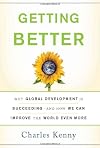
Getting Better: Why Global Development is Succeeding - and How We Can Improve the World Even More by Charles Kenny
04 February 2023
Five chapters in I became distracted by other books: all the requests at once. Kenny makes a strong case, and I find his research encouraging, but realistically I am unlikely to pick it back up. It's nice to know development works, and where it's most effective. Wouldn't it be cool if development were actually given out in an evidence-based way?
Library copy
Five chapters in I became distracted by other books: all the requests at once. Kenny makes a strong case, and I find his research encouraging, but realistically I am unlikely to pick it back up. It's nice to know development works, and where it's most effective. Wouldn't it be cool if development were actually given out in an evidence-based way?
Library copy
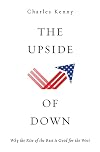
Well written, a clear argument about mutual benefits, gains from trade, and a warning about some counterproductive policies. A reasonable summary of a broad literature but not much addition to it.
You May Also Like


Statistics
- Works
- 8
- Members
- 242
- Popularity
- #93,892
- Rating
- 4.1
- Reviews
- 5
- ISBNs
- 31
- Languages
- 3