
Seth Godin
Author of Tribes: We Need You to Lead Us
About the Author
Bestselling business book author, entrepreneur, and speaker Seth Godin was born on July 10, 1960. He graduated from Tufts University in 1982 and earned an MBA in marketing from Stanford Business School. Godin worked as a brand manager for Spinnaker Software and founded his own book packaging show more business, followed by the online marketing company Yoyodyne. He was a vice president of direct marketing for Yahoo, and in 2006 he launched the popular community website Squidoo. (Bowker Author Biography) show less
Disambiguation Notice:
In the late 1980's, Godin was a book packager and developed numerous books with ghost writers under series names such as "If You're Clueless About...", "Show Me" language books, and a "Worlds of Power" series for children, as well as one-off books like "The Smiley Dictionary."
Series
Works by Seth Godin
The Dip: A Little Book That Teaches You When to Quit (and When to Stick) (2007) 1,648 copies, 49 reviews
All Marketers Are Liars: The Power of Telling Authentic Stories in a Low-Trust World (2005) 943 copies, 10 reviews
Permission Marketing : Turning Strangers Into Friends And Friends Into Customers (1999) 862 copies, 11 reviews
Small Is the New Big: and 183 Other Riffs, Rants, and Remarkable Business Ideas (2006) 572 copies, 8 reviews
Survival Is Not Enough: Zooming, Evolution, and the Future of Your Company (2002) 166 copies, 5 reviews
Tales of the Revolution: True Stories of People who are Poking the Box and Making a Difference (2011) 119 copies, 5 reviews
The Bootstrapper's Bible: How to Start and Build a Business With a Great Idea and (Almost) No Money (1998) 98 copies, 3 reviews
Wisdom, Inc. : 26 Business Virtues That Turn Ordinary People into Extraordinary Leaders (1995) 40 copies
This Is Strategy: Make Better Plans (Create a Strategy to Elevate Your Career, Community & Life) 34 copies, 1 review
The Encyclopedia of Fictional People: The Most Important Characters of the 20th Century (1996) — Editor — 32 copies
Quick Lit: Plots, themes, characters, amd sample essays for the most assigned books in Engl (1992) — Editor — 21 copies
The 1995 Information Please(R) Women's Sourcebook (Information Please Women's Sourcebook) (1994) 10 copies
Who's There 5 copies
A vaca roxa. Como transformar o seu negocio e se destacar dos concorrentes (Em Portugues do Brasil) (2019) 4 copies
Knock Knock 2 copies
¡Hazlo! 2 copies
Insubordinate 2 copies
NEW-Purple Cow 2 copies
I piccoli saranno i primi 1 copy
Che pasticcio di marketing! 1 copy
Nõusolekuturundus 1 copy
The Joy of Squidoo — Author — 1 copy
Placebos 1 copy
French Hours 1 copy
The Power of Small Steps 1 copy
What Should Google Do 1 copy
Making Money on the Web 1 copy
Thought Leaders: How to capture, package and deliver your ideas for greater commercial success 1 copy
The Tribes We Lead 1 copy
Focus: A Ship It Journal 1 copy
Moč virusne ideje 1 copy
Toti suntem ciudati 1 copy
Startup School 1 copy
Associated Works
The Big Moo: Stop Trying to Be Perfect and Start Being Remarkable (2005) — Contributor — 431 copies, 7 reviews
Word of Mouth Marketing: How Smart Companies Get People Talking (2006) — Foreword — 234 copies, 2 reviews
Fail, Fail Again, Fail Better: Wise Advice for Leaning into the Unknown (2015) — Foreword — 177 copies, 8 reviews
Why CRM Doesn't Work: How to Win by Letting Customers Manage the Relationship (2003) — Foreword — 25 copies
1,001 Ways to Keep Customers Coming Back: WOW Ideas That Make Customers Happy and Will Increase Your Bottom Line (1999) — Foreword — 14 copies
Tagged
Common Knowledge
- Canonical name
- Godin, Seth
- Legal name
- Godin, Seth W.
- Other names
- F. X. Nine
- Birthdate
- 1960-07-10
- Gender
- male
- Education
- Tufts University (Computer Science ∙ Philosophy)
Stanford Business School (MBA|1984 ∙ Marketing) - Occupations
- business executive
author - Organizations
- Squidoo
Yahoo!
Yoyodyne
Seth Godin Productions
Spinnaker - Relationships
- Godin, Helene (wife)
- Nationality
- USA
- Birthplace
- Mount Vernon, New York, USA
- Places of residence
- Hastings-on-Hudson, New York, USA
New York, New York, USA - Disambiguation notice
- In the late 1980's, Godin was a book packager and developed numerous books with ghost writers under series names such as "If You're Clueless About...", "Show Me" language books, and a "Worlds of Power" series for children, as well as one-off books like "The Smiley Dictionary."
- Associated Place (for map)
- New York, USA
Members
Reviews
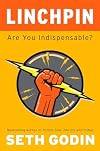
Whenever we went to the McDonald's near my college campus, it was like dining at a five-star restaurant. At this particular Mickey D's, every single customer was greeted by the most cheerful and friendliest guy I have ever encountered. He held the door open, asked you about your day, stopped by your booth to see how your Big Mac was, and engaged you in some witty repartee.
People loved this guy. The Husband and I certainly did. Its been 20 years since I last laid eyes on the guy and while I show more can't remember his name (if indeed I ever knew it to begin with), I think of him every single time I walk into a McDonald's. Any McDonald's. It's like I expect him to be there because he has made an indelible impression on my mind. I've connected him with that experience so strongly that he has come to be part of what I associate with the McDonald's brand, even two decades and two kids later.
Seth Godin would know the name of this guy.
Linchpin.
In his latest book, Godin writes about the qualities and characteristics of linchpins - those people in every organization who are the go-to people, who are the ones who seem essential and indispensable, who don't know the meaning of the phrase "not my job."
"There used to be two teams in every workplace: management and labor. Now there's a third team, the linchpins. These people invent, lead (regardless of title), connect others, make things happen, and create order out of chaos. They figure out what to do when there's no rule book. They delight and challenge their customers and peers. They love their work, pour their best selves into it, and turn each day into a kind of art." (from the book jacket)
Godin's view is that as managers, we have the ability (and some might say the responsibility) to develop linchpins among our employees. But more importantly, as employees we have the ability to develop linchpin characteristics within ourselves.
This is becoming more essential in order to survive in the workplace because the days of being a cog in the wheel are over. Back in the day, we bought into a mentality of work where, in exchange for doing what we were told and what was expected of us without any resistance, we were rewarded - with a paycheck, with health insurance, with job security, with the gold watch upon retirement.
As we all know, those days have disappeared - taking with it our paychecks, our health insurance, our security, our gold watches - but that "factory" mindset still persists. ("Factory" being a term for workplaces and organizations of any type, not just assembly-line style processing plants.) According to Godin, one of the only ways to survive this new world of work is by becoming a linchpin. After all, think about the people who usually survive the layoffs, get the bonuses and the perks others don't. They are people considered to be essential to the organization or the brand. They're indispensable. (Not irreplaceable. Indispensable. There's a difference.)
Linchpins produce art, says Godin. Not art in the Michaelangelo sense, but art as it relates to our work. Delivering (or "shipping") three grant proposals in one day, as I did on Monday. It needs to be consistent and often.
And, we need to give our art away, as a gift. Kind of like we do here on our blogs. There are so many stories (like the one about the McDonald's guy, like the one I'm about to tell you about my Uncle Warren) that I could keep to myself or perhaps store up so that they become fodder for some of my writing, work that someone, somewhere might pay a couple pennies for. And maybe it will, but in the meantime, giving it to you as a gift makes me feel good. I like that my posts are being read, enjoyed, retweeted. It's a gift to recommend a great book that I loved. In doing so, those of us who do this - often - are becoming the linchpins to readers. This is what Ron Hogan was talking about at the Book Blogger Convention when he referenced Linchpin in his talk.
When we start giving gifts, we become identified as a person who gives freely of him or herself. People who give gifts do so often (Godin says that you have to) and people gravitate to that person, making him/her a linchpin.
My grandfather's family did this constantly. They were the ones who were always at church, usually fixing something like the heater or volunteering on some committee. I spent many a Saturday of a my life reading or writing in an empty Sunday School classroom while my Dad checked on some plumbing issue or did some other sort of maintenance job at our church. At my Uncle Warren's funeral (which was a packed house and - I swear, standing room only - and the man was pushing 90) they told a story about how they found him climbing on the newly repaired church roof "just checking on whether the contractor did things correctly."
(Uncle Warren was known for giving gifts. He'd shake your hand or embrace you, and you'd look down in your palm and there was a peppermint candy. He was so subtle, so quick, that you didn't even feel the peppermint being offered. If you didn't like peppermints, he would have your favorite candy the next time he saw you. For every single person he met, there was always a piece of candy ... even at the foot of his open casket, where a basket of peppermints was there for the taking.)
Think about it. These are really not unique concepts: be good with people, connect with them in a memorable and unique and powerful way, provide joy, don't be a cog in the wheel, do great work and do it often, deliver the unexpected and give people something unexpected for free. We've heard much of this before and Godin admits just as much. The reason it hasn't stuck is because our brains (the "lizard brain") have resisted this new way of thinking. We're scared stiff that we'll lose our jobs if we take a risk, try something new, speak up in meetings. We think that we don't have the authority to be bold, yet the irony is that our bosses want these sorts of qualities. They hire for these sorts of intrinsic qualities because it is almost impossible to teach them. In some ways, I think, you've either got it or you don't. And those who have are going to be the ones leading us out of this gawd-forsaken economy we're in.
I'm a fan of Godin's. I've been one for quite some time now, primarily through Seth's blog. He has the ability to take the whole concept of marketing and other communication (whether it is in the workplace or personally or whatever) and explains it in such a way that makes sense for the average person. Linchpin is a little bit of a departure from that while still being written in the straightforward, no-nonsense style. Each chapter is divided into short, blog-post like subheadings.
Seth Godin has been getting a lot of press lately - good and bad - for his decision to make Linchpin the last book he publishes via a traditional publisher. Personally, I don't care whether Godin publishes his next book traditionally, exclusively on an e-reader, via subscription on his blog, or by scrawling on papers delivered piecemeal by carrier pigeon. Just as long as the man keeps writing stuff like this - as well as his previous books (they were darn good, too) - then however he thinks is the best way to get them into my hands or my eyes to the screen, it doesn't matter. I mean, who the hell am I to tell him what to do or how he should do it.
Instead I say good for him. After all, that's exactly what being a linchpin is all about. show less
People loved this guy. The Husband and I certainly did. Its been 20 years since I last laid eyes on the guy and while I show more can't remember his name (if indeed I ever knew it to begin with), I think of him every single time I walk into a McDonald's. Any McDonald's. It's like I expect him to be there because he has made an indelible impression on my mind. I've connected him with that experience so strongly that he has come to be part of what I associate with the McDonald's brand, even two decades and two kids later.
Seth Godin would know the name of this guy.
Linchpin.
In his latest book, Godin writes about the qualities and characteristics of linchpins - those people in every organization who are the go-to people, who are the ones who seem essential and indispensable, who don't know the meaning of the phrase "not my job."
"There used to be two teams in every workplace: management and labor. Now there's a third team, the linchpins. These people invent, lead (regardless of title), connect others, make things happen, and create order out of chaos. They figure out what to do when there's no rule book. They delight and challenge their customers and peers. They love their work, pour their best selves into it, and turn each day into a kind of art." (from the book jacket)
Godin's view is that as managers, we have the ability (and some might say the responsibility) to develop linchpins among our employees. But more importantly, as employees we have the ability to develop linchpin characteristics within ourselves.
This is becoming more essential in order to survive in the workplace because the days of being a cog in the wheel are over. Back in the day, we bought into a mentality of work where, in exchange for doing what we were told and what was expected of us without any resistance, we were rewarded - with a paycheck, with health insurance, with job security, with the gold watch upon retirement.
As we all know, those days have disappeared - taking with it our paychecks, our health insurance, our security, our gold watches - but that "factory" mindset still persists. ("Factory" being a term for workplaces and organizations of any type, not just assembly-line style processing plants.) According to Godin, one of the only ways to survive this new world of work is by becoming a linchpin. After all, think about the people who usually survive the layoffs, get the bonuses and the perks others don't. They are people considered to be essential to the organization or the brand. They're indispensable. (Not irreplaceable. Indispensable. There's a difference.)
Linchpins produce art, says Godin. Not art in the Michaelangelo sense, but art as it relates to our work. Delivering (or "shipping") three grant proposals in one day, as I did on Monday. It needs to be consistent and often.
And, we need to give our art away, as a gift. Kind of like we do here on our blogs. There are so many stories (like the one about the McDonald's guy, like the one I'm about to tell you about my Uncle Warren) that I could keep to myself or perhaps store up so that they become fodder for some of my writing, work that someone, somewhere might pay a couple pennies for. And maybe it will, but in the meantime, giving it to you as a gift makes me feel good. I like that my posts are being read, enjoyed, retweeted. It's a gift to recommend a great book that I loved. In doing so, those of us who do this - often - are becoming the linchpins to readers. This is what Ron Hogan was talking about at the Book Blogger Convention when he referenced Linchpin in his talk.
When we start giving gifts, we become identified as a person who gives freely of him or herself. People who give gifts do so often (Godin says that you have to) and people gravitate to that person, making him/her a linchpin.
My grandfather's family did this constantly. They were the ones who were always at church, usually fixing something like the heater or volunteering on some committee. I spent many a Saturday of a my life reading or writing in an empty Sunday School classroom while my Dad checked on some plumbing issue or did some other sort of maintenance job at our church. At my Uncle Warren's funeral (which was a packed house and - I swear, standing room only - and the man was pushing 90) they told a story about how they found him climbing on the newly repaired church roof "just checking on whether the contractor did things correctly."
(Uncle Warren was known for giving gifts. He'd shake your hand or embrace you, and you'd look down in your palm and there was a peppermint candy. He was so subtle, so quick, that you didn't even feel the peppermint being offered. If you didn't like peppermints, he would have your favorite candy the next time he saw you. For every single person he met, there was always a piece of candy ... even at the foot of his open casket, where a basket of peppermints was there for the taking.)
Think about it. These are really not unique concepts: be good with people, connect with them in a memorable and unique and powerful way, provide joy, don't be a cog in the wheel, do great work and do it often, deliver the unexpected and give people something unexpected for free. We've heard much of this before and Godin admits just as much. The reason it hasn't stuck is because our brains (the "lizard brain") have resisted this new way of thinking. We're scared stiff that we'll lose our jobs if we take a risk, try something new, speak up in meetings. We think that we don't have the authority to be bold, yet the irony is that our bosses want these sorts of qualities. They hire for these sorts of intrinsic qualities because it is almost impossible to teach them. In some ways, I think, you've either got it or you don't. And those who have are going to be the ones leading us out of this gawd-forsaken economy we're in.
I'm a fan of Godin's. I've been one for quite some time now, primarily through Seth's blog. He has the ability to take the whole concept of marketing and other communication (whether it is in the workplace or personally or whatever) and explains it in such a way that makes sense for the average person. Linchpin is a little bit of a departure from that while still being written in the straightforward, no-nonsense style. Each chapter is divided into short, blog-post like subheadings.
Seth Godin has been getting a lot of press lately - good and bad - for his decision to make Linchpin the last book he publishes via a traditional publisher. Personally, I don't care whether Godin publishes his next book traditionally, exclusively on an e-reader, via subscription on his blog, or by scrawling on papers delivered piecemeal by carrier pigeon. Just as long as the man keeps writing stuff like this - as well as his previous books (they were darn good, too) - then however he thinks is the best way to get them into my hands or my eyes to the screen, it doesn't matter. I mean, who the hell am I to tell him what to do or how he should do it.
Instead I say good for him. After all, that's exactly what being a linchpin is all about. show less
This is a powerful little volume that contains within it ideas with the power to better our planet and the quality of life of its inhabitants. By moving away from the industrial capitalism course that has held over a centuries' worth of employees in its thrall, and instead focusing on endowing employees with significance and the creative space and ability to better themselves, their team, their product and their customers; we advance past the generations of workers trained as automatons show more striving only for existence, if they are lucky.
This compact and worthy little volume should be part of the business library of anyone in business, particularly those who want to be leaders, managers, or part of a team. Anyone who would like to break out of the daily grind and see a way forward, filled with positivity, in fact. Corporate managers and leaders should have this on their desk, no further than an arm's reach away.
It was so refreshing to read this book and see suggestions and steps that could lead to a positive outcome for employees and businesses alike. Particularly in the current state of our country and the world at large; which is overwhelmingly depressing. Only by profound change in many aspects of life will the world and its inhabitants be able to move forward, and one of those profound changes will be the ability to work and live together in unity. This book addresses one of those profound changes in a very emphatic way.
I have not read the author's previous books and didn't know what to expect. I'm grateful to have received The Song of Significance through Goodreads Giveaways and had the opportunity to read this profound book. As I mentioned, I really needed some positivity and hope and this volume contains that in abundance. show less
This compact and worthy little volume should be part of the business library of anyone in business, particularly those who want to be leaders, managers, or part of a team. Anyone who would like to break out of the daily grind and see a way forward, filled with positivity, in fact. Corporate managers and leaders should have this on their desk, no further than an arm's reach away.
It was so refreshing to read this book and see suggestions and steps that could lead to a positive outcome for employees and businesses alike. Particularly in the current state of our country and the world at large; which is overwhelmingly depressing. Only by profound change in many aspects of life will the world and its inhabitants be able to move forward, and one of those profound changes will be the ability to work and live together in unity. This book addresses one of those profound changes in a very emphatic way.
I have not read the author's previous books and didn't know what to expect. I'm grateful to have received The Song of Significance through Goodreads Giveaways and had the opportunity to read this profound book. As I mentioned, I really needed some positivity and hope and this volume contains that in abundance. show less
Permission Marketing: Turning Strangers into Friends and Friends into Customers (A Gift for Marketers) by Seth Godin
Permission Marketing by Seth Godin had been on my reading list for a very long time after a couple of people recommended it to me and I'd seen it referenced as describing the "right" way to market. Perhaps I'm a bit too cynical, but reading this book made me realize why I hate so much of the marketing we see today. While this book is a how-to book about marketing strategy, I have to admit the techniques within sounded a bit manipulative to me. I'm a straightforward kind of person, and I show more truly don't appreciate it when people wrap up their marketing techniques in thinly veiled manipulations. In theory, I can see how permission marketing is preferable to many types of marketing, but it's really not that hard to use it to provide false choice. The book makes some excellent points about not spamming people and respecting other people's space. Godin also clues in consumers that they are agreeing to receive marketing material when they sign up for a newsletter or for a mailing list of one sort or another as well as a multitude of other things including creating an account on a website. While these things can offer some valuable information, the end goal is to sell product. While Permission Marketing is geared toward those trying to market products effectively and without spamming people, it also clues in consumers as to just what permission marketing is and how often they agree to allow a company or an individual to market products or services to them. For that reason alone, it is worth a read. I found the book itself interesting even when the techniques described made me uncomfortable. I already understood that newsletters and website are marketing tools but reading Permission Marketing made me think about how often I've given over my email address without a second thought. And, that reminded me why I receive so many emails I never even open and waste time deleting. One thing is certain, after reading Permission Marketing, I will never look at commercials, advertisements, websites, or even newsletters the same way. As someone who relies on publicity and marketing for my livelihood, I find myself torn between my discomfort with the techniques and my need to sell product, even more so after reading Permission Marketing. show less
What a great book. I turned down 10 pages in this 220 page book. In an age of affluence, satisfying basic needs is rarely enough anymore. More buying comes down to the story you tell. I like the points Godin makes about the awesome power of marketing - it is a power that can be used for good or ill. How do you know if the story you're telling is a good one? Two questions: would the consumer still be happy with the outcome if they knew everything you know? Second, does the story make the show more experience better? show less
Lists
Awards


You May Also Like


Associated Authors
Statistics
- Works
- 134
- Also by
- 11
- Members
- 15,351
- Popularity
- #1,485
- Rating
- 3.7
- Reviews
- 350
- ISBNs
- 446
- Languages
- 24
- Favorited
- 26
