
E. R. Eddison (1882–1945)
Author of The Worm Ouroboros
About the Author
Series
Works by E. R. Eddison
In Valhalla 1 copy
Associated Works
Tagged
Common Knowledge
- Legal name
- Eddison, Eric Rücker
- Birthdate
- 1882-11-24
- Date of death
- 1945-08-18
- Gender
- male
- Education
- Eton College
University of Oxford (Trinity College) - Occupations
- civil servant
novelist - Organizations
- Board of Trade
- Awards and honors
- Order of St Michael and St George (Companion, 1924)
Order of the Bath (Companion, 1929) - Relationships
- Ransome, Arthur (friend)
- Nationality
- UK
- Birthplace
- St Helens, Adel, Yorkshire, England, UK
- Places of residence
- Leeds, England, UK
St. Helens, Adel, Yorkshire, England (birth) - Place of death
- Marlborough, Wiltshire, England, UK
- Map Location
- England, UK
Members
Reviews

This novel is about the semi-legendary Viking prince from the 10th century. Named Bjorn at his birth, his quarrelsome nature caused others to add the first syllable “styr-“ to his name; we might say “bothersome Bjorn.” The name was expanded again in his youth by the addition of the epithet “sterki,” the strong; it certainly referred to his prodigious physical strength, but probably his stubborn temperament as well.
In writing it, Eddison, better remembered today as an author of show more fantasy literature, acquainted with Tolkein, adapted an ancient saga detailing this hero’s exploits. In keeping with the saga tradition, there is little interior reflection, and almost no intrusion of an omniscient author. Instead, the narrative is propulsed by the words and even more the deeds of the characters. Eddison adds to the flavor by use of archaic vocabulary (for instance, the use of “weird” as a noun, meaning fate) and kennings, metaphors composed by joining two words (sea-deer for ship, for example).
The adventures make a good tale, but the final chapter gave me pause. Despite the lack of authorial editorializing, the events recounted were enough to establish the character of the hero as badly-flawed. As powerful in body and winning in personality as he was, his haughty disregard of others, especially the thralls he and his uncle ruled over, brought unnecessary suffering and death to hordes. Yet when his lifeless corpse (sorry, forgot to signal a spoiler alert) is carried to Valhalla by the Valkyrie Skogul, her reproach to Odin is answered “I chose him first I loved the best.” So that’s the standard of quality: to be the strongest? show less
In writing it, Eddison, better remembered today as an author of show more fantasy literature, acquainted with Tolkein, adapted an ancient saga detailing this hero’s exploits. In keeping with the saga tradition, there is little interior reflection, and almost no intrusion of an omniscient author. Instead, the narrative is propulsed by the words and even more the deeds of the characters. Eddison adds to the flavor by use of archaic vocabulary (for instance, the use of “weird” as a noun, meaning fate) and kennings, metaphors composed by joining two words (sea-deer for ship, for example).
The adventures make a good tale, but the final chapter gave me pause. Despite the lack of authorial editorializing, the events recounted were enough to establish the character of the hero as badly-flawed. As powerful in body and winning in personality as he was, his haughty disregard of others, especially the thralls he and his uncle ruled over, brought unnecessary suffering and death to hordes. Yet when his lifeless corpse (sorry, forgot to signal a spoiler alert) is carried to Valhalla by the Valkyrie Skogul, her reproach to Odin is answered “I chose him first I loved the best.” So that’s the standard of quality: to be the strongest? show less

Another love-it-or-hate-it book. Mannered in its language, weird in so many ways, and chock-full of larger than life characters acting in ways that most people just don't get. If you have a problem with something written in an archaic style, then you probably won't get much out of it, but if you like that kind of thing I think the book repays reading and is definitely worth it.
First off a caveat: it took me two reads of the book to appreciate it and a third to decide that I thought it was show more genius.
The Worm is definitely unlike almost anything else out there and is a throw-back to much older works. The first sign, as mentioned above, is the prose itself. Eddison uses a faux-Jacobean that is certainly foreign to most people's preference for Hemingway-esque 'transparent prose'. Don't worry overmuch about this though, for Eddison knew what he was doing and he is one of, if not the, only writers post-Renaissance who actually can get away with this style. He knows what he's doing, as opposed to the myriad other fantasy authors who try to add 'realism' to their stories by sprinkling it with 'thee's' and 'thous' without knowing how to properly use the language. This was a man who intimately understood the archaic form of the english language and used it to perfection...he was a stylist and thus anyone who hates stylistic prose will not likely be
drawn to him, but anyone who appreciates the crafstmanship of language (think Morris & Dunsany) has to at least appreciate if not love Eddison. Reading this book is analagous to partaking of a sumptuous feast, so long as you enjoy devouring words.
The characters are not perhaps as 'psychologically realistic' as what is generally expected these days, but I'd definitely say they are more than just names. Think of them as archetypal 'supermen' striding across the pages performing great deeds for their own sake. They don't really want to save the world, just experience it to the full, so they may not be particularly sympathetic according to your world view. I always found that they generally had very distinctive characters, but they did each generally represent one dominant trait or way of looking at the world.
If you want a larger than life adventure in exquisite prose then I think _The Worm_ is great. If you want something else you should perhaps skip it. show less
First off a caveat: it took me two reads of the book to appreciate it and a third to decide that I thought it was show more genius.
The Worm is definitely unlike almost anything else out there and is a throw-back to much older works. The first sign, as mentioned above, is the prose itself. Eddison uses a faux-Jacobean that is certainly foreign to most people's preference for Hemingway-esque 'transparent prose'. Don't worry overmuch about this though, for Eddison knew what he was doing and he is one of, if not the, only writers post-Renaissance who actually can get away with this style. He knows what he's doing, as opposed to the myriad other fantasy authors who try to add 'realism' to their stories by sprinkling it with 'thee's' and 'thous' without knowing how to properly use the language. This was a man who intimately understood the archaic form of the english language and used it to perfection...he was a stylist and thus anyone who hates stylistic prose will not likely be
drawn to him, but anyone who appreciates the crafstmanship of language (think Morris & Dunsany) has to at least appreciate if not love Eddison. Reading this book is analagous to partaking of a sumptuous feast, so long as you enjoy devouring words.
The characters are not perhaps as 'psychologically realistic' as what is generally expected these days, but I'd definitely say they are more than just names. Think of them as archetypal 'supermen' striding across the pages performing great deeds for their own sake. They don't really want to save the world, just experience it to the full, so they may not be particularly sympathetic according to your world view. I always found that they generally had very distinctive characters, but they did each generally represent one dominant trait or way of looking at the world.
If you want a larger than life adventure in exquisite prose then I think _The Worm_ is great. If you want something else you should perhaps skip it. show less

Well, it took me 15 months and a stack of dictionaries, but I've finally finished this epic! I feel as much a sense of accomplishment in the reading as Eddison might have felt in the writing of it!
I don't recall it having been so laborious from my first time of reading back in my teenage years, but I guess without internet reference rabbit-holes to fall down, it would be faster, though somewhat more archaic and obscure.
Anyway, the plot takes precedence over character, and there's barely any show more plot to speak of, so what you are left with is a framework over which Eddison drapes his sumptuous language, weaving moods and reveries, sometimes loud, brash and theatrical, at othertimes delicate fretworks of bejewelled, gilded traceries. It's definitely a love/hate book, and I've needed my own mood to be right to enter into Eddison's world, but I was happy to take my time and approach it as a feast of many courses, rather than a fast food binge. show less
I don't recall it having been so laborious from my first time of reading back in my teenage years, but I guess without internet reference rabbit-holes to fall down, it would be faster, though somewhat more archaic and obscure.
Anyway, the plot takes precedence over character, and there's barely any show more plot to speak of, so what you are left with is a framework over which Eddison drapes his sumptuous language, weaving moods and reveries, sometimes loud, brash and theatrical, at othertimes delicate fretworks of bejewelled, gilded traceries. It's definitely a love/hate book, and I've needed my own mood to be right to enter into Eddison's world, but I was happy to take my time and approach it as a feast of many courses, rather than a fast food binge. show less
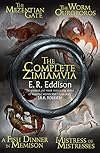
This thick volume collects four works of fiction by a British civil servant who spent his free time inventing and exploring worlds vastly different from that of his day job. He was a passionate student of the ancient Scandinavian sagas and transposed their values, along with a strong admixture of Homer, Sappho, and a bit of potted Spinoza, to imagine worlds where gods take flesh. The results have led Eddison to be called one of the first writers of fantasy literature. One of his early fans, show more the American aficionado of lost, aristocratic worlds, James Branch Cabell, used the term “romance,” however, to distinguish these books from what he called disparagingly “novels.”
I read this in the Kindle version, which was good enough, but it would have been better to have a print copy to make it easier to consult the maps or the charts of the intricate and confusing cast of characters.
The first book in the collection, The Worm Ouroboros, is set in a world the author calls Mercury. It is similar to our world but also different. The various lands are inhabited by beings motivated by recognizable human qualities but called Goblins, Ghouls, and Imps. The two leading nations are the Demons and the Witches. Despite their name, the Demons are the good guys. But while the Witches have many traits usually associated with the villains—they never make a treaty they don’t intend to break at the first opportunity—, Eddison is careful to impart to them a certain nobility. In fact, the greatest tragedy that could befall the Demons would be to not have an adversary as strong as the Witches. For then they “must turn shepherds and hunters, lest we become mere mountebanks and fops,” as their monarch, King Juss, laments. This is not the morality of the Biblical prophets; the thought of turning swords to plowshares is foreign to this world. A sword is nothing more than forged metal unless its glory is found in testing its mettle against another, wielded by a powerful foe.
Fittingly, there are many battles, and I enjoyed the way the author varied his descriptive technique. Some are told as straightforward narratives, another from the viewpoint of an observer watching from the ramparts, while others are recounted after the fact by surviving participants.
The other three books form a cycle set in a land only glimpsed from afar in Worm, Zimiamvia. They are printed here in the order they were published, although the first of them, Mistress of Mistresses, is the last narratively. I read them in the order they appear in this collection. This works because Mistress of Mistresses is the most fully realized. Eddison employs two plots in parallel, one in Zimiamvia, the other on our earth, with the action shifting back and forth. It soon becomes clear that the protagonist on earth, Lessingham, is (as is his wife) an incarnation of a figure who also lives in Zimiamvia, a more rarified plane of existence (this is also a feature of the subsequent book).
The remaining two books fill in the history of Zimiamvia and its rival dynasties. One, A Fish Dinner in Memison, has a high ratio of talk to action. Even more so than in Mistress, Eddison’s mix of intricate description and complex philosophy veers to incoherence. Overall, I found it the weakest of the four, although the dinner involves a marvelous conceit.
The final book, The Mezentian Gate, is the most ambitious in scope but was left unfinished at Eddison’s death. He left behind a plot outline, however. This, along with notes for some of the unwritten chapters, stitch together the finished chapters so that one gets the picture. Fortunately, the portion Eddison wrote includes the closing chapters. In particular, the lengthy final chapter is a fitting conclusion to the entire cycle.
It’s jarring, however, that the plot of Gate surrounds that of Fish Dinner, the events of which are crucial for the unfolding of the denouement in the final book. It seems as if Eddison did not start out with the entire trilogy in mind but added to it as new plot elements came to him.
Eddison’s style, like his values, is that of the Scandinavian sagas. It’s interesting that, on the one hand, he is an adept of philosophy, with its insistence on viewing life Sub specie aeternitatis, as the mephistophelean Vandermast is fond of saying, yet on the other, he (like the characters he creates) is in love with sensual world. Eddison spends pages describing a castle and its halls, for instance, as well as the fantastical landscapes in which it is set. Readers of modern fantasy might grow impatient, wondering when the action might begin. At first, I found the prose slow-going, but my enjoyment rose once I slowed down to savor the luxuriant, archaic prose.
Perhaps the key to this duality of philosophy and sensuality is the basic theme of these books. Eddison has the temperament of an aristocrat and is a devotee of the pantheon, whether in its Greek or Nordic guise. His heroes (all brave and manly) and his heroines (all beautiful—voluptuous, even) are, to one degree or another, incarnations of the divine two, one of whom, Zeus, creates worlds to delight the other (Aphrodite). show less
I read this in the Kindle version, which was good enough, but it would have been better to have a print copy to make it easier to consult the maps or the charts of the intricate and confusing cast of characters.
The first book in the collection, The Worm Ouroboros, is set in a world the author calls Mercury. It is similar to our world but also different. The various lands are inhabited by beings motivated by recognizable human qualities but called Goblins, Ghouls, and Imps. The two leading nations are the Demons and the Witches. Despite their name, the Demons are the good guys. But while the Witches have many traits usually associated with the villains—they never make a treaty they don’t intend to break at the first opportunity—, Eddison is careful to impart to them a certain nobility. In fact, the greatest tragedy that could befall the Demons would be to not have an adversary as strong as the Witches. For then they “must turn shepherds and hunters, lest we become mere mountebanks and fops,” as their monarch, King Juss, laments. This is not the morality of the Biblical prophets; the thought of turning swords to plowshares is foreign to this world. A sword is nothing more than forged metal unless its glory is found in testing its mettle against another, wielded by a powerful foe.
Fittingly, there are many battles, and I enjoyed the way the author varied his descriptive technique. Some are told as straightforward narratives, another from the viewpoint of an observer watching from the ramparts, while others are recounted after the fact by surviving participants.
The other three books form a cycle set in a land only glimpsed from afar in Worm, Zimiamvia. They are printed here in the order they were published, although the first of them, Mistress of Mistresses, is the last narratively. I read them in the order they appear in this collection. This works because Mistress of Mistresses is the most fully realized. Eddison employs two plots in parallel, one in Zimiamvia, the other on our earth, with the action shifting back and forth. It soon becomes clear that the protagonist on earth, Lessingham, is (as is his wife) an incarnation of a figure who also lives in Zimiamvia, a more rarified plane of existence (this is also a feature of the subsequent book).
The remaining two books fill in the history of Zimiamvia and its rival dynasties. One, A Fish Dinner in Memison, has a high ratio of talk to action. Even more so than in Mistress, Eddison’s mix of intricate description and complex philosophy veers to incoherence. Overall, I found it the weakest of the four, although the dinner involves a marvelous conceit.
The final book, The Mezentian Gate, is the most ambitious in scope but was left unfinished at Eddison’s death. He left behind a plot outline, however. This, along with notes for some of the unwritten chapters, stitch together the finished chapters so that one gets the picture. Fortunately, the portion Eddison wrote includes the closing chapters. In particular, the lengthy final chapter is a fitting conclusion to the entire cycle.
It’s jarring, however, that the plot of Gate surrounds that of Fish Dinner, the events of which are crucial for the unfolding of the denouement in the final book. It seems as if Eddison did not start out with the entire trilogy in mind but added to it as new plot elements came to him.
Eddison’s style, like his values, is that of the Scandinavian sagas. It’s interesting that, on the one hand, he is an adept of philosophy, with its insistence on viewing life Sub specie aeternitatis, as the mephistophelean Vandermast is fond of saying, yet on the other, he (like the characters he creates) is in love with sensual world. Eddison spends pages describing a castle and its halls, for instance, as well as the fantastical landscapes in which it is set. Readers of modern fantasy might grow impatient, wondering when the action might begin. At first, I found the prose slow-going, but my enjoyment rose once I slowed down to savor the luxuriant, archaic prose.
Perhaps the key to this duality of philosophy and sensuality is the basic theme of these books. Eddison has the temperament of an aristocrat and is a devotee of the pantheon, whether in its Greek or Nordic guise. His heroes (all brave and manly) and his heroines (all beautiful—voluptuous, even) are, to one degree or another, incarnations of the divine two, one of whom, Zeus, creates worlds to delight the other (Aphrodite). show less
Lists
Read These Too (1)
Unread books (1)
Awards


You May Also Like


Associated Authors
Statistics
- Works
- 13
- Also by
- 7
- Members
- 4,471
- Popularity
- #5,606
- Rating
- 3.7
- Reviews
- 67
- ISBNs
- 118
- Languages
- 7
- Favorited
- 13

