
Ian Hamilton Finlay (1925–2006)
Author of Ian Hamilton Finlay: Selections
About the Author
Works by Ian Hamilton Finlay
Ian Hamilton Finlay : the bicentennial proposal : the French War : The war of the letter (1989) 4 copies
Reef-Points 3 copies
The End 2 copies
Table talk of Ian Hamilton Finlay 2 copies
The boy's alphabet book 2 copies
Textbook 2 copies
Modern Antiquities 2 copies
F.A.L. 1 copy
West Coast 1 copy
Folding the Last Sail 1 copy
A Conceptual Cut-Up 1 copy
A Valentine: Heartsease K15 1 copy
Tidings 1 copy
Oarage of Wings 1 copy
The Old Stonypath Hoy 1 copy
Spray 1 copy
Midship Section 1 copy
The Homeward Star 1 copy
Cinema-Going 1 copy
Cobled Up (1) 1 copy
Cobled Up (2) 1 copy
Stacked Fishboxes 1 copy
Found Eclogue 1 copy
3 Suprematist Boats 1 copy
MFV 1 copy
Sweet Promise 1 copy
Euro 96 1 copy
Learner Editor..... 1 copy
2 Notices 1 copy
Sans Culotte, Sans Culottes 1 copy
Sail Plan 1 copy
3 Constructions 1 copy
Gill Sans 1 copy
Composition (French Drifter) 1 copy
Purse Seine 1 copy
A Seasonal Monument 1 copy
A Moment in Time 1 copy
Thing Poems 1 copy
The Deep-Red Brown ... 1 copy
Bitts - Bits 1 copy
A Seychelles Stradivarius 1 copy
Decommissioned Fishing Boats 1 copy
Illustrations 1 copy
Short Poem on Sandpapering 1 copy
Patch, n., a Whole Part 1 copy
A walled garden : a history of the Spandau garden in the time of the architect Albert Speer (2019) 1 copy
Untitled (A Line of Foam) 1 copy
Untitled (A Frayed Edge) 1 copy
fs 1 copy
A Mixed Exhibition 1 copy
Carvel/Clinker Built 1 copy
Les Cimetières Des Naufragés 1 copy
Poursuites révolutionnaires : 4e sanculotide an CXCV-23 frimaire an CXVI, = Revolutionary poursuits 1 copy
Thonier 1 copy
Bretonnerie 1 copy
Inside Every ... 1 copy
Glossary 1 copy
Spring Poem 1 copy
Evening 1 copy
Thought for the Day (1) 1 copy
Romanticizing 1 copy
New Scottish Parliament 1 copy
The Fluted Land 1 copy
Thought for the Day (2) 1 copy
At the Field's Edge 1 copy
Translation 1 copy
Flowers 1 copy
Nude/Draped Nude 1 copy
Suicide Note 1 copy
Trim Here 1 copy
Plank, n. 1 copy
Creels and Creels 1 copy
Evolution 1 copy
Distributive Entities 1 copy
Orchard 1 copy
3/3's 1 copy
Huff Lane 1 copy
Vessels 1 copy
Paths 1 copy
A Variation on Lines by Pope 1 copy
Holzwege 1 copy
Thermidor 1 copy
Proem 1 copy
Scud 1 copy
Crate Texts 1 copy
The Old Man And The Trout 1 copy
Hulls (1) & Hulls (2) 1 copy
Brount 1 copy
Voysey Stile 1 copy
Little Sparta 1 copy
Installation 1 copy
Bouleau / Birch 1 copy
Two Trees 1 copy
3 Spaces 1 copy
A Model of Order ... 1 copy
Which Figure is in Costume? 1 copy
Swans in Winter 1 copy
Copying Machine Gun 1 copy
Wild Rose (Summer Poem) 1 copy
Great Minds 1 copy
Hommage a David (2) 1 copy
Counter-Argument 1 copy
Ripple 1 copy
Table Talk - Prospectus 1 copy
Finlay - Poezja konkretna 1 copy
Homage to J M Synge 1 copy
Table Talk 1 copy
Panzeram Waldrande 1 copy
Marine Prototypes 1 copy
Improvisation No. 1 1 copy
'Within the System ...' 1 copy
Associated Works
Epitaphs for Lorine — Contributor — 6 copies
Catgut and blossom : Jonathan Williams in England — Contributor — 3 copies
Origin, Second Series, No. 6, July 1962 — Contributor — 1 copy
Tagged
Common Knowledge
- Birthdate
- 1925-10-28
- Date of death
- 2006-03-27
- Gender
- male
- Education
- Dollar Academy
- Occupations
- poet
writer
artist
gardener
shepherd - Relationships
- Finlay, Alec (son)
Sheeler, Jessie (friend)
Bann, Stephen (friend) - Nationality
- UK
- Places of residence
- Nassau, Bahamas (birth)
Orkney, Scotland, UK - Associated Place (for map)
- UK
Members
Reviews
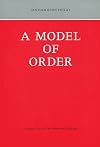
"It doesn't greatly matter to me whether I'm using plants or trees or stones or words or events," the artist, poet and gardener Ian Hamilton Finlay (1925–2006) once told an interviewer; "the impulse is always to make a coherent order out of things." Through a carefully edited selection from a voluminous correspondence, A Model of Order tracks the unique arc of Finlay's development, from poet writing in Scots dialect, to Concrete poet, toymaker and deviser of poems and inscriptions in show more glass, wood and stone, installed in parks and gardens. The title derives from Finlay's famous definition of Concrete poetry as "a model of order, even if set in a space which is full of doubt," a definition conceived in correspondence with poet Pierre Garnier. Poet and editor Thomas A. Clark's selection of Finlay's letters―to Louis Zukofsky, Robert Creeley and Ernst Jandl among others―explicates a rigorous and moral vision of the act of making.
As part of a series edited by David Bellingham, whose preface reads,'While much has been written about Finlay's references or about the content of particular works, the implications for poetry of his many formal innovations have not been drawn. These letters give some of the thinking behind the work.' show less
As part of a series edited by David Bellingham, whose preface reads,'While much has been written about Finlay's references or about the content of particular works, the implications for poetry of his many formal innovations have not been drawn. These letters give some of the thinking behind the work.' show less

Published on the occasion of the exhibition of the work of Ian Hamilton Finlay (1925-2006) marking the 90th anniversary of the artist's birth. A philosopher, sculptor, poet and gardener, Finlay drew on and reinvigorated the classical tradition. This exhibition, curated by Pia Maria Simig, features work Finlay created in response to the French Revolution, and marks the first time an exhibition in the UK has focussed solely on this body of work.
The French Revolution proved a rich subject for show more Finlay; he first received international attention for his guillotine installation A View to the Temple at Documenta 8 in Kassel in 1987 and thereafter the guillotine became one of the most enduring elements of his iconography.
For the artist the Revolution represented a moment of enormous political and aesthetic rupture and signalled a great moral, as well as political, leap. The period bookended by the dates in the title of this exhibition correspond with the establishment of the National Assembly and the storming of the Bastille in 1789, and the Thermidorian Reaction in 1794, which saw the arrest and execution of several of the key members of the Jacobin forces, including Maximilien Robespierre (1758-1794) and Louis Antoine de Saint-Just (1767-1794). This period thus encompasses extraordinary advances in secular democracy and social progress and also great bloodshed and unrest: the Enlightenment and the guillotine.
The exhibition includes a range of Finlay's Revolutionary works, including the imposing eleven metre carved relief The Sound of Running Water, 1990, which was shown in the Bienal de São Paulo in 2012. This work features an evocative line that could serve as the introduction to themes of poetry and politics, and of beauty and immanence in the artist's work: 'THE SOUND OF RUNNING WATER HEARD THROUGH THE CHINKS IN A STONE DYKE: REVOLUTION'.
Aphrodite of the Terror, 1987 is a plaster sculpture based on the Hellenic statue of the Greek goddess of love and beauty known as the Medici Venus. In Finlay's version she is adorned around the neck with a red string. The string is a reference to the thin red silk chokers worn by women whose loved ones had been executed during the Terror.
The wall painting Apollo and Daphne, After Bernini, 1991, depicts the Greek myth in which the wood nymph Daphne is transformed into a tree whilst fleeing from the god Apollo. The work is based on the sculpture by Gian Lorenzo Bernini (1598-1680), and stands as a comment on the French Revolution, in which, arguably, the revolutionary pursued ideals to the point of destruction. Finlay's appropriation and re-interpretation of this mythological allegory highlights the contemporary resonance of classical subjects and forms.
The exhibition is accompanied by two catalogues. The first features commentaries by Stephen Bann on each of the works in the exhibition. The other volume is dedicated to a garden Finlay created in London's Chelsea, and includes photographs by Robin Gillanders and an essay by Thomas A Clark. show less
The French Revolution proved a rich subject for show more Finlay; he first received international attention for his guillotine installation A View to the Temple at Documenta 8 in Kassel in 1987 and thereafter the guillotine became one of the most enduring elements of his iconography.
For the artist the Revolution represented a moment of enormous political and aesthetic rupture and signalled a great moral, as well as political, leap. The period bookended by the dates in the title of this exhibition correspond with the establishment of the National Assembly and the storming of the Bastille in 1789, and the Thermidorian Reaction in 1794, which saw the arrest and execution of several of the key members of the Jacobin forces, including Maximilien Robespierre (1758-1794) and Louis Antoine de Saint-Just (1767-1794). This period thus encompasses extraordinary advances in secular democracy and social progress and also great bloodshed and unrest: the Enlightenment and the guillotine.
The exhibition includes a range of Finlay's Revolutionary works, including the imposing eleven metre carved relief The Sound of Running Water, 1990, which was shown in the Bienal de São Paulo in 2012. This work features an evocative line that could serve as the introduction to themes of poetry and politics, and of beauty and immanence in the artist's work: 'THE SOUND OF RUNNING WATER HEARD THROUGH THE CHINKS IN A STONE DYKE: REVOLUTION'.
Aphrodite of the Terror, 1987 is a plaster sculpture based on the Hellenic statue of the Greek goddess of love and beauty known as the Medici Venus. In Finlay's version she is adorned around the neck with a red string. The string is a reference to the thin red silk chokers worn by women whose loved ones had been executed during the Terror.
The wall painting Apollo and Daphne, After Bernini, 1991, depicts the Greek myth in which the wood nymph Daphne is transformed into a tree whilst fleeing from the god Apollo. The work is based on the sculpture by Gian Lorenzo Bernini (1598-1680), and stands as a comment on the French Revolution, in which, arguably, the revolutionary pursued ideals to the point of destruction. Finlay's appropriation and re-interpretation of this mythological allegory highlights the contemporary resonance of classical subjects and forms.
The exhibition is accompanied by two catalogues. The first features commentaries by Stephen Bann on each of the works in the exhibition. The other volume is dedicated to a garden Finlay created in London's Chelsea, and includes photographs by Robin Gillanders and an essay by Thomas A Clark. show less

As w/ everything I've ever seen by Finlay, this bk is nicely crafted - &, of course, Black Sparrow Press did a good job too. I mainly think of Finlay as a Scottish Concrete Poet - but, then, I haven't read any of his short stories or plays. As the short bio about him in the back of the bk explains, he's often lived on islands - & many of the poems I've seen by him have to do w/ the sea & boats. These poems are often little more than lists of things like boat names or registration numbers show more arranged in a somewhat pictorial pattern. Such techniques(s) are usually associated w/ the 'avant-garde' but in Finlay's case it seems more folkish - maybe b/c of the subject matter, maybe b/c he makes sundials, maybe b/c his work has a seaside & rural sensibility. He's unique &, as always, that makes me like him. show less

Published to celebrate the 200 year anniversary of the French Revolution, this elegant little book consists of political slogans written by poet Ian Hamilton Finlay printed in red alongside French translations by Yves Abrioux printed in black. The texts were enlarged and mounted on sandwich boards for a 1989 exhibition at the 369 Gallery in Edinburgh.
You May Also Like


Associated Authors
Statistics
- Works
- 203
- Also by
- 7
- Members
- 366
- Popularity
- #65,729
- Rating
- 3.7
- Reviews
- 9
- ISBNs
- 53
- Languages
- 2
- Favorited
- 1