

Donal O'Shea
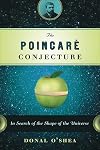
Author of The Poincare Conjecture: In Search of the Shape of the Universe
About the Author
Donal O'Shea is the Elizabeth T. Kennan Professor of Mathematics and the dean of faculty and vice president for academic affairs at Mount Holyoke College in Massachusetts
Image credit: Autore Maurizio Codogno Descrizione Donal O'Shea in occasione del Premio Peano 200 Data 20 novembre 2008 http://it.wikipedia.org/wiki/File:DonalOShea-2008.jpg
Works by Donal O'Shea
Tagged
Common Knowledge
Members
Reviews
This is one of the most beautifully written popular science books I have ever encountered. It is simple and intuitive enough to be understood by someone not familiar with the field, but is also in depth enough to be fascinating to people with some mathematical background. It explores some of the basic concepts of topology all while placing the mathematics within the context of the fascinating story of the Poincare Conjecture. Absolutely brilliant.
This was a decent book, but a bit of a hard read.
Firstly, the book introduces many concepts by name, with some short descriptions, and then goes on to discuss them in some qualitative detail; how one concept leads to another; how concepts fail to connect. For me, at least, this was difficult to follow. Granted, in order to truly understand what is being discussed, you would need to understand the mathematics; perhaps this is just an insurmountable problem in trying to translate high-level show more and difficult mathematics into lay-language.
Secondly, there are too many sections where names and dates and attempted proofs of such-and-such a conjecture/theory/etc. are listed; in these sections it very much feels like the only people who would be able to pull much meaning would be already quite familiar with the topics. There is much more of this in the last third or quarter of the book.
The middle 85% of the book isn't about the Poincare Conjecture per se. In this, I would describe the book as the history of mathematicians and mathematics, from ancient times to today, as told from the point of view of the Poincare Conjecture. An analogy might be something like a book that details the life of some famous figure by telling the history of their family/ancestry and the times and events their family lived through. show less
Firstly, the book introduces many concepts by name, with some short descriptions, and then goes on to discuss them in some qualitative detail; how one concept leads to another; how concepts fail to connect. For me, at least, this was difficult to follow. Granted, in order to truly understand what is being discussed, you would need to understand the mathematics; perhaps this is just an insurmountable problem in trying to translate high-level show more and difficult mathematics into lay-language.
Secondly, there are too many sections where names and dates and attempted proofs of such-and-such a conjecture/theory/etc. are listed; in these sections it very much feels like the only people who would be able to pull much meaning would be already quite familiar with the topics. There is much more of this in the last third or quarter of the book.
The middle 85% of the book isn't about the Poincare Conjecture per se. In this, I would describe the book as the history of mathematicians and mathematics, from ancient times to today, as told from the point of view of the Poincare Conjecture. An analogy might be something like a book that details the life of some famous figure by telling the history of their family/ancestry and the times and events their family lived through. show less
This is one of the most beautifully written popular science books I have ever encountered. It is simple and intuitive enough to be understood by someone not familiar with the field, but is also in depth enough to be fascinating to people with some mathematical background. It explores some of the basic concepts of topology all while placing the mathematics within the context of the fascinating story of the Poincare Conjecture. Absolutely brilliant.
A thoroughly researched, but easily accessible story of the (very likely satisfactory) solution of a very difficult problem in mathematics called the Poincare Conjectue. Donal O'Shea takes a subject that the vast majority of the world's mathematicians do not understand and makes it real to the non-mathematician reader. His approach describes the historic development of almost endless new math methods which resulted from the many attempts over more than 100 years to prove an obscure show more conjecture made in 1904 by Henri Poincare. He also shows that almost every new result in math builds on previous works and ideas. Poincare's conjecture has very likely been solved, finally, by a Russian Mathematician Grigory Perlman. Perlman has been awarded the highest award in mathematics (the Fields Medal) which he declined to accept and and long as his proof stands for 2 years will win $1,000,000 from the Clay Mathematics Institute. There is considerable speculation about whether he will accept the money. O'Shea's book proivdes some insight into the minds of those we call mathematicians, and the extremely complex relationships between their individual work , the work of their peers and those who preceeded them. show less
Awards

You May Also Like


Associated Authors
Statistics
- Works
- 3
- Members
- 686
- Popularity
- #36,874
- Rating
- 3.8
- Reviews
- 12
- ISBNs
- 39
- Languages
- 8